
Commonwealth Bank started as a government-owned bank and became one of Australia’s most valuable companies. Here’s how it makes its money, and why interest rates matter so much to its profits.
Commonwealth Bank of Australia, known as CBA or CommBank, is the country’s largest bank and one of the biggest companies on the ASX.
It was set up by the federal government in 1911 and was privatised in stages between 1991 and 1996. Today, it is the main financial institution for about one in three Australians and one in four Australian businesses.
In the year to June 2026, CBA reported a cash profit of $10.98 billion, up 7 per cent, a record for the bank.
How a bank earns its profit
Most of CBA’s income comes from net interest income. It takes in money from savers through deposit accounts and from wholesale markets, then lends it out to home buyers, businesses and other borrowers at a higher interest rate. The difference between what it earns and what it pays is its profit margin.
That gap, measured as a percentage, is called the net interest margin. For CBA, it was 2.05 per cent in the 2026 financial year. Small changes in that margin can swing profits by hundreds of millions of dollars.
Home loans are its biggest business. CBA is Australia’s largest mortgage lender, and its deposit base, the cheapest source of money for a bank, is also the biggest in the country.
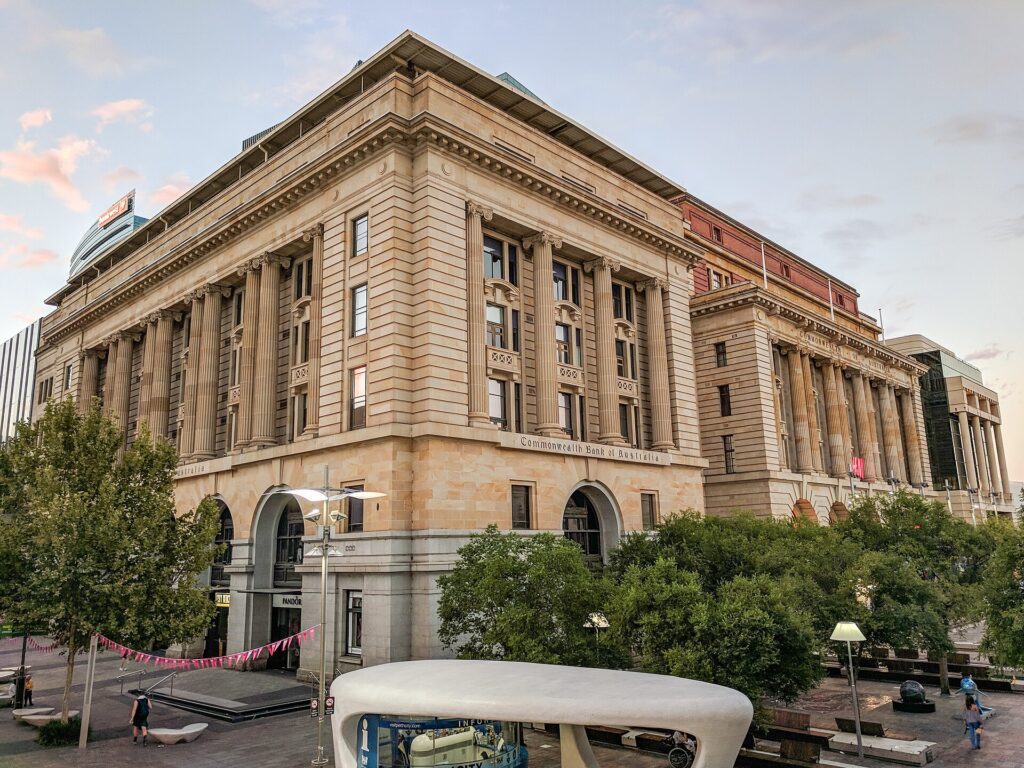
It also earns fees from business lending, credit cards, transaction accounts, foreign exchange and its CommSec share trading platform, and owns ASB Bank in New Zealand.
Interest rates, bad debts and the risks
When the Reserve Bank raises interest rates, banks can earn more on the money they hold, but competition for deposits and mortgages often limits how much of that they keep. Higher rates also put pressure on borrowers, which can increase the number of loans that go bad.
Banks set aside money for loans they expect won’t be repaid, and how much they put aside is one of the most closely watched parts of their results.
CBA spends heavily on technology, including about $2.4 billion a year on investment, and more than $1 billion to protect customers from scams, fraud and cyber attacks.
Its shares are widely held by Australian investors and super funds, partly because of its fully franked dividends. Analysts often note that its shares trade at a much higher value relative to its earnings than other big banks around the world, reflecting its dominant market position.
The risks include a housing downturn, rising unemployment, cyber attacks, regulation and competition from other banks and digital lenders. Matt Comyn has been chief executive since 2018.