
Building a successful hospitality business takes more than securing a prime location.
A compelling concept, careful financial planning and the ability to adapt to changing consumer expectations are increasingly important as operators navigate rising costs and look for opportunities to expand across Australia.
On State of Hospitality, hosted by Jeremy Koadlow, Josh Lefers, co-founder and creative force behind Pawn & Co Nightclub and Cocktail Bar, Ballers Clubhouse and a portfolio of hospitality, entertainment and creative businesses, shares his insights into what makes a hospitality venture successful, commercially attractive and ready for expansion.
For Lefers, buying a hospitality business starts with understanding the opportunity and having a clear strategy.
Whether the goal is to build a scalable operation or simply take ownership of a venue, buyers need to establish their objectives before committing capital.
Thorough due diligence is equally important, particularly when assessing the existing operation, financial position and potential for future growth.
While location remains a major consideration, Lefers believes a strong concept can be just as influential in attracting customers.
A distinctive offering can give a venue its own identity and create demand beyond what its physical location might otherwise generate.

Josh Lefers with Jeremy Koadlow at the Ticker Studio
His experience with Pawn & Co demonstrates the commercial potential of building a hospitality brand around a recognisable theme.
The former nightclub’s pawn-shop concept helped differentiate it in a competitive market, highlighting how creativity and customer experience can become valuable business assets.
However, establishing a successful venue is only part of the equation.
The ability to maintain financial resilience is critical, particularly in an industry exposed to changing consumer spending, operating costs and unexpected disruptions.
The pandemic demonstrated how quickly trading conditions can deteriorate, making adequate capital reserves and sound financial management essential for long-term survival.
Consumer expectations are also changing, with growing interest in experiential entertainment and what is increasingly known as competitive socialising.
Rather than simply offering food and drinks, venues are finding opportunities to attract customers through interactive experiences, games and entertainment.
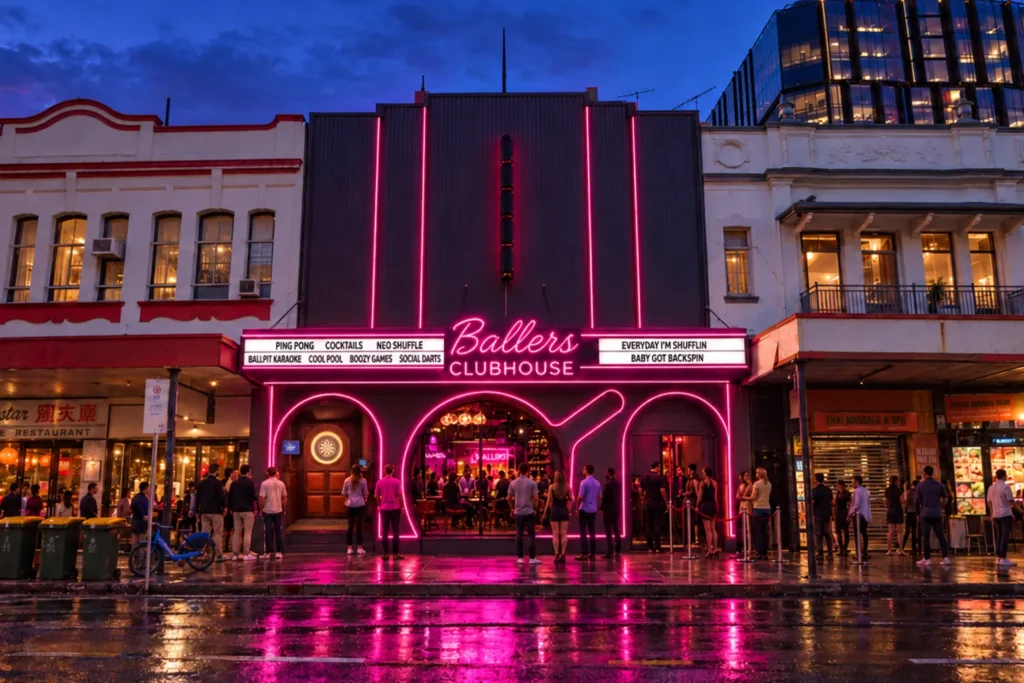
Ballers Clubhouse reflects this shift, with its entertainment-driven model offering a different approach to traditional hospitality.
Lefers believes concepts built around structured activities, bookings and functions can also provide a more consistent foundation for interstate expansion than nightlife businesses that rely heavily on promoters and unpredictable trading patterns.
Replicability is central to that strategy. A hospitality concept needs more than a successful individual venue to justify expansion.
It requires systems, an operating model and a customer proposition that can be reproduced across different markets without losing its identity.
But while opportunities exist across the country, Lefers identifies Victoria as a particularly challenging environment for hospitality operators.
He points to the state’s tax burden, regulatory requirements and broader cost-of-living pressures as factors weighing on businesses and influencing investment decisions.
These conditions can make establishing, operating and expanding a venue more difficult, particularly for businesses already managing tight margins.
Despite these challenges, operators cannot afford to wait for a more favourable business environment.
Lefers argues that building resilient operations, controlling costs and improving efficiency are essential to remaining competitive, regardless of the political landscape.
The discussion also explores what makes an established hospitality business attractive to potential buyers and investors.
Strong branding, reliable systems, profitability and clear opportunities for growth can help transform a successful venue into a more valuable commercial asset.
As Victoria approaches its November state election, the operating environment for hospitality businesses is also likely to remain part of the broader investment conversation.
For Lefers, improving the conditions for operators will be important in supporting business confidence and encouraging further investment.
Ultimately, hospitality success is no longer just about finding the right venue.
It is about creating a distinctive experience, building a business that can operate beyond its founders and developing a model capable of succeeding in different markets.
For more information, visit New Chapter Legal