
Australian Prime Minister Anthony Albanese has met with Chinese President Xi Jinping in Bali
Australian Prime Minister Anthony Albanese has met with his Chinese counterpart in what is being described as a “positive” encounter.
Albanese told Xi Australia wants to work with China, in the interests of both countries and regional peace.
“Very constructive … a warm discussion”.
anthony albanese speaking after the meet
It was good to discuss our relationship with China’s President Xi Jinping today. It was a positive and constructive discussion. We will cooperate where we can, disagree where we must, and engage in our national interest. pic.twitter.com/WBVAzW7KLR
It follows a tumultuous time between the two nations regarding a number of issues, including trade agreements, the origins of Covid-19 and reports of Beijing’s human rights violations.
The Australian PM refused to ignore his countries previous complaints with Beijing on these fronts.
On China’s trade embargo on Australia, Albanese explained this meeting was never meant for finding a resolution.
“If people thought that would happen (today) then that’s not realistic…
We put forward our position and he said that we have highly complimentary economies, so we used similar language.”
anthony albanese speaking after the meet
The meeting spanned 32 minutes as the G20 summit continues in Indonesia.
China’s president has refused to have a formal meeting with an Australian leader since Malcolm Turnbull in 2016.
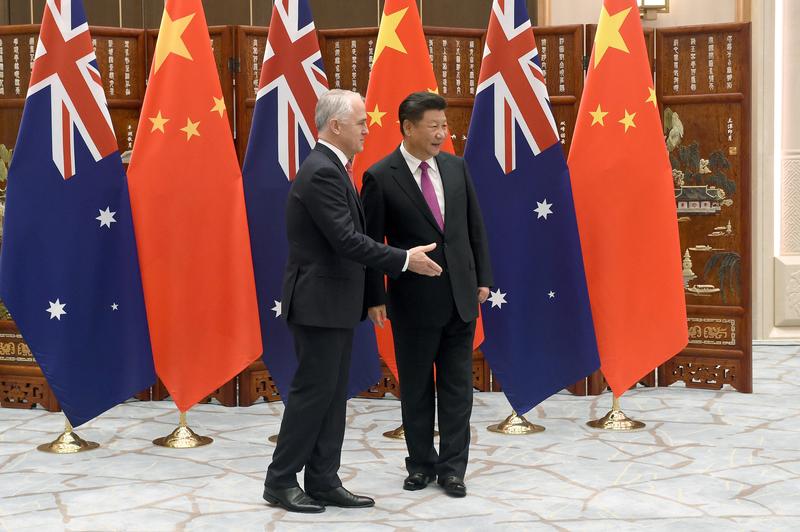
Malcolm Turnbull and Xi Jinping in 2016 Credit: Reuters
The Australia-China relationship may be putting their differences aside, as they look to a more prosperous future, in the best interest of both nations.
During the previous Morrison government in Australia, relations had soured. However, Xi is now sounding much more optimistic about the country down under.
“In the past few years, China-Australia relations have encountered some difficulties, which we didn’t want to see, because both China and Australia are important countries in the Asia-Pacific region…
We should improve, maintain and develop the relations between the two countries, which is in the fundamental interests of the two peoples and conducive to promoting the development of peace in the Asia-Pacific region and the world.”
xi jinping before the meet
Ukraine war
When it came to the ongoing conflict in Ukraine, Albanese encouraged Xi use his relationship to influence Russia when it comes to nuclear weapons.
“Specifically about Russia’s threat to use tactical nuclear weapons…
I noted that China had called that out and that is a good thing.”
anthony albanese speaking after the meet
Human rights violations
Australia has long condemned China when it comes to allegations of human rights abuses within the country, particularly against the Uyghur population.
The Australian leader “put forward the differences we have on human rights issues” specifically regarding detained Australian journalist Cheng Lei.
Albanese also reaffirmed Australia’s stance on Taiwan and worsening climate change too.
William is an Executive News Producer at TICKER NEWS, responsible for the production and direction of news bulletins. William is also the presenter of the hourly Weather + Climate segment.
With qualifications in Journalism and Law (LLB), William previously worked at the Australian Broadcasting Corporation (ABC) before moving to TICKER NEWS. He was also an intern at the Seven Network's 'Sunrise'.
A creative-minded individual, William has a passion for broadcast journalism and reporting on global politics and international affairs.
In Short:
– U.S. and Israel launched strikes against Iran amid fears of a broader regional conflict.
– Iranian officials warn that attacks could lead to full-scale war as they prepare for retaliation.
The attack marks the second war between the U.S., Israel, and Iran within eight months, raising concerns about a wider regional conflict in a critically important economic area.Israeli Defence Minister Israel Katz confirmed the strikes and declared a state of emergency across all areas of Israel.
The U.S. also carried out strikes as part of the operation, according to a U.S. official.
The military operation followed a month of U.S. military buildup, ignited by President Trump’s commitment to support Iranian protesters who demonstrated against the regime in January.
The President consistently warned Iran could face military action if it continued its nuclear program. Vice President JD Vance stated that Iran’s responses in two negotiation rounds failed to meet U.S. expectations.
Trump address
In a video address announcing the military operation against Iran, President Trump said the U.S. was facing “imminent threats” from Tehran, though he did not detail specific evidence to support that claim.
Instead, he pointed to a history of Iranian aggression and reiterated broader concerns about the country’s nuclear activities, backing of regional proxy groups and its ballistic missile programme.
Iran’s missile development has featured prominently in the administration’s recent justification for military action, with Trump raising it again during Tuesday’s State of the Union address.
However, publicly available U.S. intelligence assessments have indicated that Iran had not decided to build an intercontinental ballistic missile.
Analysts have also noted that, while Tehran possesses missiles capable of reaching parts of Europe, it still faces significant technological barriers before developing a weapon able to strike the U.S. successfully.
Escalating Tensions
Iranian officials cautioned that any attack would provoke retaliation, warning that even minor strikes could escalate into a full-scale regional war.
The nation has prepared for conflict by mobilising its forces, reinforcing its nuclear facilities, decentralising decision-making, and tightening internal security measures.
‘Trump Has Met the Moment,’ Says Sen. Lindsey Graham
In his first interview since the U.S. and Israel attacked Iran, Senator Lindsey Graham said that “President Trump has met the moment” and “put in motion the demise of the Iranian ayatollah.”
“This operation will be massive in scope and has as its goal the elimination of the regime as demanded by the people of Iran,” the staunch Trump ally said, adding that the president concluded Tehran couldn’t be trusted to make a nuclear deal. “It has been a dream of mine for so long that the ayatollah’s murderous regime would be replaced by the people who seek a better life for themselves and their country.”
Graham, echoing Trump, acknowledged the potential risks facing U.S. forces involved in the mission. “If there are death or injuries in this operation, I can say without hesitation that they sacrificed for a noble cause, a safer America and a more just world,” he said.
“The consequence of leaving the regime in place, after all the terrorism, and the slaughter of 30,000 of its own citizens, would have been catastrophic for America’s national security,” Graham continued, referencing estimates of those killed during a January crackdown on anti-regime protestors.
The senator, who recently travelled in the Middle East and has long taken a hawkish position on Tehran, suggested the potential fall of the Iranian regime could revive diplomatic efforts to normalise relations between Israel and Saudi Arabia, describing it as “the biggest regional prize of all.”
“When the regime collapses, the region will spread toward a new dawn, and that normalization will take up where it left off,” Graham said.
In Short:
– Oil prices surged after US and Israeli military actions against Iran, with Brent crude at $72.5-$72.9 per barrel.
– Tensions in the Middle East have impacted markets, prompting OPEC+ to consider increasing production to stabilise prices.
Crude oil prices rose sharply following military action by U.S. President Donald Trump and Israel against Iran.
Brent crude oil now trades between $72.5 and $72.9 per barrel, while the US benchmark West Texas Intermediate (WTI) is around $67 per barrel.
Energy markets
Escalating tensions in the Middle East have significantly impacted global energy markets, with oil prices increasing over 15 per cent since January.
Israeli forces initiated a pre-emptive strike in Tehran, resulting in multiple explosions and a marked escalation in conflict.
Israeli Defence Minister Israel Katz labelled the actions as vital for neutralising Iran’s nuclear and missile capabilities.
Diplomatic negotiations between the US and Iran, which had resumed earlier in February, collapsed earlier this week in Geneva.
Production Increase
Iran, a key OPEC member, produces substantial oil and lies strategically near the Strait of Hormuz, a critical transit point for approximately 20 per cent of the world’s oil.
OPEC+ representatives have indicated to Bloomberg that a more aggressive production increase will be considered in an emergency meeting scheduled for Sunday.
The alliance is assessing approaches to mitigate the impact of the recent developments on oil markets.
In Short:
– Market turbulence is expected after the U.S. announces major combat operations in Iran.
– Oil prices may rise due to increased geopolitical risks and uncertainties in U.S.-Iran relations.
Market watchers predict significant turbulence following the U.S. announcement of “major combat operations” in Iran.
The escalation could have broader market implications than recent geopolitical events.U.S. President Donald Trump’s military actions targeted several ministries in southern Tehran. Investors remain accustomed to absorbing geopolitical and economic shocks, including a recent tariff hike and the capture of former Venezuelan President Nicolás Maduro.
Florian Weidinger, co-chief investment officer at Santa Lucia Asset Management, noted that the ramifications from Iran could surpass those from Venezuela, as the latter primarily affects specific heavy crude markets. Analysts expect oil prices to rise significantly as a result of the situation.
Market experts highlight the Strait of Hormuz as a critical oil chokepoint, with about 13 million barrels per day transiting the area in 2025.
Past military actions in the region have resulted in short-term volatility in equities, with potential movements toward safer assets such as gold and government bonds anticipated.
Market Outlook
Investors are advised to remain cautious as they assess potential Iranian responses. While some market positioning reflects a crisis atmosphere, the future of U.S.-Iran relations remains uncertain. The duration of conflict will play a key role in shaping market reactions.
Analysts suggest that a short campaign may lead to temporary price spikes, while a prolonged conflict could result in deeper market impacts and a shift in asset allocations.