
The Prime Minister of the Solomon Islands has ruled out a Chinese military base on the Pacific archipelago
Prime Minister Manasseh Sogavare has confirmed he has no intentions of a Chinese military base in the Solomon Islands, after signing an historic security pact with Beijing.
In an interview with The Guardian, Sogavare says a military base with Beijing would make Solomon Islands an “enemy” and “put our country and our people as targets for potential military strikes”.
Sogavare met with Australia’s Prime Minister Anthony Albanese on the sidelines of the Pacific Islands Forum, which is taking place in Fiji.
“We are family, there are issues [but] that makes family strong.”
PRIME MINISTER Manasseh Sogavare
The meeting reportedly lasted 15 minutes, where Albanese said the pair spoke about “our common interests that we have of climate change, dealing with the challenge but also regional security issues”.
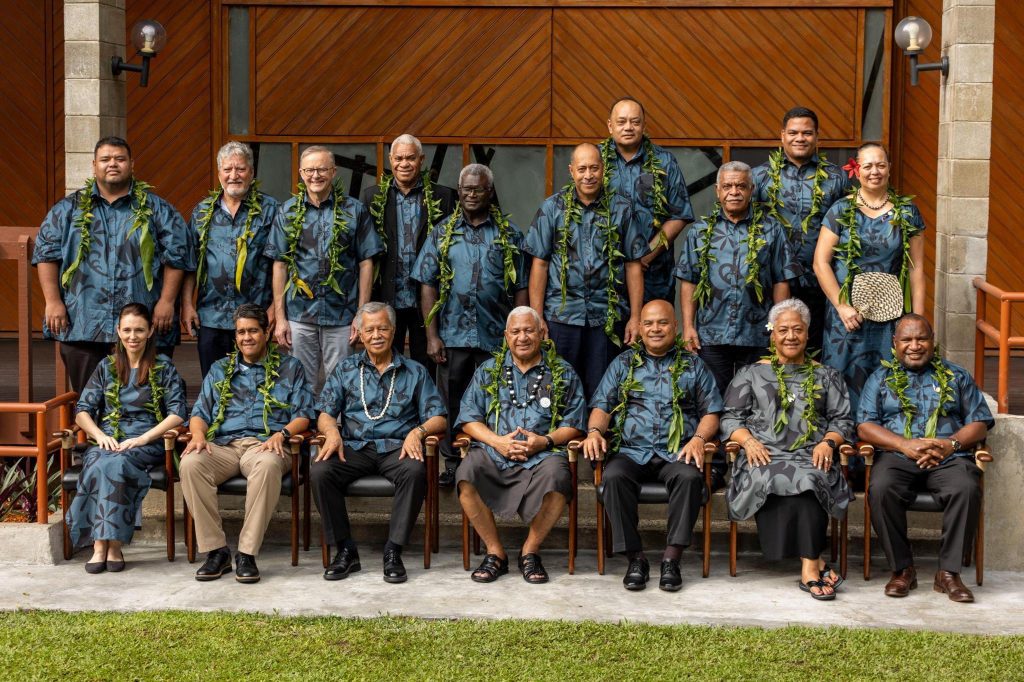
Leaders of the Pacific Islands Forum gather in Fiji.
It follows Australia’s Former Prime Minister Scott Morrison opting out of talking to Sogavare because of advice from “security and intelligence agencies”.
Sogavare has previously branded threats as an “invasion” following its tightened security arrangements with China.
Placing a pulse on the Pacific
China was denied an invitation at this year’s Pacific Islands Forum. However, U.S. Vice-President Kamala Harris gave a virtual address.
The Biden Administration will commit USD $600 million to support an envoy to the forum, infrastructure in local fisheries, and brining peace corps volunteers back to the region.
Harris conceded the U.S. has been missing when it comes to the Pacific but has vowed to “change that”. She says the U.S. wants to “significantly deepen our presence in the Pacific region”.
As part of its Pacific push, the U.S. will open embassies in Tonga and Kiribati. The latter is the closest Pacific island nation to the U.S.
However, Kiribati itself is not attending this week’s forum because of tensions over the secretary-general position. But opposition leaders believe China has also influenced this decision, something that Beijing denies.
TICKER NEWS spoke to Ebony Bennett from The Australia Institute, who says the U.S. is “going to re-engage strongly in the Pacific region”.
“The Prime Minister [Manasseh Sogavare] is making the point that they would ever only call on China if Australia can’t fill that security gap, and that Australia remains the security partner of choice for the Solomon Islands.”
Costa is a news producer at ticker NEWS. He has previously worked as a regional journalist at the Southern Highlands Express newspaper. He also has several years' experience in the fire and emergency services sector, where he has worked with researchers, policymakers and local communities. He has also worked at the Seven Network during their Olympic Games coverage and in the ABC Melbourne newsroom.
He also holds a Bachelor of Arts (Professional), with expertise in journalism, politics and international relations. His other interests include colonial legacies in the Pacific, counter-terrorism, aviation and travel.
In Short:
– Aden International Airport closed amid rising Saudi-UAE tensions, stranding passengers and highlighting the Yemen crisis.
– Saudi airstrikes targeted STC positions, escalating the conflict as Saudi Arabia and UAE’s interests increasingly clash.
Yemen’s Aden International Airport closed on Thursday due to rising tensions between Saudi Arabia and the United Arab Emirates (UAE), stranding many passengers. This shutdown highlights an escalating crisis between the two Gulf nations over control of Yemen’s resource-rich eastern provinces. Military operations backed by Saudi Arabia resulted in multiple fatalities.Air traffic was suspended following new flight restrictions imposed by Yemen’s internationally recognised government, which is supported by Riyadh. Instead of compliance, Yemen’s transport minister, aligned with the UAE-backed Southern Transitional Council (STC), announced a total shutdown, leaving travellers in difficult situations, especially those needing urgent medical care.
The aviation discord exemplifies a larger divide fracturing the Saudi-led coalition involved in the Yemen conflict. Recent Saudi airstrikes targeted an STC military camp in Al-Khasah, resulting in numerous casualties. Saudi-backed forces initiated a military campaign aimed at reclaiming control over territory occupied by the STC.
Gulf Powers
The situation escalated when the STC seized extensive regions in Hadramout and Al-Mahra provinces. Saudi Arabia publicly condemned the UAE’s activities as a threat to its national security and demanded troop withdrawal. In response, the UAE refuted the claims and prepared to withdraw its forces, although the STC has remained entrenched in its positions.
The current conflict marks a significant public feud between Saudi Arabia and the UAE. They have collaborated since 2015 to combat the Iran-backed Houthi rebels, but their diverging interests have increasingly placed them in opposition.
UAE stock markets experienced mixed results on Friday, reflecting the ongoing regional tensions. Dubai’s index rose 1.1 percent, primarily driven by gains in Emaar Development and Emirates NBD Bank. Conversely, Abu Dhabi’s index remained stable, impacted by a downturn in Abu Dhabi National Energy Company.
In Short:
– Russia claims Ukraine targeted Putin’s residence with drones, but the CIA dismisses this as disinformation.
– Ukraine denies allegations, arguing they are fabrications hindering peace talks and lacking evidence.
Russia has provided the United States with purported evidence suggesting Ukraine’s involvement in a drone attack aimed at President Vladimir Putin’s residence. This assertion comes as the CIA and other Western officials have dismissed the claims as disinformation.Admiral Igor Kostyukov, head of Russia’s military intelligence, presented a navigation controller from a downed drone to a U.S. military attache. Russian officials claim that the device’s data indicates the drones targeted Putin’s residence in an attack on December 29, involving 91 drones.
The CIA briefed President Donald Trump that Ukraine did not target Putin or his residence during the incident, asserting that the drones were aimed at a military facility instead. This assessment was communicated to Trump on December 31.
Ukraine has refuted the allegations, with President Volodymyr Zelenskyy condemning them as fabrications meant to justify further attacks and hinder peace discussions. The country’s Center for Countering Disinformation pointed out the lack of evidence, such as air defense activity or drone crash footage.
Diplomatic Ramifications
The situation arose shortly after Trump met with Zelenskyy to discuss potential peace agreements. Trump’s initial anger towards Putin’s claims shifted to skepticism as he later shared opinions that criticized Russia’s role in the peace process.
EU Foreign Policy Chief Kaja Kallas labelled Russia’s assertions as distractions aimed at hindering diplomatic negotiations. Meanwhile, Russian Foreign Minister Sergey Lavrov implied that the incident might lead Moscow to reconsider its stance in ongoing discussions aimed at resolving the conflict.
China slaps 55% tariff on Australian beef as trade and geopolitical tensions rise
China has imposed a 55% tariff on Australian beef imports that exceed quota limits, a move that threatens more than $1 billion in annual trade and has reignited tensions between Canberra and Beijing. The restrictions, effective from January 1 for three years, cap Australia’s beef quota at 205,000 tonnes—below the volume China imported in 2024—prompting industry claims the decision undermines the spirit of the China-Australia Free Trade Agreement.
Calm fears
Beef producers warn the impact could be severe, with exports to China potentially falling by as much as one-third compared to 2025 levels. Industry groups say the move advantages rival exporters, with Brazil and Argentina receiving far larger quotas, raising concerns Australia could permanently lose market share in a key global market. Prime Minister Anthony Albanese has sought to calm fears, saying Australia is not being singled out and describing the beef sector as the strongest it has ever been.
The tariff decision comes against the backdrop of growing geopolitical strain, days after Australia criticised China’s “Justice Mission 2025” military drills near Taiwan as destabilising. Opposition figures are urging the government to leverage diplomatic ties with President Xi Jinping to ensure Australia is not swept up in broader trade retaliation, as industry calls mount for urgent talks to stabilise relations.