Connect with us
https://tickernews.co/wp-content/uploads/2023/10/AmEx-Thought-Leaders.jpg

Ticker Views

Should Tokyo be the arena of activism? | ticker VIEWS

Published

on

While it may be the world arena for sporting competition, the Olympics is far from just being about our best athletes with many using their day to voice their beliefs
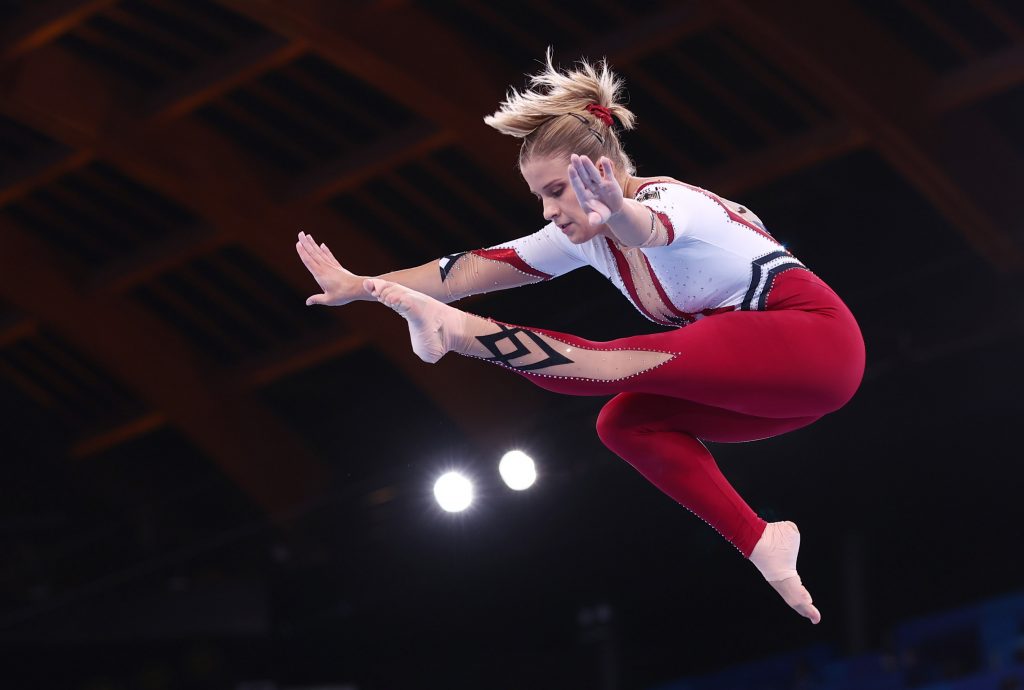
Tokyo 2020 Olympics – Gymnastics – Artistic – Women’s Beam – Qualification – Ariake Gymnastics Centre, Tokyo, Japan – July 25, 2021. Elisabeth Seitz of Germany in action on the balance beam REUTERS/Mike Blake

Sporting events have been a platform for activism for decades as athletes world-wide take to the stage to speak up against social injustice.

The 2020 Tokyo Olympics is no different, with gender equality this year’s central point of focus. 

During the weekend’s Olympic competition, Germany’s women’s gymnastics team defied expectations competing in sparkly sequined full-body unitards rather than the standard leotard.

The wardrobe change was in protest against the history of sexualisation and objectification of both women and girls in the sport, with the team receiving full support from the judges panel. 
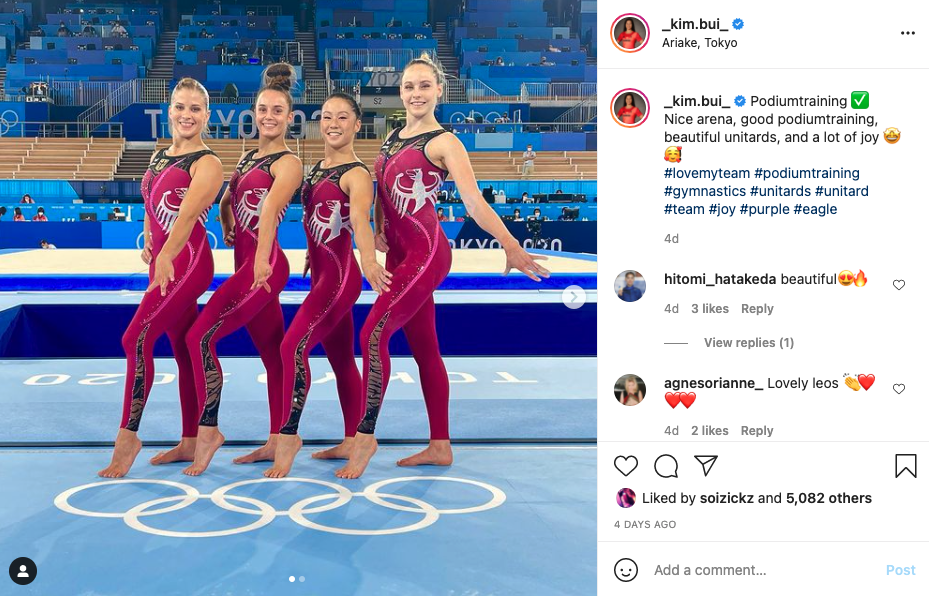
Instagram of German Gymnast Kim Bui

Norwegian women’s handball team also speak out

Earlier this month the Norwegian women’s team showed up to their match against Spain for the European beach handball championship, knowing they too were bound to make a statement.

Also protesting against the sexualisation of women, the team wore bike shorts instead of the usual bikini attire, close to the uniform of their male counterparts.

The team gained attention from thousands globally but unlike the support Germany’s gymnastic team received, the move wasn’t as widely accepted by officials.

Consequently, the team were fined 1,500 euros with the European Handball Federation (EHF) deeming the move as “a case of improper clothing”.  
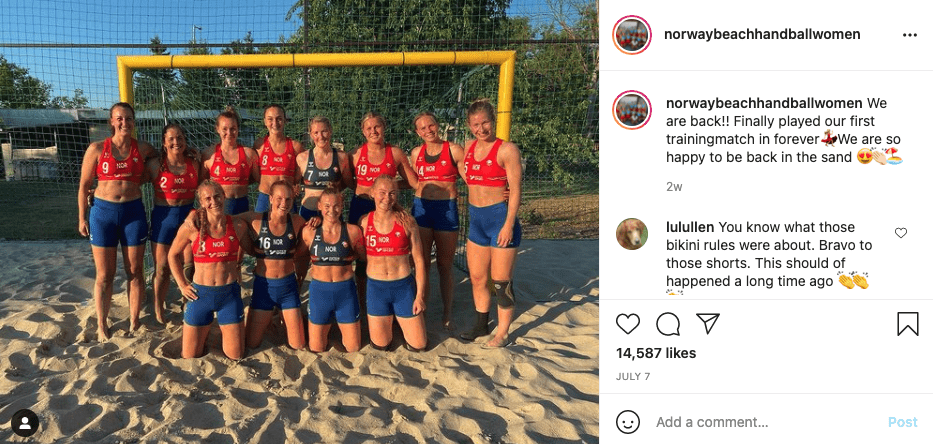
Instagram of Women’s Norwegian Beach Handball team

Yet, while using sport as a platform to educate fans on key societal issues may be perceived as an effective way of raising awareness, could it be decreasing the value of sport competition among the eyes of fans? 

Dr Alyson Crozier, Senior Lecturer in Human Movement, Sport and Exercise Psychology, says protesting in sport is an avenue for athletes to use their success as a platform to advance social causes and is often a catalyst to change social norms and cultures within particular groups.

“The protests don’t change the competition, but highlight a particular perspective that an athlete or team of athletes hold,” Dr Crozier says.

“It does often anger viewers, especially if they hold a different perspective to the athlete.”

A survey by ESPN found that seven in every ten fans support teams and athletes who speak out on issues of social justice and racial equality, however 49 percent of respondents were unsure of whether that conversation should take place on the field or court.

Additionally, there was uncertainty over how long players should spend voicing their opinions on specific issues with only half of all fans supporting a season-long advocacy. 

“Protests are not meant to be convenient or something that is scheduled to always occur off-field…Ultimately it will depend on what purpose the athlete has to protest.” Dr Crozier says.

“For the Norwegian female handball team, they likely felt that an on-field protest was required, as any off-field attempts to change the rules around the attire fell flat.”

Whether or not fans approve of activism in sport, there’s a high chance that it’s here to stay as athletes continue to think outside the box on how they can use their sport to take a stand against injustice.

Written by Rebecca Borg

Click to comment

Leave a Reply

Your email address will not be published. Required fields are marked *

Ticker Views

Iran’s exiled crown prince is touting himself as a future leader

Published

on

Iran’s exiled crown prince is touting himself as a future leader. Is this what’s best for the country?

Simon Theobald, University of Oxford; University of Notre Dame Australia

As Iranian and US diplomats meet in Geneva for crucial negotiations to avoid a potential war, opposition groups in exile are sniffing an opportunity.

The Islamic Republic faces its greatest political crisis since its inception. US President Donald Trump is threatening an imminent attack if Iran doesn’t capitulate on its nuclear program. And anti-regime protesters continue to gather, despite a brutal government crackdown that has killed upwards of 20,000 people, and possibly more.

Talk of a future Iran after the fall of the Islamic regime has grown increasingly fervent. And buoyed by cries heard during some of the protests in Iran of “long live the shah” (the former monarch of Iran), the voices of royalists in the Iranian diaspora are everywhere.

But is a return of the shah really what Iranians want, and what would be best for the country?

What are the monarchists promising?

Iran’s monarchy was ancient, but the Pahlavi dynasty that last ruled the country only came to power in 1925 when Reza Khan, a soldier in the army, overthrew the previous dynasty.

Khan adopted the name Pahlavi, and attempted to bring Iran closer to Western social and economic norms. He was also an authoritarian leader, famous for banning the hijab, and was ultimately forced into exile by the British following the Anglo-Soviet invasion of Iran in 1941.

His son, Mohammad Reza Pahlavi, attempted to continue his father’s reforms, but was similarly authoritarian. Presiding over a government that tolerated little dissent, he was ultimately forced out by the huge tide of opposition during the Islamic Revolution of 1979.

Now, the exiled crown prince, 65-year-old Reza Pahlavi, is being touted by many in the diaspora as the most credible and visible opposition figure to be able to lead the country if and when the Islamic Republic collapses.

Pro-monarchy groups such as the US-based National Union for Democracy in Iran (NUFDI) have become vocal supporters of Pahlavi.

In early 2025, the NUFDI launched a well-coordinated and media savvy “Iran Prosperity Project”, offering what the group claimed was a roadmap for economic recovery in a post-Islamic Republic Iran. Pahlavi himself penned the foreword.

Then, in July, the group released its “Emergency Phase Booklet”, with a vision for a new political system in Iran.

Although the document is mostly written in the language of international democratic norms, it envisions bestowing the crown prince with enormous powers. He’s called the “leader of the national uprising” and given the right to veto the institutions and selection processes in a transitional government.

One thing the document is missing is a response to the demands of Iran’s many ethnic minority groups for a federalist model of government in Iran.

Instead, under the plan, the government would remain highly centralised under the leadership of Pahlavi, at least until a referendum that the authors claim would determine a transition to either a constitutional monarchy or democratic republic.

But students of Iranian history cannot help but note echoes of the 1979 Islamic Revolution. Ayatollah Ruhollah Khomeini had promised a more democratic Iran with a new constitution, and without himself or other clerics in power.

After the revolution, though, Khomeini quickly grasped the reigns of power.

Online attacks against opponents

Pahlavi and his supporters have also struggled to stick to the principles of respectful debate and tolerance of different viewpoints.

When interviewed, Pahlavi has avoided discussing the autocratic nature of his father’s rule and the human rights abuses that occurred under it.

But if Pahlavi tends to avoid hard questions, his supporters can be aggressive. At the Munich Security Conference in February, British-Iranian journalist Christiane Amanpour interviewed the crown prince.

Christiane Amanpour’s interview with Reza Pahlavi.

After the interview, Amanpour’s tough questions resulted in an explosion of anger from his supporters. In a video that has been widely shared on X, royalists can be seen heckling Amanpour, saying she “insulted” the crown prince.

In online forums, the language can be even more intimidating. Amanpour asked Pahlavi point-blank if he would tell his supporters to stop their “terrifying” attacks on ordinary Iranians.

While saying he doesn’t tolerate online attacks, he added, “I cannot control millions of people, whatever they say on social media, and who knows if they are real people or not.”

Do Iranians want a monarchy?

As I’ve noted previously, the monarchist movement also talks as though it is speaking for the whole nation.

But during the recent protests, some students could be heard shouting: “No to monarchy, no to the leadership of the clerics, yes to an egalitarian democracy”.

The level of support for the shah within Iran is unclear, in part because polling is notoriously difficult.

A 2024 poll by the GAMAAN group, an organisation set up by two Iranian academics working in the Netherlands, attempted to gauge political sentiment in Iran. Just over 30% of those polled indicated Pahlavi would be their first choice if a free and fair election were held.

But the poll doesn’t indicate why people said they wanted to vote for him. It also showed just how fragmented the opposition is, with dozens of names getting lower levels of support.

The future of Iran is very unclear at the moment. Even if the Islamic Republic were to be dislodged – a very big “if” – the transition could very well be chaotic and violent.

Would Pahlavi make a good leader? For many critics, his behaviour, and that of his supporters, call into question the royalists’ promises of a more liberal and tolerant Iran.The Conversation

Simon Theobald, Research Fellow, University of Oxford; University of Notre Dame Australia

This article is republished from The Conversation under a Creative Commons license. Read the original article.

Continue Reading

Ticker Views

Tropfest sparks debate with controversial AI-generated short film

Tropfest sparks debate over AI-generated films, impacting creativity and traditional filmmaking in the festival circuit. #AIinFilm

Published

on

Tropfest sparks debate over AI-generated films, impacting creativity and traditional filmmaking in the festival circuit. #AIinFilm


Tropfest, the world’s largest short film festival, caused a stir in Sydney with the screening of a controversial AI-generated short film. The festival’s decision has reignited debates over the role of artificial intelligence in filmmaking and the impact on creative industries.

Filmmakers and audiences are divided. Some praise the innovation, while others question whether AI films should compete alongside human-directed works. The controversy also raises questions about jobs, creative ownership, and ethical considerations in using AI.

Darren Woolley from TrinityP3 weighs in on whether AI could become a legitimate creative partner or if it risks undermining traditional storytelling.

The Tropfest inclusion may mark a turning point for film festivals worldwide in how they embrace or regulate AI content.

Subscribe to never miss an episode of Ticker – https://www.youtube.com/@weareticker

#AIinFilm #Tropfest2026 #ShortFilms #FilmFestivalDebate #AIFilmmaking #CreativeFuture #DigitalCinema #FilmInnovation


Download the Ticker app

Continue Reading

Ticker Views

Australian workers using AI in Fair Work claims spark concern

Fair Work Commission tightens rules on AI-assisted claims amid rising inaccuracies, urging verification and legislative reform.

Published

on

Fair Work Commission tightens rules on AI-assisted claims amid rising inaccuracies, urging verification and legislative reform.


The Fair Work Commission is seeing a dramatic rise in inaccurate claims as Australian workers increasingly use AI tools like ChatGPT to file submissions. The surge in AI-assisted applications has prompted the commission to tighten rules, requiring applicants to disclose AI usage.

Dr Karen Sutherland from Uni SC discusses how generative AI is impacting the operations of the commission and why careful verification of claims is critical. Justice Adam Hatcher has highlighted the challenges this influx presents and is urging federal legislative reform.

The FWC’s caseload is expected to grow significantly by the end of the current financial year, putting pressure on the commission to maintain accuracy and fairness while managing a higher volume of claims.

Subscribe to never miss an episode of Ticker – https://www.youtube.com/@weareticker


Download the Ticker app

Continue Reading

Trending Now