

Leaders
Will there be a nuclear war in the U.S senate? | ticker VIEWS

Australian subs are going nuclear – so will we have nuclear war in the United States senate?
The Commander-in-Chief has his eyes cast across the horizon.
From getting Congress to pass his $3.5 trillion program to rebuild America, to keeping the government from shutting down at the end of September, to maintaining the United States from defaulting on its debts in October, to advancing the chess game with China following the unveiling of AUKUS; and the deal for nuclear-powered submarines for Australia last week and his meeting with the Quad leaders, including Prime Minister Scott Morrison, this week.
Not to mention, the CiC has nuclear threats to manage in Iran and North Korea too.
President Biden has a nuclear war to wage and win in the United States Senate beginning this week

Woven into the Biden agenda are a series of social and racial equity measures that Democrats across the country, and in every walk of life, view as essential:
- Protecting the right of women to access abortion services. Texas has virtually outlawed abortion and a major test case from Mississippi, which prohibits abortion after 15 weeks of pregnancy, will be heard by the Supreme Court in October.
- Gun control, at least by providing effective background checks on gun purchasers.
- Police reform, to change policed practices ager the murder of George Floyd by officers in Minneapolis.
- Voting rights, to ensure that all voters can vote freely and easily, in every State
As key Democratic priorities, Democrats in the House have passed several bills on all these issues (save abortion, which the House will consider in the coming days) and sent them to the Senate — where they have died, even though Democrats control the chamber.
These bills die because the Senate, over the past 30 years, has become trapped in the partisan quagmire of the “filibuster” – a Senate rule that enables any Senator to require a supermajority of 60 votes to pass any legislation.
In a 50-50 Senate, this leaves Biden 10 votes short on any bill Republicans oppose. And so the Senate has blocked all gun control proposals, all legislation to support police reform, anything significant on immigration, anything to expand Obamacare.

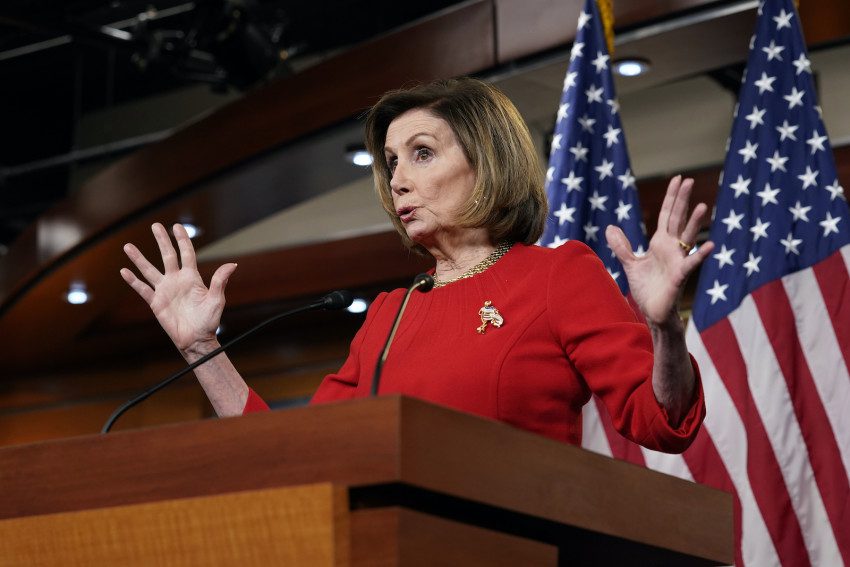
House Speaker Nancy Pelosi of Calif., speaks during a news conference on Capitol Hill in Washington, Thursday, May 13, 2021. (AP Photo/Susan Walsh)
However, it is voting rights that are at the heart of the Democratic agenda.
Trump’s Big Lie that the 2020 presidential election was stolen has induced Republican-controlled states to limit access to the ballot box.
In Georgia, voters must show more ID when they vote by mail and there are fewer ballot drop boxes. Florida has made it harder to vote by mail and also limited ballot drop boxes.
Texas makes it a criminal offence to assist voters at the polls and limits drive-through voting and extended voting hours.
The entire point of these new laws is to keep voting turnout down and to make it harder to vote by post – because too many people voted in 2020, and that record turnout denied Trump a second term.
Australians, who embrace the virtues of mandatory voting, are astonished that the “greatest democracy in the world” (as Americans see themselves) has a bias against universal voting.
The struggle for voting rights goes back to the end of the Civil War, the passage of the 14th and 15th Amendments to the Constitution to ensure that the freed Black slaves, and all citizens (except women until 1920) could vote.
A fight that continued in the civil rights marches of the 1960s with Martin Luther King and John Lewis, and the passage of civil rights laws in the 1960s.
Winning this fight now coincides with a determination that it is time the filibuster died in the Senate – not progressive legislation
For the filibuster to be eliminated or reformed, it takes a simple majority vote to change the Senate’s rules.
Killing the filibuster is seen as “going nuclear” because it would change the Senate as we know it.
In a 50-50 Senate, each individual Democrat has the power to stop the Biden-Democratic agenda.
On voting rights, it has come down to Sen Joe Manchin of West Virginia. He supports the filibuster – and voting rights too. He knows how crucial voting rights are to his president and his party. He also believes in the Senate and in working with Republicans.
Manchin has put together a voting rights bill that has every other Democrat on board. It makes Election Day a public holiday, requires same-day registration at all polling locations by 2024, and provides a minimum 15 days of early voting for federal elections. It also has strong voter ID requirements.
Many Democrats wanted much more – such as public funding for campaigns – but have agreed on a simpler bill with core voting rights protections that could pass the Senate if the filibuster is gone.
This week, if Manchin can find 10 Republicans, this bill can pass, and it would show that the Senate can still work even with the hurdles imposed by the filibuster.
If Manchin fails, it will mean the Senate is broken, and the fuse to go nuclear in the Senate will be lit. The pressure on Democrats to end the filibuster as it stands today will be excruciating.

If the heart of the Biden-Democratic agenda is in the legislation for economic recovery, jobs, infrastructure, climate change, health care, seniors, education and kids, the soul of Democratic ambitions are with the protection of their most fundamental constitutional rights – for all Americans, not just the privileged
More over, voting rights are the soul of the Democratic Party.
If voting rights die in the Senate, a higher measure of enthusiasm among Democratic voters to step up again in next year’s midterm elections for control of Congress dies with it.
Worth going to nuclear war over.

-
Tech3 days ago
Meta to cut 20% workforce for AI focus
-
News3 days ago
Iran threatens infrastructure if U.S. attacks plants
-
Tech3 days ago
OpenAI to introduce ads for free ChatGPT users
-
News4 days ago
Oil prices surge on Middle East supply disruptions
-
Money3 days ago
Global stock markets fall amid oil price surge
-
Tech2 days ago
Spotify bets on AI to retain subscribers
-
News2 days ago
Iran threatens U.S. financial institutions
-
News2 days ago
Meta launches four custom AI chips