




Connect with us
https://tickernews.co/wp-content/uploads/2023/10/AmEx-Thought-Leaders.jpg

Ticker Views

The “golden age” of travel was actually terrible

Published

on

Everyone loves the idea of travelling in the 50s, the so called “golden age” of travel. But the reality was far different and a lot more dangerous.

Imagine you’re half way into your flight to London. The plane lands, the aircraft door swings open, and the intense smells of India fill the plane. You look out the window and see lights from the fires still burning at the shanties overlooking the airport.

So why do people love the idea of old fashioned travel? After all, it was a lot of time in the sky. 

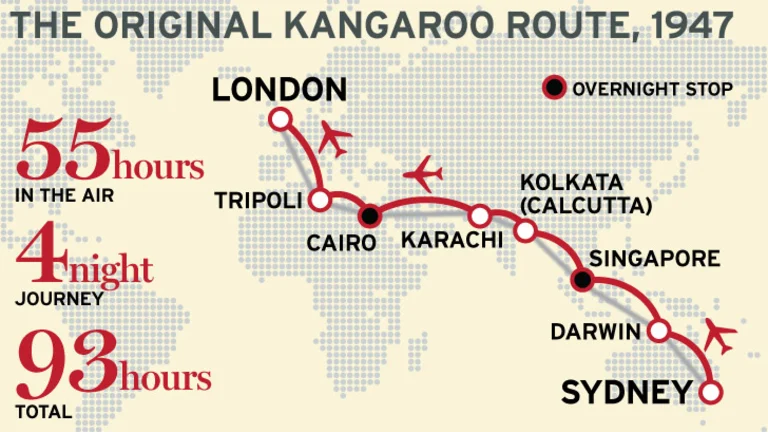
Is this a case of rose coloured travel glasses? Let’s go right back to 1947, when Qantas flew the kangaroo route all the way from Australia to London.

Today the flying kangaroo is flying direct from Australia’s mainland to London with no stops.

But there was a time, not so long ago, when it took 7 stops to kangaroo hop to London.

The original Kangaroo Route from 1947

And it was a huge deal to travel, and also hard for Qantas to pull it off.

After all, landing in some of these countries was pretty complicated at the time.

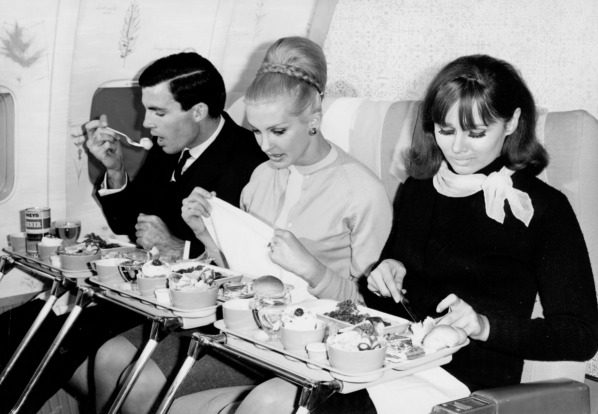
So let’s take a bite of our grapefruit and pineapple cocktail – the food they served on board at the time, and go back in history.

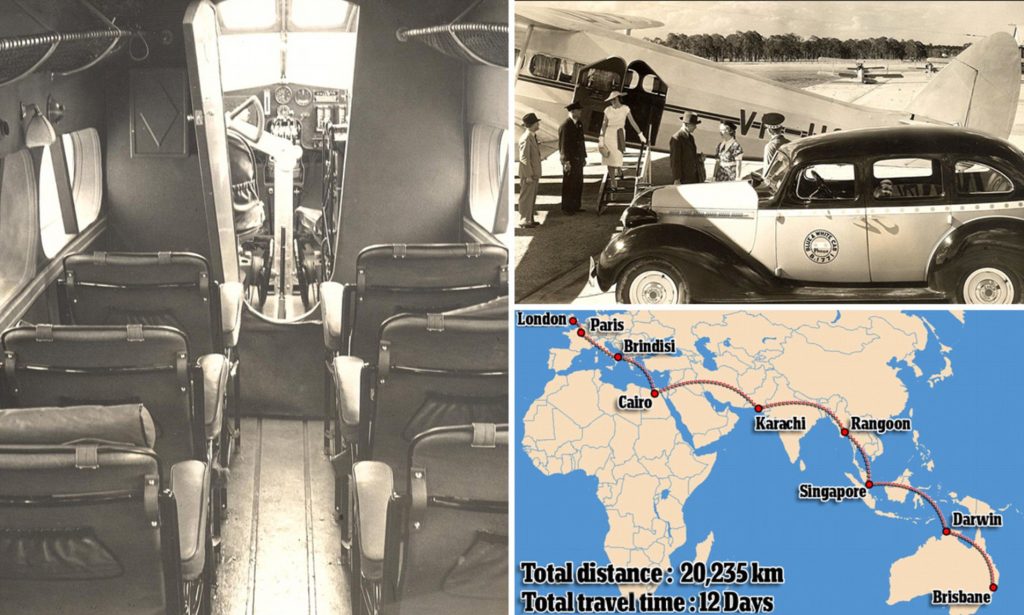
Qantas was flying to London for the Second World War, sort of. They had a code sharing agreement from Brisbane to Singapore as early as 1935, using the de Havilland D.H.86 Express, which could seat just 10 passengers.

When the plane landed in Singapore, passengers connected to a Qantas partner, Imperial airways, which took them on to London.

But it wasn’t a 15 hour flight like it is today. It was 12 and a half days.

By 1938, Qantas had taken up more of that journey itself, and by 1947 there were as many as 6 weekly flights between Sydney and England.

Flying into Singapore was part of the experience.

The fastest route was a pacy 78 hours

And then the Kangaroo Route was born. Qantas used the Lockheed Constellations, with ten crew on board, including three pilots, one navigator, one radio operator, two flight engineers and three cabin crew.

Between them, they looked after just 29 passengers. Enough to make today’s airline accountants weep.

And if you were one of the lucky few to get a seat on board, you were pretty wealthy. The flight cost from Sydney to London was around $40,000.

But for that price, you got to see the world, literally.

Qantas flight to the United Kingdom by constellation in 1935.

Starting in Darwin, on the northern tip of the Australian island, the flight would take off bound for Singapore, then on to Calcutta, before another stop in Karachi, Cairo, Castel Benito and then Rome.

Over the following decade, Qantas was pretty experimental. Adding cities like Frankfurt, Zurich, Rome, Athens and Colombo, as other cities dropped off.

Flying to London was the experience.

Passengers loved it, and before long, competitors came for the Qantas golden goose.

BOAC was running four Britannias a week both ways, Air India flew the Super Constellation between Sydney and London, and KLM ran a super constellation between Sydney and Amsterdam.

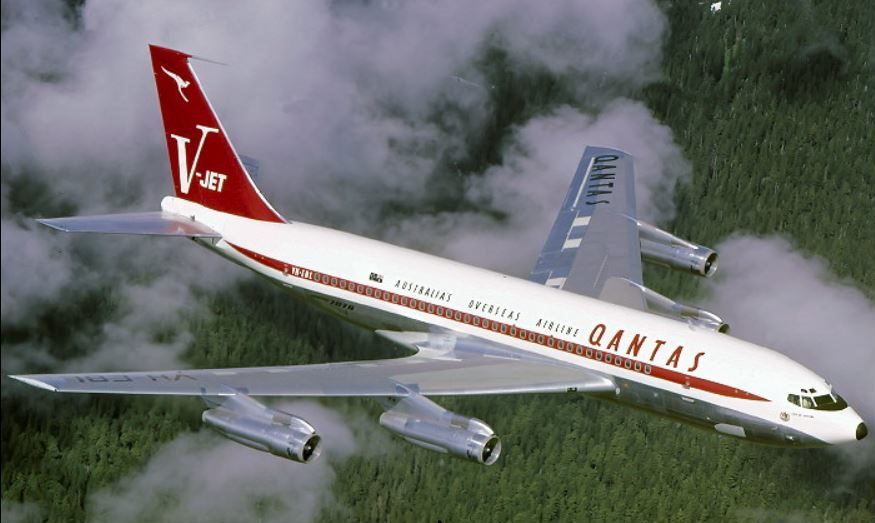
Then came the jet age! In 1959, Qantas turned to Boeing to build an aircraft that could swoop it past the competition. And Boeing delivered, with the 707.

The 707 was a game changer for the flying roo.

By now, Qantas was incorporating the Kangaroo Route into an around the world run.

With flights from Australia to the US and then on to London, in what became known as the Southern Cross route.

These were extraordinary times, and so exciting for passengers and those working in the airline industry.

By the 1970s, the 747 had changed the landscape once again. The queen of the skies could fly faster, and longer.

And with it, drastic changes to the kangaroo route.

As the planes got bigger, the routes got smaller, and the stops to places like Bombay were no longer necessary.

Airlines changed their marketing from an adventure, to speed and efficiency.

The photos look great, but the reality was much different.

Pretty soon there was just one stop, usually in Singapore, with its air bridges and air conditioning. Replacing the local smells and sights.

Now there are heaps of airlines flying the route, from Singapore to Emirate, Etihad, Thai and British airways.

The aircraft are more sophisticated, and depending on the wind, that flight to London is now 21 hours, rather than 12 and a half days.

And pretty soon, the kangaroo route wont hop down anywhere at all, flying direct from mainland Australia to London or New York direct.

But take a minute to think back to that era when travelling was an opportunity to see the world, to learn about new cultures.

But for those of us who grew up only in the jet age, it’s nice to imagine what it was like.

Ahron Young is an award winning journalist who has covered major news events around the world. Ahron is the Managing Editor and Founder of TICKER NEWS.

Ticker Views

Iran’s exiled crown prince is touting himself as a future leader

Published

on

Iran’s exiled crown prince is touting himself as a future leader. Is this what’s best for the country?

Simon Theobald, University of Oxford; University of Notre Dame Australia

As Iranian and US diplomats meet in Geneva for crucial negotiations to avoid a potential war, opposition groups in exile are sniffing an opportunity.

The Islamic Republic faces its greatest political crisis since its inception. US President Donald Trump is threatening an imminent attack if Iran doesn’t capitulate on its nuclear program. And anti-regime protesters continue to gather, despite a brutal government crackdown that has killed upwards of 20,000 people, and possibly more.

Talk of a future Iran after the fall of the Islamic regime has grown increasingly fervent. And buoyed by cries heard during some of the protests in Iran of “long live the shah” (the former monarch of Iran), the voices of royalists in the Iranian diaspora are everywhere.

But is a return of the shah really what Iranians want, and what would be best for the country?

What are the monarchists promising?

Iran’s monarchy was ancient, but the Pahlavi dynasty that last ruled the country only came to power in 1925 when Reza Khan, a soldier in the army, overthrew the previous dynasty.

Khan adopted the name Pahlavi, and attempted to bring Iran closer to Western social and economic norms. He was also an authoritarian leader, famous for banning the hijab, and was ultimately forced into exile by the British following the Anglo-Soviet invasion of Iran in 1941.

His son, Mohammad Reza Pahlavi, attempted to continue his father’s reforms, but was similarly authoritarian. Presiding over a government that tolerated little dissent, he was ultimately forced out by the huge tide of opposition during the Islamic Revolution of 1979.

Now, the exiled crown prince, 65-year-old Reza Pahlavi, is being touted by many in the diaspora as the most credible and visible opposition figure to be able to lead the country if and when the Islamic Republic collapses.

Pro-monarchy groups such as the US-based National Union for Democracy in Iran (NUFDI) have become vocal supporters of Pahlavi.

In early 2025, the NUFDI launched a well-coordinated and media savvy “Iran Prosperity Project”, offering what the group claimed was a roadmap for economic recovery in a post-Islamic Republic Iran. Pahlavi himself penned the foreword.

Then, in July, the group released its “Emergency Phase Booklet”, with a vision for a new political system in Iran.

Although the document is mostly written in the language of international democratic norms, it envisions bestowing the crown prince with enormous powers. He’s called the “leader of the national uprising” and given the right to veto the institutions and selection processes in a transitional government.

One thing the document is missing is a response to the demands of Iran’s many ethnic minority groups for a federalist model of government in Iran.

Instead, under the plan, the government would remain highly centralised under the leadership of Pahlavi, at least until a referendum that the authors claim would determine a transition to either a constitutional monarchy or democratic republic.

But students of Iranian history cannot help but note echoes of the 1979 Islamic Revolution. Ayatollah Ruhollah Khomeini had promised a more democratic Iran with a new constitution, and without himself or other clerics in power.

After the revolution, though, Khomeini quickly grasped the reigns of power.

Online attacks against opponents

Pahlavi and his supporters have also struggled to stick to the principles of respectful debate and tolerance of different viewpoints.

When interviewed, Pahlavi has avoided discussing the autocratic nature of his father’s rule and the human rights abuses that occurred under it.

But if Pahlavi tends to avoid hard questions, his supporters can be aggressive. At the Munich Security Conference in February, British-Iranian journalist Christiane Amanpour interviewed the crown prince.

Christiane Amanpour’s interview with Reza Pahlavi.

After the interview, Amanpour’s tough questions resulted in an explosion of anger from his supporters. In a video that has been widely shared on X, royalists can be seen heckling Amanpour, saying she “insulted” the crown prince.

In online forums, the language can be even more intimidating. Amanpour asked Pahlavi point-blank if he would tell his supporters to stop their “terrifying” attacks on ordinary Iranians.

While saying he doesn’t tolerate online attacks, he added, “I cannot control millions of people, whatever they say on social media, and who knows if they are real people or not.”

Do Iranians want a monarchy?

As I’ve noted previously, the monarchist movement also talks as though it is speaking for the whole nation.

But during the recent protests, some students could be heard shouting: “No to monarchy, no to the leadership of the clerics, yes to an egalitarian democracy”.

The level of support for the shah within Iran is unclear, in part because polling is notoriously difficult.

A 2024 poll by the GAMAAN group, an organisation set up by two Iranian academics working in the Netherlands, attempted to gauge political sentiment in Iran. Just over 30% of those polled indicated Pahlavi would be their first choice if a free and fair election were held.

But the poll doesn’t indicate why people said they wanted to vote for him. It also showed just how fragmented the opposition is, with dozens of names getting lower levels of support.

The future of Iran is very unclear at the moment. Even if the Islamic Republic were to be dislodged – a very big “if” – the transition could very well be chaotic and violent.

Would Pahlavi make a good leader? For many critics, his behaviour, and that of his supporters, call into question the royalists’ promises of a more liberal and tolerant Iran.The Conversation

Simon Theobald, Research Fellow, University of Oxford; University of Notre Dame Australia

This article is republished from The Conversation under a Creative Commons license. Read the original article.


Continue Reading

Ticker Views

Tropfest sparks debate with controversial AI-generated short film

Tropfest sparks debate over AI-generated films, impacting creativity and traditional filmmaking in the festival circuit. #AIinFilm

Published

on

Tropfest sparks debate over AI-generated films, impacting creativity and traditional filmmaking in the festival circuit. #AIinFilm


Tropfest, the world’s largest short film festival, caused a stir in Sydney with the screening of a controversial AI-generated short film. The festival’s decision has reignited debates over the role of artificial intelligence in filmmaking and the impact on creative industries.

Filmmakers and audiences are divided. Some praise the innovation, while others question whether AI films should compete alongside human-directed works. The controversy also raises questions about jobs, creative ownership, and ethical considerations in using AI.

Darren Woolley from TrinityP3 weighs in on whether AI could become a legitimate creative partner or if it risks undermining traditional storytelling.

The Tropfest inclusion may mark a turning point for film festivals worldwide in how they embrace or regulate AI content.

Subscribe to never miss an episode of Ticker – https://www.youtube.com/@weareticker

#AIinFilm #Tropfest2026 #ShortFilms #FilmFestivalDebate #AIFilmmaking #CreativeFuture #DigitalCinema #FilmInnovation


Download the Ticker app

Continue Reading

Ticker Views

Australian workers using AI in Fair Work claims spark concern

Fair Work Commission tightens rules on AI-assisted claims amid rising inaccuracies, urging verification and legislative reform.

Published

on

Fair Work Commission tightens rules on AI-assisted claims amid rising inaccuracies, urging verification and legislative reform.


The Fair Work Commission is seeing a dramatic rise in inaccurate claims as Australian workers increasingly use AI tools like ChatGPT to file submissions. The surge in AI-assisted applications has prompted the commission to tighten rules, requiring applicants to disclose AI usage.

Dr Karen Sutherland from Uni SC discusses how generative AI is impacting the operations of the commission and why careful verification of claims is critical. Justice Adam Hatcher has highlighted the challenges this influx presents and is urging federal legislative reform.

The FWC’s caseload is expected to grow significantly by the end of the current financial year, putting pressure on the commission to maintain accuracy and fairness while managing a higher volume of claims.

Subscribe to never miss an episode of Ticker – https://www.youtube.com/@weareticker


Download the Ticker app

Continue Reading

Trending Now