

Connect with us
https://tickernews.co/wp-content/uploads/2023/10/AmEx-Thought-Leaders.jpg

Ticker Views

Russia’s ‘permanent test’ is pushing Europe to the brink of war

Published

on

Russia’s ‘permanent test’ is pushing Europe to the brink of war – here’s what Moscow actually wants

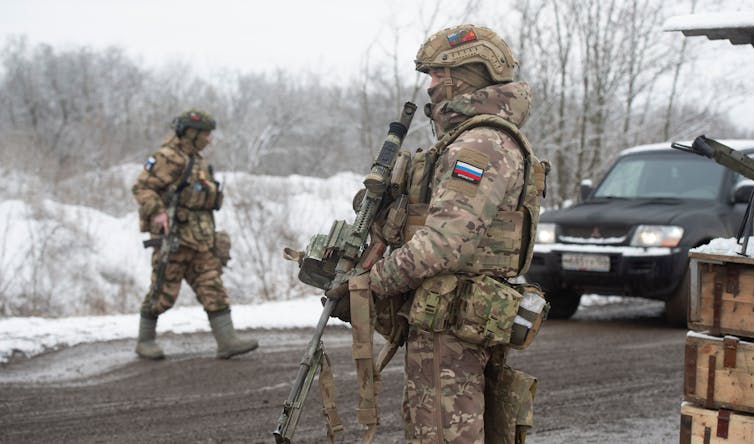
Russian army special forces inspect vehicles at a checkpoint in Zaporizhzhia, Ukraine, in February 2024.
Sergey Nikonov/Shutterstock

Christo Atanasov Kostov, IE University

The scenes have become grimly familiar: Russian tanks rolling into Georgia in 2008, the seizure of Crimea in 2014, the invasion of Ukraine in 2022, Russian military jets violating European airspace, and now mysterious drone sightings closing airports across Europe.

While these may seem like disconnected events, in reality they are but chapters in a singular, focused and evolving strategy. Russia’s aim is to wield military power when necessary, engage in “grey-zone” war tactics when possible, and exert political pressure everywhere. Moscow has been doing all this for decades, with one objective in mind: to redraw Europe’s security map without triggering direct war with Nato.

This goal is neither improvised nor ambiguous, and at its core, it is irredentist – it seeks to reverse Nato’s post-Cold War expansion, and reassert a Russian sphere of influence in Europe.

This singular focus was what governed Russia’s actions in the runup to its invasion of Ukraine. In December 2021, Moscow demanded that Nato bar Ukraine and Georgia from joining the alliance, and that Nato forces withdraw to their May 1997 positions, where they were before any former Soviet states in East Europe joined Nato.

This was not a diplomatic opening gambit to the February 2022 ground invasion, but an objective in and of itself. From the Kremlin’s perspective, Nato’s enlargement is both a humiliation and an existential threat, and must be curbed at all costs.

A toolkit of pressure

Russia’s actions can be variously interpreted as sabre-rattling, brinkmanship, or diplomatic pressure. In fact, all of these labels are accurate, but Russia uses them in conjunction to blur the typical lines between diplomacy, military action and domestic propaganda. We can break Moscow’s “toolkit” of pressure down into different types of action.

  • Brinkmanship to force dialogue: Military escalation, from troop build-ups to the invasion of Ukraine itself, creates crises that compel Western attention. Russia manufactures emergencies to earn negotiation leverage, as it successfully did during the Cold War, and more recently in Georgia in 2008 and in Ukraine from 2014 onwards.
  • Grey-zone probing: Drone and jet incursions over Germany, Estonia, Denmark and Norway are deliberate tests of Nato’s detection and response capacity. They also serve more the practical purpose of collecting intelligence on radar coverage and readiness without crossing into open hostilities.
  • Hybrid pressure on smaller Nato allies: Cyberattacks and energy disruptions in various EU member states are designed to test the alliance’s solidarity. Moscow singles out smaller, weaker states to foster resentment and doubt within Nato.
  • Domestic theatre: For Putin, confronting the West plays well at home. As Dmitry Medvedev, the Deputy Chairman of the Security Council of Russia, recently claimed, “Europe fears its own war”. For the Kremlin, that fear reinforces the narrative that Russia is the assertive power, and that the West is indecisive.

Russia’s use of these tools is not new – it builds on strategies that have been refined since the Soviet collapse. From Transnistria to Abkhazia, South Ossetia, and Donbas, Moscow sustains “unresolved” wars that lock states out of Nato and the EU, preserving Russian influence indefinitely.

Russia’s ‘permanent test’

Today, the Kremlin’s strategy increasingly favours hybrid means – drones, cyberattacks, disinformation, and energy blackmail – over warfare. These are not random provocations, but a coherent campaign of testing.

Each incursion and attack serves a diagnostic purpose: Can Europe detect? Can it coordinate a joint response? Can it enact this response swiftly and efficiently?

As Belgian officials admitted after a recent spate of drone sightings, the continent needs to “act faster” in building air-defence systems. Every such admission emboldens Moscow’s conviction that Europe is unprepared and divided.

Back home, these moments are curated into propaganda clips for state television, where pundits mock European “weakness” and frame the continent’s disarray as validation for the Kremlin’s confrontational stance. This manufactured crisis, in turn, is the latest application of a well-honed strategy.

With regard to the West, the aim is exhaustion, not conquest – a “permanent test” designed to drain resources and unity through constant, low-level pressure.

What comes next?

Russia’s escalating provocations of Nato and Europe cannot be maintained as status quo. As things stand, there are three possible scenarios for where they could lead us:

  1. A new, long-term confrontation: This is the most likely outcome, as Nato cannot concede to Russia’s core demands without undermining its founding principles. Conflict would probably take the form of a drawn-out standoff: more troops on the alliance’s eastern flank, swelling defence budgets, and a new Iron Curtain across Europe.
  2. The “Finlandisation” of Ukraine: One possible, though unstable, outcome could see Ukraine coerced into a neutral status – foreswearing Nato membership in exchange for guarantees as Finland did during the Cold War. From the West’s perspective, this would reward Moscow’s aggression, and entrench its veto over neighbours’ sovereignty.
  3. Escalation through miscalculation: In a landscape of heightened tension, even a minor incident – a drone shootdown, a cyberattack gone wrong – could spiral into wider confrontation. A deliberate war between Nato and Russia is still improbable, but no longer unthinkable.

Europe’s imperative: resilience

The Kremlin’s approach relies on fragmentation; Europe’s answer must be cohesion. This means building up certain capabilities:

  • Integrated air and missile defence: Build a truly continental shield, closing gaps that drones and hypersonic systems could exploit.
  • Collective hybrid defence: Treat cyberattacks or drone incursions as alliance-wide challenges. A single, pre-agreed Nato response mechanism would deny Moscow the ability to isolate members.
  • Technological and political autonomy: Invest in European defence industries, renewable energy independence, and resilient supply chains. Security now begins with self-sufficiency, especially in the face of wavering support from the US.
  • Deterrence through diplomacy: Europe must combine credible military deterrence with pragmatic engagement, ensuring that channels of communication remain open to prevent escalation.

Russia’s strategy is not reactive, it is structural. The Kremlin seeks to force the West to accept a redrawn security order through a blend of coercion, probing, and perpetual testing. The tools may vary – from tanks to drones, from overt invasion to a hybrid war of attrition – but the aim endures: to undermine European unity and restore the sphere of influence lost by Russia in 1991.

Europe’s challenge is equally clear. It has to resist the fatigue of endless crisis and demonstrate that resilience, not fear, defines the continent’s future.

Moscow’s provocations will continue until the costs become prohibitive. Only a unified, prepared Europe can make that happen.


A weekly e-mail in English featuring expertise from scholars and researchers. It provides an introduction to the diversity of research coming out of the continent and considers some of the key issues facing European countries. Get the newsletter!The Conversation


Christo Atanasov Kostov, International Relations, Cold War, nationalism, Russian propaganda, IE University

This article is republished from The Conversation under a Creative Commons license. Read the original article.


Ticker Views

2025 Arctic Report Card shows a region transforming faster than expected

Published

on

From record warming to rusting rivers, 2025 Arctic Report Card shows a region transforming faster than expected

As temperatures rise, the timing of the ice thaw changes.
Vincent Denarie via Arctic Report Card

Matthew L. Druckenmiller, University of Colorado Boulder; Rick Thoman, University of Alaska Fairbanks, and Twila A. Moon, University of Colorado Boulder

The Arctic is transforming faster and with more far-reaching consequences than scientists expected just 20 years ago, when the first Arctic Report Card assessed the state of Earth’s far northern environment.

The snow season is dramatically shorter today, sea ice is thinning and melting earlier, and wildfire seasons are getting worse. Increasing ocean heat is reshaping ecosystems as non-Arctic marine species move northward. Thawing permafrost is releasing iron and other minerals into rivers, which degrades drinking water. And extreme storms fueled by warming seas are putting communities at risk.

The past water year, October 2024 through September 2025, brought the highest Arctic air temperatures since records began 125 years ago, including the warmest autumn ever measured and a winter and a summer that were among the warmest on record. Overall, the Arctic is warming more than twice as fast as the Earth as a whole.

Highlights from the National Oceanic and Atmospheric Administration’s 2025 Arctic Report Card.

For the 20th Arctic Report Card, we worked with the National Oceanic and Atmospheric Administration, an international team of scientists and Indigenous partners from across the Arctic to track environmental changes in the North – from air and ocean temperatures to sea ice, snow, glaciers and ecosystems – and the impacts on communities.

Together, these vital signs reveal a striking and interconnected transformation underway that’s amplifying risks for people who live there.

A wetter Arctic with more extreme precipitation

Arctic warming is intensifying the region’s water cycle.

A warmer atmosphere increases evaporation, precipitation and meltwater from snow and ice, adding and moving more water through the climate system. That leads to more extreme rainstorms and snowstorms, changing river flows and altering ecosystems.

Charts show how the Arctic has warmed faster than the global average.
Arctic surface air temperatures are warming much faster than the global average.
NOAA and CIRES/University of Colorado Boulder.

The Arctic region saw record-high precipitation for the entire 2025 water year and for spring, with the other seasons each among the top-five wettest since at least 1950. Extreme weather – particularly atmospheric rivers, which are long narrow “rivers in the sky” that transport large amounts of water vapor – played an outsized role.

These wetter conditions are reshaping snow cover across the region.

Snow and ice losses accelerate warming, hazards

Snow blankets the Arctic throughout much of the year, but that snow cover isn’t lasting as long. In 2025, snowpack was above average in the cold winter months, yet rapid spring melting left the area covered by snow far smaller than normal by June, continuing a six-decade decline. June snow cover in recent years has been half of what it was in the 1960s.

Losing late spring snow cover means losing a bright, reflective surface that helps keep the Arctic cool, allowing the land instead to be directly warmed by the sun, which raises the temperature.

An illustration shows changes in sea level rise, temperature, precipitation, sea ice and other vital areas.
Eight vital signs and observations in 2025 from the 20th edition of the Arctic Report Card.
Arctic Report Card 2025

Sea ice tells a similar story. The year’s maximum sea ice coverage, reached in March, was the lowest in the 47-year satellite record. The minimum sea ice coverage, in September, was the 10th lowest.

Since the 1980s, the summer sea ice extent has shrunk by about 50%, while the area covered by the oldest, thickest sea ice – ice that has existed for longer than four years – has declined by more than 95%.

The thinner sea ice cover is more influenced by winds and currents, and less resilient against warming waters. This means greater variability in sea ice conditions, causing new risks for people living and working in the Arctic.

Map shows sea ice extent in 2025 and the 2005-2024 median is much smaller than the 1979-2004 median extent.
Arctic sea ice concentration in September 2025, during its annual minimum extent at the end of summer, was much smaller than the 1979-2004 median extent. The shades of blue reflect the concentration of sea ice.
NOAA and CIRES/University of Colorado Boulder.

The Greenland Ice Sheet continued to lose mass in 2025, as it has every year since the late 1990s. As the ice sheet melts and calves more icebergs into the surrounding seas, it adds to global sea-level rise.

Mountain glaciers are also losing ice at an extraordinary rate – the annual rate of glacier ice loss across the Arctic has tripled since the 1990s.

This poses immediate local hazards. Glacial lake outburst floods – when water that is dammed up by a glacier is suddenly released – are becoming more frequent. In Juneau, Alaska, recent outburst floods from Mendenhall Glacier have inundated homes and displaced residents with record-setting levels of floodwater.

A mountain view shows where the retreating glacier and possible permafrost thaw influenced valley walls exposed above open water.
An aerial photo shows the result of an Aug. 10, 2025, landslide at South Sawyer Glacier in Alaska. The light-colored area of the mountainside is where the slide occurred.
USGS

Glacier retreat can also contribute to catastrophic landslide impacts. Following the retreat of South Sawyer Glacier, a landslide in southeast Alaska’s Tracy Arm in August 2025 generated a tsunami that swept across the narrow fjord and ran nearly 1,600 feet (nearly 490 meters) up the other side. Fortunately, the fjord was empty of the cruise ships that regularly visit.

Record-warm oceans drive storms, ecosystem shifts

Arctic Ocean surface waters are steadily warming, with August 2025 temperatures among the highest ever measured. In some Atlantic-sector regions, sea surface temperatures were as much as 13 degrees Fahrenheit (7.2 Celsius) above the 1991-2020 average. Some parts of the Chukchi and Beaufort seas were cooler than normal.

A map and chart show temperatures rising.
Arctic sea surface temperatures are much warmer today than in past decades, as this map and chart of August 2025 sea surface temperatures shows.
NOAA and CIRES/University of Colorado Boulder.

Warm water in the Bering Sea set the stage for one of the year’s most devastating events: Ex-Typhoon Halong, which fed on unusually warm ocean temperatures before slamming into western Alaska with hurricane-force winds and catastrophic flooding. Some villages, including Kipnuk and Kwigillingok, were heavily damaged.

As seas warm, powerful Pacific cyclones, which draw energy from warm water, are reaching higher latitudes and maintaining strength longer. Alaska’s Arctic has seen four ex-typhoons since 1970, and three of them arrived in the past four years.

A town with homes surrounded by water.
The village of Kipnuk, shown on Oct. 12, 2025, was devastated by ex-Typhoon Halong. The storm displaced at least 1,500 people from across western Alaska.
Alaska National Guard

The Arctic is also seeing warmer, saltier Atlantic Ocean water intrude northward into the Arctic Ocean. This process, known as Atlantification, weakens the natural layering of water that once shielded sea ice from deeper ocean heat. It is already increasing sea ice loss and reshaping habitat for marine life, such as by changing the timing of phytoplankton production, which provides the base of the ocean food web, and increasing the likelihood of harmful algal blooms.

From ocean ‘borealization’ to tundra greening

Warming seas and declining sea ice are enabling southern, or boreal, marine species to move northward. In the northern Bering and Chukchi seas, Arctic species have declined sharply – by two-thirds and one-half, respectively – while the populations of boreal species expand.

On land, a similar “borealization” is underway. Satellite data shows that tundra vegetation productivity – known as tundra greenness – hit its third-highest level in the 26-year record in 2025, part of a trend driven by longer growing seasons and warmer temperatures. Yet greening is not universal – browning events caused by wildfires and extreme weather are also increasing.

An aerial view of green land dotted with lakes and a river.
Coastal tundra vegetation on the Baldwin Peninsula of Alaska. The tundra is seeing longer growing seasons with warmer temperatures, leading to the overall ‘greening’ of the region.
G. V. Frost

Summer 2025 marked the fourth consecutive year with above-median wildfire area across northern North America. Nearly 1,600 square miles (over 4,000 square kilometers) burned in Alaska and over 5,000 square miles (over 13,600 square kilometers) burned in Canada’s Northwest Territories.

Permafrost thaw is turning rivers orange

As permafrost – the frozen ground that underlies much of the Arctic – continues its long-term warming and thaw, one emerging consequence is the spread of rusting rivers.

As thawing soils release iron and other minerals, more than 200 watersheds across Arctic Alaska now show orange discoloration. These waters exhibit higher acidity and elevated levels of toxic metals, which can contaminate fish habitat and drinking water and impact subsistence livelihoods.

In Kobuk Valley National Park in Alaska, a tributary to the Akillik River lost all its juvenile Dolly Varden and slimy sculpin fish after an abrupt increase in stream acidity when the stream turned orange.

Side-by-side images show the same stream a year apart, one with rust-colored water.
Rust-colored water in a tributary of the Akillik River in Kobuk Valley National Park reflects permafrost thaw releasing metals into the water.
National Park Service/Jon O’Donnell

Arctic communities lead new monitoring efforts

The rapid pace of change underscores the need for strong Arctic monitoring systems. Yet many government-funded observing networks face funding shortfalls and other vulnerabilities.

At the same time, Indigenous communities are leading new efforts.

The Arctic Report Card details how the people of St. Paul Island, in the Bering Sea, have spent over 20 years building and operating their own observation system, drawing on research partnerships with outside scientists while retaining control over monitoring, data and sharing of results. The Indigenous Sentinels Network tracks environmental conditions ranging from mercury in traditional foods to coastal erosion and fish habitat and is building local climate resilience in one of the most rapidly changing environments on the planet.

A group of people with binoculars watch the water.
Observers with the Indigenous Sentinel Network, together with National Oceanic and Atmospheric Administration scientists, monitor the population and health of northern fur seals on St. Paul Island.
Hannah-Marie Ladd, CC BY

The Arctic is facing threats from more than the changing climate; it’s also a region where concerns of ecosystem health and pollutants come sharply into view. In this sense, the Arctic provides a vantage point for addressing the triple planetary crisis of climate change, biodiversity loss and pollution.

The next 20 years will continue to reshape the Arctic, with changes felt by communities and economies across the planet.The Conversation

Matthew L. Druckenmiller, Senior Scientist, National Snow and Ice Data Center (NSIDC), Cooperative Institute for Research in Environmental Sciences (CIRES), University of Colorado Boulder; Rick Thoman, Alaska Climate Specialist, University of Alaska Fairbanks, and Twila A. Moon, Deputy Lead Scientist, National Snow and Ice Data Center (NSIDC), Cooperative Institute for Research in Environmental Sciences (CIRES), University of Colorado Boulder

This article is republished from The Conversation under a Creative Commons license. Read the original article.

Continue Reading

Ticker Views

Australia is reeling from the worst terrorist attack on home soil. Could it have been prevented?

Published

on

Australia is reeling from the worst terrorist attack on home soil. Could it have been prevented?

Greg Barton, Deakin University

With 15 civilians and one gunman dead so far, and another 40 people injured, Australia is reeling from its worst act of terrorism on home soil. Two gunmen opened fire on a Jewish community gathering to celebrate the first night of Hanukkah at Archer Park on Sydney’s famous Bondi Beach.

Police have confirmed the two alleged attackers were father and son, aged 50 and 24. The father, Sajid Akram, who was licensed to own six firearms, was shot dead by police. The son, Naveed Akram, remains under police guard in hospital.

Given it was clearly an antisemitic attack, authorities soon after declared it an act of terrorism – that is, an act of politically motivated violence. This designation also gives authorities extra resources in their response and in bringing those responsible to justice.

As Australians try to process their shock and grief, there has been some anger in the community that not enough has been done to protect Jewish Australians from the rising antisemitism evident since the Hamas attack on Israel in October 2023 and the ensuing Gaza war.

What we know about the alleged attackers

ASIO (The Australian Security Intelligence Organisation) Director-General Mike Burgess has said one of the alleged gunmen was “known” to ASIO, though he did not specify which one. Being “known” to authorities can simply mean someone has been associated with networks and communications that have caused concern to authorities. The ABC has reported that Naveed Akram came to the attention of authorities after the arrest of Islamic State Sydney cell leader Isaac El Matari in July 2019.

However, there are hundreds of people who come to authorities’ attention for their contact, online or off, with extremist networks and individuals. With limited resources (and authorities’ resources will always be limited, no matter how much funding they have), they have to run a triage system to assess the threat an individual or a group may pose, and manage the risk as best they can.

They will carefully assess what is being said and the language used, for example, as well as looking at whether a person has a history of violence. As angry and upset as people understandably are in the wake of such a horrific incident, it needs to be recognised that authorities can’t simply arrest everyone who expresses extremist ideas or has passing links with extremist elements.

We still need to know more about this terror attack and the alleged attackers, but to date there has been no evidence of a network in operation. Given the alleged gunmen were father and son, this technically fits the profile of a “lone actor” attack, as we saw in the Lindt Cafe siege in 2014, and Christchurch in 2019.

It is very difficult for authorities to predict and therefore prevent lone actor attacks – by their nature, there’s often no sign beforehand of the potential for violence. And public sites like the reserve at Bondi Beach require extensive resources to police, meaning not all can be adequately secured.

As Burgess pointed out in his annual threat assessment, “our greatest threat remains a lone actor using an easily obtained weapon”. Sadly, that has been shown to be true.

Changing nature of terrorist threat in Australia

There has been much attention in recent years on the rise of far-right extremism and terrorism.

One of the best guides to this is Burgess’ annual threat assessment. In it he explained that a decade ago, just one in ten cases ASIO was following up involved right-wing extremists, with radical Islamist groups occupying most of their attention. However, in recent years the ratio has shifted closer to one in two investigations involving right-wing extremism. In other words, a lot of ASIO’s attention and resources are now necessarily tied up with combating right-wing extremism, especially following the Christchurch terror attack in which 51 people were shot dead by an Australian far-right terrorist during Friday prayers in two New Zealand mosques.

More broadly, Islamic terrorism continues to remain a global threat. IS and Al-Qaeda remain active in the Middle East and increasingly in Africa, as well as central Asia and Afghanistan. Generally, authorities are doing a good job of keeping on top of any threats these networks might pose in Australia.

There is no doubt the general atmosphere between pro-Palestinian and Jewish groups has become far more febrile in the wake of the Hamas attack and the Gaza war. There is a lot of anger and frustration as scenes of violence and suffering are broadcast daily, and we have seen a rise both in antisemitism and Islamophobia since the war began, simply because of the way it plays out in people’s imaginations.

But even in the protests we have seen over many months, the number of people who might use this sentiment to spur violence is small.

Again, there is no evidence the Bondi shooting was part of a wider network, and it is very difficult to stop a lone actor attack on a public site.

In a glimmer of hope, the man whose much-lauded act of heroism in wrestling one of the alleged gunman’s weapons from him has been named as 43-year-old Muslim fruit shop owner Ahmed Al-Ahmed. It is hoped this man’s bravery, which showed us the best of humanity in the midst of the worst, will stop any simplistic analysis of blaming the Muslim community for such violence. We have seen this in the United States, and Australia must do much better.

Has the government done enough?

It is very difficult to keep outdoor public events entirely safe: buildings are relatively easy to secure, but a park at a beach far less so.

The government clearly needs to do more to stop terrorism, and public events are an obvious focus for more resources. No one should be satisfied with where we are right now. It is simply horrifying. But it’s going to take a lot of work to figure out where we can best use resources.

We can’t close every loophole or thwart every risk. We can’t stop people turning to violence, and we can’t police every hateful thought. It has been said this was an attack on all of us, and that’s very true. As the message of Hanukkah inspires us, now is the time when we need to pull together as Australians from all faiths and communities, and work together to ensure that light triumphs over darkness.The Conversation

Greg Barton, Chair in Global Islamic Politics, Alfred Deakin Institute for Citizenship and Globalisation, Deakin University

This article is republished from The Conversation under a Creative Commons license. Read the original article.

Continue Reading

Ticker Views

From the Goldberg’s to the Icebergs – Bondi is Australia, Australia is Bondi beach

Published

on

When I think of Australia, I often think of Bondi Beach. Not just its great natural beauty, its hip cosmopolitan but casual feel but also because of its importance in my own family history.

My grandfather, Ken Harcourt, a Jew from Lismore, born of Romanian and Polish refugee parents, grew up in Bondi and he and his brother Sam spent most mornings in the surf and most afternoons at the track at Randwick. Ken, originally named Kopel Harkowitz, was the son of immigrants from Transylvania (which is sometimes considered Romania, sometimes Hungary but if I am talking to Frank Lowy, it’s definitely, Hungary) and Poland. Kopel’s mother Dinah Harkowitz always wanted her eldest son to be a Rabbi, but young Kopel wanted to be a true blue Aussie lifesaver at Bondi. He and his brother had trouble getting in the club as Kopel Harkowitz but when he fronted as Ken Harcourt, they said ‘no worries’. When I asked my grandfather why he changed his name, he used to say ‘Well, I didn’t really, I just went from the Goldberg’s to the Ice Bergs’. Sam became a Harcourt too and they became professional punters and even had a radio show named after them called ‘The Racing Harcourts’.

So that’s why I am a Harcourt, and why Bondi Beach means so much to me. In fact, in my first published book Beyond Our Shores deliberately chose the Bondi beach as its cover. I thought it symbolic that a son of Eastern European migrants from way beyond our shores aspiring to be a true blue Aussie lifesaver at Bondi. In fact, a major theme of the book has been how important Australia\’s immigration has been to our export performance and our national economic prosperity. Waves of English, Irish, Scottish, Greek, Jewish, Russian, Chinese, Lebanese, New Zealand and Indonesian migrants have all done their bit too grow Australia’s links with the world. Many of them have become lifesavers too! This is so special to Sydney and nowhere is this so apparent than here at Bondi with its great mix of languages and cultures.

Weakness of leadership

But what Kopel Harkowitz would make of Bondi Beach on December 14th, 2025? Like most decent Australians he would have been shocked at the explosion of anti-Semitism and the weakness of modern Australian political leadership. My grandfather was a proud Australian as well as a proud Jew and thought Australia was the safest and democratic country in the world. And he loved Christmas, Anzac Day and all the celebrations and thought religion like voting was a private matter not to be imposed on others.

I am sure he would have been shocked at the chants at the Sydney Opera House just after 7th October 2023, and the weak federal government response. He would have been shocked at people marching across the Sydney Harbour Bridge chanting ‘globalise the intifada’ and the intimidation of the Jewish community with people travelling to Bondi every weekend to wave flags and chant slogans. He would have feared for the safety of Jewish staff and students on Australian university campuses and I suspect he would have been amazed at what was broadcast on his beloved ABC.

And he would have been right. The intimidation since the Sydney Opera House chants up to the shootings at Bondi must stop. It’s not ‘balancing Islamophobia with anti-Semitism’ which the federal government seems to think it is, it’s all of the Australian community against the fundamentalist Islamicist terrorists. The attack on the Jewish Hannukah celebration at Bondi was an attack on all of us. Bondi is Australia, Australia is Bondi beach. It’s symbolic that the hero of the day was an Aussie fruit and veg shop owner (himself of Lebanese Muslim origin) who tackled the terrorist gun man and in doing so saved many lives. Responsible Muslim nations like Morocco and UAE take a hard line against terrorists, so should the west, starting with Australia.

My grandfather knew that, and that’s why he loved Australia. May his memory be a blessing.

Continue Reading

Trending Now