
The Taliban has taken control of Afghanistan again. Here’s everything that happened this week
Taliban has moved swiftly to increase their rule across the region – the military group has clashed with protestors who are fighting back against the regime.
This comes as thousands of Afghan residents and foreign nationals rush to Kabul’s main airport in a desperate bid to escape the country before it’s too late.
As of Friday, the US military has so far evacuated around 7,000 people from Afghanistan after taking control of the airport earlier in the week.
It appears that the Taliban is cooperating with the evacuation efforts but there are fears that this could change very quickly.
Did this all begin with the US withdrawal of troops?
Joe Biden “stands squarely behind” the withdrawal of troops from Afghanistan as the US military secures the Afghan capital’s airport in Kabul.
US President Joe Biden “stands squarely behind” the withdrawal of troops from Afghanistan as the US military secures the Afghan capital’s airport in Kabul
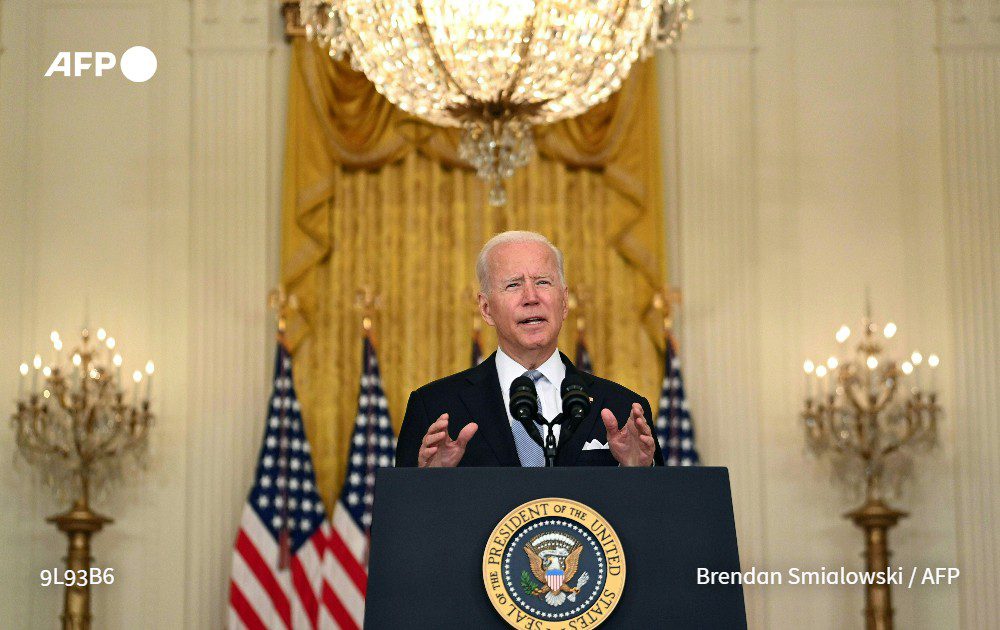
Biden says his country’s military presence will be swift and the response will be forceful if the Taliban attacks troops as evacuations continue.
The US has spent trillions of dollars over twenty years in Afghanistan and lost more than 2,000 military personnel, making the decision to withdraw largely popular among citizens.
US President Joe Biden “stands squarely behind” the withdrawal of troops from Afghanistan as the US military secures the Afghan capital’s airport in Kabul
US President Joe Biden spoke publicly about the situation just hours ago, for the first time since the Taliban took control of Kabul.
Biden says his country’s military presence will be swift and the response will be forceful if the Taliban attacks troops as evacuations continue.
This comes as the President admits that although the collapse of Afghanistan to the Taliban was quicker than anticipated and he stands by his decision and will not repeat mistakes of past leaders.
The US has spent trillions of dollars over twenty years in Afghanistan and lost more than 2,000 military personnel, making the decision to withdraw largely popular among citizens
However, there has been growing criticism on the decision to leave as swiftly as has occurred, with many saying it has undone years of work by American forces to bring the territory back under control.
He says that not a single further American soldier should lose their life in this battle.
What are people doing?
We’re also hearing reports that the Taliban is forcing Afghan residents to stay inside and the militant group is moving to enforce a curfew for “an indefinite time”.
This comes as residents line the streets in several cities to protest the Taliban’s regime and call for a return to a democratic government.
In a protest led by women, Afghans are seen carrying their national flag and chanting “LONG LIVE AFGHANISTAN”:
All kinds of movement will now be banned by the Taliban in the wake of these protests.
This clampdown follows a United Nations briefing that found that the Taliban is stepping up the search for “collaborators”.
Meanwhile, the G7 foreign ministers have called on the militant group to continue to honour their commitment to allowing safe passage out of the country.
In a statement, the UK’s Dominic Raab says “the ministers are deeply concerned by reports of violent reprisals in parts of Afghanistan”.
What about social media?
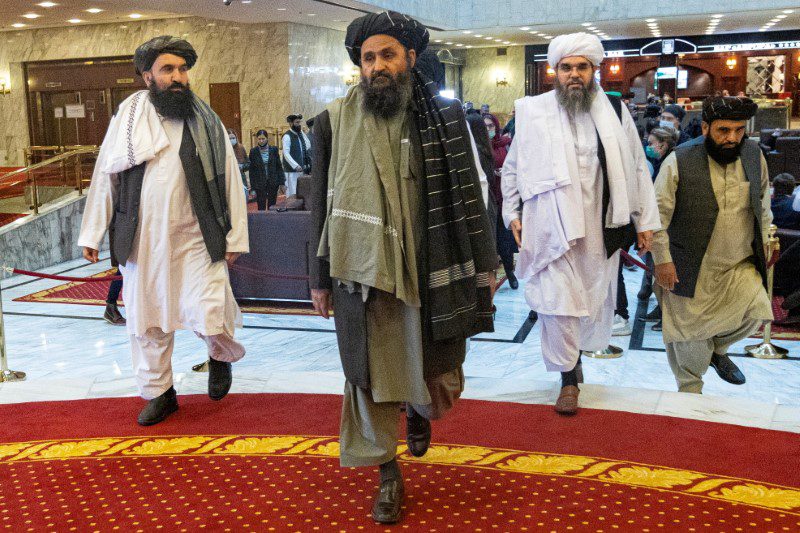
FILE PHOTO: Mullah Abdul Ghani Baradar, the Taliban’s deputy leader and negotiator, and other delegation members attend the Afghan peace conference in Moscow, Russia March 18, 2021. Alexander Zemlianichenko/Pool via REUTERS/File Photo
The social media giants are stepping up their protection efforts of users in Afghanistan
Facebook, Twitter and LinkedIn have confirmed they had moved to secure the accounts of Afghan citizens to protect them against being targeted amid the Taliban’s swift takeover of the country.
Head of security policy at Facebook, Nathaniel Gleicher stated in a tweet that Facebook has temporarily removed the ability for people to view or search the friends lists of accounts in Afghanistan.
Gleicher also stated that the company had launched a “one-click tool” for users in Afghanistan to lock down their accounts, so people who are not their Facebook friends would be unable to see their timeline posts or share their profile photos.
The Taliban has slammed social media giant Facebook over protections on freedom of speech
The militant group has taken aim at the tech giant for curbing freedom of speech in Afghanistan following a ban on its content, as a result of the crackdown by the US firm.
Reports claim that while answering a question on freedom of speech at a virtual press conference, Taliban spokesperson Suhail Shaheen stated that, “The question should be asked to those people who are claiming to be promoters of freedom of speech who do not allow publication of all information.. the Facebook company, this question should be asked to them.”
On Monday, Facebook confirmed that under the obligation of US law, it was bound to ban the outfit’s content from its social media platforms, including WhatsApp, as the Taliban are designated a terrorist group.
China slaps 55% tariff on Australian beef as trade and geopolitical tensions rise
China has imposed a 55% tariff on Australian beef imports that exceed quota limits, a move that threatens more than $1 billion in annual trade and has reignited tensions between Canberra and Beijing. The restrictions, effective from January 1 for three years, cap Australia’s beef quota at 205,000 tonnes—below the volume China imported in 2024—prompting industry claims the decision undermines the spirit of the China-Australia Free Trade Agreement.
Calm fears
Beef producers warn the impact could be severe, with exports to China potentially falling by as much as one-third compared to 2025 levels. Industry groups say the move advantages rival exporters, with Brazil and Argentina receiving far larger quotas, raising concerns Australia could permanently lose market share in a key global market. Prime Minister Anthony Albanese has sought to calm fears, saying Australia is not being singled out and describing the beef sector as the strongest it has ever been.
The tariff decision comes against the backdrop of growing geopolitical strain, days after Australia criticised China’s “Justice Mission 2025” military drills near Taiwan as destabilising. Opposition figures are urging the government to leverage diplomatic ties with President Xi Jinping to ensure Australia is not swept up in broader trade retaliation, as industry calls mount for urgent talks to stabilise relations.
Where to switch off, reset and travel well for a week
For executives in their 40s, travel has shifted. It is less about ticking off sights and more about space, comfort and coming back sharper than when you left.
In 2026, the most appealing one-week holidays are destinations that combine calm, quality and a sense of being ahead of the curve.
For executives, switching off from work is essential, but true rest comes from being gently engaged rather than completely idle.
The most rewarding breaks offer just enough stimulation, culture, nature or conversation, to quiet the mind without replacing one form of busyness with another.
Here are five global locations quietly rising to the top of travel wish lists.
East Coast Barbados
Barbados has long been associated with polished beach holidays, but the east coast offers something different.
Wild Atlantic surf, boutique retreats and fewer crowds create a slower rhythm that suits travellers who want proper rest without sacrificing style.
Days are spent between long coastal walks, ocean-facing spas and unhurried dinners, with just enough local culture to keep things interesting.
Barbados: Book a holiday package (flights + hotel) to Barbados here.
Phu Quoc
Vietnam’s largest island is emerging as a refined alternative to more established Asian beach destinations.
Phu Quoc blends thoughtful luxury with a grounded, local feel. Resorts are discreet rather than flashy, wellness is taken seriously, and the pace encourages doing very little very well.
It is an easy week of warm water swims, exceptional food and genuine mental downtime.
Phu Quoc, Vietnam: Find holiday packages and deals for Phu Quoc here.
Peloponnese
For travellers who want culture without crowds, the Peloponnese is becoming Greece’s most compelling region.
Ancient ruins sit alongside olive groves, quiet beaches and wellness-focused resorts designed for long lunches and early nights.
It offers the Mediterranean experience executives love, without the intensity of Santorini or Mykonos.
Peloponnese, Greece: Browse and book Peloponnese holiday packages with flights and hotels here.
The Red Sea
Saudi Arabia’s Red Sea coast is one of the most ambitious luxury travel projects in the world.
Opening progressively through 2025 and 2026, it promises adults-focused resorts built around sustainability, privacy and high-end wellness.
For those seeking something genuinely new, this is a destination that feels exclusive, restorative and future-facing.
Red Sea Coast (gateway for Red Sea resorts): Book a Red Sea Coast holiday package (flight + hotel) here.
Margaret River
Margaret River continues to refine its appeal for travellers who value space and quality. World-class wineries, dramatic coastline and understated luxury accommodation make it ideal for a reset without jet lag.
It is a reminder that a great week away does not need excess. It needs good food, good wine and room to breathe.
In 2026, the best holidays for executives are not about escape in the dramatic sense. They are about intention. A change of pace, fewer decisions, and environments designed to help you slow down properly. These destinations understand that luxury is not about doing more, but about feeling better when you return.
Margaret River, Western Australia: Find Margaret River holiday packages (accommodation + flight) here.
In Short:
– Iranian President Pezeshkian urged action to meet protesters’ demands amid economic crisis and currency devaluation.
– Protests intensified with shop closures in Tehran, following significant inflation and political unrest after Mahsa Amini’s death.
Iran is grappling with its most severe economic crisis in years. Mass protests erupted across Tehran following the dramatic collapse of the national currency. The rial plunged to 1.42 million against the U.S. dollar over the weekend, briefly recovering to 1.38 million. This marks a loss of more than two-thirds of its value since 2022.
Annual inflation soared to 42.2 percent in December, with food prices up 72 percent year-on-year. Many Iranians are struggling to make ends meet, fueling public anger and unrest.
In response, Iranian President Masoud Pezeshkian ordered his government to engage directly with protest representatives. Calling the demonstrations “legitimate,” he emphasized the need for reforms in the monetary and banking sectors. Officials announced a dialogue framework to hear the voices of demonstrators.
The unrest coincided with the resignation of Central Bank Governor Mohammad Reza Farzin. Former Economy Minister Abdolnaser Hemmati is set to replace him, signaling possible shifts in economic policy.
Tehran’s commercial districts were paralyzed as shopkeepers in the Grand Bazaar and major streets closed businesses in solidarity. Videos on social media showed crowds chanting slogans as security forces used tear gas to disperse them.
International pressure is also rising. U.S. officials warned they would support action against Iran if the country resumes nuclear or missile development, following recent airstrikes on Iranian facilities.
The World Bank forecasts Iran’s GDP will contract 1.7 percent in 2025 and 2.8 percent in 2026, deepening economic concerns. How the government responds to these protests and reforms its economy may shape the country’s stability in the months ahead.