
News
On Paludan’s Sweden tour – ‘He came again to provoke the everyday immigrant’

Professor of peace and conflict research Ashok Swain says Rasmus Paludan’s controversial stunts in Sweden are a pure political act
Danish politician Rasmus Paludan, member of the far right anti-immigrant and anti-Islam group Stram Kurs (Hard Line), has been organising rallies in Sweden.
Paludan has made inflammatory comments about Muslim’s holy book, Quran including burning it and making threats to burn more copies which has sparked public outrage and protests in Sweden.
Professor Ashok Swain from Uppsala university says Paludan’s actions are purely political and have been “successful in Denmark”, so “now he is trying his luck in Sweden”.
“He came again with the intention of provoking the group of everyday immigrant or the Muslims who are living in this country,” he says.
Paludan is planning to stand in the Sweden elections in September but Swain says the politician “doesn’t have enough required signatures for set”.
He says he is on the Sweden tour to attempt to gain support.
Protests against Paludan turned violent last week with clashes erupting between the protesters and the police. 26 police officers and 14 civilians were injured in the violence with more than 40 arrested.
How did the protests turn violent?
The Sweden police previously said they believed the riots had some criminal gang involvement. 20 vehicles were damaged in the violence and a school was also set on fire in the Malmo region of the country.
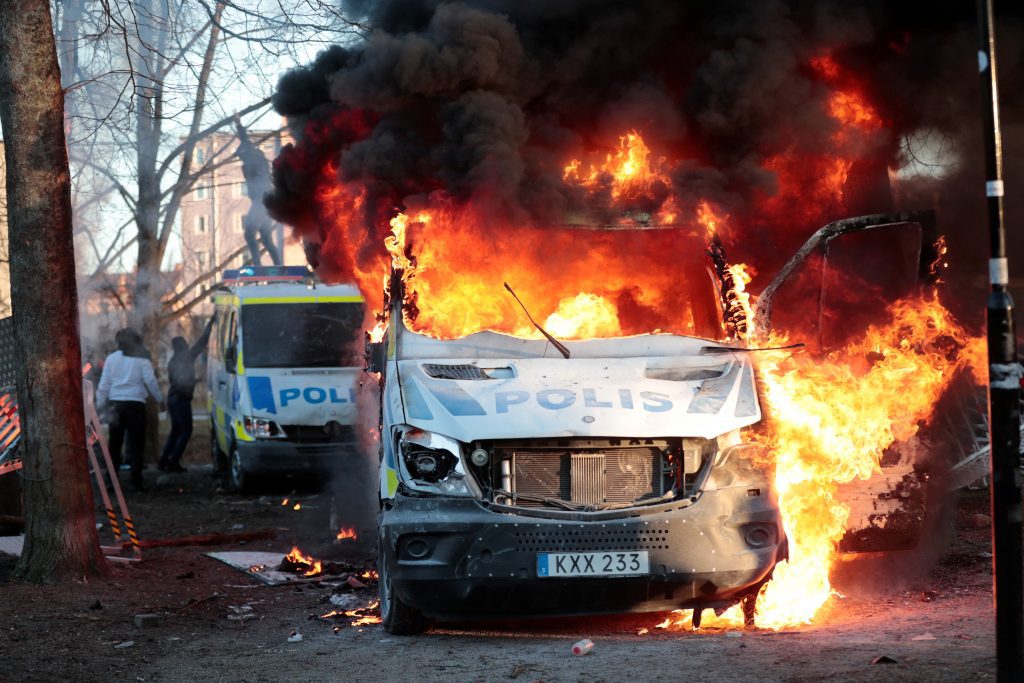
“The question is that, why are these riots not taking place against him or the kind of far right activism but against the state and the police, and particularly the state administrate infrastructure,” Swain says.
Swain raises a question surrounding the involvement of criminal elements, noting they might be taking advantage of these kind of scenarios “where it becomes difficult for the law and order”.
How can violent riots like these be prevented?
Swain gives the responsibility for the prevention to the “cooperation between the state police and the local”.
Swain says that while certain elements have been making law and order difficult, there is a lot to do to get the state and police force to work together.
He mentions the need for the Swedish system to act in a sensitive manner.
“Despite a number of provocations, the reactions of the police force have been quite mild in that sense,” he says.
Are these events an indication of the rise of far right politics in Sweden?
“Sweden was quite late to catch up to the far right politics compared to other parts of Europe,” Swain says.
Swain notes that Sweden has tried to keep the far right politics out of it’s government but there have been recent attempts such as Rasmus Paludan’s Sweden tour ahead of the September elections to gain attention.
Rijul Baath contributed to this report

-
 Shows1 day ago
AI transforms school marketing while preserving human connection
-
News2 days ago
OpenAI safety staffer resigns over culture issues
-
News2 days ago
Lab incident in Russia linked to pneumonia
-
News1 day ago
Wall Street nears record highs, tech stocks rise
-
News2 days ago
Employers warn Labor’s slavery bill harms productivity
-
Money2 days ago
“Extremely Low”: Markets could face a volatility surge
-
News2 days ago
OPEC+ maintains November oil output steady
-
Shows2 days ago
Inside Xiong’an: China’s AI powered city seeks global business