Connect with us
https://tickernews.co/wp-content/uploads/2023/10/AmEx-Thought-Leaders.jpg

News

Joe Biden is President, but America’s democracy is under immense stress

Published

on

A bird’s eye view of Washington, and America’s democracy seems normal

In America, democracy seems to have returned to normal. Joe Biden is president.  Kamala Harris is vice president and Biden’s Cabinet is in place.  He has sent a budget to the Congress.  His emergency pandemic control and economic stimulus program became law.  Vaccinations will soon reach 70 per cent of Americans and the country is open. 

Summer is coming.  The new president’s approval rating is close to 60 per cent.  The press secretary briefs the media every weekday; the press is not referred to as “the enemy of the people.”  Biden and Harris get an intelligence briefing every day.  

When a crisis erupts, as it did in Israel and Gaza two weeks ago, the president attends to it

A ceasefire is agreed on, and is in place.  The Secretary of State visits the region and promotes peace.

“We could be at the end of a major era in Israeli politics”

A normal presidency, yes?  The way it was before Trump, yes?

But, at ground level, there are rifts, fissures, earthquakes.  Hyperpartisanship is at an all-time high.  No Republicans voted for the relief package – although several are claiming credit for what’s in it when they talk to their voters. 

Bipartisan talks on a $2 trillion infrastructure package are close to collapse.  The Senate requires a supermajority of 60 votes to do business, and there are not 10 Republican votes to join with the Senate’s 50 Democrats  to promote voting rights, or gun control, or policing reform, or immigration reform.

Furthermore, on a fundamentally important issue (establishing a special independent commission to examine and report on the insurrection that threatened America’s democracy) there were not 60 votes in the Senate to get it underway.  As was he case with 9/11, the country needs, it deserves, a full examination of the forces unleashed by President Trump that led to that terrible day, and for the country to come to a reckoning with the domestic terrorism threat to America’s democracy.


Underneath these partisan forces in Washington is a political landscape riven with division

“aMERICAN DEMOCRACY IS NOT WORKING’

70 per cent of Republicans believe the 2020 presidential election was stolen from Donald Trump.  50 per cent of Republicans also believe Trump is the legitimate president – and Biden is not.


Those sentiments have triggered politicised  reviews and audits in several states of last November’s vote, and moves in several states, from Georgia to Arizona to Florida and Texas, to enact new laws that make voting much harder, and to depress voter turnout. 

It does not matter if Trump carried states like Texas and Florida; the legislatures there are passing new laws to restrict the ability to vote.


Donald Trump remains the dominant force in the Republican Party. 
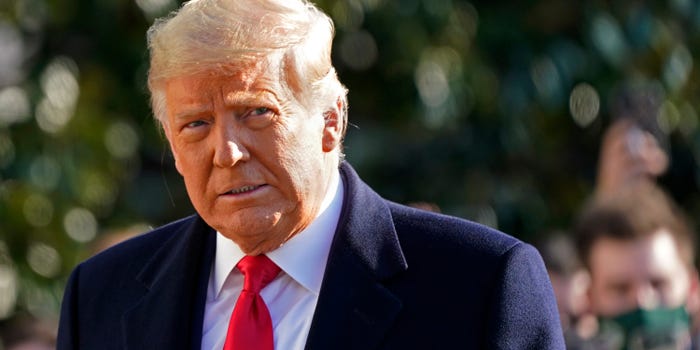
Donald Trump served as the 45th president of the United States from 2017 to 2021.

Members of Congress who question his leadership and what he does are purged from power.  The famous Trump base is intact, agitated and loyal to him.  And fear of those voters, and the threat they pose to any Republican in elected office who dares to break with Trump,  is preventing Republicans in Congress from working with Joe Biden and his program of rebuilding the country.

“tHERE NEEDS TO BE A RECKONING”


This is a difficult moment.  The country is a long way from healing.  How successful Biden will be as president is uncertain.  How empowered the Trump forces will remain is very much in play.  

Currently, at stake are not only the prospects for  domestic tranquility and steady progress towards a more perfect union, but also America’s reputation in a world dominated more and more by the forces of authoritarianism.


And the whole world is watching.

Read more by Bruce Wolpe here.

Bruce Wolpe is a Ticker News US political contributor. He’s a Senior Fellow at the US Studies Centre and has worked with Democrats in Congress during President Barack Obama's first term, and on the staff of Prime Minister Julia Gillard. He has also served as the former PM's chief of staff.

1 Comment

1 Comment

  1. Margaret Vickers

    June 1, 2021 at 8:58 am

    Excellent overview Bruce. Deeply worrying, but current polls show only 25% of voters are Republican, of these 40% agree Biden is President, so crunching the data the proportion comprising Trumps base is about 15% (ref, Heather Cox R).

Leave a Reply

Your email address will not be published. Required fields are marked *

News

China deploys over 100 ICBMs near Mongolia border

China deploys over 100 ICBMs near Mongolia amidst ongoing tensions and lack of arms control talks with the US

Published

on

China deploys over 100 ICBMs near Mongolia amidst ongoing tensions and lack of arms control talks with the US

video
play-sharp-fill
In Short:
– China has deployed over 100 ICBMs in new silos near Mongolia, marking a significant nuclear expansion.
– Beijing aims to enhance military strategies for Taiwan by 2027, potentially affecting U.S. operations in the region.

China has deployed over 100 solid-fueled intercontinental ballistic missiles (ICBMs) in newly constructed silo fields near its border with Mongolia, according to a draft Pentagon report reviewed by Reuters.This marks the most significant nuclear expansion by Beijing to date. The United States indicates that China shows no intention of engaging in arms control negotiations, despite President Trump’s calls for denuclearization talks with both China and Russia.

The report states that the DF-31 missiles, which have a range of 7,000 to 11,700 kilometers, are positioned across three silo fields. While the Pentagon had previously acknowledged these fields, this is the first confirmation of the number of deployed missiles.

China’s nuclear warhead stockpile was estimated at around 600 in 2024. The report projects an increase to over 1,000 warheads by 2030. It highlights a lack of willingness from Beijing to pursue arms control measures.

Beijing has dismissed such reports as attempts to discredit China and claims that it follows a nuclear strategy of self-defense with a no-first-use policy.

Forceful means

The Pentagon assessment indicates that China plans to be capable of fighting and winning a conflict over Taiwan by 2027. Beijing is reportedly enhancing military strategies to capture the island through forceful means.

These military strikes could potentially disrupt U.S. operations in the Asia-Pacific region.

Neither the Pentagon nor China’s embassy in Washington responded to requests for comment. U.S. officials cautioned that the draft report could change before its formal submission to lawmakers.


Download the Ticker app

Continue Reading

News

Global race for AI infrastructure amid soaring energy costs

Japan invests ¥1 trillion in AI infrastructure amid global tech race as energy costs and concerns rise

Published

on

Japan invests ¥1 trillion in AI infrastructure amid global tech race as energy costs and concerns rise

video
play-sharp-fill
In Short:
– Japan plans to invest ¥1 trillion in domestic AI to enhance infrastructure and compete globally.
– China is focusing on technological independence as domestic chipmakers prepare for public offerings.

Japan plans to invest ¥1 trillion ($6.34 billion) over five years in a domestic artificial intelligence company. This initiative aims to build infrastructure for AI, despite rising electricity costs raising concerns about the industry’s sustainability.The government will collaborate with SoftBank Group and Preferred Networks to develop the largest foundation model in Japan, employing around 100 engineers to compete globally. This effort reflects worries about the risks of relying on foreign AI technology.

China is also increasing its focus on technological independence. Domestic chipmakers are preparing for public offerings to enhance their capabilities, following successful launches by Moore Threads and MetaX in Shanghai. Companies such as Biren Technology and Baidu’s Kunlunxin are also planning to go public.

SoftBank is pursuing a $22.5 billion funding commitment to OpenAI by year-end, by selling assets and securing loans. CEO Masayoshi Son’s significant investment signifies a strong commitment to AI infrastructure.

AI Infrastructure

The rapid expansion of data centers is putting pressure on energy resources. Projections suggest data centers will consume 945 terawatt-hours by 2030, nearly tripling from 415 TWh in 2024. In the U.S., energy use by data centers could reach 9% to 12% of total supply by 2028.

Concerns have arisen over whether tech companies’ activities are raising residential electricity costs, with investigations launched by three Democratic senators targeting major companies like Alphabet, Microsoft, and Amazon. Utilities face significant expenses to upgrade grids, which may be passed on to consumers.

The energy demand is benefiting companies that supply power infrastructure. Jefferies recently upgraded GE Vernova to Buy, citing expected growth in gas pricing and long-term service demand amid rising energy needs.


Download the Ticker app

Continue Reading

News

Australia’s property market set to soar in 2026

Australia’s property market is set for strong growth in 2026, driven by demand and strategic investments across key regions.

Published

on

Australia’s property market is set for strong growth in 2026, driven by demand and strategic investments across key regions.


Australia’s property market is predicted to perform strongly in 2026, with no major losers expected as demand and prices rise across 14 key regions. Hotspotting’s latest analysis highlights which areas are set to shine and the factors driving this unprecedented growth.

Join Tim Graham from Hotspotting as he explains the methodology behind the price predictions and why infrastructure investments and government policies are playing a key role in shaping the market.

From regional hotspots to major cities, we explore emerging trends, buyer behavior, and the outlook for places like Darwin and Perth. Whether you’re a first home buyer or seasoned investor, this episode is packed with insights to navigate Australia’s booming property landscape.

Subscribe to never miss an episode of Ticker – https://www.youtube.com/@weareticker

#AustraliaProperty #PropertyMarket2026 #Hotspotting #RealEstateTrends #HousingMarket #InvestingAustralia #PropertyGrowth #FirstHomeBuyers


Download the Ticker app

Continue Reading

Trending Now