

Connect with us
https://tickernews.co/wp-content/uploads/2023/10/AmEx-Thought-Leaders.jpg

Ticker Views

Global power struggles and Arctic shipping risks

Published

on

Global power struggles over the ocean’s finite resources call for creative diplomacy

Jonas Gamso, Arizona State University and Hossain Ahmed Taufiq, Arizona State University

Oceans shape everyday life in powerful ways. They cover 70% of the planet, carry 90% of global trade, and support millions of jobs and the diets of billions of people. As global competition intensifies and climate change accelerates, the world’s oceans are also becoming the front line of 21st-century geopolitics.

How policymakers handle these challenges will affect food supplies, the price of goods and national security.

Right now, international cooperation is under strain, but there are many ways to help keep the peace. The tools of diplomacy range from formal international agreements, like the High Seas Treaty for protecting marine life, which goes into effect on Jan. 17, 2026, to deals between countries, to efforts led by companies, scientists and issue-focused organizations.

Examples of each can be found in how the world is dealing with rising tensions over Arctic shipping, seafloor mining and overfishing. As researchers in international trade and diplomacy at Arizona State University in the Thunderbird School of Global Management’s Ocean Diplomacy Lab, we work with groups affected by ocean pressures like these to identify diplomatic tools – both inside and outside government – that can help avoid conflict.

Arctic shipping: New sea lanes, new risks

As the Arctic Ocean’s sea ice cover diminishes, shipping routes that were once impassable most of the year are opening up.

For companies, these routes – such as the Northern Sea Route along Russia’s coast and the Northwest Passage through Canada’s Arctic Archipelago – promise shorter transit times, lower fuel costs and fewer choke points than traditional passages.

However, Arctic shipping also raises complex challenges.
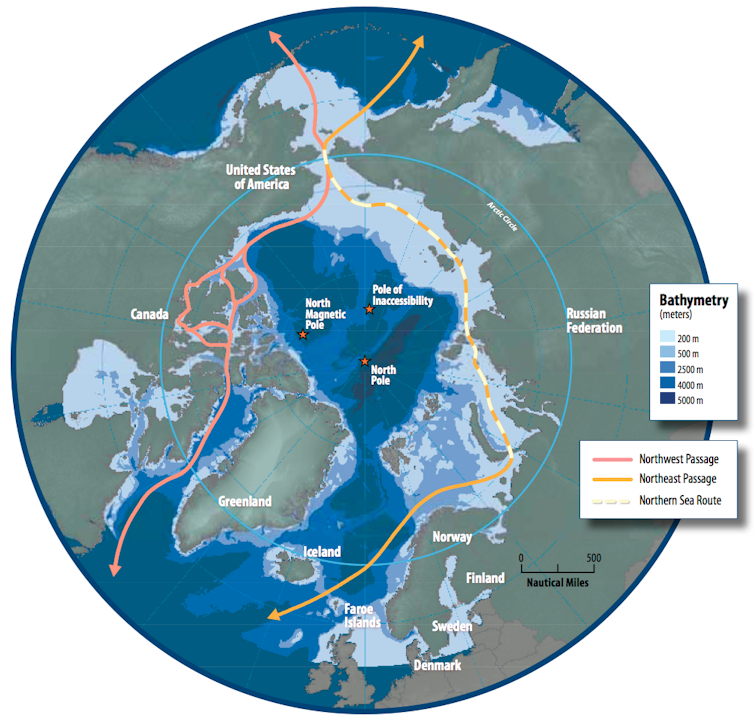
Declining sea ice is opening two shipping routes to greater use: the Northern Sea Route, off the Russian coast, and the Northwest Passage, along Alaska’s coast and through the Canadian islands.
Susie Harder/Arctic Council

The U.S., Russia, China and several European countries have each taken steps to establish an economic and military presence in the Arctic Ocean, often with overlapping claims and competing strategic aims. For example, Russia closed off access to much of the Barents Sea while it conducted missile tests near Norway in 2025. NATO has also been patrolling the same sea.

Geopolitical tensions compound the practical dangers in Arctic waters that are poorly charted, where emergency response capacity is limited and where extreme weather is common.

As more commercial vessels move through these waters, a serious incident – whether triggered by a political confrontation or weather – could be difficult to contain and costly for marine ecosystems and global supply chains.

A fleet of military ships at dusk with mountains in the background.
German Naval vessels sail near Harstad, Norway, during Arctic exercises on Oct. 13, 2025.
Sean Gallup/Getty Images

The Arctic Council is the region’s primary official forum for the Arctic countries to work together, but it is explicitly barred from addressing military and security issues – the very pressures now reshaping Arctic shipping.

The council went dormant for over a year starting in 2022 after Russia, then the Arctic Council president, invaded Ukraine. While meetings and projects involving the remaining countries have since resumed, the council’s influence has been undercut by unilateral moves by the Trump administration and Russia, and bilateral arrangements between countries, including Russia and China, often involving access to oil, gas and critical mineral deposits.

In this context, Arctic countries can strengthen cooperation through other channels. An important one is science.

For decades, scientists from the U.S., Europe, Russia and other countries collaborated on research related to public safety and the environment, but Russia’s invasion of Ukraine disrupted those research networks.

Going forward, countries could share more data on ice thaw, extreme weather and emergency response to help prevent accidents in a rapidly opening shipping corridor.

An image of the Arctic shows sea ice concentrations in 2025 were less than the 20-year average, and much less than the 20 years before then.
Arctic sea ice has been declining, with less multiyear ice and less coverage. The map shows the Arctic sea ice at its minimum extent in 2025, in September.
NOAA and CIRES/University of Colorado Boulder.

Critical minerals: Control over the seabed

The global transition to clean energy is driving demand for critical minerals, such as nickel, cobalt, manganese and rare earth elements, that are essential for everything from smartphones and batteries to fighter jets. Some of the world’s largest untapped deposits lie deep below the ocean’s surface, in places like the Clarion-Clipperton Zone near Hawaii in the Pacific. This has sparked interest from governments and corporations in sea floor mining.

Harvesting critical minerals from the seabed could help meet demand at a time when China controls much of the global critical mineral supply. But deep-sea ecosystems are poorly understood, and disruptions from mining would have unknown consequences for ocean health. Forty countries now support either a ban or a pause on deep sea mining until the risks are better understood.

These concerns sit alongside geopolitical tensions: Most deep-sea minerals lie in international waters, where competition over access and profits could become another front in global rivalry.

A map shows one area where companies are interested in mining.
A map of the Pacific Ocean between Mexico and Hawaii shows exploration targets for mining seafloor nodules that contain critical minerals in the Clarion-Clipperton Zone. National waters are shown in blue. The striped APEI squares are protected areas.
KA McQuaid, MJ Attrill, MR Clark, A Cobley, AG Glover, CR Smith and KL Howell, 2020, CC BY

The International Seabed Authority was created under the United Nations Convention on the Law of the Sea to manage seabed resources, but its efforts to establish binding mining rules have stalled. The U.S. never ratified the convention, and the Trump administration is now trying to fast-track its own permits to circumvent the international process and accelerate deep-sea mining in areas that are outside national jurisdictions.

Against this backdrop, a loose coalition of issue-focused groups and companies have joined national governments in calling for a pause on deep-sea mining. At the same time, some insurers have declined to insure deep-sea mining projects.

A visualization of deep-sea mining and the debris clouds created that could harm sea life.

Pressure from outside groups will not eliminate competition over seabed resources, but it can shape behavior by raising the costs of moving too quickly without carefully evaluating the risks. For example, Norway recently paused deep-sea mining licenses until 2029, while BMW, Volvo and Google have pledged not to purchase metals produced from deep-sea mines until environmental risks are better understood.

Overfishing: When competition outruns cooperation

Fishing fleets have been ranging farther and fishing longer in recent decades, leading to overfishing in many areas. For coastal communities, the result can crash fish stocks, threatening jobs in fishing and processing and degrading marine ecosystems, which makes coastal areas less attractive for tourism and recreation. When stocks decline, seafood prices also rise.

Unlike deep-sea mining or Arctic shipping, overfishing is prompting cooperation on many levels.

In 2025, a critical mass of countries ratified the High Seas Treaty, which sets out a legal framework for creating marine protected areas in international waters that could give species a chance to recover. Meanwhile, several countries have arrangements with their neighbors to manage fishing together.

For example, the European Union and U.K. are finalizing an agreement to set quotas for fleets operating in waters where fish stocks are shared. Likewise, Norway and Russia have established annual quotas for the Barents Sea to try to limit overfishing. These government-led efforts are reinforced by other forms of diplomacy that operate outside government.

Market-based initiatives like the Marine Stewardship Council certification set common sustainability standards for fishing companies to meet. Many major retailers look for that certification when making purchases. Websites like Global Fishing Watch monitor fishing activity in near real time, giving governments and advocacy groups data for action.

Collectively, these efforts make it harder for illegal fishing to hide.

How well countries are able to work together to update quotas, share data and enforce rules as warming oceans shift where fish stocks are found and demand continues to grow will determine whether overfishing can be stopped.

Looking Ahead

At a time when international cooperation is under strain, agreements between countries and pressure from companies, insurers and issue-focused groups are essential for ensuring a healthy ocean for the future.The Conversation

Jonas Gamso, Associate Professor and Deputy Dean of Knowledge Enterprise for the Thunderbird School of Global Management, Arizona State University and Hossain Ahmed Taufiq, Postdoctoral Fellow of Ocean Diplomacy and Leadership, Arizona State University

This article is republished from The Conversation under a Creative Commons license. Read the original article.


Ticker Views

Right turn ahead. But where are the Liberals really going?

Published

on

The Liberal Party’s decision to elevate Angus Taylor marks more than a routine leadership change.

It signals a strategic wager: that repositioning toward the right can arrest electoral decline, rebuild identity, and reconnect with voters who feel politically homeless.

For many Australians, this shift will feel both familiar and uncertain.

Familiar, because the Liberal Party has historically balanced economic liberalism with selective appeals to conservative instincts. Uncertain, because the political environment confronting Taylor is vastly different from the one navigated by John Howard or Tony Abbott. Voters are more fragmented. Trust in institutions is more fragile. Cost-of-living pressures dominate kitchen-table conversations. And the party itself is divided over what it stands for.

At its core, Taylor’s leadership represents the conservative wing’s argument that clarity beats ambiguity.

After the Coalition’s bruising defeats and what many supporters viewed as an uninspiring performance under Peter Dutton, conservatives have effectively declared: this is the direction, and this is the test. If a more explicitly right-leaning Liberal leader cannot regain ground, deeper structural questions about the party’s future become unavoidable.

History is calling

Yet history offers a cautionary lesson.

The most electorally successful Liberal eras were rarely defined by ideological purity. Howard, often remembered for cultural conservatism and strong borders rhetoric, governed primarily through economic management, fiscal discipline, and structural reform. He put his Prime Ministership on the line over and over again. His political success came from persuading Labor voters that the Liberals were the safer custodians of prosperity, not from positioning the party at the ideological edges.

Howard’s battlers were people who had been left behind by Labor’s transformative years.

Importantly, political rhetoric and governing reality have never perfectly aligned.

Howard’s pre-1996 scepticism about aspects of globalisation did not prevent Australia’s continued embrace of foreign investment and economic integration. Abbott’s emphasis on border control did not redefine the broader economic consensus. Governments, regardless of campaign tone, tend to bend toward economic necessity.

Three year election cycles push candidates towards making promises they can’t keep, and the last election became a spending spree to essentially buy votes. But who pays the bill?

That question remains the defining constraint today.

In politics, either they’re in crisis, or you’re in crisis. The art is to create the circumstances where they’re tearing themselves apart.

We want everything

Across advanced Western economies, rising social expenditure, ageing populations, and productivity challenges are placing immense pressure on public finances. Migration, taxation, and growth are no longer abstract policy debates; they are mathematical realities. Governments require revenue. Economies require expansion. Voters demand services, and they want to use their Medicare card, not their credit card.

Australia’s paradox is particularly striking.

Despite extraordinary natural resource wealth, Australians shoulder relatively high income taxes to sustain public services expected of a modern developed nation. Comparisons with low-tax resource states overlook critical differences in governance models, demographics, and institutional structures. Still, the underlying voter frustration is real: people feel they are paying more while their living standards feel squeezed.

Along comes Taylor

This is where Taylor’s leadership will be tested most severely.

Not on slogans about ideology, but on economic credibility. He is, after all, a Rhodes Scholar.

For voters in their 30s and 40s, professionals, small business owners, tradespeople, families balancing mortgages and school fees, politics is increasingly filtered through lived experience. Grocery bills. Power prices. Housing affordability. Business viability. Opportunity. Risk.

These voters are rarely ideological warriors.

They are pragmatic. They value free enterprise and economic stability. They believe in personal responsibility but also expect functioning healthcare, infrastructure, and social safety nets. They are patriotic without being insular. Globally minded without being detached from local concerns.

Many of them feel underrepresented.

Labor often feels culturally distant. The Liberals often feel strategically confused. The Teals attract slices of urban discontent but do not offer a comprehensive alternative. Minor parties channel protest but rarely deliver governing pathways.

While the Greens and One Nation recognise the problems, can they offer solutions? 

The rise of parties like One Nation reflects less a wholesale ideological shift than a hunger for perceived conviction. Voters may not agree with every position, but they respond to parties that firmly stand for something.

Liberal question

The Liberal Party’s mission is different to One Nation’s. It must stand for something credible, not merely something loud. Howard, Thatcher and Regan could all stand in the loudest room, being shouted at and abused, and calmly provided an answer.

If Taylor’s leadership becomes defined primarily by trying to win back One Nation votes, the party risks reinforcing perceptions that it is speaking to narrower constituencies rather than the economic anxieties of the mainstream.

Australians  are fed up, but voters usually make a decision on “the best of a bad bunch”. So if Taylor anchors his agenda in growth, opportunity, tax reform, business confidence, and stable government, the party may rediscover its traditional electoral advantage. Albanese’s government to his credit has been without the dramas of the Rudd/Gillard or Abbott/Turnbull/Morrison years. When Labor looks stable, the conservatives have a problem.

The uncomfortable reality is this:

Governments are ultimately judged on economic outcomes and house prices. While the media seems to want house prices to fall, the millions of people who own houses want prices to go up. Their house is their number one asset, so why wouldn’t they?

Australians are living through a period of persistent financial unease. Inflationary pressures, housing stress, and business closures have created a pervasive sense that the system is under strain. Voters do not need theoretical debates about ideology. They want explanations that match what their eyes can see.

Here are some questions to answer:

Why does migration feel disconnected from personal economic improvement?

Why do higher taxes not translate into improved services?

Why do energy transitions cost so much yet we are extending the life of coal power plants?

Why do I pay for healthcare yet my private health insurance keeps going up?

Why has Australia spent so much money on defence projects that never seem to materialise?

These are not fringe questions. They are mainstream concerns about the federal government.

The opportunity for Taylor is standing right there. Just provide an answer to those questions.

A centre-right leader who articulates a coherent economic narrative, one that acknowledges voter frustrations without retreating into simplistic solutions, could find receptive audiences across metropolitan and regional Australia alike.

The bigger problem

But leadership alone cannot solve structural problems.

The Liberal Party must also confront its internal identity crisis. A party caught between traditional conservatives, economic liberals, and socially moderate urban voters cannot thrive without reconciling competing visions. Electoral recovery requires not just a new leader, but a renewed sense of purpose.

This is nothing new. Jeff Kennett papered over the cracks of the Victorian Liberals, and John Howard dealt with one disaster after another from within his own party. But that’s where leadership matters most.

Australia, like many Western democracies, is searching for stability in an era of volatility.

Global models offer limited guidance. The UK is in a worse situation than Australia, and the Tories look set to be wiped off the map. Economic headwinds are widespread. Political polarisation is deepening. The appetite for strong leadership is growing, yet so is scepticism toward populism.

Which raises the central question:

Can Angus Taylor provide the kind of leadership that speaks to pragmatic, economically focused Australians who feel increasingly politically adrift? Can he put Australia back on the right course – one that relies on organic growth rather than artificial growth spurred by high government spending?

The answer will not be found in ideology alone.

It will be found in whether the Liberal Party can once again convince voters that it understands their lives, their pressures, and their aspirations, wherever they live, and has a credible plan to improve them.

Continue Reading

Ticker Views

Should the Winter Olympics be behind a paywall?

Exploring Olympic access challenges: rising sports rights, paywalls, and the impact on viewers with Darren Woolley.

Published

on

Exploring Olympic access challenges: rising sports rights, paywalls, and the impact on viewers with Darren Woolley.


The Winter Olympics are a global sporting spectacle, but should access to these events come at a cost? Rising sports rights and paywalls have left many viewers wondering how far is too far.

Darren Woolley from TrinityP3 joins Ticker to discuss the implications for fans and the broadcasting landscape.

We explore the current broadcasting regulations, the impact of paywalls on viewers, and the role of Anti-Siphoning laws in protecting free access to major events. Darren shares insights into how these policies affect the public and what changes could make Olympic coverage more accessible.

From commercial pressures to public expectations, the conversation delves into the balance between profit and access. Darren also highlights challenges in advocating for fair broadcasting practices and the conversations happening with regulators like the Australian Communications and Media Authority.

Subscribe to never miss an episode of Ticker – https://www.youtube.com/@weareticker

#WinterOlympics #SportsBroadcasting #PaywallDebate #AntiSiphoning #OlympicAccess #TickerTalks #SportsRights #DarrenWoolley


Download the Ticker app

Continue Reading

Ticker Views

Lunar Gateway faces delays and funding debate amid Artemis ambitions

Published

on

What’s the point of a space station around the Moon?

Berna Akcali Gur, Queen Mary University of London

The Lunar Gateway is planned space station that will orbit the Moon. It is part of the Nasa‑led Artemis programme. Artemis aims to return humans to the Moon, establishing a sustainable presence there for scientific and commercial purposes, and eventually reach Mars.

However, the modular space station now faces delays, cost concerns and potential US funding cuts. This raises a fundamental question: is an orbiting space station necessary to achieve lunar objectives, including scientific ones?

The president’s proposed 2026 budget for Nasa sought to cancel Gateway. Ultimately, push back from within the Senate led to continued funding for the lunar outpost. But debate continues among policymakers as to its value and necessity within the Artemis programme.

Cancelling Gateway would also raise deeper questions about the future of US commitment to international cooperation within Artemis. It would therefore risk eroding US influence over global partnerships that will define the future of deep space exploration.

Gateway was designed to support these ambitions by acting as a staging point for crewed and robotic missions (such as lunar rovers), as a platform for scientific research and as a testbed for technologies crucial to landing humans on Mars.

It is a multinational endeavour. Nasa is joined by four international partners, the Canadian Space Agency, the European Space Agency (Esa), the Japan Aerospace Exploration Agency and the United Arab Emirates’ Mohammed Bin Rashid Space Centre.

Schematic of the Lunar Gateway.
The Lunar Gateway.
Nasa

Most components contributed by these partners have already been produced and delivered to the US for integration and testing. But the project has been beset by rising costs and persistent debates over its value.

If cancelled, the US abandonment of the most multinational component of the Artemis programme, at a time when trust in such alliances is under unprecedented strain, could be far reaching.

It will be assembled module by module, with each partner contributing components and with the possibility of additional partners joining over time.

Strategic aims

Gateway reflects a broader strategic aim of Artemis, to pursue lunar exploration through partnerships with industry and other nations, helping spread the financial cost – rather than as a sole US venture. This is particularly important amid intensifying competition – primarily with China.

China and Russia are pursuing their own multinational lunar project, a surface base called the International Lunar Research Station. Gateway could act as an important counterweight, helping reinforce US leadership at the Moon.

In its quarter-century of operation, the ISS has hosted more than 290 people from 26 countries, alongside its five international partners, including Russia. More than 4,000 experiments have been conducted in this unique laboratory.

In 2030, the ISS is due to be succeeded by separate private and national space stations in low Earth orbit. As such, Lunar Gateway could repeat the strategic, stabilising role among different nations that the ISS has played for decades.

However, it is essential to examine carefully whether Gateway’s strategic value is truly matched by its operational and financial feasibility.

It could be argued that the rest of the Artemis programme is not dependant on the lunar space station, making its rationales increasingly difficult to defend.

Some critics focus on technical issues, others say the Gateway’s original purpose has faded, while others argue that lunar missions can proceed without an orbital outpost.

Sustainable exploration

Supporters counter that the Lunar Gateway offers a critical platform for testing technology in deep space, enabling sustainable lunar exploration, fostering international cooperation and laying the groundwork for a long term human presence and economy at the Moon. The debate now centres on whether there are more effective ways to achieve these goals.

Despite uncertainties, commercial and national partners remain dedicated to delivering their commitments. Esa is supplying the International Habitation Module (IHAB) alongside refuelling and communications systems. Canada is building Gateway’s robotic arm, Canadarm3, the UAE is producing an airlock module and Japan is contributing life support systems and habitation components.

Gateway’s Halo module at a facility in Arizona operated by aerospace company Northrop Grumman.
Nasa / Josh Valcarcel

US company Northrop Grumman is responsible for developing the Habitat and Logistics Outpost (Halo), and American firm Maxar is to build the power and propulsion element (PPE). A substantial portion of this hardware has already been delivered and is undergoing integration and testing.

If the Gateway project ends, the most responsible path forward to avoid discouraging future contributors to Artemis projects would be to establish a clear plan to repurpose the hardware for other missions.

Cancellation without such a strategy risks creating a vacuum that rival coalitions, could exploit. But it could also open the door to new alternatives, potentially including one led by Esa.

Esa has reaffirmed its commitment to Gateway even if the US ultimately reconsiders its own role. For emerging space nations, access to such an outpost would help develop their capabilities in exploration. That access translates directly into geopolitical influence.

Space endeavours are expensive, risky and often difficult to justify to the public. Yet sustainable exploration beyond Earth’s orbit will require a long-term, collaborative approach rather than a series of isolated missions.

If the Gateway no longer makes technical or operational sense for the US, its benefits could still be achieved through another project.

This could be located on the lunar surface, integrated into a Mars mission or could take an entirely new form. But if the US dismisses Gateway’s value as a long term outpost without ensuring that its broader benefits are preserved, it risks missing an opportunity that will shape its long term influence in international trust, leadership and the future shape of space cooperation.The Conversation

Berna Akcali Gur, Lecturer in Outer Space Law, Queen Mary University of London

This article is republished from The Conversation under a Creative Commons license. Read the original article.

Continue Reading

Trending Now