
Connect with us
https://tickernews.co/wp-content/uploads/2023/10/AmEx-Thought-Leaders.jpg

News

European leaders visit Ukraine in show of support

Published

on

The leaders of Europe’s three largest economies – French President Macron, Germany’s Chancellor Olaf Scholz and Italy’s Prime Minister Mario Draghi have each voiced support to Ukraine joining the European Union during a joint visit to Kyiv

The leaders agree the war-torn nation should get “immediate” candidate status, but in reality, this is just the start of a lengthy membership process.

Ukraine’s candidacy will need to be agreed on by all 27 of the EU’s member states, and this could happen during an EU summit on June 23.

A negotiation stage would follow, in which the nation could be asked to implement reforms, such as stamping out corruption.

Meanwhile, Ukraine’s deputy prime minister says while warm scenes during the visit represent an “historic breakthrough” – she also warns Western countries have shown a “gap between promises and actions” in the past.

Kyiv hopes their visit brings concrete action

All three leaders are seeking to overcome Ukraine’s criticism of their response to its fight against Russia’s invasion.

Irpin was one of the main hotspots of fighting with Russian troops in the north before they pulled back to intensify their offensive in the east.

Ukraine says Russia committed large-scale atrocities here, which Russia denies.

Macron called the town “heroic” and said there were signs war crimes were committed.
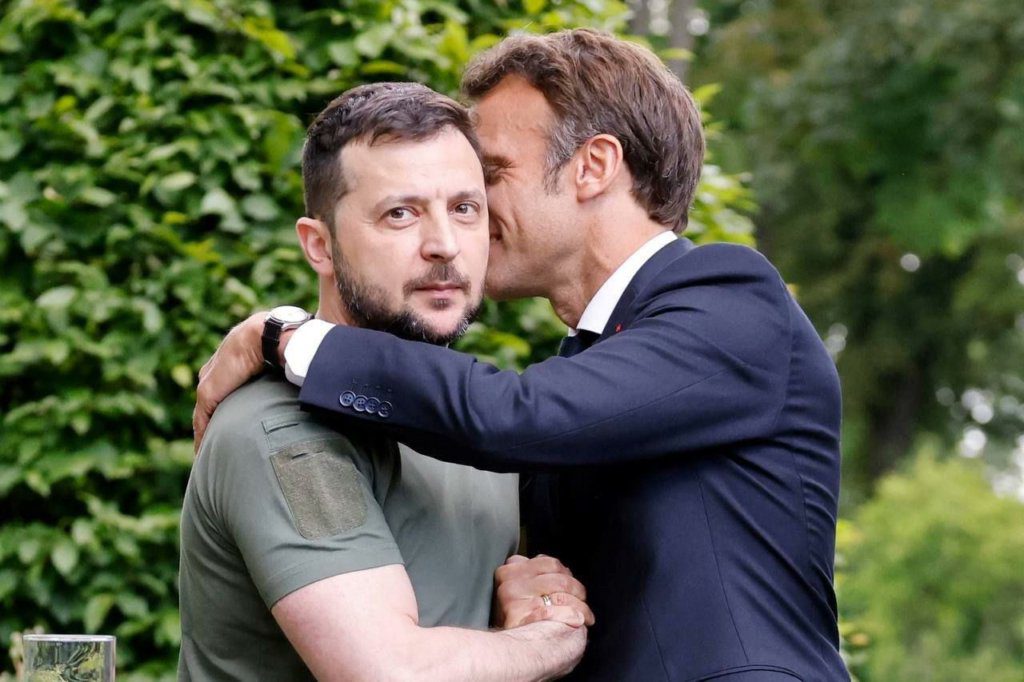
The French president has been criticized at home and abroad for not going to Ukraine earlier. He has repeatedly said he would only go if and when the visit could be “useful” and not just symbolic.

The trio arrived together by train in a show of unified solidarity, but it remains to be seen what concrete steps they bring.

“A message of unity we’re sending to the Ukrainians, yes, of support, to speak about today but also the future because we know the weeks to come will be very difficult.”

Ukrainian President Volodymyr Zelenskiy wants his visitors to deliver more arms to help his hard-pressed army withstand the Russian invaders.

“Every day of delay or delayed decisions is an opportunity for the Russian military to kill Ukrainians or destroy our cities. There is a direct correlation: the more powerful weapons we get, the faster we can liberate our people, our land. Ukrainian people are waiting for liberation of our territory, of Ukraine’s territory.”

Kyiv has accused France, Germany and, to a lesser extent, Italy, of foot-dragging: being slow to deliver weapons and putting their own prosperity ahead of Ukraine’s freedom and security.

Ukraine has been particularly critical of Germany’s military aid and wants Scholz to hand over heavy weapons that have been promised but not yet delivered.

Scholz has dismissed allegations he has held back, saying Germany was one of the biggest military and financial backers of Ukraine.

Kyiv officials have also expressed fears of pressure to accept a peace deal favorable to Russia, which calls its invasion a “special military operation”.

The Kremlin said the leaders’ visit shouldn’t only focus on supplying weapons. It’s “absolutely useless,” spokesperson Dmitry Peskov said, and will prolong suffering and cause further damage.

The European Union’s executive is expected to propose on Friday (June 17) that Ukraine become a formal candidate for membership, diplomats and officials say.

That would be a significant political gesture to Ukraine, but it’s also something EU leaders are divided on.

Reuters

William is an Executive News Producer at TICKER NEWS, responsible for the production and direction of news bulletins. William is also the presenter of the hourly Weather + Climate segment. With qualifications in Journalism and Law (LLB), William previously worked at the Australian Broadcasting Corporation (ABC) before moving to TICKER NEWS. He was also an intern at the Seven Network's 'Sunrise'. A creative-minded individual, William has a passion for broadcast journalism and reporting on global politics and international affairs.

News

Australian beef industry warns of major export losses under new China tariff

Published

on

China slaps 55% tariff on Australian beef as trade and geopolitical tensions rise

China has imposed a 55% tariff on Australian beef imports that exceed quota limits, a move that threatens more than $1 billion in annual trade and has reignited tensions between Canberra and Beijing. The restrictions, effective from January 1 for three years, cap Australia’s beef quota at 205,000 tonnes—below the volume China imported in 2024—prompting industry claims the decision undermines the spirit of the China-Australia Free Trade Agreement.

Calm fears

Beef producers warn the impact could be severe, with exports to China potentially falling by as much as one-third compared to 2025 levels. Industry groups say the move advantages rival exporters, with Brazil and Argentina receiving far larger quotas, raising concerns Australia could permanently lose market share in a key global market. Prime Minister Anthony Albanese has sought to calm fears, saying Australia is not being singled out and describing the beef sector as the strongest it has ever been.

The tariff decision comes against the backdrop of growing geopolitical strain, days after Australia criticised China’s “Justice Mission 2025” military drills near Taiwan as destabilising. Opposition figures are urging the government to leverage diplomatic ties with President Xi Jinping to ensure Australia is not swept up in broader trade retaliation, as industry calls mount for urgent talks to stabilise relations.


Download the Ticker app

Continue Reading

News

Five global escapes executives are booking for 2026

Published

on

Where to switch off, reset and travel well for a week

For executives in their 40s, travel has shifted. It is less about ticking off sights and more about space, comfort and coming back sharper than when you left.

In 2026, the most appealing one-week holidays are destinations that combine calm, quality and a sense of being ahead of the curve.

For executives, switching off from work is essential, but true rest comes from being gently engaged rather than completely idle.

The most rewarding breaks offer just enough stimulation, culture, nature or conversation, to quiet the mind without replacing one form of busyness with another.

Here are five global locations quietly rising to the top of travel wish lists.

East Coast Barbados

Barbados has long been associated with polished beach holidays, but the east coast offers something different.

Wild Atlantic surf, boutique retreats and fewer crowds create a slower rhythm that suits travellers who want proper rest without sacrificing style.

Days are spent between long coastal walks, ocean-facing spas and unhurried dinners, with just enough local culture to keep things interesting.

Barbados: Book a holiday package (flights + hotel) to Barbados here.

Phu Quoc

Vietnam’s largest island is emerging as a refined alternative to more established Asian beach destinations.

Phu Quoc blends thoughtful luxury with a grounded, local feel. Resorts are discreet rather than flashy, wellness is taken seriously, and the pace encourages doing very little very well.

It is an easy week of warm water swims, exceptional food and genuine mental downtime.

Phu Quoc, Vietnam: Find holiday packages and deals for Phu Quoc here.

Peloponnese


For travellers who want culture without crowds, the Peloponnese is becoming Greece’s most compelling region.

Ancient ruins sit alongside olive groves, quiet beaches and wellness-focused resorts designed for long lunches and early nights.

It offers the Mediterranean experience executives love, without the intensity of Santorini or Mykonos.

Peloponnese, Greece: Browse and book Peloponnese holiday packages with flights and hotels here.

The Red Sea

Saudi Arabia’s Red Sea coast is one of the most ambitious luxury travel projects in the world.

Opening progressively through 2025 and 2026, it promises adults-focused resorts built around sustainability, privacy and high-end wellness.

For those seeking something genuinely new, this is a destination that feels exclusive, restorative and future-facing.

Red Sea Coast (gateway for Red Sea resorts): Book a Red Sea Coast holiday package (flight + hotel) here.

Margaret River

Margaret River continues to refine its appeal for travellers who value space and quality. World-class wineries, dramatic coastline and understated luxury accommodation make it ideal for a reset without jet lag.

It is a reminder that a great week away does not need excess. It needs good food, good wine and room to breathe.

In 2026, the best holidays for executives are not about escape in the dramatic sense. They are about intention. A change of pace, fewer decisions, and environments designed to help you slow down properly. These destinations understand that luxury is not about doing more, but about feeling better when you return.

Margaret River, Western Australia: Find Margaret River holiday packages (accommodation + flight) here.

Continue Reading

News

Iran’s currency collapse sparks mass protests as inflation spirals

Iran president engages protesters amid economic crisis as currency tumbles and inflation surges

Published

on

Iran’s president engages protesters amid economic crisis as currency tumbles and inflation surges

video
play-sharp-fill
In Short:
– Iranian President Pezeshkian urged action to meet protesters’ demands amid economic crisis and currency devaluation.
– Protests intensified with shop closures in Tehran, following significant inflation and political unrest after Mahsa Amini’s death.

Iran is grappling with its most severe economic crisis in years. Mass protests erupted across Tehran following the dramatic collapse of the national currency. The rial plunged to 1.42 million against the U.S. dollar over the weekend, briefly recovering to 1.38 million. This marks a loss of more than two-thirds of its value since 2022.

Annual inflation soared to 42.2 percent in December, with food prices up 72 percent year-on-year. Many Iranians are struggling to make ends meet, fueling public anger and unrest.

In response, Iranian President Masoud Pezeshkian ordered his government to engage directly with protest representatives. Calling the demonstrations “legitimate,” he emphasized the need for reforms in the monetary and banking sectors. Officials announced a dialogue framework to hear the voices of demonstrators.

The unrest coincided with the resignation of Central Bank Governor Mohammad Reza Farzin. Former Economy Minister Abdolnaser Hemmati is set to replace him, signaling possible shifts in economic policy.

Tehran’s commercial districts were paralyzed as shopkeepers in the Grand Bazaar and major streets closed businesses in solidarity. Videos on social media showed crowds chanting slogans as security forces used tear gas to disperse them.

International pressure is also rising. U.S. officials warned they would support action against Iran if the country resumes nuclear or missile development, following recent airstrikes on Iranian facilities.

The World Bank forecasts Iran’s GDP will contract 1.7 percent in 2025 and 2.8 percent in 2026, deepening economic concerns. How the government responds to these protests and reforms its economy may shape the country’s stability in the months ahead.


Download the Ticker app

Continue Reading

Trending Now