

Connect with us
https://tickernews.co/wp-content/uploads/2023/10/AmEx-Thought-Leaders.jpg

Ticker Views

Hope and hardship have driven Syrian refugee returns – but many head back to destroyed homes, land disputes

Published

on

Hope and hardship have driven Syrian refugee returns – but many head back to destroyed homes, land disputes

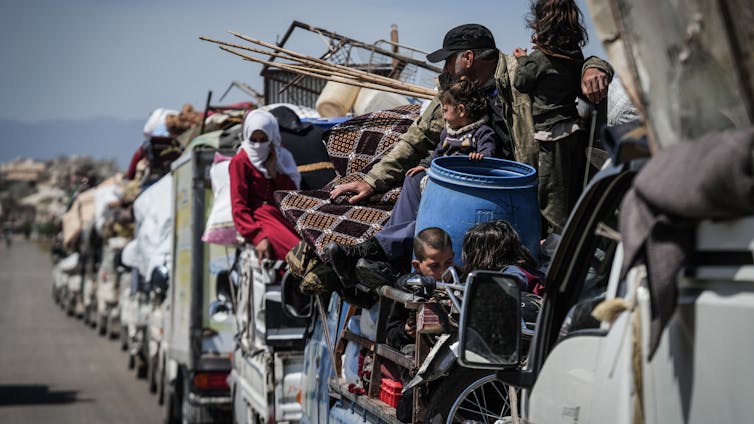
Displaced Syrian families form a return convoy to their destroyed village.
Moawia Atrash/picture alliance via Getty Images

Sandra Joireman, University of Richmond

Close to 1.5 million Syrian refugees have voluntarily returned to their home country over the past year.

That extraordinary figure represents nearly one-quarter of all Syrians who fled fighting during the 13-year civil war to live abroad. It is also a strikingly fast pace for a country where insecurity persists across broad regions.

The scale and speed of these returns since the overthrow of Bashar Assad’s brutal regime on Dec. 8, 2024, raise important questions: Why are so many Syrians going back, and will these returns last? Moreover, what conditions are they returning to?

As an expert in property rights and post-conflict return migration, I have monitored the massive surge in refugee returns to Syria throughout 2024. While a combination of push-and-pull factors have driven the trend, the widespread destruction of property during the brutal civil war poses an ongoing obstacle to resettlement.

Where are Syria’s refugees?

By the time a rebel coalition led by Sunni Islamist organization Hayat Tahrir al-Sham overthrew the Assad government, Syria’s civil war had been going on for more than a decade. What began in 2011 as part of the Arab Spring protests quickly escalated into one of the most destructive conflicts of the 21st century.

Millions of Syrians were displaced internally, and about 6 million sought refuge abroad. The majority went to neighboring countries, including Turkey, Jordan and Lebanon, but a little over a million sought refuge in Europe.

Now, European countries are struggling to determine how they should respond to the changed environment in Syria. Germany and Austria have put a hold on processing asylum applications from Syrians. The international legal principle of non-refoulement prohibits states from returning refugees to unsafe environments where they would face persecution and violence.

But people can choose to return home on their own. And the fall of Assad altered refugees’ perceptions of safety and possibility.

Indeed, the U.N. refugee agency surveys conducted in January 2025 across Jordan, Lebanon, Iraq and Egypt found that 80% of Syrian refugees hoped to return home – up sharply from 57% the previous year. But hope and reality are not always aligned, and the factors motivating return are far more complex than the change in political authority.
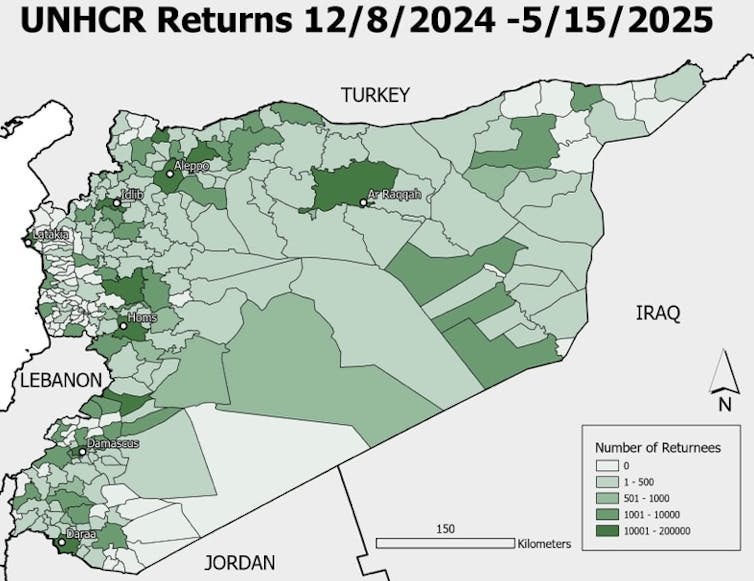
Sandra F. Joireman, CC BY-SA

Why are people returning?

In most post-conflict settings, voluntary return begins only after security improves, schools reopen, basic infrastructure is restored and housing reconstruction is underway. Even then, people often return to their country but not their original communities, especially when local political control has shifted or reconstruction remains incomplete.

In present-day Syria, violence continues in several regions, governance is fragmented, and sectarian conflicts persist. Yet refugees are returning anyway.

A major factor is the deteriorating conditions in neighboring host countries. Most of those who came back to Syria in the early months after Assad’s fall came from neighboring states that have hosted large refugee populations for more than a decade and are now struggling with economic crises, political tensions and declining aid.

In Turkey, for example, Syrians have faced increasing deportations and growing structural barriers to integration, such as temporary status without the possibility of naturalization and strict local registration policies.

In Lebanon, meanwhile, recent violence and a steep drop in international assistance have left Syrian refugees unable to secure food, education and health care.

And in Jordan, international reductions in humanitarian support have made daily life more precarious for refugees.

In other words, many Syrians are not returning because their homeland has become safer, but because the places where they sought refuge have become more difficult.

We do not have data on the religious or ethnic makeup of returnees. But patterns from other post-conflict settings suggest that returnees are usually from the majority community aligned with the new dominant political actors. After the war in Kosovo, for instance, ethnic Albanians returned quickly, while Serb and Roma minorities returned in much smaller numbers due to insecurity and threats of reprisals.

If Syria follows this trajectory, Sunni Muslims may return in higher numbers, as the country’s president, Ahmed al-Sharaa, led the Sunni rebel coalition that overthrew Assad.

Syrian minority groups, including Alawites, Christians, Druze and Kurds, may avoid returning altogether. Violent incidents targeting minority communities have underscored ongoing instability. Recent attacks on the Alawite population have triggered new waves of displacement into Lebanon, while conflicts between Druze militias and the government in Sweida, in southern Syria, have led to more displacement within the country. These episodes illustrate that while pockets of the country may feel safe to some, instability persists.
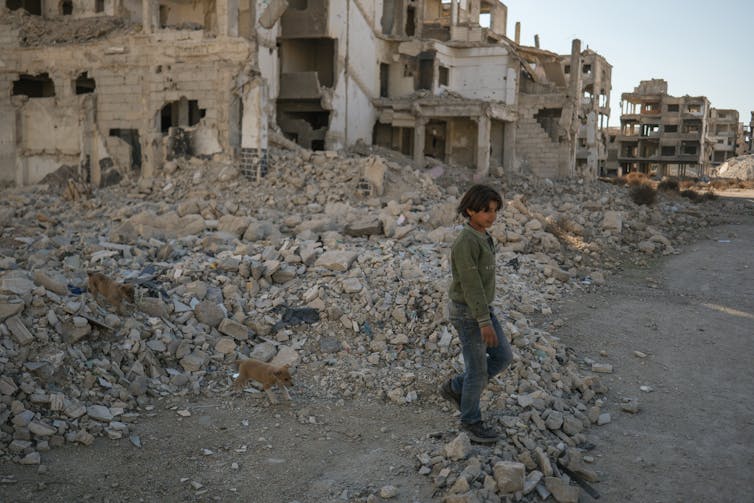
A child walks through rubble.
Thirteen years of civil war left much of Syria in ruin.
Ercin Erturk/Anadolu via Getty Images

Barriers to returns

One of the most significant obstacles facing refugees who wish to return is the condition of their homes and the status of their property rights.

The civil war caused widespread destruction of housing, businesses and public buildings.

Land administration systems, including registry offices and records, were damaged or destroyed. This matters because refugees’ return requires more than physical safety; people need somewhere to live and proof that the home they return to is legally theirs.

Analysis by the conflict-monitoring group ACLED of more than 140,000 qualitative reports of violent incidents between 2014 and 2025 shows that property-related destruction was more concentrated in inland provinces than in the coastal regions, with cities such as Aleppo, Idlib and Homs sustaining some of the heaviest damage.

Sandra F. Joireman, CC BY-SA

This has major implications for where return is feasible and where it will stall. With documentation lost, homes reoccupied and records destroyed, many Syrians risk returning to legal uncertainty or direct – and sometimes violent – conflict over land and housing.

Post-civil war reconstruction will require not only the rebuilding of physical infrastructure but also the restoration of land governance, including mechanisms for property verification, dispute resolution and compensation. Without all this, refugee returns will likely slow as people confront uncertainty about whether they can reclaim their homes.

Shaping Syria

Whether the wave of returns throughout 2025 continues or proves to be a temporary surge will depend on three main criteria: the security situation in Syria, reconstruction of houses and land administration systems, and the policies of the countries hosting Syrian refugees.

But ultimately, a year after the civil war ended, Syrians are returning because of a mixture of hope and hardship: hope that the fall of the Assad government has opened a path home, and hardship driven by declining support and safety in neighboring states.

Whether these returns will be safe, voluntary and sustainable are critical questions that will shape Syria’s recovery for years to come.The Conversation

Sandra Joireman, Weinstein Chair of International Studies, Professor of Political Science, University of Richmond

This article is republished from The Conversation under a Creative Commons license. Read the original article.


Ticker Views

Lunar Gateway faces delays and funding debate amid Artemis ambitions

Published

on

What’s the point of a space station around the Moon?

Berna Akcali Gur, Queen Mary University of London

The Lunar Gateway is planned space station that will orbit the Moon. It is part of the Nasa‑led Artemis programme. Artemis aims to return humans to the Moon, establishing a sustainable presence there for scientific and commercial purposes, and eventually reach Mars.

However, the modular space station now faces delays, cost concerns and potential US funding cuts. This raises a fundamental question: is an orbiting space station necessary to achieve lunar objectives, including scientific ones?

The president’s proposed 2026 budget for Nasa sought to cancel Gateway. Ultimately, push back from within the Senate led to continued funding for the lunar outpost. But debate continues among policymakers as to its value and necessity within the Artemis programme.

Cancelling Gateway would also raise deeper questions about the future of US commitment to international cooperation within Artemis. It would therefore risk eroding US influence over global partnerships that will define the future of deep space exploration.

Gateway was designed to support these ambitions by acting as a staging point for crewed and robotic missions (such as lunar rovers), as a platform for scientific research and as a testbed for technologies crucial to landing humans on Mars.

It is a multinational endeavour. Nasa is joined by four international partners, the Canadian Space Agency, the European Space Agency (Esa), the Japan Aerospace Exploration Agency and the United Arab Emirates’ Mohammed Bin Rashid Space Centre.

Schematic of the Lunar Gateway.
The Lunar Gateway.
Nasa

Most components contributed by these partners have already been produced and delivered to the US for integration and testing. But the project has been beset by rising costs and persistent debates over its value.

If cancelled, the US abandonment of the most multinational component of the Artemis programme, at a time when trust in such alliances is under unprecedented strain, could be far reaching.

It will be assembled module by module, with each partner contributing components and with the possibility of additional partners joining over time.

Strategic aims

Gateway reflects a broader strategic aim of Artemis, to pursue lunar exploration through partnerships with industry and other nations, helping spread the financial cost – rather than as a sole US venture. This is particularly important amid intensifying competition – primarily with China.

China and Russia are pursuing their own multinational lunar project, a surface base called the International Lunar Research Station. Gateway could act as an important counterweight, helping reinforce US leadership at the Moon.

In its quarter-century of operation, the ISS has hosted more than 290 people from 26 countries, alongside its five international partners, including Russia. More than 4,000 experiments have been conducted in this unique laboratory.

In 2030, the ISS is due to be succeeded by separate private and national space stations in low Earth orbit. As such, Lunar Gateway could repeat the strategic, stabilising role among different nations that the ISS has played for decades.

However, it is essential to examine carefully whether Gateway’s strategic value is truly matched by its operational and financial feasibility.

It could be argued that the rest of the Artemis programme is not dependant on the lunar space station, making its rationales increasingly difficult to defend.

Some critics focus on technical issues, others say the Gateway’s original purpose has faded, while others argue that lunar missions can proceed without an orbital outpost.

Sustainable exploration

Supporters counter that the Lunar Gateway offers a critical platform for testing technology in deep space, enabling sustainable lunar exploration, fostering international cooperation and laying the groundwork for a long term human presence and economy at the Moon. The debate now centres on whether there are more effective ways to achieve these goals.

Despite uncertainties, commercial and national partners remain dedicated to delivering their commitments. Esa is supplying the International Habitation Module (IHAB) alongside refuelling and communications systems. Canada is building Gateway’s robotic arm, Canadarm3, the UAE is producing an airlock module and Japan is contributing life support systems and habitation components.

Gateway’s Halo module at a facility in Arizona operated by aerospace company Northrop Grumman.
Nasa / Josh Valcarcel

US company Northrop Grumman is responsible for developing the Habitat and Logistics Outpost (Halo), and American firm Maxar is to build the power and propulsion element (PPE). A substantial portion of this hardware has already been delivered and is undergoing integration and testing.

If the Gateway project ends, the most responsible path forward to avoid discouraging future contributors to Artemis projects would be to establish a clear plan to repurpose the hardware for other missions.

Cancellation without such a strategy risks creating a vacuum that rival coalitions, could exploit. But it could also open the door to new alternatives, potentially including one led by Esa.

Esa has reaffirmed its commitment to Gateway even if the US ultimately reconsiders its own role. For emerging space nations, access to such an outpost would help develop their capabilities in exploration. That access translates directly into geopolitical influence.

Space endeavours are expensive, risky and often difficult to justify to the public. Yet sustainable exploration beyond Earth’s orbit will require a long-term, collaborative approach rather than a series of isolated missions.

If the Gateway no longer makes technical or operational sense for the US, its benefits could still be achieved through another project.

This could be located on the lunar surface, integrated into a Mars mission or could take an entirely new form. But if the US dismisses Gateway’s value as a long term outpost without ensuring that its broader benefits are preserved, it risks missing an opportunity that will shape its long term influence in international trust, leadership and the future shape of space cooperation.The Conversation

Berna Akcali Gur, Lecturer in Outer Space Law, Queen Mary University of London

This article is republished from The Conversation under a Creative Commons license. Read the original article.

Continue Reading

Ticker Views

South Korea introduces AI job protection legislation

South Korea is proposing laws to protect jobs from AI, balancing innovation with workers’ rights amid rising automation.

Published

on

South Korea is proposing laws to protect jobs from AI, balancing innovation with workers’ rights amid rising automation.


South Korean lawmakers are taking bold steps to protect workers from the growing impact of AI on employment. The proposed legislation aims to safeguard jobs and support workers transitioning into new roles as machines increasingly enter the workforce.

Professor Karen Sutherland of Uni SC joins Ticker to break down what these changes mean for employees and industries alike. She explains how the laws are designed to balance technological innovation with workers’ rights, and why proactive measures are crucial as AI adoption accelerates.

With major companies like Hyundai Motor introducing advanced robots, labour unions have raised concerns about fair treatment and the future of human labour. Experts say South Korea’s approach is faster and more comprehensive than similar initiatives in the United States and European Union, aiming to secure livelihoods while improving the quality of life for displaced workers.

Subscribe to never miss an episode of Ticker – https://www.youtube.com/@weareticker

#AIJobs #SouthKorea #FutureOfWork #Automation #TechPolicy #LaborRights #WorkforceInnovation #Ticker


Download the Ticker app

Continue Reading

Ticker Views

U.S. ambassador responds to NATO criticism at Munich Security Conference

At Munich Security Conference, U.S. NATO ambassador discussed defense autonomy, hybrid warfare, and transatlantic cooperation amid rising tensions.

Published

on

At Munich Security Conference, U.S. NATO ambassador discussed defense autonomy, hybrid warfare, and transatlantic cooperation amid rising tensions.


At the Munich Security Conference, the U.S. ambassador to NATO faced tough questions on global order as European allies explored greater defense autonomy amid rising geopolitical tensions. The discussion highlighted the challenges NATO faces in maintaining unity while responding to evolving threats.

The ambassador addressed criticisms directly, emphasizing the importance of transatlantic cooperation and NATO’s role in ensuring international security. European nations voiced concerns about independent defense capabilities and the impact of hybrid warfare from Russia on regional stability.

Oz Sultan from Sultan Interactive Group provides analysis.

Subscribe to never miss an episode of Ticker – https://www.youtube.com/@weareticker

#MunichSecurityConference #NATO #GlobalSecurity #DefenseAutonomy #Geopolitics #TransatlanticAlliance #HybridWarfare #USForeignPolicy


Download the Ticker app

Continue Reading

Trending Now