Connect with us
https://tickernews.co/wp-content/uploads/2023/10/AmEx-Thought-Leaders.jpg

News

Trump surrenders in election interference case – mug shot released

Published

on

Former President Donald Trump has surrendered himself at the Fulton County jail in Atlanta.

The surrender comes in response to over a dozen charges linked to his alleged involvement in attempting to overturn Georgia’s 2020 election outcomes.

Having agreed to a $200,000 bond and other stringent release conditions earlier this week, Trump is prohibited from utilising social media to target co-defendants and witnesses involved in the ongoing case.

This marks the fourth instance this year in which the former president has voluntarily turned himself over to either local or federal authorities due to criminal accusations.

https://twitter.com/rawsalerts/status/1694868885160214830

Trump addressed reporters after leaving the jail, where he described the situation as “a very sad day for America,” adding he should have the right to challenge the outcome of an election.

Trump arrives under a “hard lockdown”

The Fulton County Sheriff’s Office has announced that Trump’s arrival will lead to a “hard lockdown” in the surrounding area.


While he has previously been booked and arraigned in three other prosecutions, this instance will be the first to include a mug shot, which is anticipated to be made public.

Preceding his surrender, Trump made changes to his legal team, enlisting the expertise of Steven Sadow, a seasoned Atlanta-based lawyer specialising in white-collar and high-profile defence.

Notably, Sadow, reported to be Trump’s new lead lawyer in the case, will accompany Trump during the booking process at the Atlanta jail.

In a social media update on Thursday afternoon, the former president stated his intention to surrender at 7:30 p.m. ET, with the booking process expected to be brief, lasting under an hour.
As part of an agreement reached earlier in the week between Trump’s attorneys and Georgia prosecutors, a $200,000 bond was set.

The terms of this agreement prohibit Trump from engaging in any actions that could intimidate his co-defendants, witnesses, or alleged victims in the case, including on social media.

Will Trump be fingerprinted?

Trump is expected to be treated like any other defendant during his time at the Fulton County jail. Apart from the standard booking procedures such as fingerprinting, defendants are subjected to biometric identification through eye scans.

Defendants have various options to post bond, which includes cash, commercial surety, or putting up 10% of the bail amount. This allows them to remain free while their case unfolds, with the bond serving as a guarantee of their appearance in court.

The booking and arraignment processes are distinct in Fulton County, meaning that Trump’s appearance in court will not occur on Thursday.

The timing of Trump’s appearance before a judge for arraignment and plea entry remains uncertain. District Attorney Fani Willis proposed that all 19 individuals charged under Georgia’s racketeering law in connection to the 2020 election case have their arraignments during the week of September 5th, though the judge’s approval is still pending.

Willis stipulated a noon deadline on Friday for all defendants to surrender at the Fulton County jail. Already, at least nine individuals, including Trump’s former lawyer Rudy Giuliani, have complied.

The former president has consistently denied any wrongdoing in the case, asserting that Willis is spearheading a politically motivated “witch hunt” aimed at undermining his electoral prospects for the 2024 election.

What’s in the indictment?

The indictment, comprising 41 counts, alleges Trump’s involvement in a “criminal enterprise” that sought to reverse his loss in Georgia’s 2020 presidential election.

The charges include making false statements to state officials and legislatures, fabricating counterfeit Electoral College documents, enlisting supporters to cast fraudulent votes, harassing an election worker, and “corruptly” seeking support from senior Justice Department officials and then-Vice President Mike Pence.

Among the 13 counts Trump faces are an alleged violation of Georgia’s racketeering law, making false statements and writings, and conspiring to commit forgery in connection to an alleged plot to replace duly elected presidential electors with new ones who would vote for him.

The Fulton County prosecution marks Trump’s fourth criminal case, leading to his fourth booking since April.

He’s also entangled in two federal cases overseen by special counsel Jack Smith—one in South Florida concerning sensitive government records, and the other in Washington, D.C., stemming from alleged attempts to impede the transfer of presidential power post the 2020 election.

Furthermore, Trump faces 34 state felony charges in New York related to an alleged “hush-money” payment scheme aimed at concealing damaging information before the 2016 presidential election. Trump has pleaded not guilty in all three previous cases, maintaining that they are motivated by political considerations.


News

U.S. and Israel attack Iran, escalating regional conflict

U.S. and Israel strike Iran, escalating war fears and risking wider regional conflict for the second time in eight months

Published

on

U.S. and Israel strike Iran, escalating war fears and risking wider regional conflict for the second time in eight months

video
play-sharp-fill
In Short:
– U.S. and Israel launched strikes against Iran amid fears of a broader regional conflict.
– Iranian officials warn that attacks could lead to full-scale war as they prepare for retaliation.

The attack marks the second war between the U.S., Israel, and Iran within eight months, raising concerns about a wider regional conflict in a critically important economic area.Israeli Defence Minister Israel Katz confirmed the strikes and declared a state of emergency across all areas of Israel.

The U.S. also carried out strikes as part of the operation, according to a U.S. official.

The military operation followed a month of U.S. military buildup, ignited by President Trump’s commitment to support Iranian protesters who demonstrated against the regime in January.

The President consistently warned Iran could face military action if it continued its nuclear program. Vice President JD Vance stated that Iran’s responses in two negotiation rounds failed to meet U.S. expectations.

Trump address

In a video address announcing the military operation against Iran, President Trump said the U.S. was facing “imminent threats” from Tehran, though he did not detail specific evidence to support that claim.

Instead, he pointed to a history of Iranian aggression and reiterated broader concerns about the country’s nuclear activities, backing of regional proxy groups and its ballistic missile programme.

Iran’s missile development has featured prominently in the administration’s recent justification for military action, with Trump raising it again during Tuesday’s State of the Union address.

However, publicly available U.S. intelligence assessments have indicated that Iran had not decided to build an intercontinental ballistic missile.

Analysts have also noted that, while Tehran possesses missiles capable of reaching parts of Europe, it still faces significant technological barriers before developing a weapon able to strike the U.S. successfully.

Escalating Tensions

Iranian officials cautioned that any attack would provoke retaliation, warning that even minor strikes could escalate into a full-scale regional war.

The nation has prepared for conflict by mobilising its forces, reinforcing its nuclear facilities, decentralising decision-making, and tightening internal security measures.

‘Trump Has Met the Moment,’ Says Sen. Lindsey Graham

In his first interview since the U.S. and Israel attacked Iran, Senator Lindsey Graham said that “President Trump has met the moment” and “put in motion the demise of the Iranian ayatollah.”

“This operation will be massive in scope and has as its goal the elimination of the regime as demanded by the people of Iran,” the staunch Trump ally said, adding that the president concluded Tehran couldn’t be trusted to make a nuclear deal. “It has been a dream of mine for so long that the ayatollah’s murderous regime would be replaced by the people who seek a better life for themselves and their country.”

Graham, echoing Trump, acknowledged the potential risks facing U.S. forces involved in the mission. “If there are death or injuries in this operation, I can say without hesitation that they sacrificed for a noble cause, a safer America and a more just world,” he said.

“The consequence of leaving the regime in place, after all the terrorism, and the slaughter of 30,000 of its own citizens, would have been catastrophic for America’s national security,” Graham continued, referencing estimates of those killed during a January crackdown on anti-regime protestors.

The senator, who recently travelled in the Middle East and has long taken a hawkish position on Tehran, suggested the potential fall of the Iranian regime could revive diplomatic efforts to normalise relations between Israel and Saudi Arabia, describing it as “the biggest regional prize of all.”

“When the regime collapses, the region will spread toward a new dawn, and that normalization will take up where it left off,” Graham said.

Continue Reading

News

Crude oil prices spike amid U.S.-Israel military action

Crude oil prices soar as tensions escalate with US and Israeli military actions against Iran

Published

on

Crude oil prices soar as tensions escalate with U.S. and Israeli military actions against Iran

video
play-sharp-fill
In Short:
– Oil prices surged after US and Israeli military actions against Iran, with Brent crude at $72.5-$72.9 per barrel.
– Tensions in the Middle East have impacted markets, prompting OPEC+ to consider increasing production to stabilise prices.

Crude oil prices rose sharply following military action by U.S. President Donald Trump and Israel against Iran.

Brent crude oil now trades between $72.5 and $72.9 per barrel, while the US benchmark West Texas Intermediate (WTI) is around $67 per barrel.

Energy markets

Escalating tensions in the Middle East have significantly impacted global energy markets, with oil prices increasing over 15 per cent since January.

Israeli forces initiated a pre-emptive strike in Tehran, resulting in multiple explosions and a marked escalation in conflict.

Israeli Defence Minister Israel Katz labelled the actions as vital for neutralising Iran’s nuclear and missile capabilities.

Diplomatic negotiations between the US and Iran, which had resumed earlier in February, collapsed earlier this week in Geneva.

Production Increase

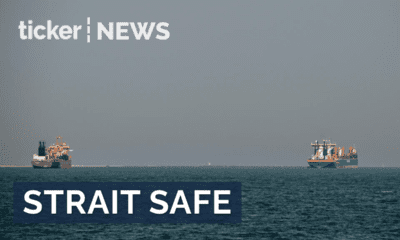
Iran, a key OPEC member, produces substantial oil and lies strategically near the Strait of Hormuz, a critical transit point for approximately 20 per cent of the world’s oil.

OPEC+ representatives have indicated to Bloomberg that a more aggressive production increase will be considered in an emergency meeting scheduled for Sunday.

The alliance is assessing approaches to mitigate the impact of the recent developments on oil markets.


Download the Ticker app

Continue Reading

News

Markets brace for turmoil after U.S. strikes Iran

Markets brace for turbulence as U.S. confirms major combat operations in Iran, sparking fears of increased oil prices and volatility

Published

on

Markets brace for turbulence as U.S. confirms major combat operations in Iran, sparking fears of increased oil prices and volatility

video
play-sharp-fill
In Short:
– Market turbulence is expected after the U.S. announces major combat operations in Iran.
– Oil prices may rise due to increased geopolitical risks and uncertainties in U.S.-Iran relations.
Market watchers predict significant turbulence following the U.S. announcement of “major combat operations” in Iran.
The escalation could have broader market implications than recent geopolitical events.U.S. President Donald Trump’s military actions targeted several ministries in southern Tehran. Investors remain accustomed to absorbing geopolitical and economic shocks, including a recent tariff hike and the capture of former Venezuelan President Nicolás Maduro.

Banner

Florian Weidinger, co-chief investment officer at Santa Lucia Asset Management, noted that the ramifications from Iran could surpass those from Venezuela, as the latter primarily affects specific heavy crude markets. Analysts expect oil prices to rise significantly as a result of the situation.

Market experts highlight the Strait of Hormuz as a critical oil chokepoint, with about 13 million barrels per day transiting the area in 2025.

Past military actions in the region have resulted in short-term volatility in equities, with potential movements toward safer assets such as gold and government bonds anticipated.

Market Outlook

Investors are advised to remain cautious as they assess potential Iranian responses. While some market positioning reflects a crisis atmosphere, the future of U.S.-Iran relations remains uncertain. The duration of conflict will play a key role in shaping market reactions.

Analysts suggest that a short campaign may lead to temporary price spikes, while a prolonged conflict could result in deeper market impacts and a shift in asset allocations.


Download the Ticker app

Continue Reading

Trending Now