
News
Sendle shuts down, small businesses left scrambling
Sendle’s sudden closure leaves small businesses reeling as they scramble for shipping solutions


Sendle’s sudden closure leaves small businesses reeling as they scramble for shipping solutions

– Sendle has unexpectedly ceased operations, leaving small businesses without courier services and cancelled pickups.
– Customers are frustrated and searching for alternatives, while competitor firms are reaching out to fill the gap.
Customers have been left confused and frustrated, lacking guidance on how to fulfill orders.
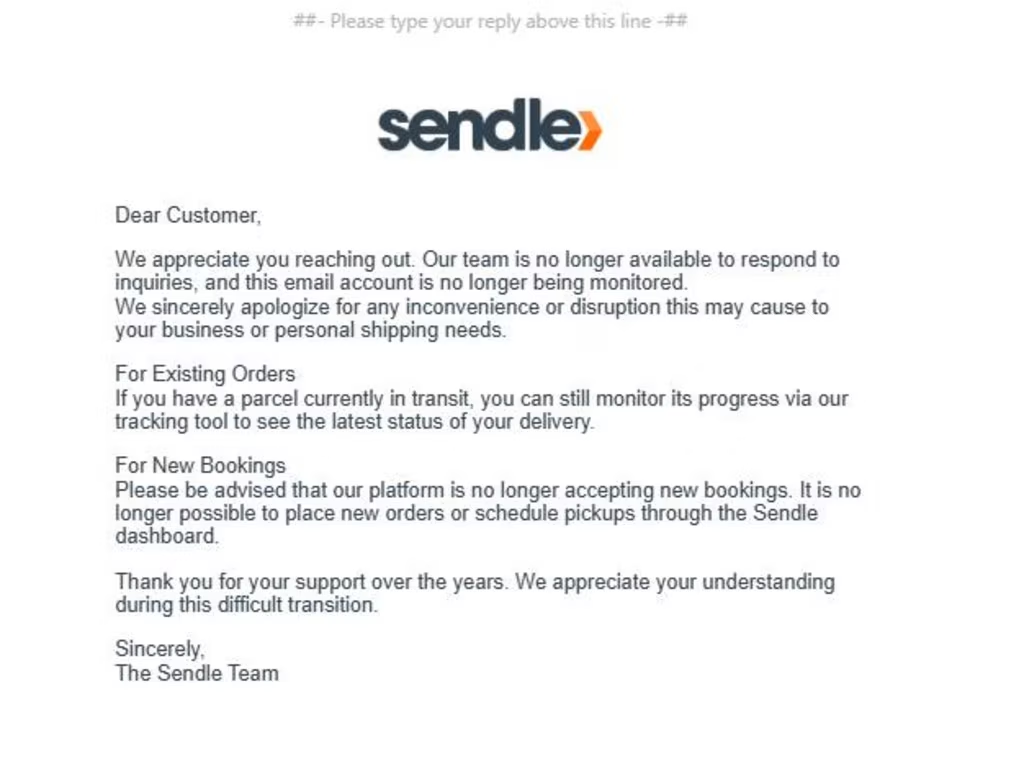
Sendle expressed regret for the disruption but did not provide a detailed explanation for the closure. A banner on their website confirmed the halt in services, with social media accounts disabled and customer inquiries no longer being monitored.

The shutdown comes as Sendle had recently merged with US logistics firms to create FAST Group, but that merger has now reportedly unraveled due to financial issues.
Small business owners, many of whom had turned to Sendle for better pricing compared to competitors like Australia Post, are now scrambling to find alternative delivery options.
Unexpected Closure
Many business owners shared their experiences on social media, highlighting the immediate need to find new courier services. One owner reported significant losses and mentioned having to repackage orders that were scheduled for shipment.
The collapse of Sendle has raised concerns about job losses, though the company has not disclosed the number of affected employees.
Competitors have begun reaching out to small businesses in response to the demand created by Sendle’s sudden exit from the market.
Aramex Australia says it “is aware that Sendle has halted all bookings for parcel pick-ups and deliveries in Australia with immediate effect. Aramex recognises that this development may create uncertainty for businesses that rely on Sendle to ship their goods.”
“While Aramex cannot comment on the specific circumstances surrounding Sendle’s operations, we are ready to support e-comm and B2B businesses that are seeking an alternative courier partner moving forward. Aramex has the infrastructure, global network, national coverage and local franchise expertise in place to assist customers who need ongoing delivery services without disruption. Our priority is providing certainty, reliability and continuity of service for Australian businesses.”
“Sendle is a tech platform that has enabled business customers to book courier services. Aramex has a long history of delivering for Sendle customers. Aramex operations continue as normal, providing reliable courier services to our customers.”

News
Oil prices surge amid rising Middle East conflict risks
Crude oil surges 7% amid fears of Middle East conflict; Strait of Hormuz disruptions may push Brent over $100.

Crude oil surges 7% amid fears of Middle East conflict; Strait of Hormuz disruptions may push Brent over $100.
Crude oil prices spiked dramatically as investors react to the growing risk of a wider conflict in the Middle East. U.S. crude surged 7.2 percent, trading near $71.84 a barrel, signalling heightened concern across energy markets.
The Strait of Hormuz, a critical shipping chokepoint, has come under intense scrutiny. Rising war-risk insurance premiums and suspended tanker traffic are already slowing the movement of oil, creating ripple effects in global supply chains.
JPMorgan has warned that prolonged disruptions over three weeks could force Gulf producers to reduce output, potentially pushing Brent crude prices to between $100 and $120 a barrel. Markets are closely watching for developments that could reshape global energy pricing.
Subscribe to never miss an episode of Ticker – https://www.youtube.com/@weareticker
News
Trump warns of last opportunity to hit Iran as conflict escalates
Trump declares final chance to strike Iran, aiming to dismantle missile systems and prevent nuclear weapons amid U.S. troop losses.
Trump declares final chance to strike Iran, aiming to dismantle missile systems and prevent nuclear weapons amid U.S. troop losses.
President Trump has declared this is the final opportunity to strike Iran as conflict intensifies across the Middle East, outlining four key military objectives including dismantling Iran’s missile capabilities and targeting its navy.
The U.S. says its mission is to prevent Iran from acquiring a nuclear weapon and to halt its alleged support for terrorist groups abroad, signalling a potentially prolonged campaign in the region.
Four U.S. troops have already been killed, with officials warning further casualties are possible as operations continue.
#Trump #Iran #MiddleEast
Subscribe to never miss an episode of Ticker – https://www.youtube.com/@weareticker
-
 News3 days ago
Crude oil prices spike amid U.S.-Israel military action
-
Tech5 days ago
Meta launches lawsuits over alleged scam advertising operations
-
News3 days ago
Iran warns ships to avoid Strait of Hormuz
-
News19 hours ago
Airlines face disruptions that surpass previous Middle East conflicts
-
News3 days ago
U.S. and Israel attack Iran, escalating regional conflict
-
News3 days ago
Markets brace for turmoil after U.S. strikes Iran
-
Shows2 days ago
Cities reshaped by capital, policy, and design insights
-
Shows2 days ago
Understanding commercial lending’s unique challenges and strategies