
News
‘Lots of lube’ for gruesome Stranger Things monster


The first part of Stranger Things Season 4 dropped on Netflix just a few weeks ago, and has viewers looking in dark corners for monsters
Without giving too much away, Vecna is already the breakout star of the season.
He’s the big, scary monster wreaking havoc on Hawkins. But behind the scenes, it seems like a nightmare process to make the gruesome creature.
Season 4 of Stranger Things has a new monster dressed in lube
An 80s technique to create Stranger Things’ new monster, Vecna, took designers up to 7 hours to apply.
The process behind it
To give Vecna a slimy look, prosthetics were painted with silicone and a whole lot of lube.
Parts of the costume were attached to the actor’s skin directly which took up to 7 hours to complete.
Prosthetics designer, Barrie Gower who had worked on films like the Harry Potter series, was hired for season 4 of Stranger Things.

Speaking to the Verge, make-up department head Amy Forsythe says getting Gower on board added another level to the show.
“Practical effects are such a huge thing with the nostalgia of the ‘80s, and we were losing that so much in our show.”
Lube is a popular technique to make monsters look slimy and was particularly used in the 80s.
Stranger Things’ success
Though season 4 took the team 14 months to film (including a 6 month disruption due to Covid-19), the new season has proven to be successful.
Since the release of season 4, 286.79 million hours were viewed in just the first few days of its release.
Breaking a Netflix record, Stranger Things 4 surpasses Bridgerton’s premiere and also reached the top 10 in 93 countries.
Katerina Kostakos contributed to this article

News
U.S. and Israel strike Iran as missiles hit Gulf bases and oil surges
U.S. and Israel launch major military operation against Iran; tensions rise as conflict escalates, impacting global markets.

U.S. and Israel launch major military operation against Iran; tensions rise as conflict escalates, impacting global markets.
The United States and Israel have launched a sweeping military operation against Iran, striking leadership targets and more than 500 military sites in what President Trump has dubbed Operation Epic Fury.
Explosions have rocked Tehran, with civilians fleeing the capital as U.S. sea and air assets carry out sustained attacks. Washington says the mission is designed to prevent a nuclear armed Iran and has even called on Iranians to rise up against the regime.
Iran has retaliated with a barrage of missiles and drones targeting Israel and U.S. bases across the region, including in Qatar, Kuwait, the United Arab Emirates and Bahrain. While many projectiles were intercepted, a U.S. base in Bahrain sustained damage.
Gulf states long seen as stable hubs for global business are now directly in the firing line, raising fears of a wider regional war.
Oil prices are climbing and tankers are diverting from the Strait of Hormuz as markets react to the escalating conflict. U.S. aircraft carriers, advanced fighter jets and missile destroyers remain in position, signalling more strikes could follow.
With global leaders scrambling diplomatically, the world is watching to see whether this spirals further or shifts back to negotiations.
News
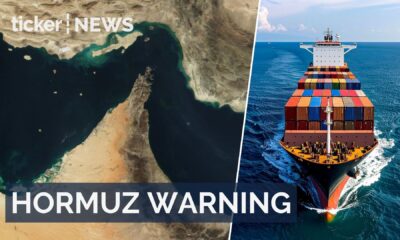
Iran warns ships to avoid Strait of Hormuz
Iran warns ships to avoid Strait of Hormuz amid rising tensions and military buildup in the region
Iran warns ships to avoid Strait of Hormuz amid rising tensions and military buildup in the region

– Iran’s Guard Corps advises ships to avoid the Strait of Hormuz due to rising tensions.
– Tankers have diverted to Qatar and UAE amidst concerns over safety and potential Iranian threats.
Ships have been repeatedly warned against entering the strait, as stated by crews in the area and the European Union’s naval command, Aspides. On Saturday, dozens of tankers diverted, with some seeking refuge in Qatar and the United Arab Emirates while others opted to steer clear of the region, as reported by oil brokers and shipowners.
Shipping Concerns
Tensions continue to impact shipping operations as carriers remain cautious in the Gulf region.
Tanker crews reported hearing explosions near Iran’s Kharg Island, which is vital for the country’s oil exports, as it handles 90% of its crude oil shipments.
-
 Tech5 days ago
OpenAI moves to replace software giants with AI products
-
Money3 days ago
Australia’s inflation report and Nvidia earnings impact explained
-
Tech2 days ago
Meta launches lawsuits over alleged scam advertising operations
-
Tech4 days ago
Nvidia earnings soar as AI drives 75% revenue growth
-
News4 days ago
Qantas announces 8,500 jobs and frequent flyer changes
-
News23 hours ago
U.S. and Israel attack Iran, escalating regional conflict
-
News17 hours ago
Iran warns ships to avoid Strait of Hormuz
-
News24 hours ago
Crude oil prices spike amid U.S.-Israel military action