
Connect with us
https://tickernews.co/wp-content/uploads/2023/10/AmEx-Thought-Leaders.jpg

Ticker Views

Iran’s leaders should take Trump’s warnings seriously. They have few options left

Published

on

Today Venezuela, tomorrow Iran: can the Islamic Republic survive a second Trump presidency?

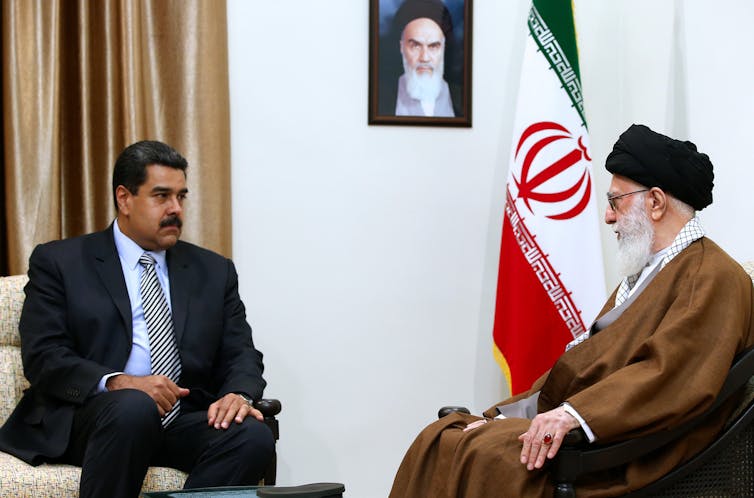
Better days: Venezuelan President Nicolas Maduro, left, met the supreme leader of Iran, Ali Khamenei, in Tehran on Oct. 22, 2016.
Pool/Supreme Leader Press Office/Anadolu Agency/Getty Images

Aaron Pilkington, University of Denver

Perhaps no one outside of Venezuela or Cuba should care more about the U.S. capture of nominal President Nicolás Maduro than the Islamic Republic of Iran’s supreme leader, Ali Khamenei.

Khamenei and his regime are in trouble, and it’s not clear how they would survive should the Trump administration decide to support the millions who want a new government system without Khamenei and his ilk.

Iran has no state allies that would be willing to intervene militarily on its behalf. Further, its once-powerful network of partner and proxy militias – Lebanese Hezbollah, the Houthi rebels in Yemen, and other members of the Axis of Resistance – has been rendered incapable or reluctant to get involved. And Iran’s economy is in shambles in the midst of an ongoing water crisis with no relief in sight.

Further, the Iranian people have again taken to the streets to air their grievances against harsh economic conditions as well as government corruption, mismanagement and hypocrisy, echoing similar conditions to Venezuela in recent years.

Lastly, President Donald Trump has returned his attention to Iran. On Jan. 2, Trump warned Khamenei that if his forces violently suppress protesters, Iran would be “hit very hard” by the U.S.

Trump’s warning and show of solidarity will likely embolden protesters, which will almost certainly cause Iran’s internal security to crack down harder, as has happened in the past. Such U.S. intervention could lead to the overthrowing of the ayatollah, intended or not. Furthermore, Maduro’s fate demonstrates that the Trump administration is willing to use military force for that purpose if deemed necessary.

As an analyst of Middle East affairs focusing on Iran, I believe that these conditions place Khamenei’s regime under greater threat today than perhaps any other time in its 46-year history.

Protesters and security forces clash in Tehran’s Grand Bazaar in a video released on Jan. 6, 2026.

Growing threats, internal and external

If Khamenei hopes to survive politically or mortally, I believe he has three options.

First, he could capitulate to U.S. demands to halt Iran’s nuclear enrichment program. Second, Iran could sprint toward a nuclear bomb. Lastly, he could flee.

In hopes of restoring deterrence, Khamenei could also continue rebuilding his country’s military capabilities, which were significantly degraded during the June 2025 12-day war in which Israel and the U.S. aimed to destroy Iran’s nuclear capability.

Israel is eager to stifle Iran’s reconstitution plans, protests are spreading and growing more intense, and Trump – through hostile rhetoric and offensive military action – has put Khamenei on notice.

Khameini’s problems aren’t his alone. The revolutionary theocratic system of government that he leads is in danger of falling. And his military and internal security apparatus may not have the time or ability to address its growing and interrelated internal and external threats simultaneously.

There are two fundamental factors analysts like me consider when assessing enemy threats: offensive capability to inflict damage and hostile intentions to use these capabilities to harm enemies.

Determining offensive capability involves evaluating the quality of a country or organization’s complete arsenal – air, ground, maritime, cyber and space capabilities – and how trained, disciplined, integrated and lethal their forces might be. Determining intentions involves evaluating if, when and under what conditions offensive capabilities will be used to achieve their goals.

If states hope to survive when they come under such pressure, their defense strategy should account for differences between their own military capability and the enemy’s, especially if enemies intend to attack. Or states need to convince enemies to be less hostile, if possible.

Maduro’s mistake was his inability to defend against a far superior U.S. military capability while believing that U.S. leaders would not remove him from office. Maduro gambled and lost.

Bad choices

Iran’s supreme leader faces a similar conundrum: First, there is no foreseeable path that allows Tehran to produce or acquire the military capabilities necessary to deter Israel or defeat the United States, unless Iran develops a nuclear weapon.

And decades of mutual hostility, the memory of Iran’s once-clandestine nuclear weaponization program and recent Iranian lawmaker calls to develop nuclear bombs minimizes the prospect that U.S. leaders view Khamenei’s intentions as anything but hostile.

But as the clear weaker party, it is in Tehran’s interest to change Trump’s mind about Tehran’s hostile intent. The way to do that would be by abandoning nuclear enrichment.

In terms of threat analysis, the regime’s oft-repeated chants of “Death to America” and “Death to Israel” perhaps have sent an easily misinterpreted message: that Iran’s hostile leaders intend to destroy the U.S. and Israel. But they simply lack the capability, for now.

President Theodore Roosevelt famously said “speak softly and carry a big stick; you will go far.” Today, he might say that Khamenei is unwise for speaking with such vitriol considering the size of Iran’s stick. The United States and Israel possess military capabilities far superior to Iran’s – as demonstrated by the 12-day war – but they did not then share the same intent. Though both Israel and the U.S. operations shared the objective of neutralizing Iran’s nuclear capability, Israel’s objectives were more broad and included targeting senior Iranian leaders and destabilizing the regime.

To Khamenei’s momentary personal and institutional fortune, Trump immediately called for a ceasefire following U.S. B-2 strikes on Iranian nuclear facilities, delineating the United States’ narrower objectives that at the time did not include regime change in Iran.

But that was before U.S. forces removed Maduro from Caracas and before the outbreak of protests in Iran, both of which coincide with Israel’s signaling preparations for Round 2 against Iran.

A fighter jet taxiing behind a person holding lights.
Israel is telegraphing its ambitions for another attack on Iran; fighter jets like this taxiing F-16I would likely be part of Israel’s next campaign.
Israel Defense Forces (IDF) / Handout/Anadolu via Getty Images)

Iran without Khamenei?

During Trump’s Dec. 29 press conference at Mar-a-Lago with Israeli Prime Minister Benjamin Netanyahu, he warned that the U.S. could “knock the hell” out of Iran if the country reconstitutes its nuclear facilities.

This is separate from the ominuous warning that the U.S. could intervene on behalf of Iranian protesters; it would almost certainly differ in scale.

Nevertheless, a potential U.S. intervention could embolden protesters and further undermine and destabilize the Islamic Republic regime. Khamenei has predictably scoffed at and dismissed Trump’s warning.

I believe this is a serious mistake.

Secretary of State Marco Rubio warned on Jan. 3, 2025, that Khameini should not “play games” as Maduro did. Khamenei, Rubio said, should take Trump’s warnings seriously. I agree.

If Iran refrains from violent crackdowns on protesters, there is a chance that anti-government protestors overthrow the government. But the supreme leader’s chances of surviving a popular uprising are probably greater than surviving an unbridled U.S. or Israeli military intent on ushering in a new – post-Islamic Republic – Iran.

Otherwise, Khamenei has to address superior U.S. and Israeli military capability, quickly. But Iran is broke, and even if sanctions were not continuously strangling Iran economically, the country could probably never purchase its way to military parity with the U.S. or Israel.

Alternatively, Iran could determine that it must move quickly to develop a nuclear weapon to mitigate U.S. and Israeli military capabilities and deter future aggression. However, it is extremely unlikely Iran could do this without U.S. and Israeli intelligence discovering the project, which would immediately trigger an overwhelming military campaign that would likely expedite regime change in Iran.

And like Maduro, the supreme leader is utterly alone. None of Maduro’s closest partners – China, Russia, Cuba and even Iran – were willing to fight in his defense, despite weeks of forewarning and U.S. military buildup near Venezuela.

Under these circumstances, it may be impossible for Khamenei to address overwhelming U.S. and Israeli military capabilities. He could, however, reduce the threat by doing what is necessary to ensure the United States’ objectives for Iran remain narrow and focused on the nuclear program, which may also keep Israel at bay.

However, Khamenei would have to demonstrate unprecedented restraint from cracking down violently on protesters and a willingness to give up nuclear enrichment. Due to historical animosity and distrust toward the U.S., both are unlikely, increasing, I believe, the probability of a forthcoming Iran without Khamenei.The Conversation

Aaron Pilkington, Fellow at the Center for Middle East Studies, University of Denver

This article is republished from The Conversation under a Creative Commons license. Read the original article.


Ticker Views

3 things to know about Kevin Warsh, Trump’s nod for Fed chair

Published

on

3 things to know about Kevin Warsh, Trump’s nod for Fed chair

Kevin Warsh has been tapped by Donald Trump to lead the Federal Reserve.
AP Photo/Alastair Grant

D. Brian Blank, Mississippi State University and Brandy Hadley, Appalachian State University

After months of speculation, President Donald Trump nominated Kevin Warsh on Jan. 30, 2026, to be the next chair of the Federal Reserve.

If confirmed by Congress, Warsh will inherit leadership of the U.S. central bank at a delicate time. For months, current Fed Chair Jerome Powell has come under attack from the Trump administration for failing to heed the president’s call for lower interest rates. The fight has put into question the central bank’s independence and its role in stewarding the economy.

Powell’s term as chair will end in mid-May, leaving his successor to navigate an economy that has improved on some fronts but remains uneven and uncertain.

But what should America expect from the next Fed chair? Here are three things to note about Trump’s nominee.

1. He is a familiar face …

Warsh brings deep experience with monetary policymaking to the role.

A graduate of Stanford University and Harvard Law School, he served as special assistant to the president for economic policy and executive secretary of the White House National Economic Council under President George W. Bush before becoming one of the youngest members of the Federal Reserve Board of Governors.

Warsh is no newcomer to discussions about Federal Reserve leadership. He was a finalist for the job in 2017, when Trump instead appointed Powell. Trump has since stated that he made a mistake by not selecting Warsh then – though clashes between Trump and Powell may have influenced that view.

Two men in suits walk outside.
Fed Chair Jerome Powell increasingly found himself out of step with Donald Trump’s wishes.
AP Photo/Pablo Martinez Monsivais

Warsh’s credentials are unquestionable. As a governor of the Federal Reserve Board from 2006 to 2011, he worked closely with other policymakers and with Wall Street during the global financial crisis of 2008. Since departing the Fed, he has returned to Stanford as a visiting fellow at the Hoover Institution and a lecturer at the Graduate School of Business, as well as a member of the Panel of Economic Advisers of the Congressional Budget Office.

He also has ties to the finance industry. He began his career in mergers and acquisitions at Morgan Stanley and, since leaving the Fed, has worked as a partner at Duquesne Family Office, an investment firm that manages the personal wealth of hedge fund manager Stanley Druckenmiller and other investors.

In 2016, Trump included Warsh in an economic advisory group assembled during his transition. Critics of Warsh’s nomination point toward his father-in-law, Ronald Lauder, a college friend and donor of the president, as evidence of politicization.

2. … with evolving monetary views

The big question people have is what a Warsh Fed would mean for monetary policy – that is, is it likely to play tight or loose with rates.

When the economy is growing quickly, like in 2021, the Federal Reserve tightens policy by raising interest rates to avoid the kind of economic growth that may not be sustainable long term and can lead to bubbles. However, during downturns, like in 2008 or 2020, the economic policy that can provide a backstop for the economy is looser. The Fed tends to lower rates in these situations, which supports growth.

Warsh’s views on monetary policy have long been considered hawkish, meaning he is inclined toward tighter policy and generally higher interest rates to keep inflation in check, even at the expense of slower economic growth. During his previous tenure at the Fed, he signaled concern about expansive monetary tools such as quantitative easing, in which the central bank buys Treasurys and other securities to stimulate the economy. This resulted in what Warsh called a “bloated” Fed balance sheet that held almost US$9 trillion of debt at its peak in 2022.

In recent public remarks leading up to his nomination, however, he has increasingly aligned in part with Trump’s push for lower interest rates and discussed establishing a new Treasury-Fed Accord, like in 1951, when Fed independence from fiscal authorities such as the Treasury Department was established.

3. His nod highlights fight over Fed independence

A central question surrounding this nomination is whether it promotes the politicization of the Federal Reserve.

The Fed’s independence from day-to-day political pressure has long been viewed as a cornerstone of U.S. economic policymaking. Decisions about interest rates, inflation control and financial stability are insulated from electoral politics for that reason. A truly independent Fed can resist making decisions that provide a short-term economic bump – something incumbent governments tend to like – but may lead to longer-term economic pain down the road.

The Fed tends to use its monetary policy tools carefully. Yet politicians tend to want looser monetary policy so the economy grows fast and they get credit for it.

And Warsh’s nomination can be seen in the context of a broader push from the executive branch to exert greater influence over monetary policy. Given Trump’s public criticism of Powell and vocal calls for his early departure, the president almost certainly intended to nominate someone who would lower interest rates according to preferences stated by the administration.

Critics of the nomination have argued that Warsh has a tendency to be more opportunistic with his policy views than Powell and other economists, who try to ignore political preferences.

As such, Warsh’s nomination encapsulates more than just a leadership transition. It highlights the ongoing tensions between political priorities and the traditional economic playbook, between short-term growth pressures and long-term stability, and between institutional independence and democratic accountability.

Time will tell whether he turns out to be hawkish or politically motivated as chair, if he is confirmed.The Conversation

D. Brian Blank, Associate Professor of Finance, Mississippi State University and Brandy Hadley, Associate Professor of Finance and Distinguished Scholar of Applied Investments, Appalachian State University

This article is republished from The Conversation under a Creative Commons license. Read the original article.

Continue Reading

Ticker Views

How Iran is powering Russia’s next generation drone war

Published

on

Russia’s drone pipeline: How Iran helps Moscow produce an ever-evolving unmanned fleet

Ukrainian firefighters extinguish a fire in a house after it was hit by a Russian drone on Jan. 15, 2026.
Diego Herrera Carcedo/Anadolu via Getty Images

Amy McAuliffe, University of Notre Dame

With Russian ground troops bogged down in a grinding war of attrition, Moscow is striving to press home its advantage in the skies – through an ever-evolving army of drones, courtesy of Iran.

In early January, wreckage of a drone found in Ukraine hinted at a new high-speed model of drone being deployed by Russia in the conflict. It prompted Ukraine President Volodymyr Zelenskyy to air fears over failing to keep pace. “We produce (drones) at about 1,000 a day. We really produce them, but it’s not enough. It’s still not enough,” he told an audience of political business leaders at the World Economic Forum on Jan. 22, 2026.

Ukrainian intelligence suggests that Moscow, too, will also soon be pumping out 1,000 drone units a day, in large part thanks to the support and technical assistance of Iran. A central concern for Ukraine is Russia’s increasing production of long-range attack drones that it has used in mass attacks to strike targets in Ukraine.

Tehran’s role in supplying Russia with hundreds of long-range, kamikaze-style drones is long known. But what has gone largely unnoticed outside Ukraine is Iran’s central role in teaching Russia to produce these drones itself.

As an expert on weapons technology and former assistant director of the CIA for weapons and counterproliferation, I believe use of Iranian technology has helped Russia develop a fleet of sophisticated drones able to erode Ukrainian air defenses and strain the country’s resolve. By doing so, Moscow is able to preserve more expensive missiles for long-range precision strikes.

Designed in Iran, produced in Russia

Both Ukraine and Russia have ramped up drone production since the beginning of the current conflict in February 2022.

Russia was initially unable to produce large numbers of kamikaze drones, and the country’s military seemingly did not at first understand the decisive role long-range strike drones could play. Instead, Moscow invested in traditional battlefield weapons, such as missiles. It mainly thought of drones as carrying out the roles of intelligence, reconnaissance and surveillance.

Tehran had the expertise Russia needed. It also had an existing defense relationship with Russia. Moreover, faced with a cash-strapped economy due to yearslong sanctions, Iran needed money.

Since probably about early 2022, Tehran has been providing drones and drone technology to Russia for use in Ukraine. Later that year, Russia and Iran signed the agreement to set up a production plant in Russia for Iranian-designed attack drones.

With Iranian blueprints and technology, a production plant in Tatarstan in western Russia now produces large numbers of drones originally designed by Iran. At this factory, Russia manufactures the Geran-2, Moscow’s name for the Iranian Shahed-136 strike drone.

Easily identifiable by its delta-wing shape, the drone has optimized certain design features, such as range, endurance and weight capacity. It can carry an estimated 90 to 110 pounds of explosives hundreds of miles.

Meanwhile, the delta-wing design optimizes precision diving, helps prevent stalling at low speeds, and increases the drone’s stability during the attack phase.

These features enable targeting of strategic infrastructure at much less cost than long-range missiles.

Two men look over a winged aerial vehicle
Remains of a Russian drone in Vinnytsia Oblast on March 18, 2024.
National Police of Ukraine/Wikimedia Commons, CC BY-SA

Russia can now produce hundreds of one-way Geran-2 attack drones a day. It may soon be able to launch thousands in salvos.

Russia is also modifying and enhancing the drones with features such as precise navigation, heavier warheads and new engines.

Some reports claim Russia is testing telemetry and video links to fly drones remotely, a significant improvement over its current preprogrammed design that would improve accuracy and range. Iran also supplied Russia with technology to build a jet-powered drone variant based on the Shahed-238 that can fly faster.

Called the Geran-3, Russia has produced and used fewer of these drones, whose jet power makes them more challenging for Ukrainian air defense to detect and intercept. New generations of the drone – Geran-4s and Geran-5s – have since been rolled out and apparently deployed in the war with Ukraine.

Sanctions-busting procurement

Even with the blueprints and Iranian assistance, Russia is still reliant on Western and Chinese suppliers for some drone components, many of them commercial, off-the-shelf technology. These include the engine, fuel pump, GPS and navigation systems, semiconductors and components for antennas.

To assist Russia, Iran exploits its networks of brokers and companies in acquiring Western components to evade international sanctions.

A procurement network headed by the Iranian company Sahara Thunder used shipping firms in the UAE and India to sell Russia the original Iranian drones and components and to negotiate the deal for the production plant.

The U.S. Treasury Department has sanctioned this firm and others involved in the drone sales, but Iran set up new companies to help Moscow acquire components. Multiple studies and reports documenting the inclusion of foreign components in downed Geran-2s show Moscow’s continued acquisition of these parts, almost certainly with Iranian assistance.

A weapon of terror

Russia uses the Geran and other longer-range Iranian and Russian models to purposefully target civilians and civilian infrastructure in Ukraine, including residential housing in Ukrainian cities. Russia has even targeted first responders and humanitarian distribution points, according to a United Nations account.

In fact, the U.N. concluded in October 2025 that Russia’s use of short-range, unmanned aerial vehicles against civilians in southern Ukraine constituted a crime against humanity and a war crime.

An explosion is seen with smoke around it.
A screen grab from a video shows Russian strikes in the Kharkiv region of Ukraine on Dec. 23, 2025.
The Russian Ministry of Defense/Anadolu via Getty Images

A two-day attack in May 2025 on the Ukrainian cities of Kharkiv in the northeast and Odessa in the south highlights the destructive power and human cost of the drone attacks. According to accounts in the Kyiv Post, Russia launched over 100 drones. In Kharkiv, three blocks were burned down, including 90 shops, and two people were injured. In Odessa, the drones killed one person and damaged residential buildings.

Beyond psychologically tormenting the Ukrainian population, these drones have a profound effect on the battlefield.

Ukraine has responded to Russia’s battlefield success with the Iranian-designed drones by diversifying the types of drones it manufactures, attacking Russian infrastructure for manufacturing drones and developing counter-drone technologies.

A mutually beneficial arrangement

Iran also benefits from this terror campaign. Reeling from the economic impact of sanctions, Iran will make an estimated US$1 billion to $1.75 billion from the deal for drones and the production facility. Russia is reportedly paying Iran a portion of the bill in gold.

A screen shows flying vehicles.
Iranian families watch a video clip of Iranian-made unmanned aerial vehicles during a ceremony commemorating the 45th anniversary of the Iran-Iraq war in Tehran on Sept. 25, 2025.
Morteza Nikoubazl/NurPhoto via Getty Images

Iran is unlikely to stop its assistance anytime soon, given its own economic problems. Helping Moscow obtain drone components and even modify new versions of the Geran-2 will also benefit Iran militarily as it, too, learns to make the new drones and use them itself.

But the main beneficiary of this relationship is Moscow. Without Iranian support, Russia would face more difficult trade-offs on the battlefield. The lower-cost drones allow Russia to preserve its expensive advanced missiles for the most significant targets in Ukraine and to employ large swarms of drones to target Ukrainian infrastructure.

And with the ground offensive yielding little progress of late for Moscow, that could be crucial as the war enters its fifth year.The Conversation

Amy McAuliffe, Visiting Distinguished Professor of the Practice, University of Notre Dame

This article is republished from The Conversation under a Creative Commons license. Read the original article.

Continue Reading

Ticker Views

Australia inflation, USD volatility and Fed dissent explained

Australia’s inflation report raises questions for the RBA, influencing interest rates, markets, and a volatile US dollar.

Published

on

Australia’s inflation report raises questions for the RBA, influencing interest rates, markets, and a volatile US dollar.


Australia’s latest inflation report is raising questions about the Reserve Bank of Australia (RBA) and its next moves.

David Scutt from StoneX breaks down what the numbers mean for interest rates, investors, and global markets, highlighting the ripple effects that could reach far beyond Australia.

Meanwhile, the US dollar has seen a surge in volatility, sparking concerns about the impact on Australia’s economy and global trade. David explains the challenges and potential risks of pursuing a weaker dollar policy, and what it could mean for markets in the months ahead.

Subscribe to never miss an episode of Ticker – https://www.youtube.com/@weareticke

#AustraliaInflation #RBA #USDVolatility #WeakerDollar #FedMeeting #GlobalMarkets #FinanceNews #TickerInterview


Download the Ticker app

Continue Reading

Trending Now