

News
$148 million seized in global crackdown on organised crime

Australian Federal Police and the FBI have smashed an industrial-scale drug trafficking ring in what’s being described as the plot of the century.
The audacious police sting targeted an encrypted communications app that was being secretly monitored by police, leading to hundreds of arrests of organised crime figures in 18 countries.
Mafia figures, bikies, South American drug cartels, Asian triads and Middle Eastern and European crime syndicates are alleged to be caught up in the sting.
Police said they uncovered 21 murder plots and seized more than 3,000 kilograms of drugs and $35 million in cash.
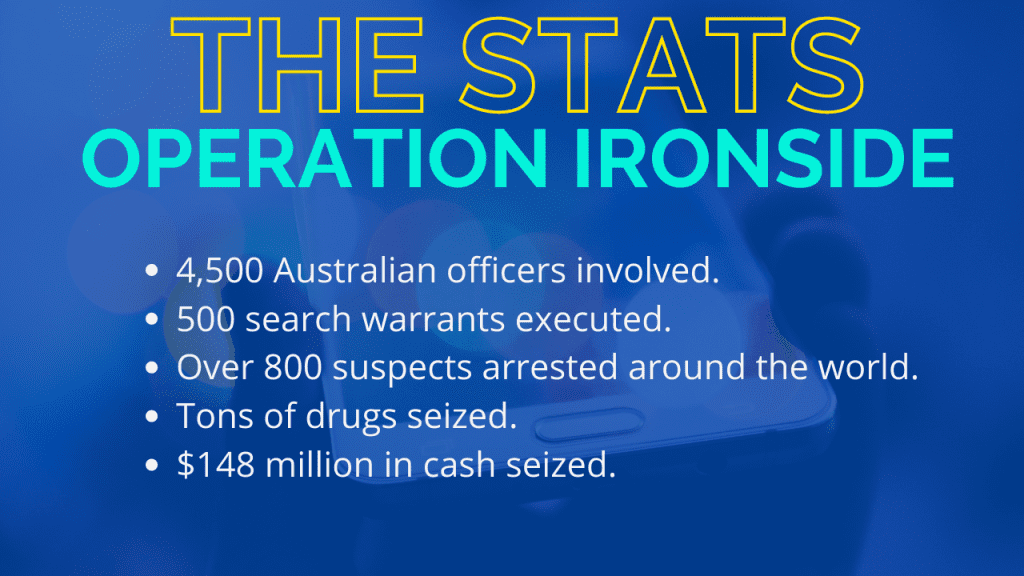
Over 800 suspected members of organised crime gangs were arrested and $148 million in cash seized in raids around the world. Tons of drugs were also seized, officials confirmed.
Police say they were using the trojan horse app ANOM that was operated by the FBI and secretly monitored by the Australian Federal Police.
The app was used by organised crime gangs around the world to plan executions, mass drug importations and money laundering.
Prime Minister Scott Morrison says the mass raids and arrests struck a heavy blow against organised crime.
The plan is said to have been hatched by an AFP tech guru in 2018, with the AFP planting pre-loaded mobile phones into the hands of criminals.
Investigators intercepted 25 million messages sent on the ANOM, viewing the communications in real time.
300 search warrants were carried out across Australia on Monday night, with simultaneous stings in the US and Europe, according to reports from the ABC.
Police say they have exposed the secret relationships between bikies and syndicates who were thought to be enemies.
“This is a watershed moment in Australian law enforcement history”
SYDNEY:The Prime Minister was joined by Minister for Home Affairs Karen Andrews, AFP Commissioner Reece Kershaw and FBI Legal Attaché US Embassy Anthony Russo to speak on ‘Operation Ironside’, a three-year sting involving the FBI, organised crime and an encrypted app.
Prime Minister Scott Morrison said the operation had “struck a heavy blow against organised crime. Not just in this country, but one that will echo around organised crime around the world”.
“We have never taken our eye a day from the threats presented in this country”
Morrison has reiterated calls for stronger border security and anti-encryption laws off the back of Operation “Ironside.”
“The most significant policing operation in Australian history”
Home Affairs Minister Karen Andrews called Operation Ironside “the most significant policing operation in Australian history”.
Worldwide, 9000 law enforcement officials were involved in the operation, with over 4500 of those officials being Australian Federal Police.
Commissioner Kershaw said federal agents had been in the “back pockets” of criminals through the encryption app.
Commissioner Kershaw said federal agents have arrested some “of the most dangerous criminals in Australia”
Commissioner Kershaw said criminal gangs are targeting Australia because “it’s one of the most profitable countries in the world to sell drugs.”
Commissioner Kershaw confirmed criminal “kingmakers” have been arrested and AFP have prevented mass shootings.
The plan that began over beers
“Some of the best ideas come over a couple of beers,” AFP Commissioner Reece Kershaw said in his address to media on Tuesday.
“The FBI had the lead on this. We provided the technical capability to decrypt those messages,”
AFP Commissioner Kershaw.
The FBI’s representative Anthony Russo says he’s proud to represent the US and stand with his Australian colleagues.
“In today’s world, crime continues to transverse international borders. The threats we face are too diverse and too complex for any one organisation to tackle alone,”
Russo said.
-
 News4 days ago
Iraq’s oil exports halted, output down 70%
-
Tech3 days ago
Anthropic bans third-party tools from Claude subscriptions
-
News4 days ago
Trump imposes 100% tariff on imported drugs
-
Tech1 day ago
Artemis II crew tests suits ahead of flyby
-
Tech1 day ago
Altman advises CEOs to secure AI capacity now
-
News2 days ago
Western carriers gain routes as Gulf airlines struggle
-
Leaders5 days ago
Simon Bedard explains how global instability is reshaping small business valuations
-
Tech3 days ago
Artemis II crew halfway on lunar flyby mission