China’s influence in the Pacific is causing concern for some Western nations who are playing a diminished role in the region
Tides are changing in the Pacific, an area which has long deferred to the West, but is increasingly gazing eastward.
The changing dynamic has been typified by the landmark security deal signed by China and the Solomon Islands. This week, Chinese foreign minister Wang Yi embarked on an historic 10 day tour of eight Pacific Island nations.
Should Western nations fear China’s growing influence in the Pacific?
The Pacific Islands have a long history of Western influence, dating back hundreds of years to European colonisation.
But nations such as Australia and the U.S. are suddenly having to contend with the arrival of a new player.
Benjamin Herscovitch, a research fellow at the Australia National University, told TICKER NEWS China’s increased influence in the area represents a “dramatic shift in circumstances” for the region.
“We are at the beginning of a really heated up period of competition between Australia and China for influence in the Pacific,” he says.
This will place further pressure on an already strained relationship.
In recent years, the two nations have butted heads over a number of issues including human rights and territorial disputes in the South China Sea.
Two weeks ago, relations between the two nations flared again. In the lead up to the Australian federal election, then defence minister Peter Dutton labelled the presence of a Chinese spy ship off the coast of Western Australia was “an aggressive act”.
Despite outcry from the West, there is still no evidence China’s intentions in the Pacific have militaristic undercurrents.
Yi has started his tour of the Pacific by promising his government has “no intention” of building a military base in the Solomon Islands.
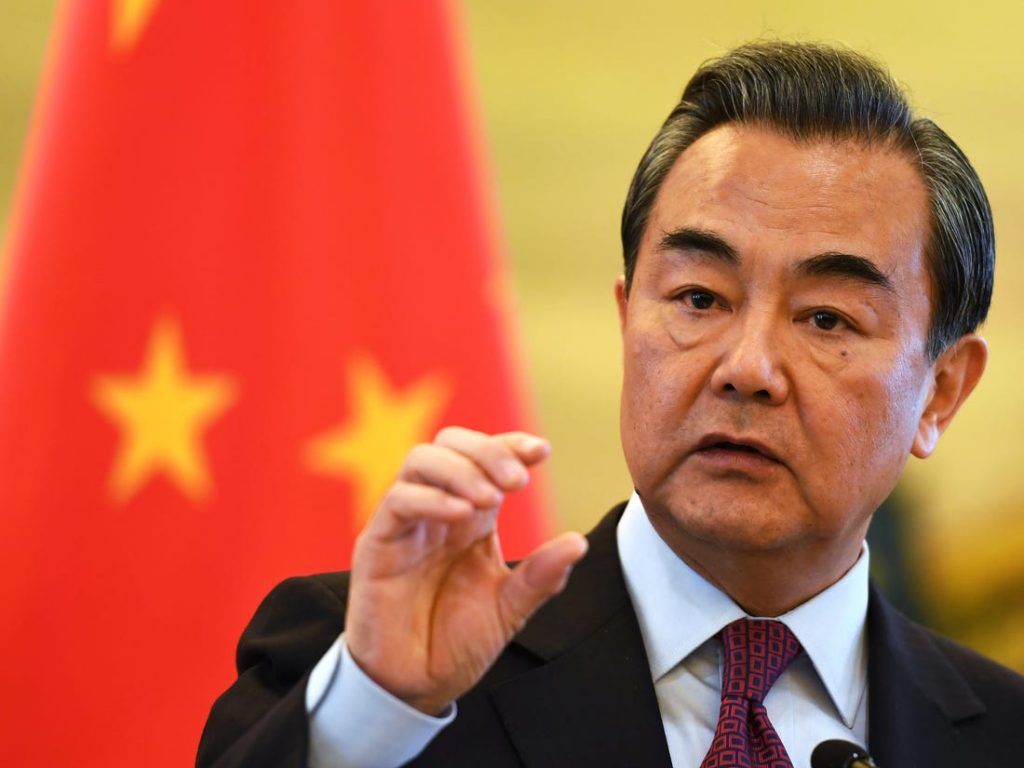
Chinese Foreign Minister Wang Yi is on a ten day tour of the Pacific
What is China’s goal in the Pacific?
While China’s role in the Pacific will likely become a point of contention, Herscovitch doesn’t believe it is coming from a position of Chinese aggression.
Rather, it is the natural progression for a country becoming more influential across the globe.
“A lot of the alarmist commentary in Australia maybe fails to appreciate that we’re coming in this period of rising Chinese influence and power globally,” he says.
“It’s almost to be expected that you’d have Beijing having a much larger footprint in Australia’s region.”
“China is a country with an incredibly large economy, with trading interests that span the globe, with diplomatic and political interests that span the globe.”
Benjamin Herscovitch, ANU
“China’s expanding footprint, expanding influence is just part and parcel of China emerging as the globe’s greatest economic power,” he says.
Will Island nations benefit from competition in the Pacific?
Herscovitch says the dispute could be “a good news story” for island nations because states will compete to invest in the area as a way to build influence in the Pacific.
“We’ll see a lot of competition for investment, a lot of competition for influence between key economies, and that’s probably beneficial for Pacific Island countries,” he says.
Pacific nations also look set to benefit by increased action on climate change.
As some of the most low-lying nations in the world, global warming and rising sea levels are of huge concern to the area.
Australia’s foreign minister Penny Wong also visited the Pacific to pledge an improvement in Australia’s climate change policy.
“There’s a sense here in which Australia’s desire for influence will encourage Australia to be more forward leaning, more proactive on climate change issues,” Herscovitch says.
New role for the West in the pacific?
With China beginning to gain a foothold in the Pacific, Herscovitch says the West may have to alter its diplomatic approach.
He believes Australia and U.S. have been overly critical of South Pacific countries, and in particular the Solomon Islands, for engaging with China.
In the backlash following Solomon Islands’ defence treaty with China, the nation’s Prime Minister Mannasseh Sogavare accused the Australian government and its allies of undermining his government.
Herscovitch labels this approach as “counterproductive” to maintaining relations with the Pacific nations, saying “we should always respect their sovereign decisions and respect their independent choices.”
He says Australia, the U.S. and Japan has a highly important role in providing expertise and advise on how to manage their relationship with China as they become more economically entwined with the global power.
“They’re relying on China for more infrastructure, and it’s really important that their officials are empowered with all the necessary information to manage that relationship and to manage that growing dependency,” he says.
Airbus faces manufacturing issues with A320 fuselage panels, impacting shares but confirming safety for in-service aircraft.
Airbus is confronting a fresh manufacturing issue after discovering a quality defect in several dozen fuselage panels used on A320-family jets. The revelation sparked investor concern, with shares falling by up to 10% as the news broke.
While the newly identified flaw has caused some delivery delays, Airbus confirms that aircraft already in service are safe and unaffected. The defect is limited to a specific batch of panels, and all new production now meets required standards.
The company has apologised for the disruption and says it is working closely with suppliers to prevent a repeat of the issue.
Subscribe to never miss an episode of Ticker – https://www.youtube.com/@weareticker
Bitcoin drops over 7% to $84,555, its lowest in a week, amid waning investor confidence and bearish market pressures.
Bitcoin has suffered a sharp decline, falling more than 7% and slipping to $84,555 — its lowest point in over a week. After a brutal November where BTC shed more than $18,000, its biggest dollar drop since mid-2021, investor confidence is wavering. Analysts say multiple pressures, including negative ratings for major stablecoins, are amplifying bearish sentiment across the market.
Subscribe to never miss an episode of Ticker – https://www.youtube.com/@weareticker
Tasmania’s AFL bid hinges on the Macquarie Point stadium-precinct; insights from Professor Tim Harcourt on Footynomics.
Seven things to know about the stadium-precinct and the Tassie Devils
Word by Tim Harcourt*
Tasmania’s been wanting a footy team in the national competition for decades.
Now they are pretty close, but they need the bill for the new stadium-precinct at Macquarie Point to pass the Legislative Council in order to cement their spot as the 19 th team in the Australian Football League (AFL). The bill passed the lower house by a whopping 25-9 majority and the Yes Stadium – Yes Team drew an amazing 15000 crowd from generations of Tasmanians all over the state compared to a paltry 1500 “No” crowd of a narrower demographic that turned up the week before.
I spoke to the Legislative Council stadium committee last week and to cut through all the noise and disinformation I came up with seven key things to consider with the stadium-precinct.
1. The stadium-precinct is a unique opportunity.
According to Brad Van Wely, stadium and sports innovation expert who appeared on my show Footynomics, Stadium Tasmania in Hobart with be the newest stadium in the southern hemisphere and an opportunity to implement all the amazing technology and innovation in smart stadiums that are happening around the world. Tasmania could be a leader in innovation not a laggard and develop a whole sports industry eco-system on the back of the success of the Devils, the JackJumpers, the Hobart Hurricanes and Cricket Tasmania.
2. It’s not just a stadium, it’s a stadium-precinct.
Stadium Tasmania won’t a cold concrete slab on the outskirts of the city. It will be right next to Hobart’s picturesque waterfront in close proximity to bars and restaurants, hotels and other attractions that can be explored easily. And the whole area can be developed as a precinct with cultural attractions, fan zones and the like to make the whole pre-game and post-game experience exciting and to engage fans and visitors all days of the week with a variety of activities.
For instance, why not have the AFL hall of fame in the precinct (for all of Australia not just Tasmania), a hotel to host the Draft or the Brownlow, and host some arts and cultural events in the precinct. The Tasmania Devils Arts Foundation can assist creative Tasmanians too – as arts and sport are not mutually exclusive – they can generate activity together.
3. The stadium-precinct is not just for footy.
Some have said all this is for 7 games a year. It’s not the case. It’s a multi-purpose stadium for a range of sports, footy, soccer, cricket, rugby union, rugby league and may more. It will be used for concerts and conventions, entertainment and with the precinct a whole range of arts and cultural amenities, fan zones etc. According to James Avery of Stadiums Tasmania, their modelling shows that the stadium-precinct will be able to host 334 events a year. This is a once in a century piece of infrastructure that Tasmanians can shape themselves for maximum benefit.
This is similar to international case studies like the soccer stadium in St Louis that hosted 200 events a year that had nothing to do with soccer, and the new Tottenham Hotspur ground that hosts 300 events a year including a National Football League game from the USA. The new rugby union stadiums in Christchurch and Dunedin host a range of other sports including soccer, cricket rugby league and concerts by Elton John. Pink and ACDC.
Similarly, with the Adelaide Oval redevelopment, the Oval now hosts a range of events, many non-sporting, and the whole CBD precinct has been revitalised. South Australian Premier Peter Malinauskas told us on Footynomics, the State Government originally faced great opposition spending $500 million on the Adelaide Oval redevelopment but now you couldn’t find a soul who opposed it, especially at Gather Round or the Adelaide Test match.
4. But the stadium-precinct does unlock the team and all its benefits.
Most importantly building the stadium-precinct unlocks the team and team infrastructure. As the AFL Tasmanian Taskforce says the stadium-precinct, the high performance training centre, and the upgrades around the state enables the Devils to enter the AFL on a sustainable footing to hit the ground running.
This brings economic and social benefits to the Tasmanian community or the ‘powerful enduring stimulus’ as the Devils CEO Brendon Gale put it. This included a boost in construction and other jobs – 6270 new jobs and with a potential boost to tourism of around 123,500 international and interstate visitors, plus intra state visitors.
Leading Burnie business woman Kelly Elphinstone pointed out the potential boost in the Tasmania brand in business and tourism, in education with TALS, UTAS and TAFE pathways for careers in sport and event management and the opportunity for a football club foundation to assist disadvantaged Tasmanians.
The boost in Tassie pride as the community has an emotional connection to their team was mentioned by basketball CEO Christine Finnegan about ‘the JackJumper effect’ with both economic and psychological benefits of having a team to rally around. The impact of a footy team would be even bigger than basketball Finnegan said as Tassie is footy heartland. There’s no need for the AFL to send out missionaries like they send out in western Sydney.
This community connection or emotional engagement was highlighted by Grant O’Brien in Footynomics. He related growing up in Penguin and the role the footy club played in the town and how the connection with the Devils would boost these ties all over the state. Economists call this ‘social capital’, and Grant’s description of his upbringing in Penguin and his motivation to steer a genuine Tassie team into the national competition was the perfect example of social capital at work and the economic benefit it brings to the community.
A genuine Tassie team has more economic benefit than a Fly In Flight Out (FIFO) team, as Hawthorn and North Melbourne have being doing in Launceston and Hobart respectively. It was useful as a stop gap, and brought some economic benefit. The Tasmanian AFL Taskforce cited research showing $28 million being injected into the Tasmanian economy due to Hawthorn playing in Launceston and $40 million due to North Melbourne playing in Hobart decade ago.
With the Devils this stimulus will be turbo charged. Given the scale of the Devils, there will be more home games, the players, staff and their families be based in Tasmania and contributing to the local economy, and they’ll also be AFLW, VFL and VFL teams as well.
The advantage of having a home-grown team, embedded in the state and the state owned infrastructure, rather than a FIFO or re-located team avoids some of the issues with sports economics in the USA when teams move. This is very different to Tasmania, where the Tassie Devils are here for good and the new stadium-precinct will be here to benefit the Tasmania whole community in the arts and entertainment and business and community events as well as sports.
The Tassie Devils will be more like the Green Bay Packers who can never leave Green Bay due to the ownership and governance requirements. And that hasn’t stopped Green Bay being one of the most famous, successful and best supported US football teams in the National Football League (NFL). Green Bay is a small town and much colder and less picturesque than Hobart (and not a state capital city either).
5. Investment in infrastructure is what governments do
Some have been worried about governments taking on the investment and not getting exactly the same amount in their coffers. This is confusing economics with public accounts. Only governments can take on big infrastructure projects like a bridge, or an airport or a stadium-precinct in the first instance (individuals can’t easily) but the benefits come in increased welfare in future jobs for workers and incomes for small business who pay taxes and regenerate the economy.
For instance when a government builds an airport, the passengers, the airlines and the tourism operators benefit and regenerate income in the economy, that improves the welfare of the community (in this case Tasmanians) over future generations. The same goes for a bridge or a stadium-precinct. The government is not like a household, it can take on big projects where required for economic and social benefit.
6. Tasmania can’t afford not to do it.
Many say the state can’t afford it because of the state of the Tasmanian budget. But the alternative is austerity, no growth, no population growth and with nothing to enable the economy to generate the jobs and income to fund education, health and essential services.
There’s a lot of talk about the cost of the stadium-precinct, but what about the cost of not doing it. Imagine the shock to confidence, and the signal to investors looking at Tasmania, if the team didn’t go ahead. It would be such a lost opportunity. Tassie with an ageing population, low literacy rate can’t end up an island state with everyone on NDIS or in nursing homes, it need jobs and growth and a reason for young people to stay or come back to. We have already seen that with the calibre of Tasmanians returning to work for the Devils as well as the VFL draftees.
If the stadium precinct bill was blocked, there would be the psychological shock of losing the team and then the demographic outcomes would follow – lower participation in sport, poorer health outcomes, another outflow of talent to the mainland, and ultimately worse budget outcomes.
And in undertaking this new project, remember Tasmania is not on its own. Tasmania is part of the federation and a foundation footy state. Therefore it will and it should get support from the Commonwealth and the AFL. And it has $240 million from the Commonwealth and $360 million from the Australian Football League (AFL) to invest in grass roots infrastructure not just in Hobart and Launceston but all around the state. And given the spending of $3.4 billion to Brisbane for the Olympics and a reported $1 billion to Adelaide for the climate change conference COP31 for a week in 2026, I’d say the multipurpose stadium-precinct in Hobart that will be around for a century for future generations is pretty good value for money for the Commonwealth.
And Tasmania is not alone as there are examples from other states, like the Adelaide Oval and Optus Stadium in Perth where state governments have built whole industrial strategies around sports and sport infrastructure.
7. The bottom line – maximise the benefits by following some basic principles.
In conclusion, this is a once in a century opportunity and I am excited for Tasmania as they can now maximise the benefits of the new club, the new stadium-precinct, the high performance centre and the upgrades to infrastructure around the whole state from Burnie to Bruny Island.
To maximise the benefits of this exciting new project, Tasmania can:
Use the stadium for multiple sports, entertainment, cultural and business and education events like concerts, conferences and conventions
See the stadium as a stadium-precinct to add a Hall of Fame, Arts centre, Hotel, fan zones and other facilities
Streamline the links to the rest of city to boost tourism and hospitality like restaurants, street vendors live music and the other delights of Hobart’s picturesque waterfront setting
Use the benefits of the AFL package to upgrade infrastructure and community football as well as fan engagement around the state.
This is exciting for Tasmania, and for the rest of Australia, whom I am sure will get behind Tassie and the Devils as they finally take their rightful place in the national competition of the game that we Australians invented ourselves, or as Geoffrey Blainey called it, ‘A game of our own.’