
Connect with us
https://tickernews.co/wp-content/uploads/2023/10/AmEx-Thought-Leaders.jpg

Ticker Views

2025 Arctic Report Card shows a region transforming faster than expected

Published

on

From record warming to rusting rivers, 2025 Arctic Report Card shows a region transforming faster than expected

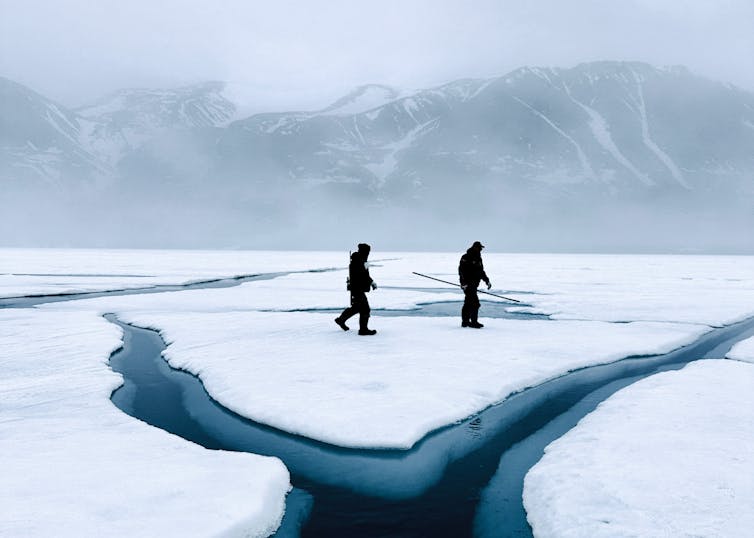
As temperatures rise, the timing of the ice thaw changes.
Vincent Denarie via Arctic Report Card

Matthew L. Druckenmiller, University of Colorado Boulder; Rick Thoman, University of Alaska Fairbanks, and Twila A. Moon, University of Colorado Boulder

The Arctic is transforming faster and with more far-reaching consequences than scientists expected just 20 years ago, when the first Arctic Report Card assessed the state of Earth’s far northern environment.

The snow season is dramatically shorter today, sea ice is thinning and melting earlier, and wildfire seasons are getting worse. Increasing ocean heat is reshaping ecosystems as non-Arctic marine species move northward. Thawing permafrost is releasing iron and other minerals into rivers, which degrades drinking water. And extreme storms fueled by warming seas are putting communities at risk.

The past water year, October 2024 through September 2025, brought the highest Arctic air temperatures since records began 125 years ago, including the warmest autumn ever measured and a winter and a summer that were among the warmest on record. Overall, the Arctic is warming more than twice as fast as the Earth as a whole.

Highlights from the National Oceanic and Atmospheric Administration’s 2025 Arctic Report Card.

For the 20th Arctic Report Card, we worked with the National Oceanic and Atmospheric Administration, an international team of scientists and Indigenous partners from across the Arctic to track environmental changes in the North – from air and ocean temperatures to sea ice, snow, glaciers and ecosystems – and the impacts on communities.

Together, these vital signs reveal a striking and interconnected transformation underway that’s amplifying risks for people who live there.

A wetter Arctic with more extreme precipitation

Arctic warming is intensifying the region’s water cycle.

A warmer atmosphere increases evaporation, precipitation and meltwater from snow and ice, adding and moving more water through the climate system. That leads to more extreme rainstorms and snowstorms, changing river flows and altering ecosystems.
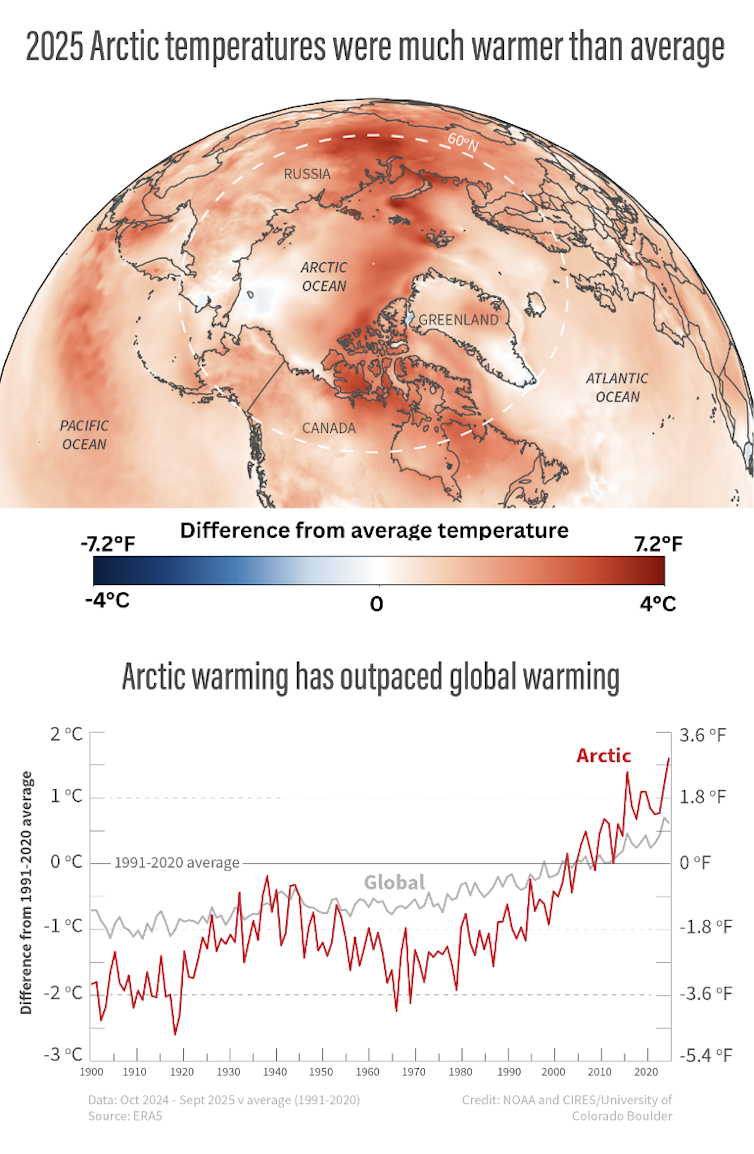
Charts show how the Arctic has warmed faster than the global average.
Arctic surface air temperatures are warming much faster than the global average.
NOAA and CIRES/University of Colorado Boulder.

The Arctic region saw record-high precipitation for the entire 2025 water year and for spring, with the other seasons each among the top-five wettest since at least 1950. Extreme weather – particularly atmospheric rivers, which are long narrow “rivers in the sky” that transport large amounts of water vapor – played an outsized role.

These wetter conditions are reshaping snow cover across the region.

Snow and ice losses accelerate warming, hazards

Snow blankets the Arctic throughout much of the year, but that snow cover isn’t lasting as long. In 2025, snowpack was above average in the cold winter months, yet rapid spring melting left the area covered by snow far smaller than normal by June, continuing a six-decade decline. June snow cover in recent years has been half of what it was in the 1960s.

Losing late spring snow cover means losing a bright, reflective surface that helps keep the Arctic cool, allowing the land instead to be directly warmed by the sun, which raises the temperature.
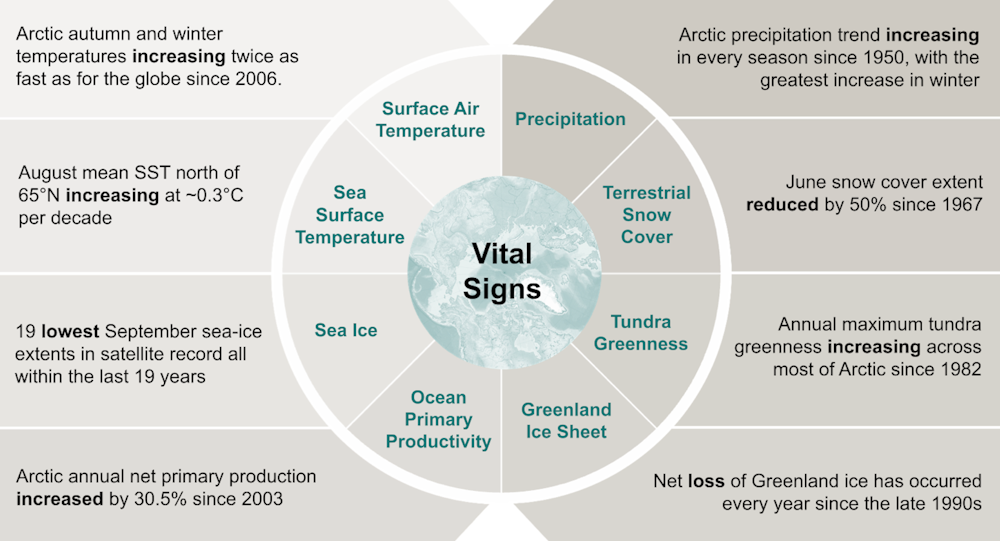
An illustration shows changes in sea level rise, temperature, precipitation, sea ice and other vital areas.
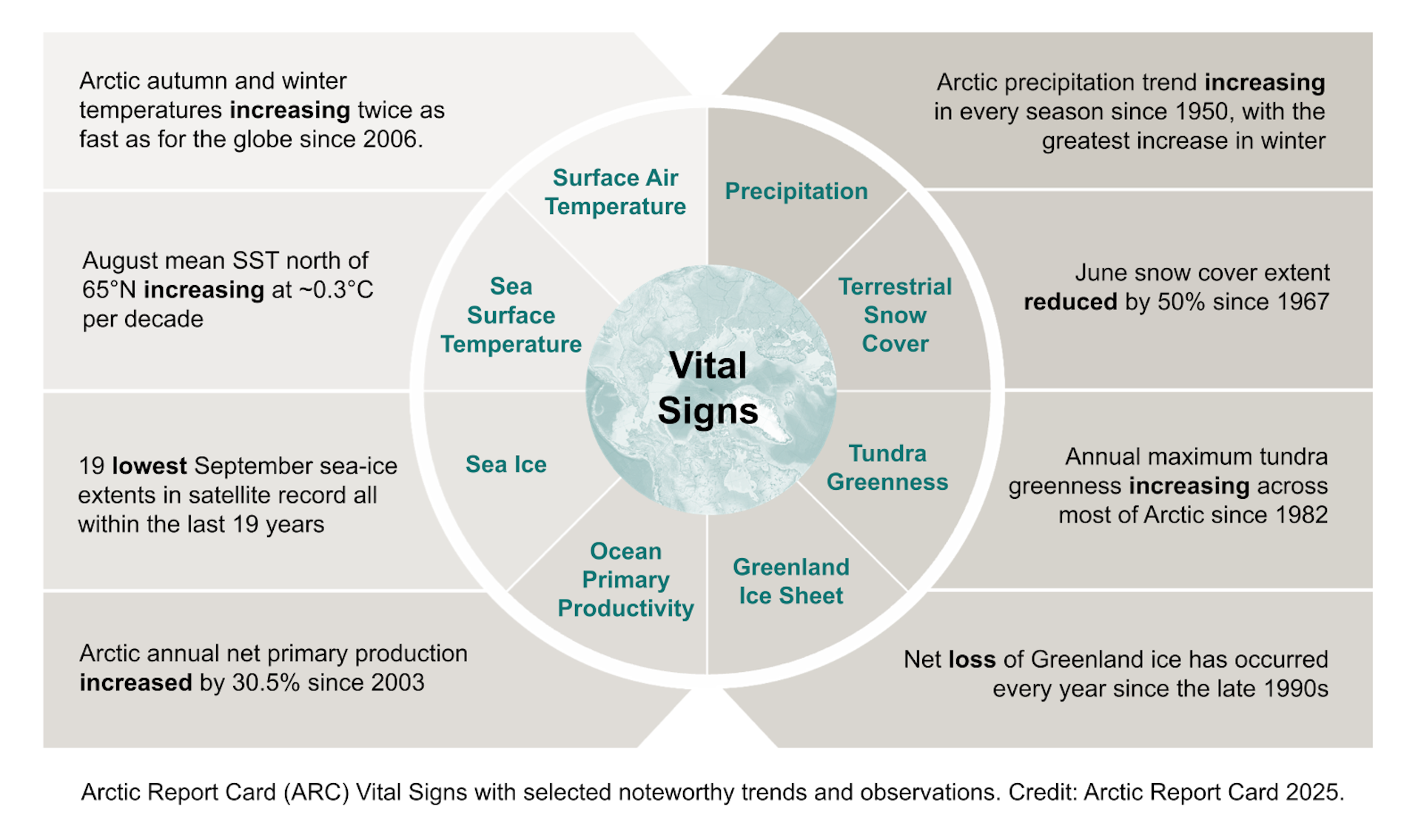
Eight vital signs and observations in 2025 from the 20th edition of the Arctic Report Card.
Arctic Report Card 2025

Sea ice tells a similar story. The year’s maximum sea ice coverage, reached in March, was the lowest in the 47-year satellite record. The minimum sea ice coverage, in September, was the 10th lowest.

Since the 1980s, the summer sea ice extent has shrunk by about 50%, while the area covered by the oldest, thickest sea ice – ice that has existed for longer than four years – has declined by more than 95%.

The thinner sea ice cover is more influenced by winds and currents, and less resilient against warming waters. This means greater variability in sea ice conditions, causing new risks for people living and working in the Arctic.
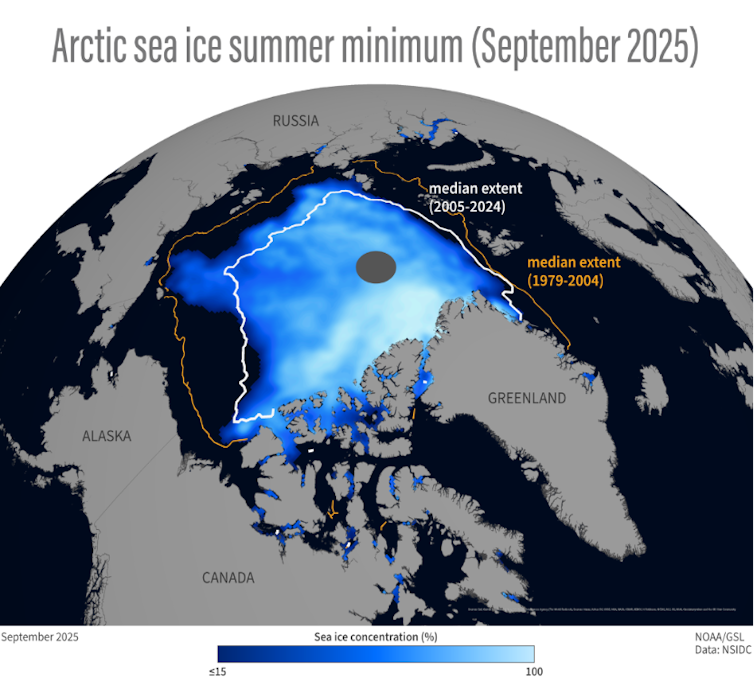
Map shows sea ice extent in 2025 and the 2005-2024 median is much smaller than the 1979-2004 median extent.
Arctic sea ice concentration in September 2025, during its annual minimum extent at the end of summer, was much smaller than the 1979-2004 median extent. The shades of blue reflect the concentration of sea ice.
NOAA and CIRES/University of Colorado Boulder.

The Greenland Ice Sheet continued to lose mass in 2025, as it has every year since the late 1990s. As the ice sheet melts and calves more icebergs into the surrounding seas, it adds to global sea-level rise.

Mountain glaciers are also losing ice at an extraordinary rate – the annual rate of glacier ice loss across the Arctic has tripled since the 1990s.

This poses immediate local hazards. Glacial lake outburst floods – when water that is dammed up by a glacier is suddenly released – are becoming more frequent. In Juneau, Alaska, recent outburst floods from Mendenhall Glacier have inundated homes and displaced residents with record-setting levels of floodwater.

A mountain view shows where the retreating glacier and possible permafrost thaw influenced valley walls exposed above open water.
An aerial photo shows the result of an Aug. 10, 2025, landslide at South Sawyer Glacier in Alaska. The light-colored area of the mountainside is where the slide occurred.
USGS

Glacier retreat can also contribute to catastrophic landslide impacts. Following the retreat of South Sawyer Glacier, a landslide in southeast Alaska’s Tracy Arm in August 2025 generated a tsunami that swept across the narrow fjord and ran nearly 1,600 feet (nearly 490 meters) up the other side. Fortunately, the fjord was empty of the cruise ships that regularly visit.

Record-warm oceans drive storms, ecosystem shifts

Arctic Ocean surface waters are steadily warming, with August 2025 temperatures among the highest ever measured. In some Atlantic-sector regions, sea surface temperatures were as much as 13 degrees Fahrenheit (7.2 Celsius) above the 1991-2020 average. Some parts of the Chukchi and Beaufort seas were cooler than normal.
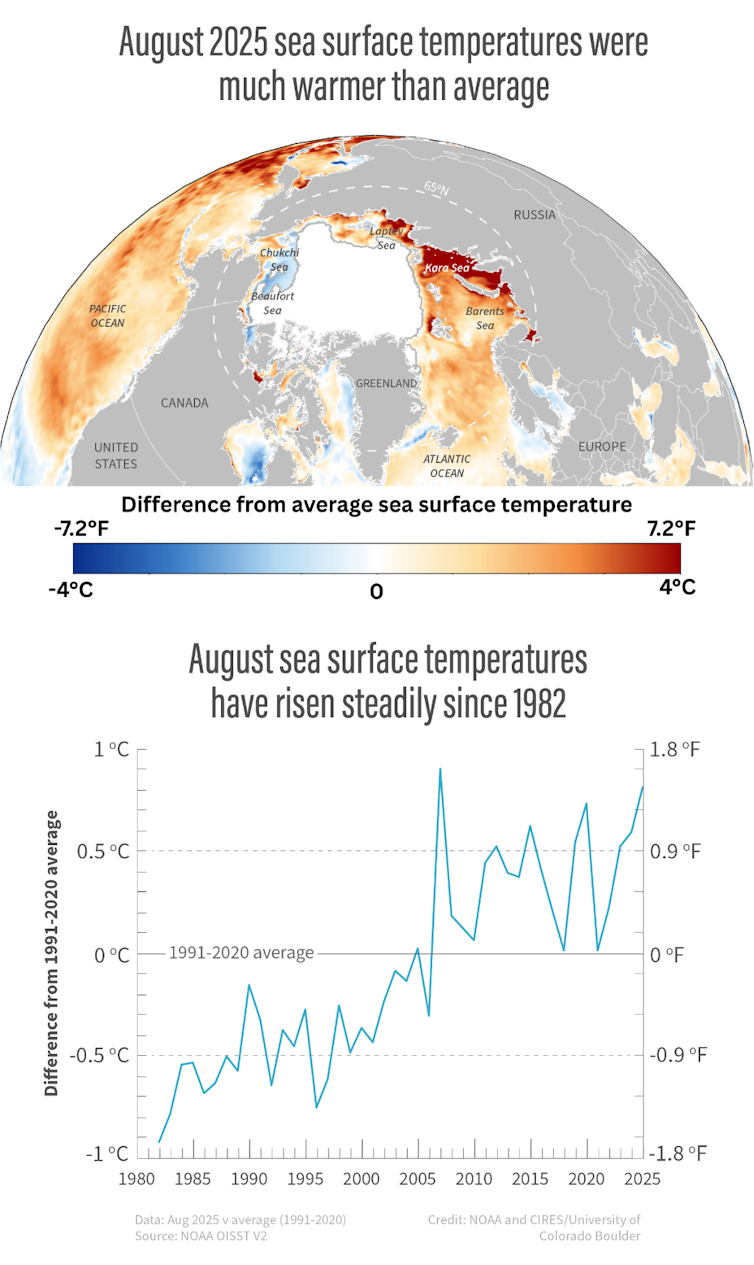
A map and chart show temperatures rising.
Arctic sea surface temperatures are much warmer today than in past decades, as this map and chart of August 2025 sea surface temperatures shows.
NOAA and CIRES/University of Colorado Boulder.

Warm water in the Bering Sea set the stage for one of the year’s most devastating events: Ex-Typhoon Halong, which fed on unusually warm ocean temperatures before slamming into western Alaska with hurricane-force winds and catastrophic flooding. Some villages, including Kipnuk and Kwigillingok, were heavily damaged.

As seas warm, powerful Pacific cyclones, which draw energy from warm water, are reaching higher latitudes and maintaining strength longer. Alaska’s Arctic has seen four ex-typhoons since 1970, and three of them arrived in the past four years.

A town with homes surrounded by water.
The village of Kipnuk, shown on Oct. 12, 2025, was devastated by ex-Typhoon Halong. The storm displaced at least 1,500 people from across western Alaska.
Alaska National Guard

The Arctic is also seeing warmer, saltier Atlantic Ocean water intrude northward into the Arctic Ocean. This process, known as Atlantification, weakens the natural layering of water that once shielded sea ice from deeper ocean heat. It is already increasing sea ice loss and reshaping habitat for marine life, such as by changing the timing of phytoplankton production, which provides the base of the ocean food web, and increasing the likelihood of harmful algal blooms.

From ocean ‘borealization’ to tundra greening

Warming seas and declining sea ice are enabling southern, or boreal, marine species to move northward. In the northern Bering and Chukchi seas, Arctic species have declined sharply – by two-thirds and one-half, respectively – while the populations of boreal species expand.

On land, a similar “borealization” is underway. Satellite data shows that tundra vegetation productivity – known as tundra greenness – hit its third-highest level in the 26-year record in 2025, part of a trend driven by longer growing seasons and warmer temperatures. Yet greening is not universal – browning events caused by wildfires and extreme weather are also increasing.
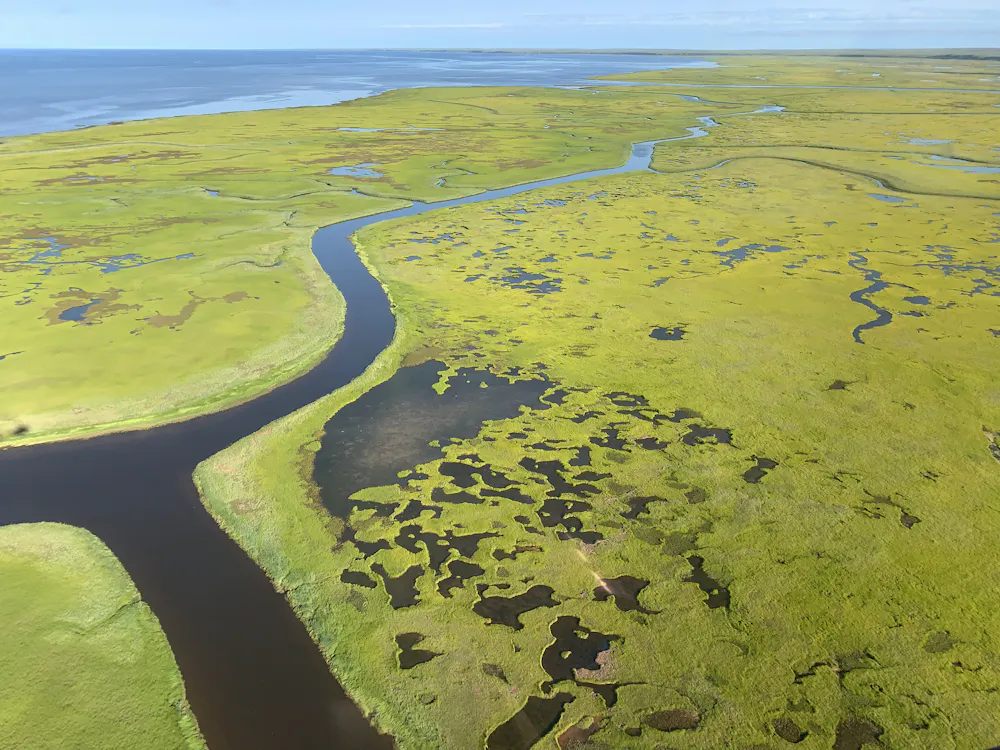
An aerial view of green land dotted with lakes and a river.
Coastal tundra vegetation on the Baldwin Peninsula of Alaska. The tundra is seeing longer growing seasons with warmer temperatures, leading to the overall ‘greening’ of the region.
G. V. Frost

Summer 2025 marked the fourth consecutive year with above-median wildfire area across northern North America. Nearly 1,600 square miles (over 4,000 square kilometers) burned in Alaska and over 5,000 square miles (over 13,600 square kilometers) burned in Canada’s Northwest Territories.

Permafrost thaw is turning rivers orange

As permafrost – the frozen ground that underlies much of the Arctic – continues its long-term warming and thaw, one emerging consequence is the spread of rusting rivers.

As thawing soils release iron and other minerals, more than 200 watersheds across Arctic Alaska now show orange discoloration. These waters exhibit higher acidity and elevated levels of toxic metals, which can contaminate fish habitat and drinking water and impact subsistence livelihoods.

In Kobuk Valley National Park in Alaska, a tributary to the Akillik River lost all its juvenile Dolly Varden and slimy sculpin fish after an abrupt increase in stream acidity when the stream turned orange.
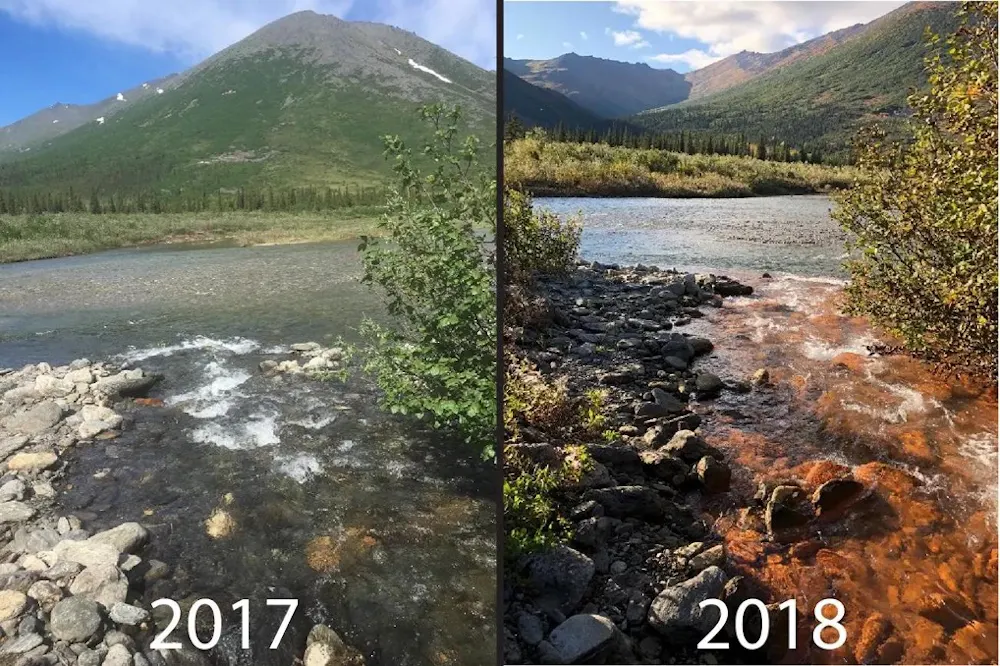
Side-by-side images show the same stream a year apart, one with rust-colored water.
Rust-colored water in a tributary of the Akillik River in Kobuk Valley National Park reflects permafrost thaw releasing metals into the water.
National Park Service/Jon O’Donnell

Arctic communities lead new monitoring efforts

The rapid pace of change underscores the need for strong Arctic monitoring systems. Yet many government-funded observing networks face funding shortfalls and other vulnerabilities.

At the same time, Indigenous communities are leading new efforts.

The Arctic Report Card details how the people of St. Paul Island, in the Bering Sea, have spent over 20 years building and operating their own observation system, drawing on research partnerships with outside scientists while retaining control over monitoring, data and sharing of results. The Indigenous Sentinels Network tracks environmental conditions ranging from mercury in traditional foods to coastal erosion and fish habitat and is building local climate resilience in one of the most rapidly changing environments on the planet.

A group of people with binoculars watch the water.
Observers with the Indigenous Sentinel Network, together with National Oceanic and Atmospheric Administration scientists, monitor the population and health of northern fur seals on St. Paul Island.
Hannah-Marie Ladd, CC BY

The Arctic is facing threats from more than the changing climate; it’s also a region where concerns of ecosystem health and pollutants come sharply into view. In this sense, the Arctic provides a vantage point for addressing the triple planetary crisis of climate change, biodiversity loss and pollution.

The next 20 years will continue to reshape the Arctic, with changes felt by communities and economies across the planet.The Conversation

Matthew L. Druckenmiller, Senior Scientist, National Snow and Ice Data Center (NSIDC), Cooperative Institute for Research in Environmental Sciences (CIRES), University of Colorado Boulder; Rick Thoman, Alaska Climate Specialist, University of Alaska Fairbanks, and Twila A. Moon, Deputy Lead Scientist, National Snow and Ice Data Center (NSIDC), Cooperative Institute for Research in Environmental Sciences (CIRES), University of Colorado Boulder

This article is republished from The Conversation under a Creative Commons license. Read the original article.

Ticker Views

Business class battles and ultra long-haul flights with Simon Dean

Aviation expert Simon Dean shares insights on premium travel trends, business class, and the future of ultra-long-haul flights.

Published

on

Aviation expert Simon Dean shares insights on premium travel trends, business class, and the future of ultra-long-haul flights.


From the latest trends in premium travel to the rise of ultra-long-haul flights, aviation reviewer Simon Dean from Flight Formula shares his firsthand insights on the airlines leading the charge.

We dive into what makes a great business class experience, and whether first class is still worth it in 2026.

Simon breaks down common passenger misconceptions about premium cabins and explores how airlines are redesigning business class for comfort on the world’s longest flights.

He also gives a sneak peek into what excites—and worries him—about Qantas Project Sunrise, set to redefine ultra long haul travel.

Finally, we discuss the future of premium aviation: will ultra-long-haul flights become the new normal or remain a niche experience?

Subscribe to never miss an episode of Ticker – https://www.youtube.com/@weareticker

#BusinessClass #UltraLongHaul #ProjectSunrise #AviationReview #FirstClass #AirlineTrends #TravelInsights #FlightFormula


Download the Ticker app

Continue Reading

Ticker Views

Trump’s expanding executive power raises alarms over Congress’ role

Published

on

Congress’ power has been diminishing for years, leaving Trump to act with impunity

Samuel Garrett, University of Sydney

A year into US President Donald Trump’s second term, his record use of executive orders, impoundment of government spending, and military interventions in Venezuela and Iran have sparked criticisms from Democrats and even some Republicans. They say he is unconstitutionally sidelining Congress.

As Trump increasingly wields his power unilaterally, some have wondered what the point of Congress is now. Isn’t it supposed to act as a check on the president?

But the power of the modern presidency had already been growing for decades. Successive presidents from both parties have taken advantage of constitutional vagaries to increase the power of the executive branch. It’s a long-running institutional battle that has underwritten US political history.

The years-long erosion of Congress’ influence leaves the president with largely unchecked power. We’re now seeing the consequences.

A fraught relationship

Congress is made up of the House of Representatives and the Senate. Under the US Constitution, it’s the branch of the government tasked with making laws. It’s supposed to act as a check on the president and the courts.

It can pass legislation, raise taxes, control government spending, review and approve presidential nominees, advise and consent on treaties, conduct investigations, declare war, impeach officials, and even choose the president in a disputed election.

But the Constitution leaves open many questions about where the powers of Congress end and the powers of the president begin.

In a 2019 ruling on Trump’s tax returns, the judge commented:

disputes between Congress and the President are a recurring plot in our national story. And that is precisely what the Framers intended.

Relative power between the different branches of the US government has changed since independence as constitutional interpretations shifted. This includes whether the president or Congress takes the lead on making laws.

Although Congress holds legislative power, intense negotiations between Congress and the executive branch (led by the president) are now a common feature of US lawmaking. Modern political parties work closely with the president to design and pass new laws.

Redefining the presidency

By contrast, presidents in the 19th and early 20th centuries generally left Congress to lead policymaking. Party “czars” in Congress dominated the national legislative agenda.

Future president Woodrow Wilson noted in 1885 that Congress:

has entered more and more into the details of administration, until it has virtually taken into its own hands all the substantial powers of government.

Wilson and Franklin Roosevelt after him would later help to redefine the president not only as the head of the executive branch, but as head of their party and of the government.

In the 1970s, in the wake of the Watergate scandal and secret bombing of Cambodia, Congress sought to expand its oversight over what commentators suggested was becoming an “imperial presidency”.

This included the passage of the 1973 War Powers Resolution, designed to wrest back Congressional control of unauthorised military deployments.

Nevertheless, the Clinton, George W. Bush and Obama administrations all argued that Congressional authorisation was not required for operations in Kosovo, Iraq and Libya (though Bush still sought authorisation to secure public support).

In turn, the Trump administration argued its actions in Venezuela were a law-enforcement operation, to which the resolution does not apply.

Why presidents bypass Congress

Historically, presidents have sought to bypass Congress for reasons of personality or politics. Controversial decisions that would struggle to pass through Congress are often made using executive orders.

Obama’s 2011 “We Can’t Wait” initiative used executive orders to enact policy priorities without needing to go through a gridlocked Congress. One such policy was the 2012 creation of the DACA program for undocumented immigrants.

Franklin Roosevelt’s use of executive orders dwarfed that of his predecessors. He issued eight times as many orders in his 12-year tenure than were signed in the first 100 years of the United States’ existence.

The question of what constitutes a genuine threat to the preservation of the nation is especially pertinent now. More than 50 “national emergencies” are currently in effect in the United States.

This was the controversial basis of Trump’s tariff policy under the International Emergency Economic Powers Act. It bypassed Congressional approval and is now being considered by the Supreme Court.

Recent presidents have also increasingly claimed executive privilege to block Congress’ subpoena power.

Institutional wrestling

Institutional wrestling is a feature of Congressional relations with the president, even when the same party controls the White House and both chambers of the legislature, as the Republican party does now.

While Roosevelt dominated Congress, his “court-packing plan” to take control of the US Supreme Court in 1937 proved a bridge too far, even for his own sweeping Democratic majorities. The Democrats controlled three quarters of both the House and Senate and yet refused to back his plan.

More recently, former Democrat Speaker Nancy Pelosi delivered many of Barack Obama’s early legislative achievements, but still clashed with the president in 2010 over congressional oversight.

As House minority leader, she rallied many Democrats against Obama’s US$1.1 trillion (A$1.6 trillion) budget proposal in 2014. Obama was forced to rely on Republican votes in 2015 to secure approval for the Trans-Pacific Partnership, despite his heavy lobbying of congressional Democrats.

Even today’s Congress, which has taken Trump’s direction at almost every turn, demonstrated its influence perhaps most notably by forcing the president into a backflip on the release of the Epstein files after a revolt within Trump’s supporters in the Republican party.

Given the extremely slim Republican majority in Congress, the general unity of the Republican party behind Trump has been a key source of his political strength. That may be lost if public opinion continues to turn against him.

Is Trump breaking the rules?

Trump and his administration have taken an expansive view of presidential power by regularly bypassing Congress.

But he’s not the first president to have pushed the already blurry limits of executive power to redefine what is or is not within the president’s remit. The extent to which presidents are even bound by law at all is a matter of long running academic debate.

Deliberate vagaries in US law and the Constitution mean the Supreme Court is ultimately the arbiter of what is legal.

The court is currently the most conservative in modern history and has taken a sweeping view of presidential power. The 2024 Supreme Court ruling that presidents enjoy extensive immunity suggests the president is, in fact, legally able to do almost anything.

Regardless, public opinion and perceptions of illegality continue to be one of the most important constraints on presidential action. Constituents can take a dim view of presidential behaviour, even if it’s not technically illegal.

Even if Trump can legally act with complete authority, it’s public opinion — not the letter of the law — that may continue to shape when, and if, he does so.The Conversation

Samuel Garrett, Research Associate, United States Studies Centre, University of Sydney

This article is republished from The Conversation under a Creative Commons license. Read the original article.

Continue Reading

Ticker Views

DOJ to charge Don Lemon under historic KKK Act

DOJ plans to charge Don Lemon under KKK Act, emphasizing civil rights law’s relevance and implications for legal enforcement.

Published

on

DOJ plans to charge Don Lemon under KKK Act, emphasizing civil rights law’s relevance and implications for legal enforcement.


The Department of Justice has announced plans to charge Don Lemon under the Ku Klux Klan Act, a landmark federal civil rights law designed to protect citizens from intimidation and violence.

This unprecedented move highlights the continued relevance of civil rights statutes in modern America.

We break down the implications of the DOJ’s decision, exploring how the KKK Act functions, its enforcement mechanisms, and the potential consequences for individuals charged under it. Legal experts weigh in on why this act remains a critical tool for safeguarding civil liberties.

For deeper insight, we speak with Oz Sultan from Sultan Interactive Group to unpack the historical context, recent developments, and what this could mean for civil rights enforcement going forward.

Subscribe to never miss an episode of Ticker – https://www.youtube.com/@weareticker

#DonLemon #KKKAct #CivilRights #DOJ #LegalNews #BreakingNews #USPolitics #TickerNews


Download the Ticker app

Continue Reading

Trending Now