
Money
Why are Virgin Galactic shares crashing after world-first space flight?

Just over 24 hours since billionaire Richard Branson made history and took off into space and Virgin Galactic stock has plummeted from the sky
Shares in Virgin Galactic rose over 200 per cent in the two months ahead of Sunday’s world first flight.
The luck for the space tourism company continued with a stock climb of about 9 per cent in Monday’s pre-market trading.
However, shares took a steep fall around 17 per cent during the regular session on Monday.
The stock’s move feels odd given the success the company had on Sunday.
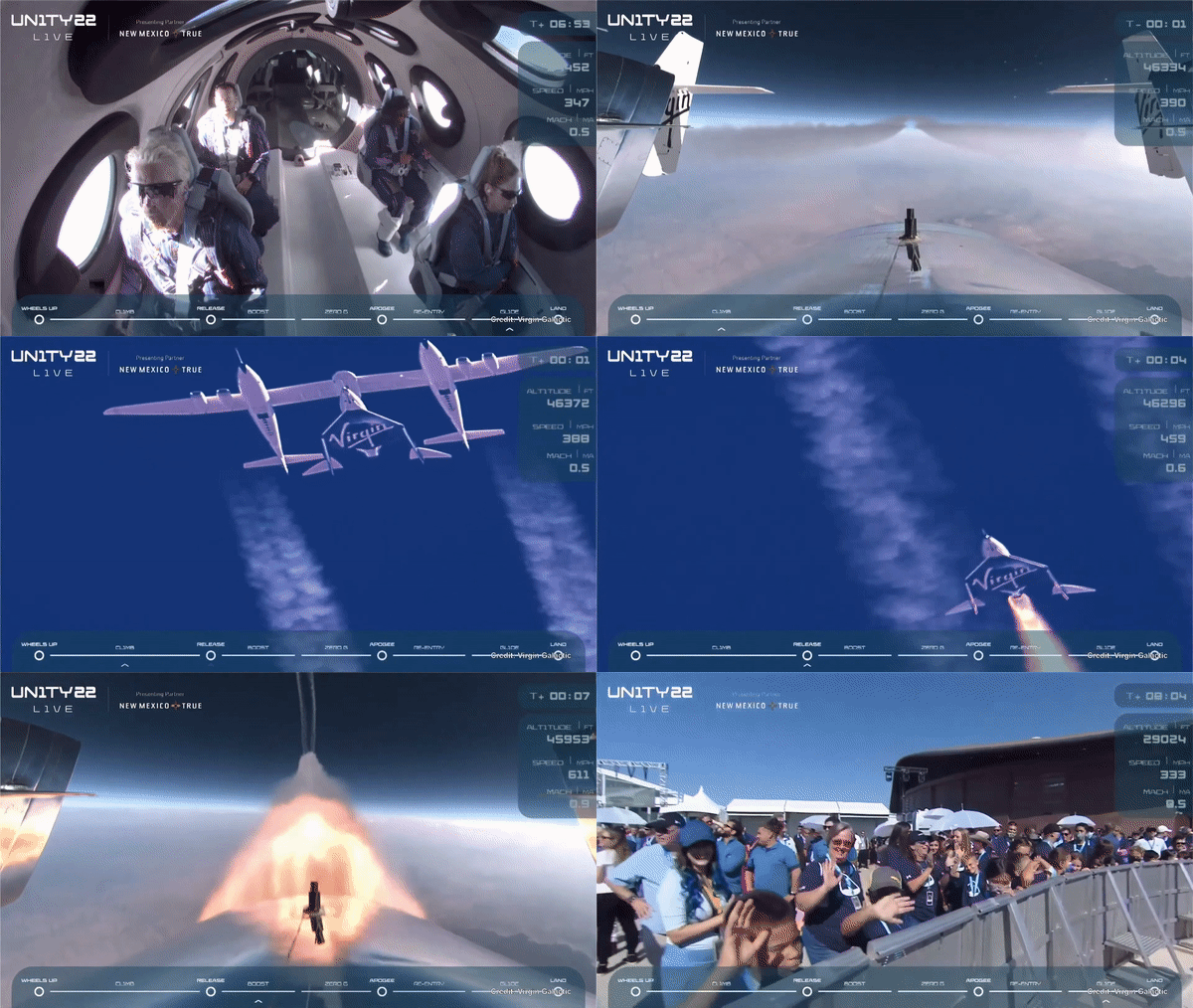
The landmark flight to the edge of space opened up a new frontier for commercial space travel in a race between billionaires that has investors eye’s peeled.
Part of the reason for the fall may have to do with Virgin Galactic’s plans to sell more stock.
Market Expert Christopher Uhl joined ticker news and says there are simply no more buyers willing to pay higher prices for Virgin Galactic stock, now that the huge event of heading to the skies has passed.
“I was once a kid with a dream”: Richard Branson blasts into space
Well he finally did it. 17 years after Richard Branson first launched Virgin Galactic, the thrill-seeking billionaire has taken to the skies and reached space.
In his boldest adventure yet, the 70 year old Richard Branson took off for the first stage of the flight.
On the ground, about 500 people watched on, including Richard Branson’s wife, children and grandchildren.
On board were his five crewmates from his Virgin Galactic space tourism company.
The space plane detached from the mother ship at an altitude of about 13km and fired its engine, reaching the edge of space about 88km up.
After a few minutes of weightlessness for the crew, the space plane is began its decent, set to end with a glide to a runway landing.
Richard Branson couldn’t contain his excitement, as he spoke on the journey back to earth.
He thanked his crew and remembered all those who had worked on the mammoth project.
After a decade of promises, the moment finally came for Richard Branson to unveil his spaceship for the people.
He said on board:: “To all you kids down there, I was once a kid with a dream. Now I’m up here, in a space ship!”
Customer spaceflight experience
As Branson took to space onboard Virgin Galactic, his official role for the journey will be “evaluating customer spaceflight experience”.
And that’s an important role – after all anyone who wants to rise Virgin Galactic will need to part with a quarter of a million dollars first, and that price is expected to rise.
Along with the two pilots, there is room for six passengers with a flight time of about an hour and a half.
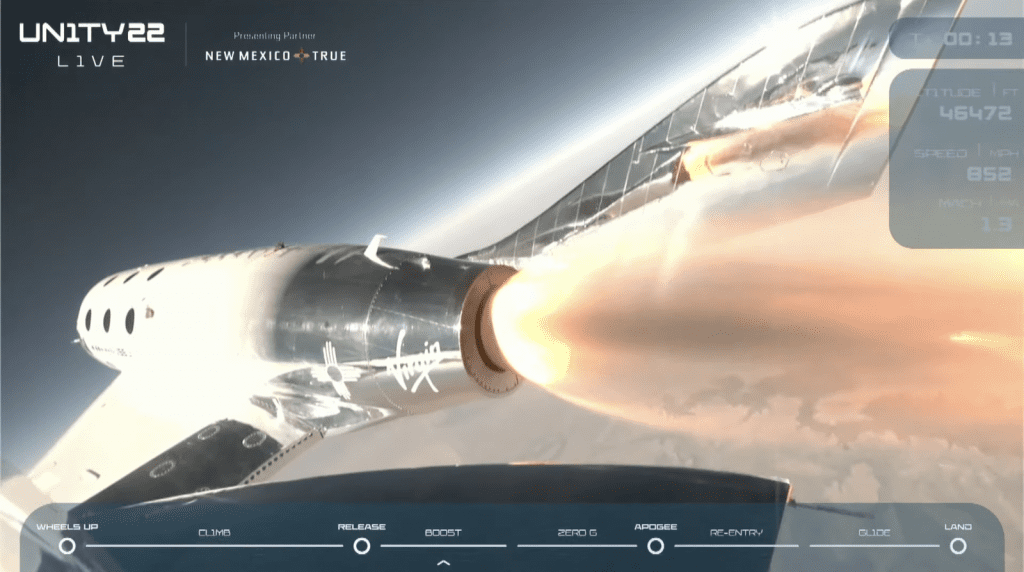
The spaceship will just go over the 82 kilometres, which is where the US recognises someone as having been into space.
Then, passengers will get to experience about six minutes of weightlessness and seeing the curvature of the Earth and the darkness of space.
They will then descend, landing on a runway much like the old space shuttle or a normal passenger plane.
The new space race
Richard Branson’s adventure will pre-empt next week’s first flight for Blue Origin, as Jeff Bezos launches his space dreams.
Jeff and Blue Origin are promising a completely different experience for their customers.
Blue Origin’s New Shepard, which has no pilots and room for six passengers, reaches more than 100 kilometres high, which is the internationally recognised boundary of space
Passengers on Blue Origin will get about three minutes to float around and feel like they are in space.
Might be half the time, but the price is 50,000 dollars cheaper than flying on Virgin Galactic.
But either way, the expensive thrill ride marks the beginning of earth’s commercial passenger trips into space.
Virgin Galactic doesn’t expect to start flying customers before next year.

-
 Tech4 days ago
Nvidia to double chip sales next year
-
News4 days ago
Qantas fights against holiday ground crew strikes
-
Shows1 day ago
Confidence in Slough’s regeneration and community growth
-
News1 day ago
Ukraine conducts largest drone attack on Moscow
-
News1 day ago
Trump proposes new AI Force amid AI debate
-
News4 days ago
Canada’s potential EU membership sparks discussion
-
Shows5 days ago
Why traditional property investment strategies need updating
-
Ticker Views4 days ago
One Nation controversy puts political messaging under the spotlight