
Connect with us
https://tickernews.co/wp-content/uploads/2023/10/AmEx-Thought-Leaders.jpg

News

The actors who had their Oscars revoked, or refused to accept

Published

on

Imagine you’re called up on stage to receive the honour of a lifetime – an Academy award – but instead of thanking everyone you know, you decide to take a stand.

To date, just three people have rejected an Oscar out of well over 2,000 winners.

So let’s start with them.

Dudley Nichols – 1935 Oscar for Best Screenplay

The first person to reject an Oscar was screenwriter Dudley Nichols, who won for Best Screenplay for the 1935 film, ‘The Informer’. Set during the Irish War Of Independence and adapted from the novel of the same name by Liam O’Flaherty, John Ford would go on to win Best Director with Nichols winning Best Screenplay.

Nichols refused to accept the Oscar and cited an ongoing writer’s strike in Hollywood as his reason.

George C. Scott shows his feelings.

George C. Scott – 1971 Oscar for Best Actor

Scott famously called the Oscars “a two-hour meat parade, a public display with contrived suspense for economic reasons,” and sent a telegram to the Academy telling them that he’d be refusing the award.

Scott, who was noted for his utter distaste for the entire ceremony.
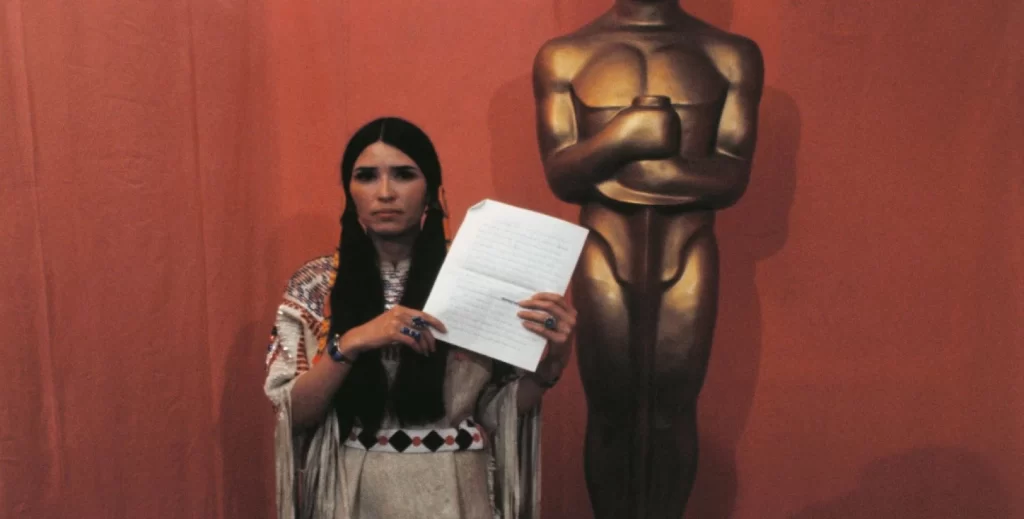
Sacheen Littlefeather displays the hand-written speech from Marlon Brando.

Marlon Brando – 1973 Oscar for Best Actor

In 1973, perhaps one of the most famous moments in Oscar history occurred. Marlon Brando, another heavy favourite to win the Academy Award for Best Actor for his performance in ‘The Godfather’, was announced as the winner.

But Brando didn’t turn up to the Academy Awards – as an added gesture, he sent Sacheen Littlefeather in his stead.

Then there are the very rare instances where the Academy has revoked a nomination. 

Hondo (1953)

In 1954, the John Wayne western Hondo was nominated for Best Story. The film was later disqualified when it was discovered that the script was based on a short story called “The Gift of Cochise.” What a story.

Tuba Atlantic (2010)

Tuba Atlantic is a 25-minute Norwegian short film about a 70-year-old man who only has six days to live and spends that time reconciling with his estranged family.

It was nominated for Best Live Action Short Film in 2012, but the nomination was wa later revoted because the film appeared on TV before movie cinemas. And at the Oscars, film comes first.

13 Hours (2016)

In 2017, 13 Hours earned a single Oscar nomination for Best Achievement in Sound Mixing, with four members of the sound team (Gary Summers, Jeffrey J. Haboush, Mac Ruth, and Greg P. Russell) singled out for their work.

But just one day before the ceremony — the Academy announced that they were rescinding Russell’s nomination as a result of “telephone lobbying.”

Upon recommendation by the Sound Branch Executive Committee, the Academy’s Board of Governors voted to rescind the Sound Mixing nomination for Greg P. Russell from 13 Hours: The Secret Soldiers of Benghazi for violation of Academy campaign regulations. The decision was prompted by the discovery that Russell had called his fellow members of the Sound Branch during the nominations phase to make them aware of his work on the film, in direct violation of a campaign regulation that prohibits telephone lobbying.

Academy awards statement

Will Smith apologises to Chris Rock

News

AI stocks surge amid market shifts and spending warnings

AI sector drives economic growth; Meta adjusts strategy, Palantir’s valuation sparks questions, and Nvidia leads amid rising competition.

Published

on

AI sector drives economic growth; Meta adjusts strategy, Palantir’s valuation sparks questions, and Nvidia leads amid rising competition.


The artificial intelligence sector continues to be a major driver of growth for both the U.S. and global economies. Companies at the forefront of AI innovation are influencing market trends and reshaping industries worldwide.

Meta’s stock has rebounded slightly following reports of potential cost-cutting measures and job reductions in its Reality Labs division. Investors are watching closely as the company adjusts its strategy to manage rising expenses and optimize innovation.

Palantir is trading at over 120 times forward sales and 180 times forward earnings, signaling investor confidence but also raising questions about valuation risks. Meanwhile, Nvidia maintains a market cap of $4.2 trillion as a leading AI chip supplier, yet competition is ramping up.

These moves highlight the growing tension between tech giants’ AI ambitions and the practical need to balance profits with heavy R&D spending.

Some analysts, however, warn that rapid growth may not be sustainable, with current levels of AI-related spending potentially overshooting realistic returns.

Subscribe to never miss an episode of Ticker – https://www.youtube.com/@weareticker

#AIStocks #TechInvesting #Nvidia #Meta #Palantir #ArtificialIntelligence #StockMarket #TickerNews


Download the Ticker app

Continue Reading

News

AI investments set to surge in 2026 as companies target productivity gains

Analysts forecast $500 billion AI investment by 2026, transforming corporate spending priorities and enhancing economic productivity.

Published

on

Analysts forecast $500 billion AI investment by 2026, transforming corporate spending priorities and enhancing economic productivity.


Analysts predict that artificial intelligence companies could invest over $500 billion in 2026, signaling a major shift in corporate spending priorities. This surge in capital allocation comes as businesses look to harness AI to drive growth and efficiency across multiple sectors.

Following strong third-quarter earnings, overall capital spending estimates for 2026 have been revised upward. However, investors are becoming more selective, focusing on companies that can clearly demonstrate revenue benefits from their AI investments, separating hype from tangible results.

AI adoption is expected to boost economic productivity, with significant investment already flowing into AI infrastructure such as semiconductors and data centres. The coming year could redefine how companies leverage technology to gain a competitive edge.

Subscribe to never miss an episode of Ticker – https://www.youtube.com/@weareticker

#AIInvestment #TechGrowth #FutureEconomy #DataCenters #Semiconductors #ArtificialIntelligence #ProductivityBoost #CapitalSpending


Download the Ticker app

Continue Reading

News

Stocks, AI and the economy: What to expect in 2026

2025’s market turmoil analyzed: AI hype, tariffs, global politics, and Federal Reserve impacts—tune in for expert insights!

Published

on

2025’s market turmoil analyzed: AI hype, tariffs, global politics, and Federal Reserve impacts—tune in for expert insights!


2025 has been a rollercoaster for investors, with AI hype, tariffs, and global politics shaking up markets. We break down what these trends mean for your portfolio and the risks ahead.

Joining us for insights is Kyle Rodda from Capital.com, who explains how Treasury yields, unemployment data, and inflation readings are shaping investor sentiment. We also dive into what the Federal Reserve’s recent moves could mean for 2026.

From the potential impact of a 43-day government shutdown to payroll numbers and market expectations, this episode gives you the clarity you need to navigate the next year in stocks.

Subscribe to never miss an episode of Ticker – https://www.youtube.com/@weareticker

#StockMarket #Investing2026 #AIStocks #FederalReserve #EconomyWatch #MarketTrends #FinanceNews #TreasuryYields


Download the Ticker app

Continue Reading

Trending Now