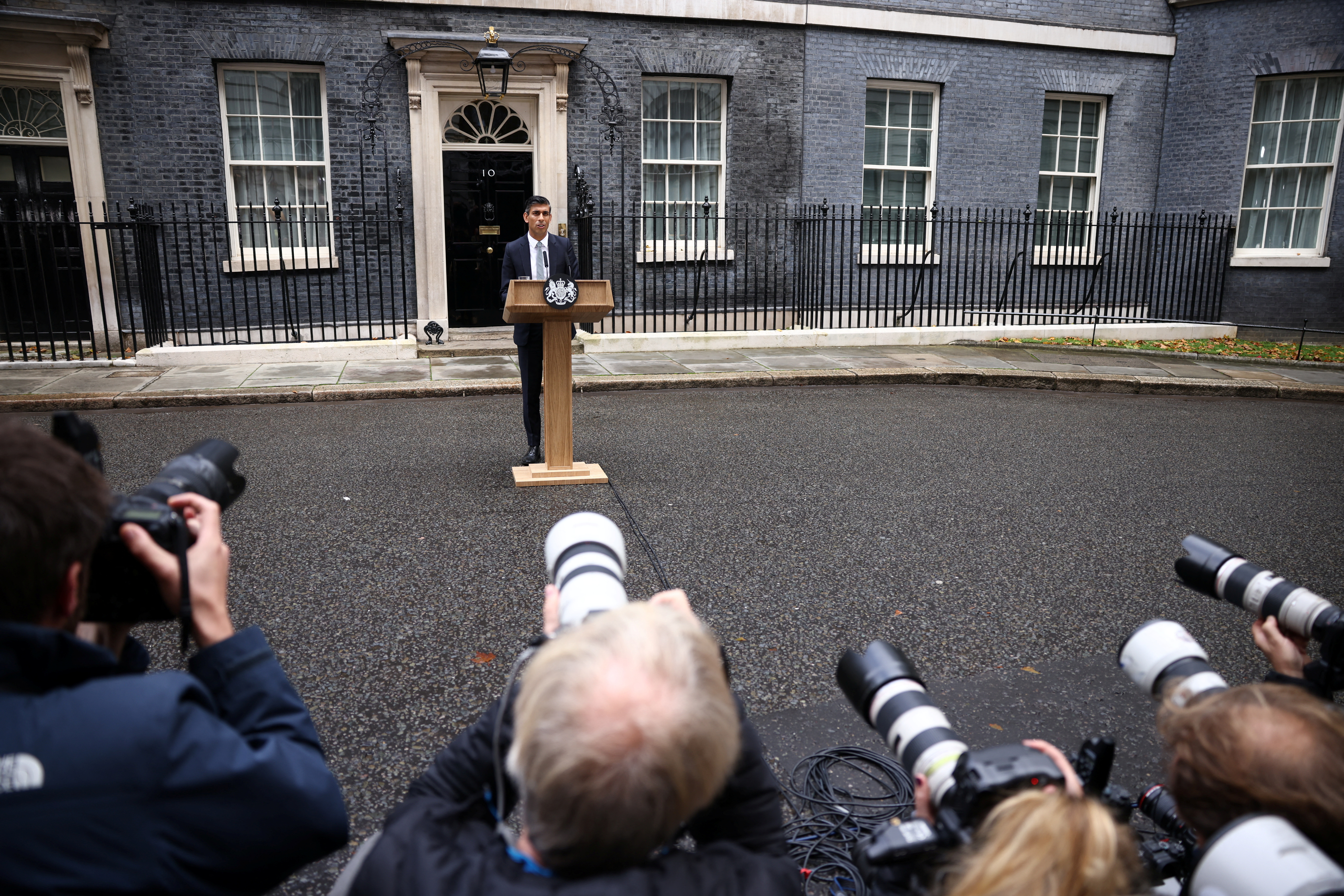
Sunak has also begun reshuffling his cabinet, as UK residents feel the pinch of what is a “profound economic crisis”.
Jeremy Hunt will stay on as chancellor, a position he acquired after Kwasi Kwarteng’s disastrous mini-budget.
Suella Braverman will once again be home secretary just days after sensationally resigning from this very role.
Dominc Raab is deputy PM and justice secretary, while Michael Gove is levelling up secretary.
Grant Shapps is the new business secretary, with Sunak’s former leadership rival Penny Mordaunt staying on as leader of the House of Commons.
Mistakes have been made
Speaking outside his new home, 10 Downing Street, Sunak paid tribute to his predecessor, Liz Truss, while also acknowledging mistakes have been made.
“Our country is facing a profound economic crisis. The aftermath of COVID still lingers. Putin’s war in Ukraine has destabilised energy markets and supply chains the world over,” Sunak said.
“I will place economic stability and confidence at the heart of this government’s agenda. This will mean difficult decisions to come.
“I want to pay tribute to my predecessor Liz Truss. She was not wrong to want to improve growth in this country. It is a noble aim. And I admired her restlessness to create change.
“But some mistakes were made — not born of ill will, or bad intentions. Quite the opposite, in fact. But mistakes, nonetheless. And I have been elected as leader of my party and your prime minister, in part to fix them.”
William is an Executive News Producer at TICKER NEWS, responsible for the production and direction of news bulletins. William is also the presenter of the hourly Weather + Climate segment.
With qualifications in Journalism and Law (LLB), William previously worked at the Australian Broadcasting Corporation (ABC) before moving to TICKER NEWS. He was also an intern at the Seven Network's 'Sunrise'.
A creative-minded individual, William has a passion for broadcast journalism and reporting on global politics and international affairs.

Australia’s social media ban leads to 4.7 million teen account closures, prompting debate over online safety and freedom.
Nearly five million social media accounts belonging to Australian teenagers have been closed since the nation’s social media ban began in December. Platforms such as Instagram and TikTok were responsible for removing around 4.7 million accounts held by minors, according to the eSafety Commissioner.
Prime Minister Anthony Albanese described the figures as encouraging, highlighting the government’s commitment to protecting children online. The new law holds social media companies accountable, with fines imposed on platforms that fail to prevent underage accounts from being created or maintained.
Despite these measures, some teenagers have reportedly bypassed the restrictions by falsifying their ages or using parental information. The debate continues over the effectiveness of these regulations and the balance between safety and online freedom.
Subscribe to never miss an episode of Ticker – https://www.youtube.com/@weareticker
Protests in Iran escalate as citizens demand women’s rights; Rabbi Cooper discusses global solidarity and advocacy efforts.
Amid escalating protests in Iran, citizens are risking everything to demand women’s rights and basic freedoms. The world watches as these demonstrations grow, with many hoping for meaningful change in the face of a brutal regime.
We speak with Rabbi Abraham Cooper from the Simon Wiesenthal Center about the advocacy work supporting Iranian voices and the historical context of defending human rights. He explains the vital role of international solidarity and how governments and communities can respond.
From the human cost on the ground to the influence of the Iranian diaspora in Los Angeles, this interview sheds light on the stakes, the movement, and why public attention is critical.
Subscribe to never miss an episode of Ticker – https://www.youtube.com/@weareticker
Greenland, Denmark assert Arctic island not for sale, emphasizing cooperation with the US on their own terms.
Greenland and Denmark have used high-level talks in Washington, D.C. to firmly restate that the Arctic island is not for sale, pushing back against long-standing US interest in the strategically vital territory.
Foreign ministers from both Greenland and Denmark acknowledged that major disagreements remain following discussions with US officials, despite what they described as constructive engagement on shared priorities.
Greenland’s government made clear it is open to closer cooperation with Washington, but only on its own terms, rejecting any suggestion of ownership or control.
Subscribe to never miss an episode of Ticker – https://www.youtube.com/@weareticker