News
Oil prices fall as Iran opens Strait of Hormuz
U.S. oil prices drop below $84 as Iran opens Strait of Hormuz, easing supply concerns amid Middle East conflict

U.S. oil prices drop below $84 as Iran opens Strait of Hormuz, easing supply concerns amid Middle East conflict
– Oil prices fell after Iran confirmed the Strait of Hormuz is open amid regional tensions.
– U.S. crude oil futures dropped nearly 12%, while analysts warn of potential supply disruptions from ongoing conflicts.
Oil prices have dropped significantly after Iran’s foreign minister announced that the Strait of Hormuz is “completely open” amid ongoing tensions in the region.
Foreign Minister Seyed Abbas Araghchi’s statement raised expectations of reduced supply disruptions during a ceasefire between Israel and Lebanon.
In line with the ceasefire in Lebanon, the passage for all commercial vessels through Strait of Hormuz is declared completely open for the remaining period of ceasefire, on the coordinated route as already announced by Ports and Maritime Organisation of the Islamic Rep. of Iran.
— Seyed Abbas Araghchi (@araghchi) April 17, 2026
Oil price drop
U.S. crude oil futures for May fell nearly 12%, closing at $83.85 per barrel, while the Brent benchmark for June dropped 9% to $90.38 per barrel.
In a statement on social media, Araghchi outlined that vessels through the Strait must adhere to a route set by Iran’s maritime authorities.

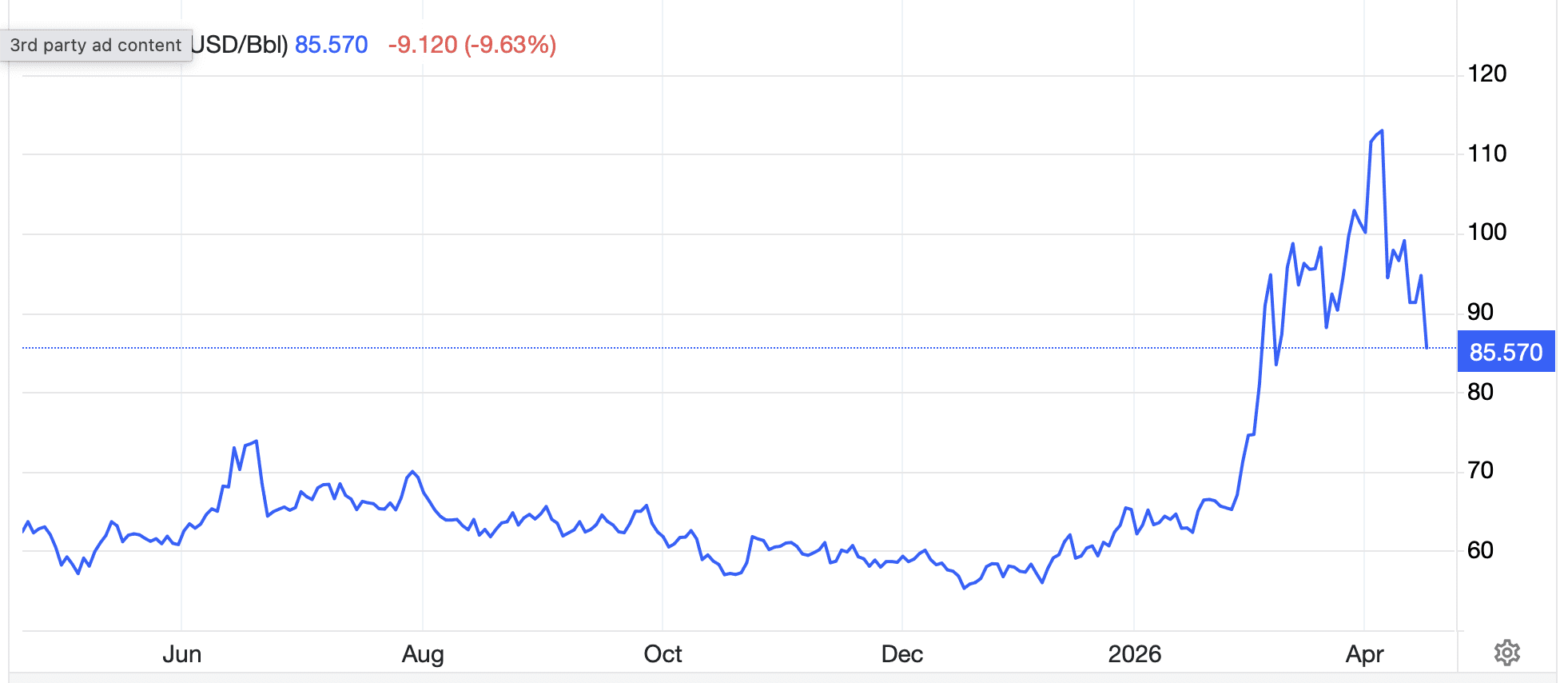
The oil price drops after the Strait of Hormuz reopens.
U.S. President Donald Trump acknowledged Iran’s announcement but maintained that a naval blockade will remain in place until a deal is reached.
The ceasefire between Israel and Lebanon is expected to foster constructive discussions, as both nations prepare for potential talks at the White House.
The U.S. State Department is aiming for a peaceful resolution involving mutual recognition of sovereignty and enhanced border security.
BREAKING: US oil prices crash to $83/barrel as Iran officially reopens the Strait of Hormuz for the remainder of the ceasefire. pic.twitter.com/DorAuSEck9
— The Kobeissi Letter (@KobeissiLetter) April 17, 2026
Both parties share concerns regarding nonstate groups undermining Lebanon’s stability, as Trump urged Lebanon to tackle Hezbollah effectively.
ING analysts have noted oil price declines relate to potential extensions of the ceasefire between the U.S. and Iran, as well as resumption of negotiations.
However, analysts warned of tightening oil markets, with an estimated 13 million barrels per day of supply already disrupted by the conflict.

