

Connect with us
https://tickernews.co/wp-content/uploads/2023/10/AmEx-Thought-Leaders.jpg

News

New evidence? MH370 pilot’s flight path was “carefully planned”

Published

on

It’s been seven years since the Malaysian Airlines flight MH370 went missing without a trace, but is this a new piece to the puzzling mystery?

The pilot made many turns and speed changes… according to new research.

Apparently the pilot was most likely avoiding giving any clear idea where he was heading.
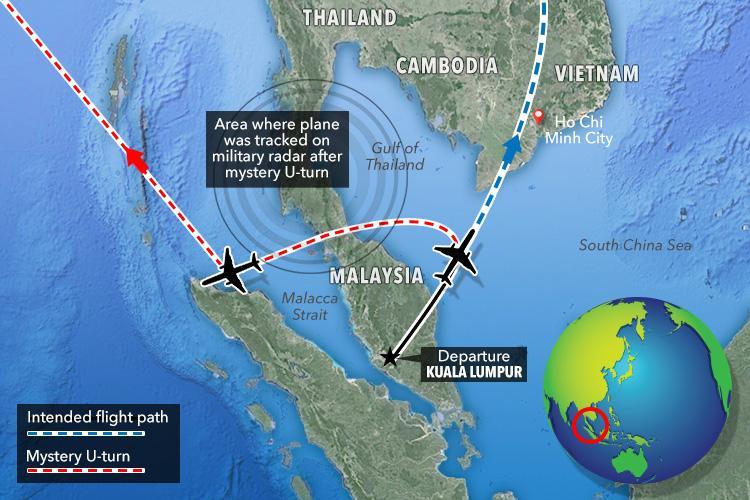
Aerospace engineer Richard Godfrey is behind the new research.

He says applying new technology will provide “credible new evidence”, that was not available during previous underwater searches.

On March 7th, 2014 the Boeing 777 took off for Kaula Lumpa bound for Beijing

The aircraft disappeared from air traffic controls screens – only one hour into the flight.

 239 women, men and children were on board.

There are 239 people on board the missing Malaysia Airlines flight MH370, comprising 227 passengers (including two infants) and 12 crew members. About two-thirds of them are Chinese, and other nationalities include 38 Malaysians, seven Indonesians, six Australians, five Indians, four French and three Americans. Among the passengers are French teenagers Hadrien Wattrelos and Zhao Yan heading for school in Beijing, and Australian grandparents Rodney and Mary Burrows on vacation.

New technology leading new findings

Godfrey is seen one of world’s leading investigators into the mystery.

He based his findings on weak radio signals that cover the earth. also called Weak Signal Propagation (WSPR), which is a digital radio communication protocol.

“WSPR is like a bunch of tripwires or laser beams, but they work in every direction over the horizon to the other side of the globe,” Mr. Godfrey says.
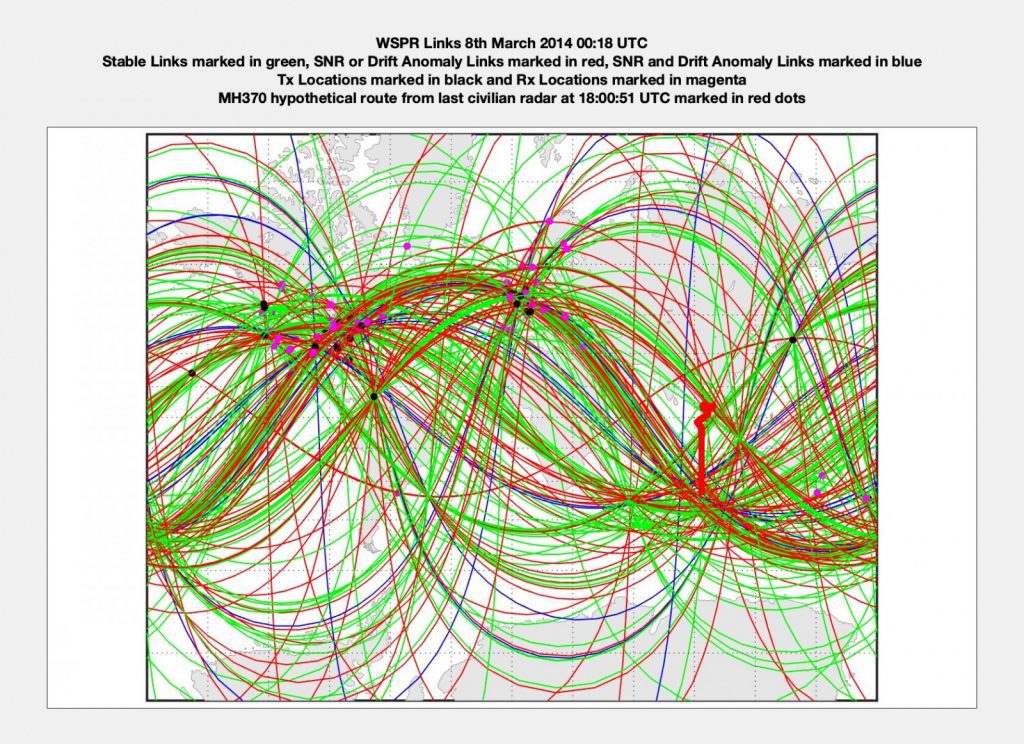
He said they triggered invisible signals when aircraft crossed them and they can help solve the mystery of MH370.

The flight path appears “carefully planned” said Mr. Godfrey.

“The pilot of MH370 generally avoided official flight routes from 18:00 UTC (2am Australian Western Standard Time) onwards but used waypoints to navigate on unofficial flight paths in the Malacca Strait, around Sumatra and across the Southern Indian Ocean,” Mr Godfrey said.

“The flight path seems well planned and avoids commercial flight routes. The pilot appears not so concerned about fuel usage and much more concerned about leaving false trails.”

“The significant number of changes of track and speed suggest that there was an active pilot during the flight,” Mr. Godfrey said.

“Speed changes were beyond the level of changes expected if the aircraft was following a speed schedule such as the long range cruise (LRC) or maximum range cruise (MRC) mode.”

“The pilot of MH370 generally avoided official flight routes from 18:00 UTC (2 am AWST) onwards but used waypoints to navigate on unofficial flight paths in the Malacca Strait, around Sumatra and across the Southern Indian Ocean. The flight path follows the coast of Sumatra and flies close to Banda Aceh Airport,” Mr. Godfrey said.

He said all the end-of-flight analysis points to a spiral dive into the ocean.

Its suspected crash site at 34.5 degrees south, south-west of Western Australia

This new paper examines in finer detail the turn around Indonesia before settling onto a course for the Southern Indian Ocean.

Two searches failed to find any trace of the plane…but Godfrey says a more detailed analysis of flight’s final destination will be underway soon.

Although, there continues to be more questions than answers to the greatest aviation mystery of all time.

Click to comment

Leave a Reply

Your email address will not be published. Required fields are marked *

News

China deploys over 100 ICBMs near Mongolia border

China deploys over 100 ICBMs near Mongolia amidst ongoing tensions and lack of arms control talks with the US

Published

on

China deploys over 100 ICBMs near Mongolia amidst ongoing tensions and lack of arms control talks with the US

video
play-sharp-fill
In Short:
– China has deployed over 100 ICBMs in new silos near Mongolia, marking a significant nuclear expansion.
– Beijing aims to enhance military strategies for Taiwan by 2027, potentially affecting U.S. operations in the region.

China has deployed over 100 solid-fueled intercontinental ballistic missiles (ICBMs) in newly constructed silo fields near its border with Mongolia, according to a draft Pentagon report reviewed by Reuters.This marks the most significant nuclear expansion by Beijing to date. The United States indicates that China shows no intention of engaging in arms control negotiations, despite President Trump’s calls for denuclearization talks with both China and Russia.

The report states that the DF-31 missiles, which have a range of 7,000 to 11,700 kilometers, are positioned across three silo fields. While the Pentagon had previously acknowledged these fields, this is the first confirmation of the number of deployed missiles.

China’s nuclear warhead stockpile was estimated at around 600 in 2024. The report projects an increase to over 1,000 warheads by 2030. It highlights a lack of willingness from Beijing to pursue arms control measures.

Beijing has dismissed such reports as attempts to discredit China and claims that it follows a nuclear strategy of self-defense with a no-first-use policy.

Forceful means

The Pentagon assessment indicates that China plans to be capable of fighting and winning a conflict over Taiwan by 2027. Beijing is reportedly enhancing military strategies to capture the island through forceful means.

These military strikes could potentially disrupt U.S. operations in the Asia-Pacific region.

Neither the Pentagon nor China’s embassy in Washington responded to requests for comment. U.S. officials cautioned that the draft report could change before its formal submission to lawmakers.


Download the Ticker app

Continue Reading

News

Global race for AI infrastructure amid soaring energy costs

Japan invests ¥1 trillion in AI infrastructure amid global tech race as energy costs and concerns rise

Published

on

Japan invests ¥1 trillion in AI infrastructure amid global tech race as energy costs and concerns rise

video
play-sharp-fill
In Short:
– Japan plans to invest ¥1 trillion in domestic AI to enhance infrastructure and compete globally.
– China is focusing on technological independence as domestic chipmakers prepare for public offerings.

Japan plans to invest ¥1 trillion ($6.34 billion) over five years in a domestic artificial intelligence company. This initiative aims to build infrastructure for AI, despite rising electricity costs raising concerns about the industry’s sustainability.The government will collaborate with SoftBank Group and Preferred Networks to develop the largest foundation model in Japan, employing around 100 engineers to compete globally. This effort reflects worries about the risks of relying on foreign AI technology.

China is also increasing its focus on technological independence. Domestic chipmakers are preparing for public offerings to enhance their capabilities, following successful launches by Moore Threads and MetaX in Shanghai. Companies such as Biren Technology and Baidu’s Kunlunxin are also planning to go public.

SoftBank is pursuing a $22.5 billion funding commitment to OpenAI by year-end, by selling assets and securing loans. CEO Masayoshi Son’s significant investment signifies a strong commitment to AI infrastructure.

AI Infrastructure

The rapid expansion of data centers is putting pressure on energy resources. Projections suggest data centers will consume 945 terawatt-hours by 2030, nearly tripling from 415 TWh in 2024. In the U.S., energy use by data centers could reach 9% to 12% of total supply by 2028.

Concerns have arisen over whether tech companies’ activities are raising residential electricity costs, with investigations launched by three Democratic senators targeting major companies like Alphabet, Microsoft, and Amazon. Utilities face significant expenses to upgrade grids, which may be passed on to consumers.

The energy demand is benefiting companies that supply power infrastructure. Jefferies recently upgraded GE Vernova to Buy, citing expected growth in gas pricing and long-term service demand amid rising energy needs.


Download the Ticker app

Continue Reading

News

Australia’s property market set to soar in 2026

Australia’s property market is set for strong growth in 2026, driven by demand and strategic investments across key regions.

Published

on

Australia’s property market is set for strong growth in 2026, driven by demand and strategic investments across key regions.


Australia’s property market is predicted to perform strongly in 2026, with no major losers expected as demand and prices rise across 14 key regions. Hotspotting’s latest analysis highlights which areas are set to shine and the factors driving this unprecedented growth.

Join Tim Graham from Hotspotting as he explains the methodology behind the price predictions and why infrastructure investments and government policies are playing a key role in shaping the market.

From regional hotspots to major cities, we explore emerging trends, buyer behavior, and the outlook for places like Darwin and Perth. Whether you’re a first home buyer or seasoned investor, this episode is packed with insights to navigate Australia’s booming property landscape.

Subscribe to never miss an episode of Ticker – https://www.youtube.com/@weareticker

#AustraliaProperty #PropertyMarket2026 #Hotspotting #RealEstateTrends #HousingMarket #InvestingAustralia #PropertyGrowth #FirstHomeBuyers


Download the Ticker app

Continue Reading

Trending Now