Connect with us
https://tickernews.co/wp-content/uploads/2023/10/AmEx-Thought-Leaders.jpg

Ticker Views

Global power struggles and Arctic shipping risks

Published

on

Global power struggles over the ocean’s finite resources call for creative diplomacy

Jonas Gamso, Arizona State University and Hossain Ahmed Taufiq, Arizona State University

Oceans shape everyday life in powerful ways. They cover 70% of the planet, carry 90% of global trade, and support millions of jobs and the diets of billions of people. As global competition intensifies and climate change accelerates, the world’s oceans are also becoming the front line of 21st-century geopolitics.

How policymakers handle these challenges will affect food supplies, the price of goods and national security.

Right now, international cooperation is under strain, but there are many ways to help keep the peace. The tools of diplomacy range from formal international agreements, like the High Seas Treaty for protecting marine life, which goes into effect on Jan. 17, 2026, to deals between countries, to efforts led by companies, scientists and issue-focused organizations.

Examples of each can be found in how the world is dealing with rising tensions over Arctic shipping, seafloor mining and overfishing. As researchers in international trade and diplomacy at Arizona State University in the Thunderbird School of Global Management’s Ocean Diplomacy Lab, we work with groups affected by ocean pressures like these to identify diplomatic tools – both inside and outside government – that can help avoid conflict.

Arctic shipping: New sea lanes, new risks

As the Arctic Ocean’s sea ice cover diminishes, shipping routes that were once impassable most of the year are opening up.

For companies, these routes – such as the Northern Sea Route along Russia’s coast and the Northwest Passage through Canada’s Arctic Archipelago – promise shorter transit times, lower fuel costs and fewer choke points than traditional passages.

However, Arctic shipping also raises complex challenges.
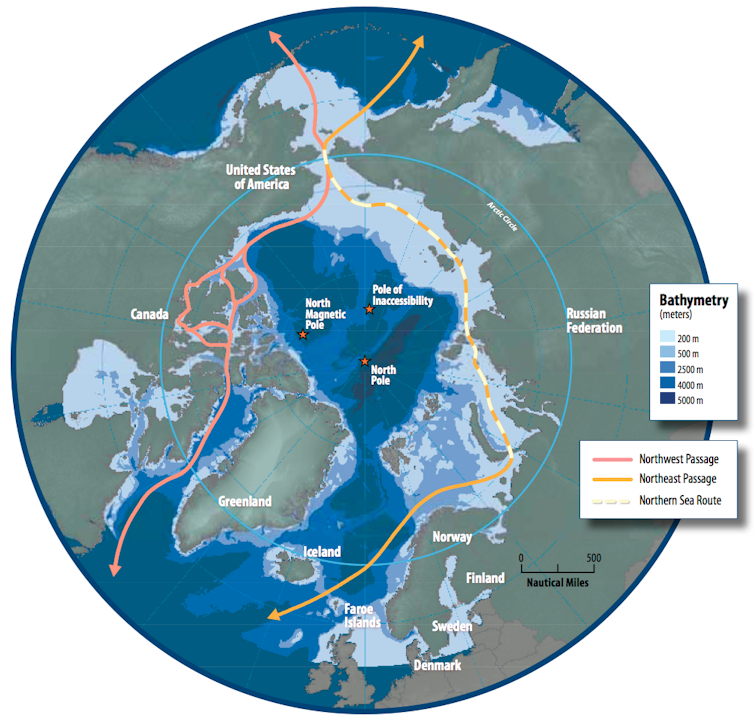
Declining sea ice is opening two shipping routes to greater use: the Northern Sea Route, off the Russian coast, and the Northwest Passage, along Alaska’s coast and through the Canadian islands.
Susie Harder/Arctic Council

The U.S., Russia, China and several European countries have each taken steps to establish an economic and military presence in the Arctic Ocean, often with overlapping claims and competing strategic aims. For example, Russia closed off access to much of the Barents Sea while it conducted missile tests near Norway in 2025. NATO has also been patrolling the same sea.

Geopolitical tensions compound the practical dangers in Arctic waters that are poorly charted, where emergency response capacity is limited and where extreme weather is common.

As more commercial vessels move through these waters, a serious incident – whether triggered by a political confrontation or weather – could be difficult to contain and costly for marine ecosystems and global supply chains.

A fleet of military ships at dusk with mountains in the background.
German Naval vessels sail near Harstad, Norway, during Arctic exercises on Oct. 13, 2025.
Sean Gallup/Getty Images

The Arctic Council is the region’s primary official forum for the Arctic countries to work together, but it is explicitly barred from addressing military and security issues – the very pressures now reshaping Arctic shipping.

The council went dormant for over a year starting in 2022 after Russia, then the Arctic Council president, invaded Ukraine. While meetings and projects involving the remaining countries have since resumed, the council’s influence has been undercut by unilateral moves by the Trump administration and Russia, and bilateral arrangements between countries, including Russia and China, often involving access to oil, gas and critical mineral deposits.

In this context, Arctic countries can strengthen cooperation through other channels. An important one is science.

For decades, scientists from the U.S., Europe, Russia and other countries collaborated on research related to public safety and the environment, but Russia’s invasion of Ukraine disrupted those research networks.

Going forward, countries could share more data on ice thaw, extreme weather and emergency response to help prevent accidents in a rapidly opening shipping corridor.

An image of the Arctic shows sea ice concentrations in 2025 were less than the 20-year average, and much less than the 20 years before then.
Arctic sea ice has been declining, with less multiyear ice and less coverage. The map shows the Arctic sea ice at its minimum extent in 2025, in September.
NOAA and CIRES/University of Colorado Boulder.

Critical minerals: Control over the seabed

The global transition to clean energy is driving demand for critical minerals, such as nickel, cobalt, manganese and rare earth elements, that are essential for everything from smartphones and batteries to fighter jets. Some of the world’s largest untapped deposits lie deep below the ocean’s surface, in places like the Clarion-Clipperton Zone near Hawaii in the Pacific. This has sparked interest from governments and corporations in sea floor mining.

Harvesting critical minerals from the seabed could help meet demand at a time when China controls much of the global critical mineral supply. But deep-sea ecosystems are poorly understood, and disruptions from mining would have unknown consequences for ocean health. Forty countries now support either a ban or a pause on deep sea mining until the risks are better understood.

These concerns sit alongside geopolitical tensions: Most deep-sea minerals lie in international waters, where competition over access and profits could become another front in global rivalry.

A map shows one area where companies are interested in mining.
A map of the Pacific Ocean between Mexico and Hawaii shows exploration targets for mining seafloor nodules that contain critical minerals in the Clarion-Clipperton Zone. National waters are shown in blue. The striped APEI squares are protected areas.
KA McQuaid, MJ Attrill, MR Clark, A Cobley, AG Glover, CR Smith and KL Howell, 2020, CC BY

The International Seabed Authority was created under the United Nations Convention on the Law of the Sea to manage seabed resources, but its efforts to establish binding mining rules have stalled. The U.S. never ratified the convention, and the Trump administration is now trying to fast-track its own permits to circumvent the international process and accelerate deep-sea mining in areas that are outside national jurisdictions.

Against this backdrop, a loose coalition of issue-focused groups and companies have joined national governments in calling for a pause on deep-sea mining. At the same time, some insurers have declined to insure deep-sea mining projects.

A visualization of deep-sea mining and the debris clouds created that could harm sea life.

Pressure from outside groups will not eliminate competition over seabed resources, but it can shape behavior by raising the costs of moving too quickly without carefully evaluating the risks. For example, Norway recently paused deep-sea mining licenses until 2029, while BMW, Volvo and Google have pledged not to purchase metals produced from deep-sea mines until environmental risks are better understood.

Overfishing: When competition outruns cooperation

Fishing fleets have been ranging farther and fishing longer in recent decades, leading to overfishing in many areas. For coastal communities, the result can crash fish stocks, threatening jobs in fishing and processing and degrading marine ecosystems, which makes coastal areas less attractive for tourism and recreation. When stocks decline, seafood prices also rise.

Unlike deep-sea mining or Arctic shipping, overfishing is prompting cooperation on many levels.

In 2025, a critical mass of countries ratified the High Seas Treaty, which sets out a legal framework for creating marine protected areas in international waters that could give species a chance to recover. Meanwhile, several countries have arrangements with their neighbors to manage fishing together.

For example, the European Union and U.K. are finalizing an agreement to set quotas for fleets operating in waters where fish stocks are shared. Likewise, Norway and Russia have established annual quotas for the Barents Sea to try to limit overfishing. These government-led efforts are reinforced by other forms of diplomacy that operate outside government.

Market-based initiatives like the Marine Stewardship Council certification set common sustainability standards for fishing companies to meet. Many major retailers look for that certification when making purchases. Websites like Global Fishing Watch monitor fishing activity in near real time, giving governments and advocacy groups data for action.

Collectively, these efforts make it harder for illegal fishing to hide.

How well countries are able to work together to update quotas, share data and enforce rules as warming oceans shift where fish stocks are found and demand continues to grow will determine whether overfishing can be stopped.

Looking Ahead

At a time when international cooperation is under strain, agreements between countries and pressure from companies, insurers and issue-focused groups are essential for ensuring a healthy ocean for the future.The Conversation

Jonas Gamso, Associate Professor and Deputy Dean of Knowledge Enterprise for the Thunderbird School of Global Management, Arizona State University and Hossain Ahmed Taufiq, Postdoctoral Fellow of Ocean Diplomacy and Leadership, Arizona State University

This article is republished from The Conversation under a Creative Commons license. Read the original article.


Ticker Views

Why Greenland matters in a multipolar world

Published

on

Four ways to understand what’s going on with the US, Denmark and Greenland

Shutterstock/Michal Balada

Ian Manners, Lund University

European countries, and Denmark in particular, are scrambling to respond to threats from US officials over the future of Greenland.

Having successfully taken out the leadership of Venezuela in a raid on January 3, an emboldened US government is talking about simply taking Greenland for itself.

Various European leaders have expressed their concern but haven’t been able to formulate a coherent response to the betrayal by a supposed ally.

Since the September 11 attacks in 2001, Danish governments have willingly participated in US-led invasions of Afghanistan (2001-2021) and Iraq (2003-2007). The rightward movement across the Danish political spectrum had led to Denmark rejecting some Nordic and EU cooperation in favour of pro-US transatlanticism.

However, the 2022 Russian invasion of Ukraine led to a rethink of Danish foreign policy. The country joined the EU’s common security and defence policy and tightened cooperation with recent Nato members Finland and Sweden.

And when Trump came to power for the second time, the chaotic rightward swing of US foreign policy left Denmark reaching out for support from its EU colleagues over the challenge to Greenland.

While a member of the European Union, Denmark has placed itself at the bloc’s periphery since copying the UK in opting out of the euro and from cooperation in justice and home affairs. But any US invasion of Greenland is likely to break Denmark’s fixed exchange rate policy with the euro (and before that the deutschmark) that has been in place since 1982. So there are economic implications as well as territorial.

The fallout from the US’s threats, and certainly any US intervention in Greenland, go much further than Denmark. While the EU tried to stay in step with the US in its support of Ukraine during Joe Biden’s presidency, since the re-election of Trump, EU member states have very much fallen out with the US. During 2025, the US and EU clashed over trade and tariffs, social media regulation, environment and agriculture policies.

But the latest developments demonstrate that Trump’s US can no longer be trusted as a long-term ally – to Greenland and Denmark, the EU and Europe.

This is a crisis engulfing many countries and triggered by many drivers. In order to understand this complex situation, we can use four different analytical approaches from academic thinking. These can help us contextualise not just the Greenland case, but also the emerging multipolar world of “might makes right”.

1. Realism

Currently the most popular approach comes from within the conservative tradition of “realism”. This predicts every state will act in their own national interest.

In this framing, Trump’s actions are part of the emergence of a multipolar world, in which the great powers are the US, China, India and Russia. In this world, it makes sense for Russia to invade Ukraine to counter the US, for the US to seize assets in Venezuela and Greenland to counter China, and for China to invade Taiwan to counter the US.

2. The new elites

Many think that to understand the events of the past few years, including Trump’s return and Vladimir Putin’s foreign policies, you need to look beyond conservative or liberal explanations to seek out who holds power and influence in the global superpowers. That means the wealthy families, corporations and oligarchs who exert control over the politics of the ruling elite through media and campaign power and finance.

In the cases of Venezuela and Greenland there are two factors at work – the US rejection of the rule of law and the desire for personal wealth via energy resources. But the timing is also important. The operation in Venezuela has been the only story to eclipse the Epstein files in the news in many months.

3. The decline of the liberal order

Many academic explanations see these recent events in the context of the decline of a “liberal order” dominated by the US, Europe, the “developed world” and the UN. In this view, the actions of Putin and Trump are seen as the last days of international law, the importance of the UN, and what western nations see as a system based on multilateralism.

However, this approach tends to overlook the continued dominance of the global north in these systems. The lack of support for the US and EU’s defence of Ukraine has been repeatedly demonstrated in the unwillingness of many global south countries, including China and India, to condemn the Russian invasion in the UN general assembly. It would be interesting to see how such voting would play out if it related to a US invasion of Greenland.

4. The planetary approach

The final – and most important – view is found in the planetary politics approach. This approach is based on the simple observation that so many planetary crises, such as global heating, mass extinctions of wildlife, climate refugees, rising autocracy and the return of international conflict are deeply interrelated and so can only be understood when considered together.

From this perspective it is Greenland’s sustainability and Greenlanders’ lives that must shape the understanding of Denmark’s and other European responses to Trump’s claims. It is through acknowledging the deep relationship that indigenous people have to their ecology that solutions can be found.

And Greenlanders have already expressed their vision for the future. Living on the frontline of the climate crisis, they want an economy built on resilience – not on ego-driven political drama.

While it’s quick and easy to to judge the events in Venezuela or Greenland in terms of the daily news cycle, the four perspectives set out here force people to think for themselves how best to understand complex international crises.

There is, however, a final observation to emphasise. Only one of these perspectives is likely to bring any way of thinking ourselves out of our planetary political crisis.The Conversation

Ian Manners, Professor, Department of Political Science, Lund University

This article is republished from The Conversation under a Creative Commons license. Read the original article.

Continue Reading

Ticker Views

Pentagon’s AI gamble: Is Grok safe for defense?

Pentagon to integrate Elon Musk’s AI chatbot Grok, exploring military data and innovation amid AI controversies.

Published

on

Pentagon to integrate Elon Musk’s AI chatbot Grok, exploring military data and innovation amid AI controversies.


Defense Secretary Pete Hegseth announced that Elon Musk’s AI chatbot Grok will soon be integrated with the Pentagon’s networks.

The move aims to harness military data to develop advanced AI technology, despite recent controversies surrounding Grok’s content generation. This integration signals a bold step toward combining commercial AI tools with national defence systems.

Dr Karen Sutherland from UniSC explores the implications of this partnership. We discuss how Hegseth’s approach to AI differs from the Biden administration’s framework, the measures in place to ensure responsible use, and the limitations on Grok’s image generation capabilities.

We also examine the potential risks and international reactions, as well as Hegseth’s vision for innovation within the military. From civil rights considerations to prioritising key technologies, this story highlights the complex balancing act of AI in modern defence.

Subscribe to never miss an episode of Ticker – https://www.youtube.com/@weareticker

#PentagonAI #ElonMusk #GrokAI #MilitaryTech #AIControversy #TechNews #DefenseInnovation #TickerNews


Download the Ticker app

Continue Reading

Ticker Views

U.S. pushes Latin American dominance

Published

on

What lies ahead for Latin America after the Venezuela raid?

Nicolas Forsans, University of Essex

The Trump administration has justified the recent capture of Venezuelan leader Nicolás Maduro as a law enforcement operation to dismantle a “narco‑state”. It also claimed it would break Venezuela’s ties to China, Russia and Iran, and put the world’s largest known oil reserves back under US‑friendly control.

This mix of counter‑narcotics, great power rivalry and energy security had already been elevated to a central priority by the administration in its national security strategy. Published in late 2025, the document announced a pledge to “reassert and enforce American preeminence in the western hemisphere” and deny “strategically vital assets” to rival powers.

Donald Trump has referred to this hemispheric project as the “Donroe doctrine”, casting it as a revival of the Monroe doctrine policy of the 19th century through which the US sought to stop European powers from meddling in the Americas. He seems to be seeking to tighten the US grip on Latin America by rewarding loyal governments and punishing defiant ones.

If Venezuela is the first test case of the Donroe doctrine, several other Latin American countries now sit squarely in Washington’s crosshairs. The most immediate target is Cuba, which the US has opposed since 1959 when communist revolutionary Fidel Castro overthrew a US-backed regime there.

Trump and his secretary of state, Marco Rubio, have openly hinted that Cuba could be Washington’s next target. They have described Cuba as “ready to fall” after the loss of Venezuelan oil and have boasted that there is no need for direct intervention because economic collapse will finish the job.

Cuba is enduring its worst crisis since 1959. Blackouts now regularly last up to 20 hours, real wages are collapsing and roughly 1 million Cubans have fled the country since 2021. This is all happening as Venezuelan crude oil is being redirected under US control.

For over two decades, Venezuela has provided Cuba with fuel and financing in exchange for doctors, teachers and security personnel – 32 of whom were killed in the US capture of Maduro, according to the Cuban government. Strangling Cuba’s remaining lifelines may well be enough to topple the government there without US forces needing to fire a single shot.

It is possible that Mexico will also soon come under fire. Mexico has quietly become Cuba’s main oil supplier, shipping roughly 12,000 barrels per day in 2025 to account for about 44% of the island’s crude imports. This is unlikely to please the Trump administration, which has recently renewed its threats to “do something” about Mexican drug cartels.

The raid in Venezuela’s capital, Caracas, took six months of meticulous planning and required an extraordinary amount of resources. So it is unrealistic to expect similar raids on other Latin American countries. However, targeted military strikes cannot be excluded.

Speaking on Fox News’s “Hannity” show on January 8, Trump said: “We are going to start now hitting land with regard to the cartels. The cartels are running Mexico.” He did not provide further details about the plans.

Mexico’s president, Claudia Sheinbaum, is trying to construct protective buffers. She has combined condemnation of the raid on Caracas with intense cooperation with the US on migration and security. This includes a deal for Mexico’s navy to intercept suspected drug-running boats near its coastline before US forces do.

But as part of a strategy that pushes US dominance of Latin America, Trump has already floated classifying Mexico’s cartels as terrorist organisations and the fentanyl they traffic across the border as a weapon of mass destruction. These are legal framings that could be used to justify strikes on Mexican soil in the name of counter-narcotics in the near future.

Trump’s other targets

Colombia, historically Washington’s closest military ally in South America, has flipped from “pillar” to possible target. The country’s president, Gustavo Petro, has been one of the loudest critics of the Venezuela raid. He called it an “abhorrent violation” of Latin American sovereignty committed by “enslavers”, adding that it constituted a “spectacle of death” comparable to Nazi Germany’s 1937 carpet bombing of Guernica in Spain.

Trump, who imposed sanctions on Petro and his family in October, responded by labelling the Colombian president a “sick man who likes making cocaine and selling it to the United States”. He then mused that a Venezuela‑style operation in Colombia “sounds good to me” before a hastily arranged phone call and White House invitation dialled back the immediate threat.

How long the conciliation between the two men lasts remains to be seen. Colombia has entered a heated presidential campaign season in which Trump’s remarks are already being read as an attempt to tilt the race, much as his interventions shaped recent contests in Argentina and Honduras.

Further down the hierarchy, Nicaragua’s government will also have watched events unfold in Venezuela with terror. Long treated in Washington as part of a trilogy of dictatorships with Cuba and Venezuela, Nicaragua features in US indictments against Maduro as a transit point for cocaine flights. Nicaragua was also recently designated by the US as a key drug‑transit country.

The unusually cautious statement on the Venezuela raid by Nicaraguan presidential couple Daniel Ortega and Rosario Murillo, as well as the rapid reinforcement of the presidential compound in the capital Managua, suggest a regime that knows it could be next in line should Trump choose to extend his “narco‑terrorism” narrative.

Trump appears to be turning longstanding US concerns – drugs, migration and interference by other major powers – into a flexible toolbox for coercion in Latin America. Countries that defy Washington or host its rivals risk being framed as security threats, stripped of economic lifelines and, possibly, targeted militarily.

Those that keep their heads down may avoid immediate punishment. But this comes at the price of treating hemispheric dominance as a fact of life rather than a doctrine to be resisted.The Conversation

Nicolas Forsans, Professor of Management and Co-director of the Centre for Latin American & Caribbean Studies, University of Essex

This article is republished from The Conversation under a Creative Commons license. Read the original article.
Continue Reading

Trending Now