

Connect with us
https://tickernews.co/wp-content/uploads/2023/10/AmEx-Thought-Leaders.jpg

Money

Elon Musk a frat boy? The mentality of the billionaire Tesla boss

Published

on

Elon Musk during SNL appearance

Elon Musk has been making headlines across the world in recent weeks – and now a journalist has told ticker NEWS the billionaire has a “frat boy mentality” – and it all mostly comes from his tweets

The billionaire Tesla boss recently sold a combined $7.8 billion worth of his shares in his EV company – a tactic he says is to pay tax.

Musk, at the age of 50, has sold 2.8 million shares worth about $3 billion USD specifically to pay taxes on three tranches of stock options that he exercised this week, according to filings with the US Securities and Exchange Commission.

That means he has sold roughly $6.9 billion more in shares than he needs at present

Under a compensation plan from 2012, Mr Musk has options to buy 26.4 million shares.

The options expire next year, and the tax bill will come due.

Wedbush analyst Daniel Ives told Ticker News that he estimates the bill of the billionaire entrepreneur to be between $10 billion to $15 billion USD – depending on the stock price.

Mr Musk’s options so far allowed him to buy shares at $6.24 USD each, and the stock is selling for about $1080 USD.

When you think about it, it is a big tax bill, but questions loom as to why the 50 year-old sold more than he needs.

“Frat boy mentality”

When it comes to his personality and mentality – there are many questions with how Musk is behind closed doors.

Patrick McGee from the Financial Times spoke to Ticker News on Thursday, labels his attitude as like a “frat boy.”

We all know Elon Musk to be a vocal kinda guy but now JP Morgan is taking Tesla to court over such tweets

JP Morgan Chase is suing Tesla for $162million over tweets in 2018 by boss Elon Musk that claimed he could take the electric car maker private.

The multinational bank accused Tesla of “flagrantly” – meaning it breached a deal it claims should have triggered payments to JP Morgan.

Musk’s notorious tweets that he had funding to take Tesla off the New York stock market sparked volatility in the share price.

He later abandoned the move and was fined by the US financial regulator.

JP Morgan’s suit, filed in a Manhattan federal court, says the companies had an agreement signed in 2014 that allowed the bank to buy Tesla shares at a set price and date.
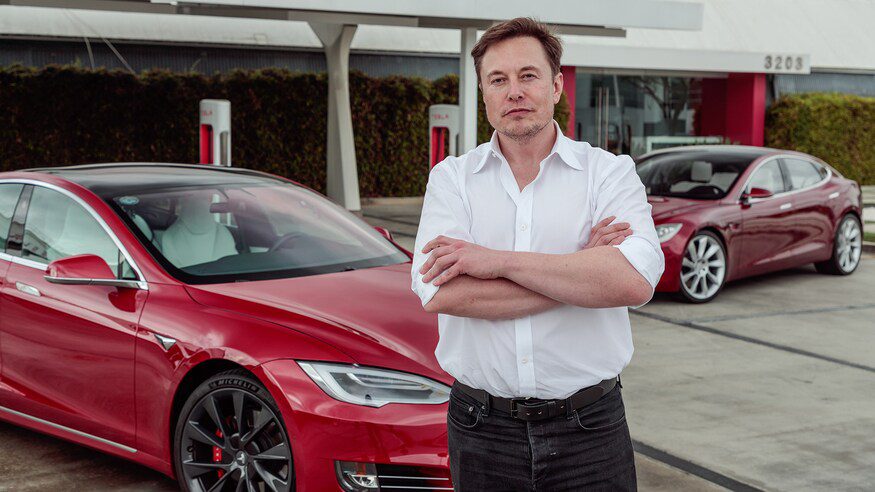
Elon Musk taken to court by multinational bank, JP Morgan chase / Image: File

This recent sales stunt isn’t all the busy EV boss has been getting up to

Over the course of the last fortnight, Musk has used his Twitter account as a platform to express his opinion, conduct polls and at times, interrupt the cryptocurrency market.

His actions to sell his Tesla stock came after he conducted a Twitter poll to his 60 million followers, asking them if he should as a way to pay off his taxes.

“Much is made lately of unrealised gains being a means of tax avoidance, so I propose selling 10 per cent of my stock,” he wrote.

According to Mr Musk, 58 per cent of those who responded said yes.

Musk has conceded that much of his wealth is held up in stocks

The billionaire says much of his riches aren’t in physical cash, rather it’s being held up in stocks.

 “I have only stock, thus the only way for me to pay taxes personally is to sell stock,” he wrote.

Musk started selling his shares on Monday, and as of Wednesday, he had liquidated about 5 per cent of his holdings.

According to reports, his federal tax obligations could be as high as 40 per cent on proceeds from some of the sales.

And who could forget Musk’s swing at Bernie Sanders?

Elon Musk was trolling yet again on his Twitter account this week (yes after he conducted the polls to sell his shares and blah blah blah) – and this time his target is US Senator Bernie Sanders

The billionaire has taken aim at a recent tweet from Mr Sanders which stated the rich must pay more tax

“I keep forgetting that you’re still alive,” was the response from Mr Musk.

The Tesla boss then stated he’s willing to sell more of his EV stocks in order to pay more tax.

Sassy.

Money

Global stocks rise to record highs in 2025

Global stocks surge to record highs at 2025 year-end, driven by Fed rate cuts and AI optimism across markets

Published

on

Global stocks surge to record highs at the 2025 year-end, driven by Fed rate cuts and AI optimism across markets

video
play-sharp-fill
In Short:
– World equities are expected to reach record highs in 2025, driven by anticipated Federal Reserve rate cuts and AI gains.
– The MSCI index gained nearly 21% in 2025, while the S&P 500 achieved its 39th record close this year.

Global equity markets ended 2025 on a historic high, capping off a year of extraordinary gains. The MSCI world equity gauge recorded an almost 21% year-to-date increase, while the S&P 500 closed at 6,932.05 on Christmas Eve—its 39th record close of the year. European shares also touched intraday records, as investors bet on continued Federal Reserve interest rate cuts and strong AI-driven growth.

Asian markets led the year-end surge, with Taiwan’s benchmark index hitting a record high of 28,832.55, fueled by gains from Taiwan Semiconductor Manufacturing. South Korea’s Kospi rose 2.2%, marking its best year since 1999. Across the region, investors placed big bets on artificial intelligence, overshadowing concerns about trade tariffs and economic uncertainty.

The U.S. Federal Reserve’s rate cuts provided further optimism for global markets. After lowering its main funds rate to 3.5%-3.75% in December, money markets are anticipating additional cuts in 2026. While gold dipped slightly, it still recorded its largest annual gain since 1979, and copper hit a new record high. Investors are balancing bullish AI exposure with safe-haven hedges, signaling cautious confidence as 2025 draws to a close.


Download the Ticker app

Continue Reading

Money

New Zealand experiences unexpected economic growth surge

New Zealand economy sees 1.1% growth in third quarter, surpassing forecasts and signalling broad recovery after earlier contraction

Published

on

New Zealand economy sees 1.1% growth in third quarter, surpassing forecasts and signalling broad recovery after earlier contraction

video
play-sharp-fill
In Short:
– New Zealand’s economy grew by 1.1% in Q3, exceeding expectations after a mid-year contraction.
– Fourteen industries reported gains, with business services and manufacturing leading the growth at 2.2%.

New Zealand’s economy bounced back in the third quarter, growing by 1.1% and exceeding forecasts of 0.9%. This follows a revised 1.0% contraction in Q2, signaling a clear turnaround. According to Statistics New Zealand, 14 out of 16 industries reported growth, with business services and manufacturing leading the charge. Construction also picked up, rising by 1.7%, while exports were boosted by strong dairy and meat sales.

Retail spending showed robust gains, especially in categories sensitive to interest rates, including a 9.8% increase in electrical goods and a 7.2% jump in motor vehicle parts. Despite the positive quarter-on-quarter growth, the economy was still 0.5% lower than the same period last year, with telecommunications and education the only sectors experiencing declines.

Cautiously optimistic, Reserve Bank Governor Anna Breman noted that monetary policy will continue to depend on incoming data, as financial conditions have tightened beyond earlier projections. While positive GDP numbers support current low rates, the services sector—comprising two-thirds of GDP—has contracted for 21 consecutive months, suggesting the recovery may remain uneven.


Download the Ticker app

Continue Reading

Money

US economy grows 4.3% in Q3, exceeding forecasts

US economy grows 4.3% in Q3 2025, surpassing forecasts despite inflation and shutdown challenges

Published

on

US economy grows 4.3% in Q3 2025, surpassing forecasts despite inflation and shutdown challenges

video
play-sharp-fill
In Short:
– The US economy grew by 4.3 percent in Q3 2025, exceeding forecasts and showing consumer resilience.
– Consumer spending rose by 3.5 percent, with increases in healthcare and recreational goods driving growth.

The US economy grew at a robust annual rate of 4.3% in Q3 2025, exceeding forecasts and marking its strongest quarterly expansion in two years. This growth comes despite lingering inflation concerns and political instability, showing that American consumers are continuing to spend and drive economic momentum.

Consumer spending, which accounts for roughly 70% of the economy, jumped 3.5% in the quarter, up from 2.5% previously. Much of this increase was fueled by healthcare expenditures, including hospital and outpatient services, along with purchases of recreational goods and vehicles. Exports surged 8.8%, while imports fell 4.7%, giving net economic activity a boost, and government spending bounced back 2.2% after a slight decline in Q2.

Remains optimistic

Despite the strong growth, inflation remains in focus. The personal consumption expenditures (PCE) price index rose 2.8%, up from 2.1%, with core PCE also climbing. Economists are closely watching the job market and tariff-related pressures. Meanwhile, the recent federal “Schumer shutdown” is expected to slow Q4 growth, potentially trimming GDP by 1 to 2 percentage points. Treasury Secretary Scott Bessent, however, remains optimistic that 2025 will still reach a 3% growth rate.

The Q3 numbers are also influencing expectations for the Federal Reserve. Analysts now see an 85% probability that interest rates will remain stable at the January 2026 meeting. Steady rates could provide a measure of certainty for investors, businesses, and consumers alike as they make decisions heading into 2026. Overall, the data paints a picture of a resilient US economy navigating both challenges and opportunities.


Download the Ticker app

Continue Reading

Trending Now