Money
China’s economy slows as retail sales drop
China’s economy struggles as April retail sales hit 40-month low amid weakened consumption and investment growth

China’s economy struggles as April retail sales hit 40-month low amid weakened consumption and investment growth

– China’s economy struggled in April, with retail sales and industrial output falling short of expectations.
– Energy markets are volatile, while discussions with the U.S. indicate potential agricultural product purchases from China.
China’s economy faced challenges in April with key metrics underperforming expectations amid ongoing global tensions.Retail sales increased by only 0.2%, significantly below the anticipated 2% rise, marking the weakest growth since December 2022.


Economic downturn continues
Industrial output also slowed, rising just 4.1% compared to 5.7% in March and falling short of expectations for a 5.9% increase.
Fixed asset investment contracted by 1.6% in early 2023, inconsistent with anticipated growth, primarily due to declining activity in the property sector.
The property market has worsened, with investment down 13.7% compared to last year, impacting related sectors and employment.
Home prices continued their downward trend in April, contributing to broader economic concerns.
Exports, however, surged due to increased demand, expanding by 14.1% amid fears of rising costs from the Iran conflict.
The urban unemployment rate slightly improved to 5.2% from 5.4% as reported data showed.
Discussions between U.S. President Donald Trump and China’s Xi Jinping indicated that Beijing is set to purchase significant U.S. agricultural products in the coming years.
This meeting also led to the establishment of a U.S.-China Board of Trade to discuss trade issues and market access.
Concerns exist about potential economic decoupling between the two nations, as this could have large implications for their economies.

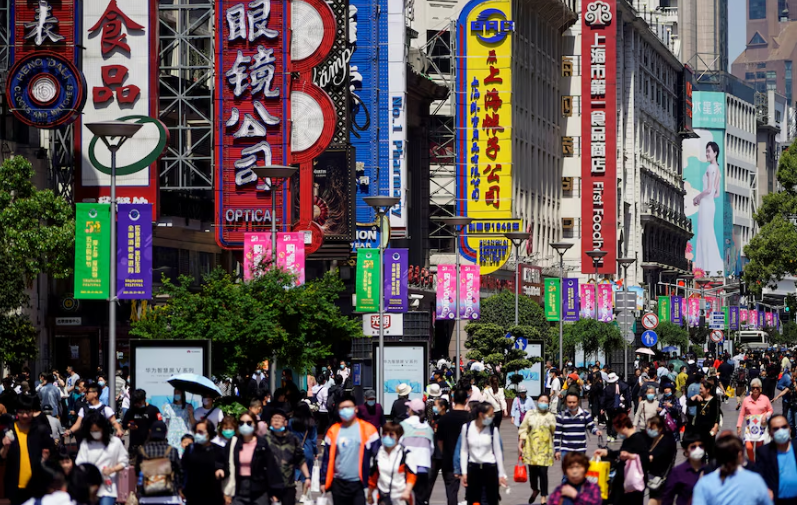
REUTERS/Aly Song/File Photo
Energy market volatility
Energy markets remain unstable, with crude oil refining volumes declining sharply for a second consecutive month.
Prices for producers and consumers have risen due to commodity cost increases, with the producer price growth now outpacing consumer price gains.
Efforts to stimulate domestic demand need enhancement, as current measures have shown limited effectiveness.
Noteworthy spending growth has been observed in cultural and tourism sectors, with service retail sales up 5.6% in the first four months of the year.
Analysts suggest the government may hold off on further stimulus until more economic data is available later this year.
Beijing will likely evaluate its economic strategy in July, following Q2 GDP results as initial growth this year was promising.
