
Connect with us
https://tickernews.co/wp-content/uploads/2023/10/AmEx-Thought-Leaders.jpg

News

Baltimore Bridge investigators to examine whether dirty fuel played role
Published

on

A safety investigation into the collapse of the Francis Scott Key Bridge in Baltimore will include an examination of whether contaminated fuel contributed to the incident.

As of late Tuesday afternoon, safety investigators had not yet boarded the Dali, the giant cargo ship involved in the crash, which remained lodged at a pillar of the collapsed bridge.

  • The vessel is expected to remain in its current location for weeks, while rescue crews continue to search for potential survivors.

  • The Dali experienced power issues shortly after embarking on its journey early Tuesday.

Reports indicate that the lights on the ship began to flicker about an hour after departure, with the harbor pilot and assistant reporting a loss of propulsion before the collision. An officer aboard the ship described a sudden loss of power, with one of the engines ceasing to function and a pervasive smell of burnt fuel in the engine room.
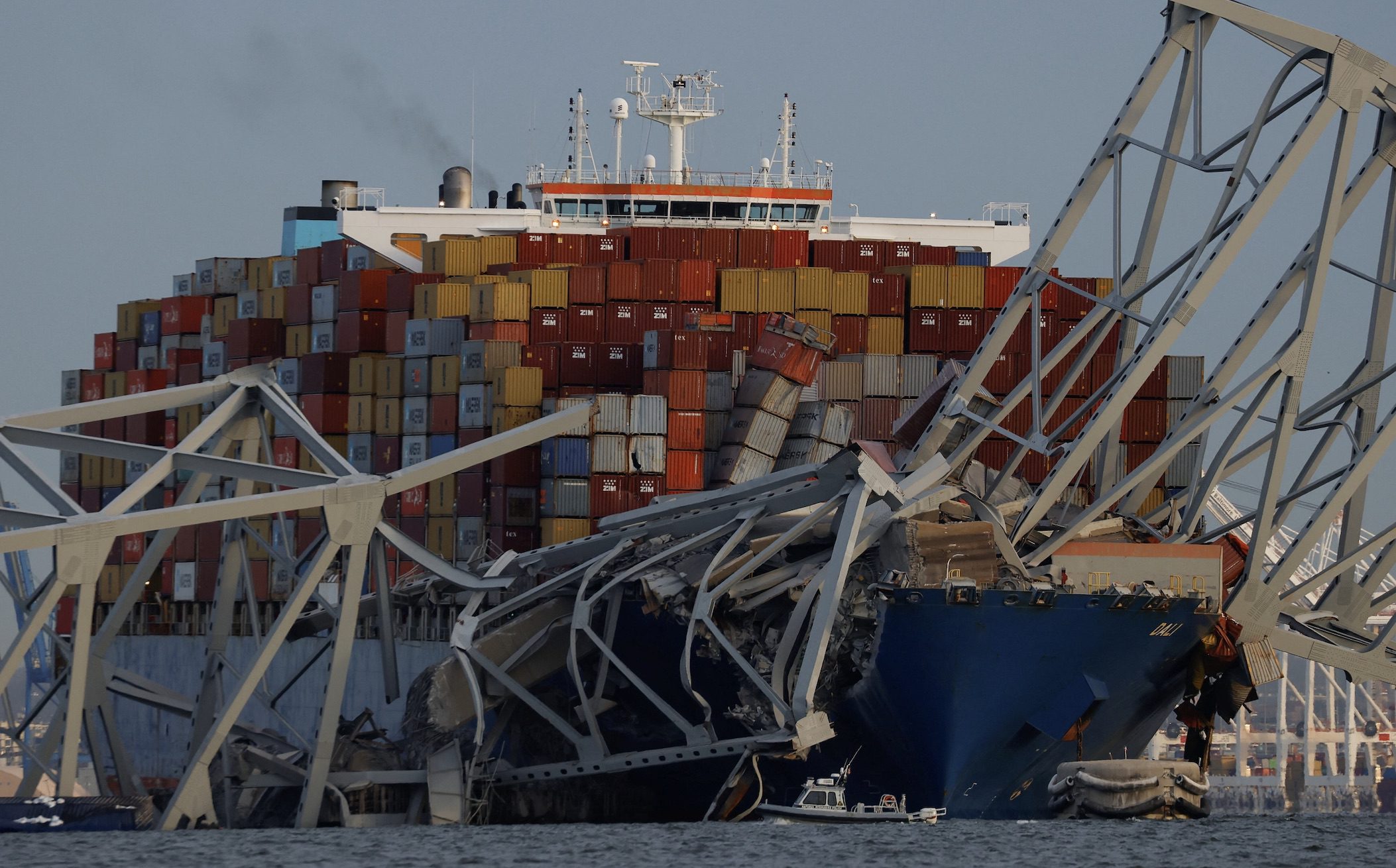
Contaminated fuel

According to Fotis Pagoulatos, a naval architect based in Athens, contaminated fuel can pose significant risks to a ship’s main power generators, potentially leading to a complete blackout and loss of propulsion.

While smaller generators may activate in response, they are unable to fully replace the functions of the main generators and may take time to engage.

Jennifer Homendy, chair of the National Transportation Safety Board, announced during a press conference that the investigation will encompass reviews of the vessel’s operations and safety history, as well as those of its owner and operator.

Efforts will also be made to secure recorders from the ship to gain further insight into the sequence of events leading up to the collision.

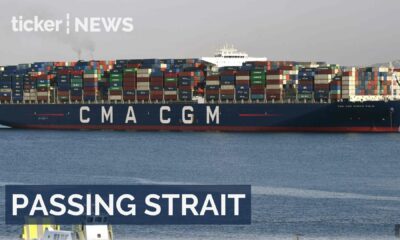
The Dali, constructed in 2015 by South Korea’s Hyundai Heavy Industries, is a Panamax-type ship capable of carrying up to 10,000 containers.

Despite its size, the vessel is a common sight in U.S. ports on the East Coast and regularly transits through major canals such as the Panama and Suez Canals.

Ahron Young is an award winning journalist who has covered major news events around the world. Ahron is the Managing Editor and Founder of TICKER NEWS.

News

Five global escapes executives are booking for 2026

Published

on

Where to switch off, reset and travel well for a week

For executives in their 40s, travel has shifted. It is less about ticking off sights and more about space, comfort and coming back sharper than when you left.

In 2026, the most appealing one-week holidays are destinations that combine calm, quality and a sense of being ahead of the curve.

For executives, switching off from work is essential, but true rest comes from being gently engaged rather than completely idle.

The most rewarding breaks offer just enough stimulation, culture, nature or conversation, to quiet the mind without replacing one form of busyness with another.

Here are five global locations quietly rising to the top of travel wish lists.

East Coast Barbados

Barbados has long been associated with polished beach holidays, but the east coast offers something different.

Wild Atlantic surf, boutique retreats and fewer crowds create a slower rhythm that suits travellers who want proper rest without sacrificing style.

Days are spent between long coastal walks, ocean-facing spas and unhurried dinners, with just enough local culture to keep things interesting.

Barbados: Book a holiday package (flights + hotel) to Barbados here.

Phu Quoc

Vietnam’s largest island is emerging as a refined alternative to more established Asian beach destinations.

Phu Quoc blends thoughtful luxury with a grounded, local feel. Resorts are discreet rather than flashy, wellness is taken seriously, and the pace encourages doing very little very well.

It is an easy week of warm water swims, exceptional food and genuine mental downtime.

Phu Quoc, Vietnam: Find holiday packages and deals for Phu Quoc here.

Peloponnese


For travellers who want culture without crowds, the Peloponnese is becoming Greece’s most compelling region.

Ancient ruins sit alongside olive groves, quiet beaches and wellness-focused resorts designed for long lunches and early nights.

It offers the Mediterranean experience executives love, without the intensity of Santorini or Mykonos.

Peloponnese, Greece: Browse and book Peloponnese holiday packages with flights and hotels here.

The Red Sea

Saudi Arabia’s Red Sea coast is one of the most ambitious luxury travel projects in the world.

Opening progressively through 2025 and 2026, it promises adults-focused resorts built around sustainability, privacy and high-end wellness.

For those seeking something genuinely new, this is a destination that feels exclusive, restorative and future-facing.

Red Sea Coast (gateway for Red Sea resorts): Book a Red Sea Coast holiday package (flight + hotel) here.

Margaret River

Margaret River continues to refine its appeal for travellers who value space and quality. World-class wineries, dramatic coastline and understated luxury accommodation make it ideal for a reset without jet lag.

It is a reminder that a great week away does not need excess. It needs good food, good wine and room to breathe.

In 2026, the best holidays for executives are not about escape in the dramatic sense. They are about intention. A change of pace, fewer decisions, and environments designed to help you slow down properly. These destinations understand that luxury is not about doing more, but about feeling better when you return.

Margaret River, Western Australia: Find Margaret River holiday packages (accommodation + flight) here.

Continue Reading

News

Iran’s currency collapse sparks mass protests as inflation spirals

Iran president engages protesters amid economic crisis as currency tumbles and inflation surges

Published

on

Iran’s president engages protesters amid economic crisis as currency tumbles and inflation surges

video
play-sharp-fill
In Short:
– Iranian President Pezeshkian urged action to meet protesters’ demands amid economic crisis and currency devaluation.
– Protests intensified with shop closures in Tehran, following significant inflation and political unrest after Mahsa Amini’s death.

Iran is grappling with its most severe economic crisis in years. Mass protests erupted across Tehran following the dramatic collapse of the national currency. The rial plunged to 1.42 million against the U.S. dollar over the weekend, briefly recovering to 1.38 million. This marks a loss of more than two-thirds of its value since 2022.

Annual inflation soared to 42.2 percent in December, with food prices up 72 percent year-on-year. Many Iranians are struggling to make ends meet, fueling public anger and unrest.

In response, Iranian President Masoud Pezeshkian ordered his government to engage directly with protest representatives. Calling the demonstrations “legitimate,” he emphasized the need for reforms in the monetary and banking sectors. Officials announced a dialogue framework to hear the voices of demonstrators.

The unrest coincided with the resignation of Central Bank Governor Mohammad Reza Farzin. Former Economy Minister Abdolnaser Hemmati is set to replace him, signaling possible shifts in economic policy.

Tehran’s commercial districts were paralyzed as shopkeepers in the Grand Bazaar and major streets closed businesses in solidarity. Videos on social media showed crowds chanting slogans as security forces used tear gas to disperse them.

International pressure is also rising. U.S. officials warned they would support action against Iran if the country resumes nuclear or missile development, following recent airstrikes on Iranian facilities.

The World Bank forecasts Iran’s GDP will contract 1.7 percent in 2025 and 2.8 percent in 2026, deepening economic concerns. How the government responds to these protests and reforms its economy may shape the country’s stability in the months ahead.


Download the Ticker app

Continue Reading

News

CIA launches first drone strike in Venezuela

CIA conducts first drone strike in Venezuela, targeting drug gang facility amid escalating US military campaign

Published

on

CIA conducts first drone strike in Venezuela, targeting drug gang facility amid escalating US military campaign

video
play-sharp-fill
In Short:
– The CIA conducted its first drone strike in Venezuela since the Trump administration’s military campaign began.
– Trump’s operation targeted a dock linked to drug trafficking, resulting in no casualties.

The United States has carried out its first confirmed drone strike inside Venezuela, marking a dramatic escalation in Washington’s expanding military campaign across the Caribbean. The operation, reportedly conducted by the CIA, targeted a remote port facility believed to be used by the Tren de Aragua gang to store and transport narcotics. No casualties were reported, as the dock was empty at the time of the strike.

President Donald Trump publicly acknowledged the attack in late December, describing a “major explosion” at a dock where drug-laden boats were allegedly loaded. Trump first revealed the strike during a radio interview, placing the operation around December 24, before later confirming it to reporters while declining to specify whether the CIA or the military carried out the mission. “I know exactly who it was, but I don’t want to say who it was,” he said from his Mar-a-Lago residence.

Drug networks

The strike comes amid a significant expansion of Operation Southern Spear, now the largest US military deployment in the Caribbean since the Cuban Missile Crisis. Around 15,000 US troops have been positioned across the region, supported by the USS Gerald R. Ford carrier strike group and F-35 fighter jets. Since September, US forces have carried out at least 28 strikes on vessels in the Caribbean and eastern Pacific, resulting in more than 100 deaths, as Washington intensifies efforts to dismantle transnational drug networks.

The campaign has drawn fierce criticism from legal experts and international bodies. United Nations investigators have condemned the strikes as “extrajudicial executions,” warning they violate the UN Charter’s prohibition on the use of force. US legal scholars have also questioned the domestic legality of the operation, arguing it exceeds constitutional and statutory limits on executive power.

A slave’s peace

Venezuela has not formally commented on the dock strike, though Interior Minister Diosdado Cabello has accused the United States of months of “imperial madness.” President Nicolás Maduro has rejected Trump’s demands to step aside, telling supporters the country seeks peace “with sovereignty, equality, and freedom” — not what he described as “a slave’s peace.”


Download the Ticker app

Continue Reading

Trending Now