
Anthony Albanese is the first Australian Prime Minister to visit war-torn Ukraine
Anthony Albanese has made history, becoming the first Australian Prime Minister to visit war-torn Ukraine.
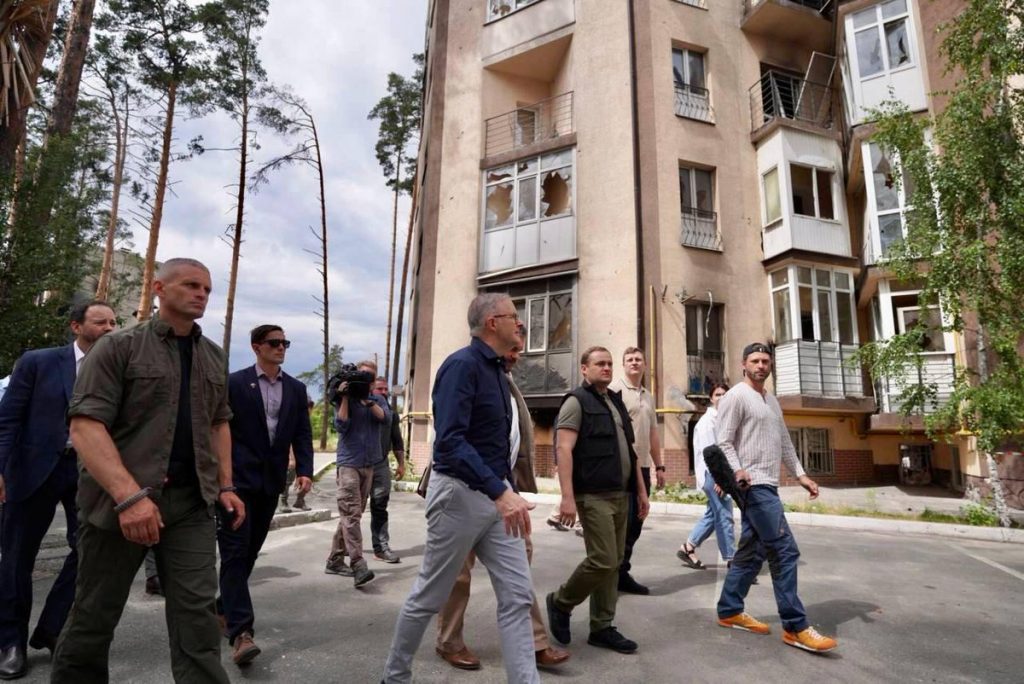
Only months into the top job, the new Prime Minister traveled to three destroyed cities surrounding the capital of Kyiv and met with Ukrainian leader Volodymyr Zelensky.
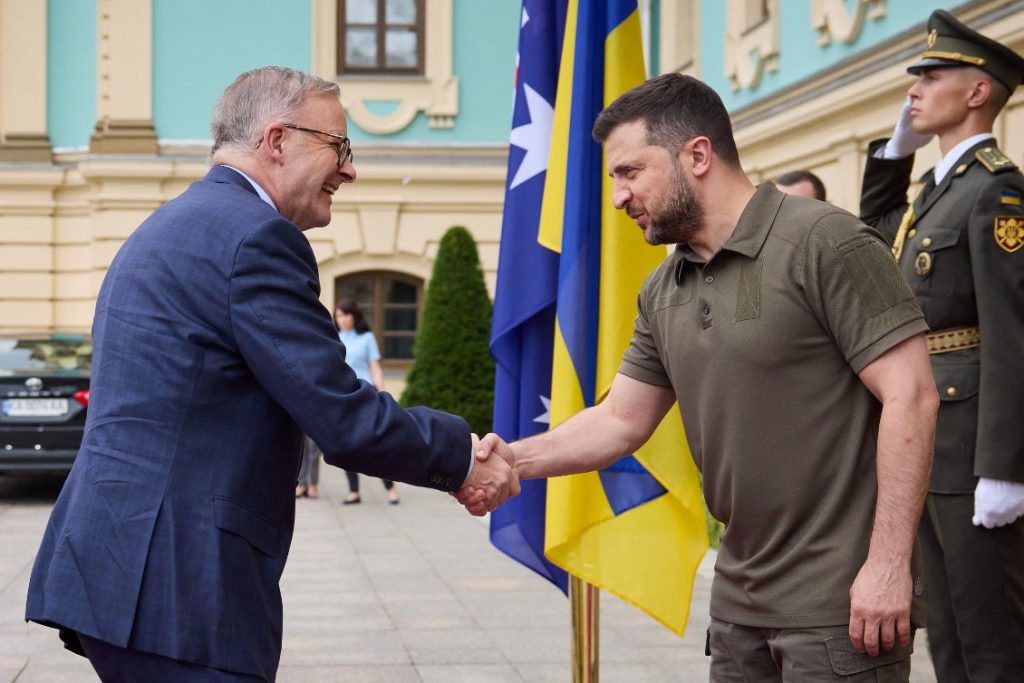
Photo Credit: The Australian
Albanese visited the city of Bucha, Irpin, and Hostomel, which were the first victims of Russia’s war.
Irpin has a population of approximately 70,000, Bucha 37,000, and Hostomel about 17, 000.
Russia chose to attack each of the towns, early in the war with many suggesting this was a tactic to encircle the capital.
Thousands of civilians have lost their lives in these regions since the war began in February.
Albanese was surrounded by heavy security during his visit, with the Prime Minister witnessing first-hand the ‘devastating’ atrocities carried out by Russia.
Although Russia has continued to deny the attacks, Albanese says they’re “a war crime”.
“Clearly, civilian areas have been targeted by the Russian forces as part of this illegal and amoral war.
It’s devastating. These are homes and these are livelihoods and indeed lives that have been lost here in this town. And the fact that you had such a significant force – you can see the use of tanks, missiles, heavy artillery being used in a civilian area – it’s just devastating.”
anthony albanese
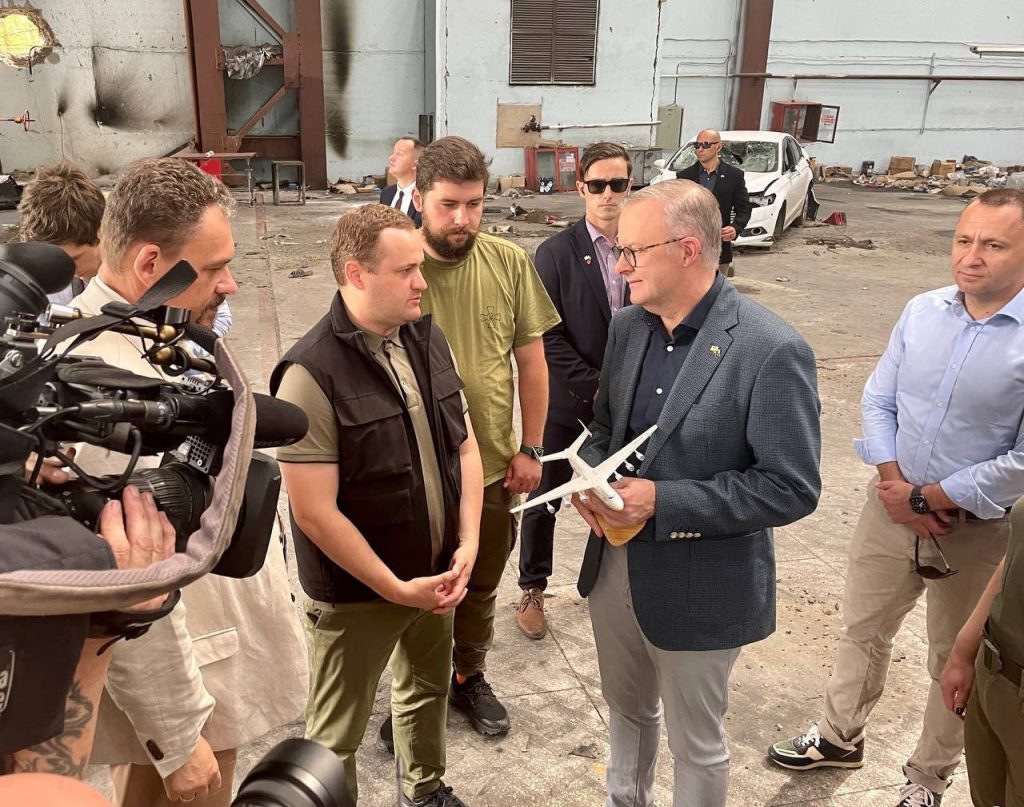
During a briefing with Ukraine’s Volodymyr Zelensky, the new Prime Minister says Australia will provide $100 million in military and technical might.
The package will include 14 armoured personnel carriers, 20 more Bushmaster vehicles, and drones.
Albanese also confirmed Australia will move to ban Russian gold imports.
He confirmed his country will support Ukraine for “as long as it takes” to win the war.
So far, Australia has given Ukraine $285 million in military aid and $65 million in humanitarian relief.
“We understand that the defence of Ukraine is about defending the rules-based international order and the implications for its disruption would have ramifications throughout the world.
Because you are fighting for the international rule of law, you are fighting for international rules in which we conduct our activity to be respected and to occur in an orderly way.”
anthony albanese
Zelensky welcomed Albanese’s visit and show of support and compassion.
“I am grateful for [Australia’s] decision to join the process. It is important for us, it is important for the whole world.”
Ukraine’s energy and nuclear safety systems have come under severe strain after a major Russian missile and drone attack struck critical power infrastructure, forcing all nuclear power plants in Kyiv-controlled territory to halt electricity generation and triggering urgent international warnings.
The February 7 assault damaged high-voltage substations supplying nuclear facilities, destabilising the national grid. The International Atomic Energy Agency said the disruption compromised nuclear safety, with one reactor shutting down automatically and others reducing output due to grid instability. IAEA Director General Rafael Grossi called for military restraint, warning of potentially dangerous consequences.
Nuclear terrorism
The attack targeted infrastructure across eight regions as Ukraine faces a deep freeze, with temperatures in Kyiv forecast to fall to minus 19 degrees Celsius. Emergency power outages have been introduced nationwide, while energy companies report extensive damage to thermal power plants.
President Volodymyr Zelensky condemned the strikes as nuclear terrorism and called for a global response. The IAEA also confirmed a recent loss of off-site power at the Chornobyl site, raising concerns that continued attacks on energy infrastructure could increase nuclear risks beyond Ukraine’s borders.
President Donald Trump has moved to reshape US trade policy on two major fronts, signing executive orders that both ease tariffs on India and threaten new levies on countries that continue to trade with Iran.
The rollback of tariffs on India follows New Delhi’s commitment to halt imports of Russian oil, a move welcomed by Washington as it seeks to tighten pressure on Moscow’s energy revenues. The decision signals a thaw in trade tensions between the two nations and underscores the administration’s willingness to reward partners that align with US foreign policy priorities.
At the same time, Trump warned that nations maintaining commercial ties with Iran could face fresh US tariffs, escalating economic pressure on Tehran and its trade partners. The move reinforces a hardline strategy aimed at isolating Iran economically, while using trade measures as leverage in broader geopolitical negotiations.
Together, the twin decisions highlight the Trump administration’s increasingly assertive use of tariffs as a diplomatic tool, targeting both allies and adversaries. From the Indo-Pacific to the Middle East, the approach underscores how trade policy is being deployed not just to protect US industries, but to advance America’s strategic interests on the global stage.
The United States has announced an additional $6 million in humanitarian aid for Cuba, bringing total assistance since Hurricane Melissa struck the island in October to $9 million. The new relief package will focus on Cuba’s eastern provinces, including Holguín, Granma, Santiago de Cuba, and Guantánamo, providing staples like rice, beans, pasta, canned tuna, and solar lamps. U.S. officials said embassy staff will monitor distribution to prevent the government from diverting supplies.
The announcement comes amid worsening energy and fuel shortages. Cuba has faced widespread blackouts, leaving millions without electricity in several provinces, while rising food prices and limited fuel supplies have intensified humanitarian pressures. Officials warn that without sufficient oil imports, hospitals, transport, and essential services could be severely affected. The crisis has escalated following U.S. restrictions on Cuba’s oil shipments and Venezuela’s inability to supply fuel, forcing Cuba to turn to Mexico as its primary energy partner.
Humanitarian situation
Cuba’s President Miguel Díaz‑Canel accused the U.S. of imposing an “energy blockade,” while Mexican officials work to deliver fuel without triggering U.S. tariffs. Díaz‑Canel expressed willingness to engage in dialogue but insisted talks must respect Cuba’s sovereignty. U.N. Secretary-General António Guterres has voiced serious concern, warning that the humanitarian situation could deteriorate further if oil supplies remain restricted.
As Cuba struggles to balance disaster recovery with an ongoing energy crisis, the international community faces a delicate challenge: providing humanitarian support while navigating complex geopolitical tensions.