
News
Watered down meetings for Pacific leaders

Solomon Islands Prime Minster concludes his second overseas trip in a week as strategic competition heightens
It’s hard to believe a time when leaders from the Pacific jumped on board their emissions-spurting jets to meet with the U.S. President.
But last week 12 leaders from across the Pacific gathered in Washington to meet with President Joe Biden in the first U.S.-Pacific Island Country Summit.
“We honoured the history and values that our nations share and expanded our cooperation on key areas that will benefit our people for years to come,” President Biden said.
What was the meeting about?
Leaders from Fiji, Solomon Islands, Palau and the Federated States of Micronesia were among the guests at the summit.
They discussed maritime security, climate change, and economic development.
Of course, climate change is a crucial issue for these Pacific Island states, many of which are low-lying and vulnerable to the impacts of rising temperatures and sea levels.
These countries are already experiencing higher temperatures, shifts in rainfall patterns, and rising sea levels.
There are also long-term climate variables, which are expected to occur in the future.
The U.S. believes the summit was a platform to “reaffirm its commitment to the Pacific region” and “strengthen its relationships”.
But it was only a matter of time before the climate guise was dropped.
“The security of America, quite frankly, and the world depends on your security, and the security of the Pacific Islands.”
JOE BIDEN, U.S. PRESIDENT
Security is the key word here, because President Biden’s definition of this, may differ from the low-lying states of the Pacific.
Why was it important?
One word: China. When Beijing’s Foreign Minister Wang Yi blitzed through 10 Pacific countries earlier in the year, he had a big deal on his mind: a regional security pact.
“China practices the diplomatic principle of equality among all countries,” China’s Ministry of Foreign Affairs said.
The Pacific sensationally declined to sign up to the sweeping deal, which included greater economic and security ties.
Wang said the Pacific region should not to be “too anxious” about Beijing’s intentions.
“China is not a newcomer, but rather an old friend with Pacific Island countries,” the Ministry of Foreign Affairs said.
Solomon Islands is the key example here, especially after Prime Minster Manasseh Sogavare’s stance on the Declaration following last week’s U.S.-Pacific Partnership.
Foreign Minister Jeremiah Manele said he watered down the initial language because it “put us in a position where we’d have to choose sides”.
He added there were “indirect” references to China, however, officials later found “common ground” and Solomon Islands signed up.
It’s no surprise Sogavare was then seen standing next to President Joe Biden for the official photo at last week’s Washington Summit. Fiji’s leader Frank Bainimarama was also strategically on the other side.
It was the first time in 40 years where a Fijian Prime Minister had an official audience with the U.S. President.
Why is Solomon Islands at the centre of this?
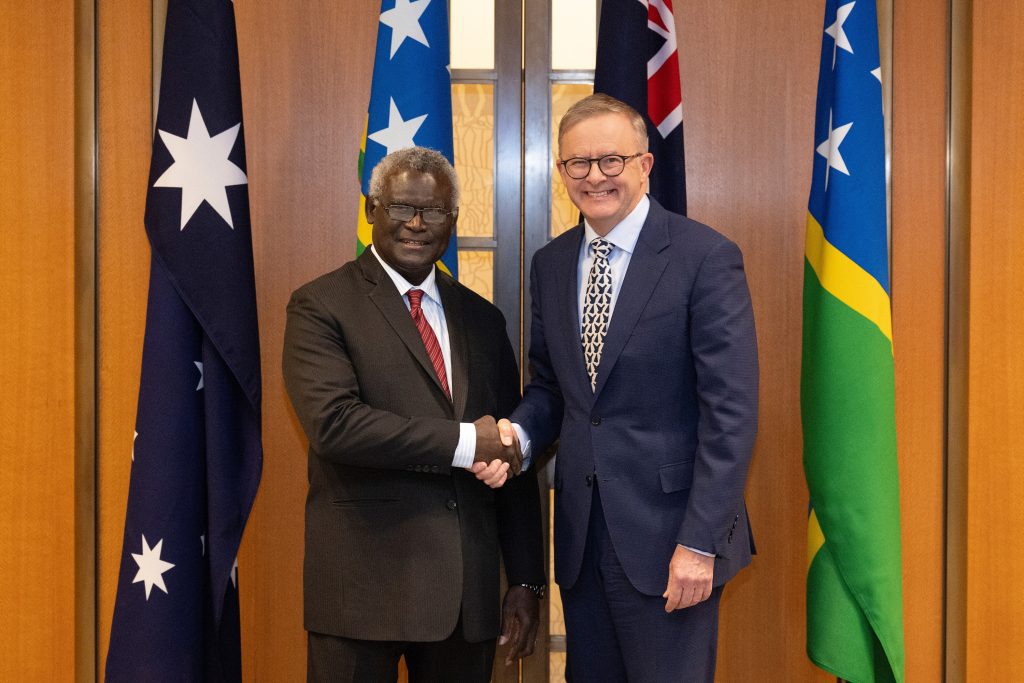
Prime Minister Manasseh Sogavare met with Australia’s leader Anthony Albanese in Canberra today, where the pair reiterated their relationship as “proud Pacific nations”.
“I look forward to engaging with Prime Minister Sogavare on building a strong and prosperous Pacific region, based on principles of transparency, respect and partnership.”
ANTHONY ALBANESE, PRIME MINISTER OF AUSTRALIA
Australia remains Solomon Islands’ largest development partner. But Sogavare’s state visit largely remained behind closed doors, with no media opportunities scheduled.
Prime Minister Sogavare welcomed Australia’s $16.68 million commitment to support the 2023 Pacific Games, and offer to support the next Solomon Islands’ election—an issue where earlier friction was caused.
Sogavare’s visit was part of Canberra’s plan to reduce friction between the two nation.
Earlier this year, Honiara signed a security alliance with Beijing. It stirred a diplomatic pot over concerns a Chinese military base could be established on the island nation.
Australia’s then-Prime Minister Scott Morrison asked for greater transparency over the deal.
But Sogavare lashed out at Australian officials in his nation’s parliament, asking where the same transparency was over the AUKUS alliance between Australia, Britain and the U.S.
“I learnt of the AUKUS treaty in the media. One would expect that as a member of the Pacific family, the Solomon Islands and members of the Pacific should have been consulted to ensure this AUKUS treaty is transparent.”
MANASSEH SOGAVARE, PRIME MINISTER OF THE SOLOMON ISLANDS
The recent Washington summit was the perfect opportunity for President Biden to roll out the red carpet and discuss his administration’s plans for the Indo-Pacific region.
On the other hand, China’s Ministry of Foreign Affairs said it “will keep in close communication with all parties” and “make good use of the mechanism of China-Pacific Island Countries Foreign Ministers’ Meeting”.
-
 News4 days ago
Saudi Arabia faces renewed missile and drone attacks
-
Shows4 days ago
Hospitality industry faces crisis with rising insolvencies
-
News4 days ago
Selma Blair arrested for in-flight incident aboard Delta
-
Shows4 days ago
Midkey offers flexible loans for homeowners accessing equity
-
News4 days ago
ATO targets trusts, leading to $13.3bn costs
-
News4 days ago
‘Russia is a fail safe’: Iran conflict mediation
-
News5 days ago
Iran rejects U.S. response on Strait of Hormuz
-
Ticker Views5 days ago
France’s student protests revive 1968 comparisons amid political tensions