

Connect with us
https://tickernews.co/wp-content/uploads/2023/10/AmEx-Thought-Leaders.jpg

News

Senate set to kill abortion rights this week

Published

on

The aftershocks of the earthquake triggered in Washington last week, with the explosive leak of the first draft of an opinion authored by Supreme Court Justice Samuel Alito, and backed in by four other Justices, including the three radical conservatives appointed by former president Donald Trump, continue to shake the foundations of the capital and the landscape across the country

USSC Bruce Wolpe joins U.S correspondent Veronica Dudo, and ticker’s Holly Stearnes join a panel on U.S. abortion rights

The magnitude of the impact of the draft opinion is simply enormous. 

What has been accepted by well over 60% of the American people as a constitutional right – the ability of women to have access to abortion services – is about to be removed. 

There is no good that comes from going down that road of taking rights away from people. In 1856, in the Dred Scott case, the Supreme Court held that former slaves did not have standing in federal courts because they lacked U.S. citizenship, even after they were freed.

PROTESTORS IN U.S.

That decision, so outrageous, contributed to the Civil War.  In 1954, in Brown v Board of Education, the Court ruled that segregated “separate but equal” schools for Black students recognised by the Supreme Court 50 years earlier was unconstitutional as this did not afford equal protection under law – a right guaranteed by the 14th Amendment enacted after President Lincoln and the North won the civil war and ended slavery. 

The arc of justice in other words, is best when the law advances rights – not takes them away.

33 million American women between the ages of 15 and 44 living in over two dozen states across the country will be denied access to abortion services if this draft opinion is ultimately adopted. 

But nothing in the Constitution prevents Congress from enacting a law to legally establish and protect a woman’s right to have access to abortion services. 
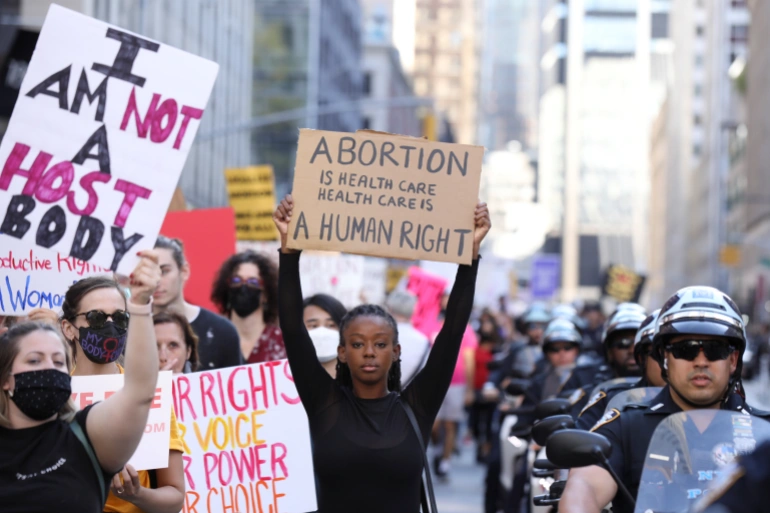
U.S WOMAN PROTESTS

This is the basis of the Women’s Health Protection Act which passed the House last September. 

The Democratic leadership of the House recognised that what everyone is facing this week was coming, and that the best protection against overturning the precedent of Roe v Wade is through legislation. 

The bill provides that, “Congress finds abortion services are essential to health care. A health care provider has a statutory right under this Act to provide abortion services.”

This is the bill that the Democratic leadership will bring to the Senate this week.  It will fail.

No Republicans in the House voted for this bill, which passed on a party-line vote of 218-211.  There are only two Republicans in the Senate– both women, Susan Collins of Maine and Lisa Murkowski of Alaska – who support abortion rights.

All but one or two of the 50 Democrats will support it. Bu the Senate is not a democratic institution.  A simple majority vote is insufficient to pass legislation. 
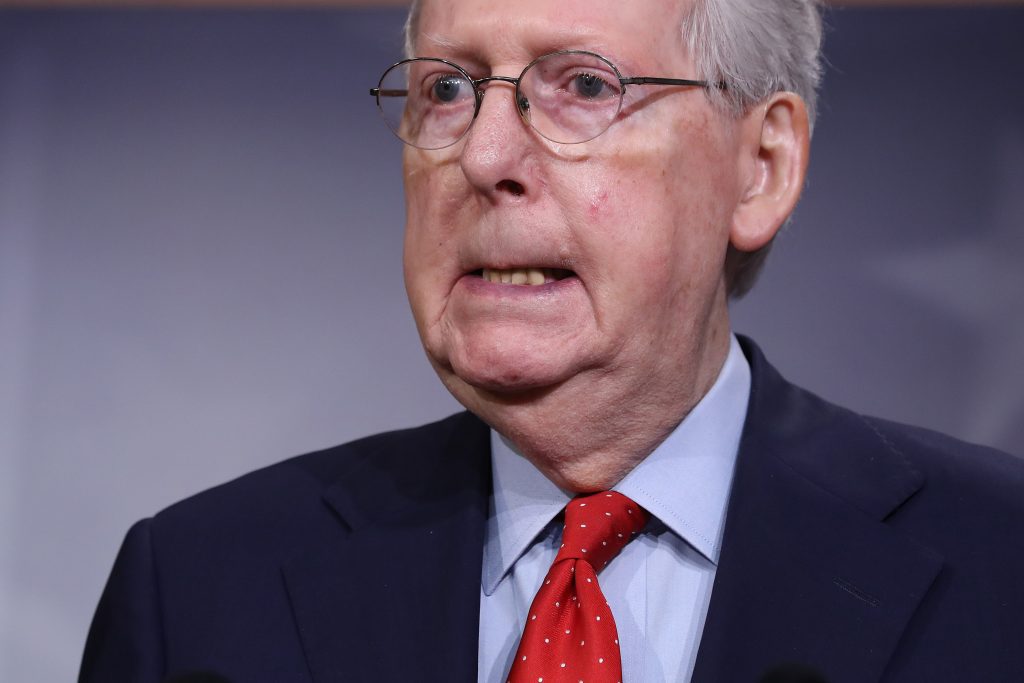
WASHINGTON, DC – APRIL 21: Senate Majority Leader Mitch McConnell

A bill needs a supermajority of 60 votes to pass the Senate.  That is completely out of reach today for abortion rights.

The Senate could change its rules and allow the abortion rights bill to pass in this one instance by a simple majority.  But that will not happen either.

At least two Democrats oppose upending this Senate tradition, and no Republican will vote against their leadership to alter the Senate to pass a Democratic bill on abortion.

This ugly hyper-partisanship will have several ramifications. 

If this Senate cannot protect these rights, perhaps more Democrats in the Senate can.   Democrats will use this vote to target Senate seats held by Republicans that are up in the November midterm elections in states like Pennsylvania, Georgia, and Wisconsin. 

This could well energise not only Democrats but also key swing independent voters who do support, in significant numbers, abortion rights.

But the human impact on women is frightening. 

The journalist who obtained the draft opinion in the leak from the Supreme Court, and broke the story, Josh Gerstein of Politico, said this last Friday:

“And if Justice Alito’s draft opinion that we reported and made public on Monday becomes the Supreme Court’s final word on this issue, you’d have really a situation of abortion haves and have-nots across the country, where you would have many states where abortion was relatively available and probably about 26 states where abortion is banned or very, very sharply restricted. You would then have women trying to get medication abortions in those states or possibly travel through what might develop as a kind of Underground Railroad to get them out of those states and into other states where they could get legal abortions. It would be a pretty dramatic change in the availability of abortion across the country.”

Gerstein is right. This is the world we are in. 
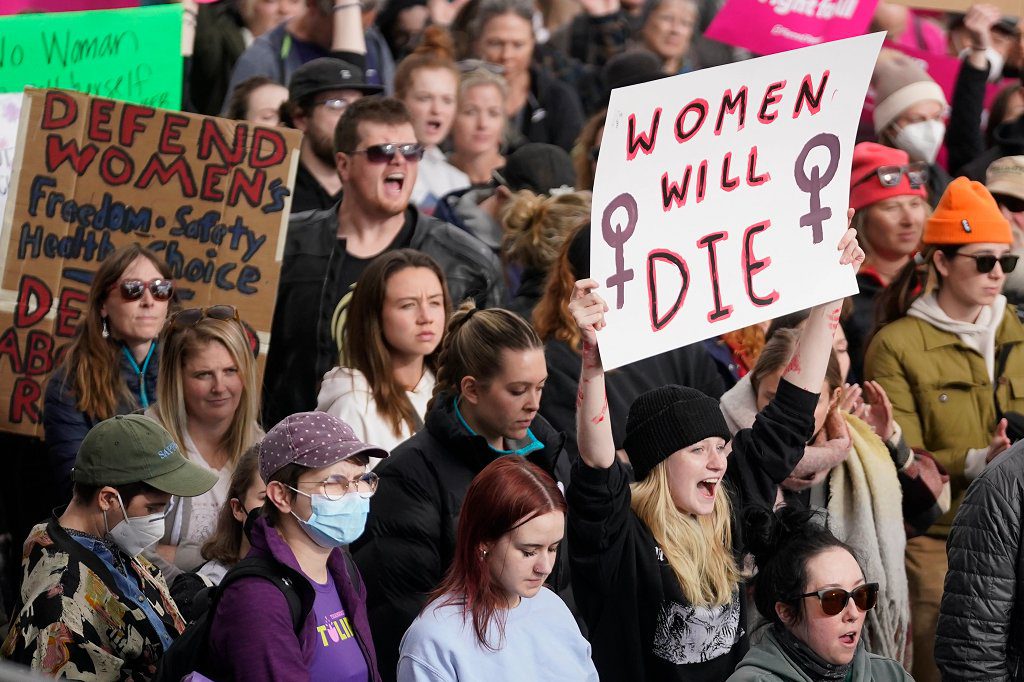
WOMEN ACROSS THE U.S RALLY IN PROTEST

160 years after the Civil War, another Underground Railroad – this time to take women away from states with restrictive medical laws. 

A Handmaid’s Tale come to life, as Canada pledges to open its borders to American women seeking reproductive health services.

Engraved on the pediment of the Supreme Court building in Washington are the words, “Equal Justice Under Law.”

The Supreme Court’s imminent decision and the failure of Congress to enact legislation to overturn it betrays a US political system failing to protect all women equally under law.

Bruce Wolpe is a Ticker News US political contributor. He’s a Senior Fellow at the US Studies Centre and has worked with Democrats in Congress during President Barack Obama's first term, and on the staff of Prime Minister Julia Gillard. He has also served as the former PM's chief of staff.

News

China deploys over 100 ICBMs near Mongolia border

China deploys over 100 ICBMs near Mongolia amidst ongoing tensions and lack of arms control talks with the US

Published

on

China deploys over 100 ICBMs near Mongolia amidst ongoing tensions and lack of arms control talks with the US

video
play-sharp-fill
In Short:
– China has deployed over 100 ICBMs in new silos near Mongolia, marking a significant nuclear expansion.
– Beijing aims to enhance military strategies for Taiwan by 2027, potentially affecting U.S. operations in the region.

China has deployed over 100 solid-fueled intercontinental ballistic missiles (ICBMs) in newly constructed silo fields near its border with Mongolia, according to a draft Pentagon report reviewed by Reuters.This marks the most significant nuclear expansion by Beijing to date. The United States indicates that China shows no intention of engaging in arms control negotiations, despite President Trump’s calls for denuclearization talks with both China and Russia.

The report states that the DF-31 missiles, which have a range of 7,000 to 11,700 kilometers, are positioned across three silo fields. While the Pentagon had previously acknowledged these fields, this is the first confirmation of the number of deployed missiles.

China’s nuclear warhead stockpile was estimated at around 600 in 2024. The report projects an increase to over 1,000 warheads by 2030. It highlights a lack of willingness from Beijing to pursue arms control measures.

Beijing has dismissed such reports as attempts to discredit China and claims that it follows a nuclear strategy of self-defense with a no-first-use policy.

Forceful means

The Pentagon assessment indicates that China plans to be capable of fighting and winning a conflict over Taiwan by 2027. Beijing is reportedly enhancing military strategies to capture the island through forceful means.

These military strikes could potentially disrupt U.S. operations in the Asia-Pacific region.

Neither the Pentagon nor China’s embassy in Washington responded to requests for comment. U.S. officials cautioned that the draft report could change before its formal submission to lawmakers.


Download the Ticker app

Continue Reading

News

Global race for AI infrastructure amid soaring energy costs

Japan invests ¥1 trillion in AI infrastructure amid global tech race as energy costs and concerns rise

Published

on

Japan invests ¥1 trillion in AI infrastructure amid global tech race as energy costs and concerns rise

video
play-sharp-fill
In Short:
– Japan plans to invest ¥1 trillion in domestic AI to enhance infrastructure and compete globally.
– China is focusing on technological independence as domestic chipmakers prepare for public offerings.

Japan plans to invest ¥1 trillion ($6.34 billion) over five years in a domestic artificial intelligence company. This initiative aims to build infrastructure for AI, despite rising electricity costs raising concerns about the industry’s sustainability.The government will collaborate with SoftBank Group and Preferred Networks to develop the largest foundation model in Japan, employing around 100 engineers to compete globally. This effort reflects worries about the risks of relying on foreign AI technology.

China is also increasing its focus on technological independence. Domestic chipmakers are preparing for public offerings to enhance their capabilities, following successful launches by Moore Threads and MetaX in Shanghai. Companies such as Biren Technology and Baidu’s Kunlunxin are also planning to go public.

SoftBank is pursuing a $22.5 billion funding commitment to OpenAI by year-end, by selling assets and securing loans. CEO Masayoshi Son’s significant investment signifies a strong commitment to AI infrastructure.

AI Infrastructure

The rapid expansion of data centers is putting pressure on energy resources. Projections suggest data centers will consume 945 terawatt-hours by 2030, nearly tripling from 415 TWh in 2024. In the U.S., energy use by data centers could reach 9% to 12% of total supply by 2028.

Concerns have arisen over whether tech companies’ activities are raising residential electricity costs, with investigations launched by three Democratic senators targeting major companies like Alphabet, Microsoft, and Amazon. Utilities face significant expenses to upgrade grids, which may be passed on to consumers.

The energy demand is benefiting companies that supply power infrastructure. Jefferies recently upgraded GE Vernova to Buy, citing expected growth in gas pricing and long-term service demand amid rising energy needs.


Download the Ticker app

Continue Reading

News

Australia’s property market set to soar in 2026

Australia’s property market is set for strong growth in 2026, driven by demand and strategic investments across key regions.

Published

on

Australia’s property market is set for strong growth in 2026, driven by demand and strategic investments across key regions.


Australia’s property market is predicted to perform strongly in 2026, with no major losers expected as demand and prices rise across 14 key regions. Hotspotting’s latest analysis highlights which areas are set to shine and the factors driving this unprecedented growth.

Join Tim Graham from Hotspotting as he explains the methodology behind the price predictions and why infrastructure investments and government policies are playing a key role in shaping the market.

From regional hotspots to major cities, we explore emerging trends, buyer behavior, and the outlook for places like Darwin and Perth. Whether you’re a first home buyer or seasoned investor, this episode is packed with insights to navigate Australia’s booming property landscape.

Subscribe to never miss an episode of Ticker – https://www.youtube.com/@weareticker

#AustraliaProperty #PropertyMarket2026 #Hotspotting #RealEstateTrends #HousingMarket #InvestingAustralia #PropertyGrowth #FirstHomeBuyers


Download the Ticker app

Continue Reading

Trending Now