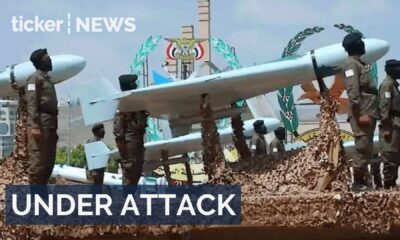

Late on Saturday night, local time, the United States carried out strikes against Iranian nuclear enrichment sites at Fordow, Natanz and Isfahan.
The US says it fired 30 submarine-launched missiles at the sites in Natanz and Isfahan, as well as dropping more than a dozen “bunker buster” bombs at Fordow and Natanz.
The kind of bomb in question is the extremely destructive GBU-57 Massive Ordance Penetrator, or MOP, which weighs around 13.5 tonnes.The attacks raise a lot of questions. What are these enormous bombs? Why did the US feel it had to get involved in the conflict? And, going forward, what does it mean for Iran’s nuclear ambitions?
What are ‘bunker busters’, and why are they used?
Bunker busters are weapons designed to destroy heavily protected facilities such as bunkers deep underground, beyond the reach of normal bombs.
Bunker busters are designed to bury themselves into the ground before detonating. This allows more of the explosive force to penetrate into the ground, rather than travelling through the air or across the surface.
Iran’s nuclear enrichment sites at Fordow, Natanz and Isfahan are built deep underground. Estimates suggest that Fordow for example could be 80m beneath the surface, and capped with layers of reinforced concrete and soil.
What is the MOP?
The bunker buster used in this particular operation is the largest in the US arsenal. Leaving aside nuclear weapons, the MOP is the largest known bunker buster in the world.
Weighing some 13.5 tonnes, the MOP is believed to be able to penetrate up to 60 metres below ground in the right conditions. It is not known how many the US possesses, but the numbers are thought to be small (perhaps 20 or so in total).
We also don’t know exactly how many were used in Iran, though some reports say it was 14. However, it is likely to be a significant portion of the US MOP arsenal.
Why does only the US possess this capability?
The US is not the only state with bunker-busting weaponry. However, the size of MOP means it requires very specialised bombers to carry and drop it.
Only the B2 stealth bomber is currently able to deploy the MOP. Each B2 can carry at most two MOPs at a time. Around seven of America’s 19 operational B2s were used in the Iran operation.
There has been some consideration whether large transport aircraft such as the C-130 Hercules could be modified to carry and drop the MOP from its rear cargo doors. While this would allow other countries (including Israel) to deploy the MOP, it is for now purely hypothetical.
Why has the US (apparently) used them in Iran
The Trump administration claims Iran may be only a few weeks from possessing a nuclear weapon, and that it needed to act now to destroy Iranian nuclear enrichment sites. This claim is notably at odds with published assessments from the US intelligence community.
However, Israel lacks bunker-busting weaponry sufficient to damage the deeply buried and fortified enrichment sites at Fordow, Natanz and Isfahan.
An F-15E Strike Eagle releases a GBU-28 ‘bunker buster’ laser-guided bomb, a smaller equivalewnt of the 13,600 kg GBU-57 ‘Massive Ordnance Penetrator’ believed to have been used in Iran. Michael Ammons / US Air Force
Only the MOP could do the job (short of using nuclear weapons). Even then, multiple MOPs would have been required to ensure sufficient damage to the underground facilities.
The US has claimed that these sites have been utterly destroyed. We cannot conclusively say whether this is true.
Iran may also have other, undeclared nuclear sites elsewhere in the country.
Iran’s reaction
The US has reportedly reached out to Iran via diplomatic channels to emphasise that this attack was a one-off, not part of a larger project of regime change. It is hard to say what will happen in the next few weeks.
Iran may retaliate with large strikes against Israel or against US forces in the region. It could also interrupt shipping in the Strait of Hormuz, which would affect a large portion of global oil shipments, with profound economic implications.
Alternatively, Iran could capitulate and take steps to demonstrate it is ending its nuclear program. However, capitulation would not necessarily mean the end of Iran’s nuclear ambitions.
The value of nuclear weapons
Perhaps a greater concern is that the attack will reinforce Iran’s desire to go nuclear. Without nuclear weapons, Iran was unable to threaten the US enough to deter today’s attack.
Iran may take lessons from the fate of other states. Ukraine (in)famously surrendered its stockpile of former Soviet nuclear weapons in the early 1990s. Russia has since felt emboldened to annex Crimea in 2014 and launch an ongoing invasion in 2022. Other potential nuclear states, such as Iraq and Gadaffi’s regime in Libya, also suffered from military intervention.
By contrast, North Korea successfully tested its first nuclear weapon in 2006. Since then there has been no serious consideration of military intervention in North Korea.
Iran may yet have the ability to produce useful amounts of weapons-grade uranium. It may now aim to buy itself time to assemble a relatively small nuclear device, similar in scale to the bombs used in Hiroshima and Nagasaki.
Depending on what facilities and resources have survived the US strikes, the attack has likely reinforced that the only way the Iranian regime can guarantee its survival is to possess nuclear weapons.
The New START treaty, the last remaining agreement constraining Russian and US nuclear weapons, is due to lapse on February 4.
There are no negotiations to extend the terms of the treaty, either. As US President Donald Trump said dismissively in a recent interview, “if it expires, it expires”.
The importance of the New START treaty is hard to overstate. As other nuclear treaties have been abrogated in recent years, this was the only deal left with notification, inspection, verification and treaty compliance mechanisms between Russia and the US. Between them, they possess 87% of the world’s nuclear weapons.
The demise of the treaty will bring a definitive and alarming end to nuclear restraint between the two powers. It may very well accelerate the global nuclear arms race, too.
What is New START?
The New START or Prague Treaty was signed by then-US President Barack Obama and his Russian counterpart, Dimitri Medvedev, in Prague on April 8, 2010. It entered into force the following year.
It superseded a 2002 treaty that obligated Russia and the United States to reduce their operationally deployed, strategic nuclear warheads to between 1,700 and 2,200 by the end of 2012.
The New START Treaty called for further reductions on long-range nuclear weapons and provided greater specificity about different types of launchers. The new limits were:
700 deployed intercontinental and submarine-launched ballistic missiles (together with heavy bombers)
1,550 nuclear warheads deployed on those platforms, and
800 launchers (both deployed and non-deployed).
These reductions were achieved by February 5, 2018.
The treaty included mechanisms for compliance and verification, which have worked effectively. It provided for twice-yearly exchanges of data and ongoing mutual notification about the movement of strategic nuclear forces, which in practice occurred on a nearly daily basis.
Importantly, the treaty also mandated short-notice, on-site inspections of missiles, warheads and launchers covered by the treaty, providing valuable and stabilising insights into the other’s nuclear deployments.
Lastly, the treaty established a bilateral consultative commission and clear procedures to resolve questions or disputes.
Limitations of the deal
The treaty was criticised at the time for its modest reductions and the limited types of nuclear weapons it covered.
But the most enduring downside was the political price Obama paid to achieve ratification by the US Senate.
To secure sufficient Republican support, he agreed to a long-term program of renewal and modernisation of the entire US nuclear arsenal – in addition to the facilities and programs that produce and maintain nuclear weapons. The overall pricetag was estimated to reach well over US$2 trillion.
This has arguably done more harm by entrenching the United States’ possession of nuclear weapons and thwarting prospects for disarmament.
As the New START treaty was about to expire in 2021, Russia offered to extend it for another five years, as allowed under the terms. US President Donald Trump, however, refused to reciprocate.
After winning the 2020 US presidential election, Joe Biden did agree to extend the treaty on February 3, 2021, just two days before it would have expired. The treaty does not provide for any further extensions.
In February 2023, Russia suspended its implementation of key aspects of the treaty, including stockpile data exchange and on-site inspections. It did not formally withdraw, however, and committed to continue to abide by the treaty’s numerical limits on warheads, missiles and launchers.
What could happen next
With the imminent expiry of the treaty this year, Russian President Vladimir Putin announced in September 2025 that he was prepared to continue observing the numerical limits for one more year if the US acted similarly.
Besides an off-the-cuff comment by Trump – “it sounds like a good idea to me” – the US did not formally respond to the Russian offer.
Trump has further complicated matters by insisting that negotiations on any future nuclear arms control agreements include China. However, China has consistently refused this. There is also no precedent for such trilateral nuclear control or disarmament negotiations, which would no doubt be long and complex. Though growing, China’s arsenal is still less than 12% the size of the US arsenal and less than 11% the size of Russia’s.
The New START treaty now looks set to expire without any agreement to continue to observe its limits until a successor treaty is negotiated.
This means Russia and the US could increase their deployed warheads by 60% and 110%, respectively, within a matter of months. This is because both have the capacity to load a larger number of warheads on their missiles and bombers than they currently do. Both countries also have large numbers of warheads in reserve or slated for dismantlement, but still intact.
If they took these steps, both countries could effectively double their deployed strategic nuclear arsenals.
The end of the treaty’s verification, data exchanges, and compliance and notification processes would also lead to increased uncertainty and distrust. This, in turn, could lead to a further build-up of both countries’ already gargantuan military capabilities.
An ominous warning
The most unsettling part of this development: it means nuclear disarmament, and even more modest arms control, is now moribund.
No new negotiations for disarmament or even reducing nuclear risks are currently under way. None are scheduled to begin.
At a minimum, after New START expires this week, both Russia and the US should agree to stick to its limits until they negotiate further reductions.
And, 56 years after making a binding commitment in the nuclear Non-Proliferation Treaty to achieve nuclear disarmament, both nations should work to implement a verifiable agreement among all nuclear-armed states to eliminate their arsenals.
But Russia, the US and and other nuclear-armed states are moving in the opposite direction.
Trump’s actions since taking office a second time – from bombing Iran to toppling Venezuela’s leader – show his general disdain for international law and treaties. They also affirm his desire to use any instrument of power to assert US (and his personal) interests and supremacy.
Trump announces new trade deal with India, reducing tariffs to 18% in a major shift in U.S.-India relations.
In a major geopolitical shift, U.S. President Donald Trump announced a new trade deal with India that slashes tariffs on Indian goods to 18%, reversing punitive levies previously as high as 50%.
The deal came following a phone call with Indian Prime Minister Narendra Modi and marks a significant pivot in U.S.–India economic relations after months of tension. Oz Sultan from Sultan Interactive Group joins us to break down what this means for exporters and global markets.
‘Subscribe to never miss an episode of Ticker – https://www.youtube.com/@weareticker
UK PM visits Beijing to strengthen trade and tackle security issues; insights from Professor Tim Harcourt on Brexit’s impact.
The British Prime Minister has made the first visit to Beijing in eight years, aiming to strengthen trade links and address growing security concerns with China.
Joining us to unpack the visit is Professor Tim Harcourt, Chief Economist at UTS, who discusses how Brexit has reshaped Britain’s approach and the delicate balance between economic opportunities and security commitments to the USA and NATO.
We also explore how China’s alliances with countries like Myanmar and Russia, along with Canada’s differing approach, influence trade relations, and what this visit means for Australia’s relationship with China.
Subscribe to never miss an episode of Ticker – https://www.youtube.com/@weareticker