
News
The Kremlin is not a place for losers

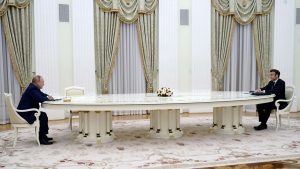
Russian President Vladimir Putin may have used an ultra-long table to protect him from coronavirus, but he might need more than that to protect him from Russia’s hard-line military elite.
When the final leader of the Soviet Union, Mikhail Gorbachev, died last month, we were reminded of the disastrous 1991 coup by the hard-line elements within his administration.
Claiming Gorbachev was ill, the coup leaders, headed by former vice president Gennady Yanayev, declared a state of emergency and attempted to take control of the government.
Side by side at a press conference, they sat stony faced. They were when asked by reporters what had happened to Gorbachev, and why tanks were rolling through Moscow on the way to the White House.
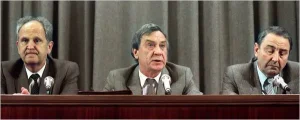
“He’s very tired, he needs rest” was the line fed to non-believing Russian journalists, who for the first time, had the taste of press freedom within their grasp.
“Very tired” or very detained? In Russia, the difference between in power, or out, is only determined by the strength of the person who pushes the hardest.
Push or be pushed
In recent months, Russia’s business elite have had a shocking habit of falling out of windows and finding other sudden yet creative ways to die.
Ravil Maganov was the chairman of Russia’s second largest oil producer, Lukoil. He died after falling from a hospital window in Moscow – the latest in a series of businessmen who suddenly… died.
Journalists who asked questions to police were referred to the state Investigative Committee, who of course never return calls.
At least six other Russian businessmen, mostly tied to the energy industry, died suddenly in unclear circumstances over the last few months.
The only thing they had in common was their suspected wavering loyalty to Vladimir Putin.
Unusually among Russian companies, Lukoil had taken a public stand against Moscow’s war in Ukraine.
On March 3, the company’s board of directors expressed concern over the “tragic events” in Ukraine and called for an end to the conflict.
Power is everything
Inside the Kremlin, power is key. It’s not a place for losers. Eat or be eaten. Push, or be pushed.
Putin took the military risk of his life in February, when he sent his troops to Ukraine for a “special operation”. After an easy win in Crimea back in 2014, a divided west and European Union, and a (former) British Prime Minister who was busy unsuccessfully holding on to power after defending his covid-parties, February seemed the perfect time to bring the country in a fabulous Soviet pastime – invading the neighbours.
But Ukraine did not fall. Kyiv did not fall. And the “drug addicted” leadership in Ukraine, led by former actor Volodymyr Zelensky, turned out to be a more resilient and even more handsome opponent than Putin had anticipated.
Putin may go for shirtless horse rides, but Zelensky looks like an in the trenches leader, with that wife. You just want him to win.
Disastrous disaster
Everywhere you look, Russia’s invasion of Ukraine has been a disaster, pushing it towards further isolation. Yes, it has friends in low moral places, from China to North Korea, and flip flopping nations like Turkey and India that are reliant on its cheap military hardware – they have their own problems.
Remember the 40 mile column that was snaking its way towards Kyiv? Or the 400 mercenaries sent to kill Zelensky?
Granted, it’s hard to know exactly what IS happening across Ukraine, as Kyiv’s military propaganda is disturbingly good. Journalists aren’t allowed to report from the front line, and the narrative is firmly being dictated from Ukraine’s side.
Which is a huge problem for Vladimir Putin. While Russian troops may have had no idea why they were crossing the border to fight their brothers, back home in Moscow, the message is out that Putin’s war is failing, no matter how hard the Kremlin suppresses the media in Russia.
Russians are world experts at reading between the lines.
Who’s to blame?
Russian hard line military leaders are blaming the Kremlin for the embarrassing failure, and these guys don’t mess around.
There are two things that every Russian man is born with – a lifelong live of vodka, and a world-leading sense of pride.
Russia is a proud country, proud of its victory over the Nazis, proud of its history, even though no one can exactly agree on what that is.
Control the narrative
Which makes Putin’s failure in Ukraine a disaster for him.
He may be riding high in the polls, but in Russia, you can never believe the polls. Honesty does not live freely in Russia.
So how does this all end? Russian troops are said to be withdrawing from the Kharkiv region at record pace, commandeering anything with wheels to roll back to the other side of the border.
The West has known all along it cant afford to humiliate Putin, despite how much it might like to. The man still has the ability to kickstart proceedings that would lead to a long nuclear winter.
Putin himself seems so scared of assassination that he couldn’t even attend Gorbachev’s funeral (among a number of reasons I’m sure).
Don’t drink the tea
Russia’s military commanders must be furious, and asking some tough questions. Why were their soldiers sent to Ukraine in such a bad state? Some don’t have any food, or water, or blankets, so they don’t sleep. Morale is disastrously low. I mean, how good can you feel when a mobile crematorium is parked outside your tent?
What happened to all the money that’s been spent on military infrastructure and war-time logistics?
Why are they fighting with weapons that date back to the Soviet invasion of Afghanistan? What on earth happened to Russia’s prized Air Force? Where have they been?
Why is Russia now having to ask its neighbours for Soviet-era weapons to keep fighting?
At first, many believed that Putin was playing 4D chess. Setting up Trump, creating RT to confuse with a propaganda war, dividing Europe, cuddling up to China.
Putin isn’t playing chess at all. He’s playing Scrabble. No agenda, no strategy. Just making up words as he tried to defend the war.
But Scrabble sounds like the perfect game to play when you’re under house arrest.
Something has to give. The business community has so far found that criticising Putin’s war finds you too close to an open window on a 20 storey building.
But will Putin have the luck silencing the hard-line military commanders?

News
Israel strikes Tehran anew as conflict escalates and global markets react
Israel strikes Tehran after Khamenei’s death; U.S. warns of prolonged conflict as tensions escalate in the Middle East.

Israel strikes Tehran after Khamenei’s death; U.S. warns of prolonged conflict as tensions escalate in the Middle East.
Israel has launched a new wave of strikes on Tehran, following the reported killing of Iran’s Supreme Leader, Ali Khamenei. U.S. President Donald Trump has warned the campaign could last up to a month, framing the operation as a move to prevent Iran from acquiring nuclear capabilities.
Iran has retaliated with missile attacks, while its Revolutionary Guards claim responsibility for assaults on oil tankers in the Gulf. The escalating hostilities are already disrupting global shipping lanes and air travel, sending shockwaves through international markets.
With reports of the first U.S. casualties emerging and Washington declaring the Tehran operation a success, tensions across the Middle East are intensifying rapidly. The question now is how far this conflict could spread — and at what cost.
Subscribe to never miss an episode of Ticker – https://www.youtube.com/@weareticker
#Israel #Iran #Tehran #MiddleEastConflict #Geopolitics #OilMarkets #BreakingNews #GlobalSecurity

News
U.S. and Israel strike Iran as missiles hit Gulf bases and oil surges
U.S. and Israel launch major military operation against Iran; tensions rise as conflict escalates, impacting global markets.
U.S. and Israel launch major military operation against Iran; tensions rise as conflict escalates, impacting global markets.
The United States and Israel have launched a sweeping military operation against Iran, striking leadership targets and more than 500 military sites in what President Trump has dubbed Operation Epic Fury.
Explosions have rocked Tehran, with civilians fleeing the capital as U.S. sea and air assets carry out sustained attacks. Washington says the mission is designed to prevent a nuclear armed Iran and has even called on Iranians to rise up against the regime.
Iran has retaliated with a barrage of missiles and drones targeting Israel and U.S. bases across the region, including in Qatar, Kuwait, the United Arab Emirates and Bahrain. While many projectiles were intercepted, a U.S. base in Bahrain sustained damage.
Gulf states long seen as stable hubs for global business are now directly in the firing line, raising fears of a wider regional war.
Oil prices are climbing and tankers are diverting from the Strait of Hormuz as markets react to the escalating conflict. U.S. aircraft carriers, advanced fighter jets and missile destroyers remain in position, signalling more strikes could follow.
With global leaders scrambling diplomatically, the world is watching to see whether this spirals further or shifts back to negotiations.
-
 Money5 days ago
Australia’s inflation report and Nvidia earnings impact explained
-
Tech4 days ago
Meta launches lawsuits over alleged scam advertising operations
-
News2 days ago
Crude oil prices spike amid U.S.-Israel military action
-
News2 days ago
Iran warns ships to avoid Strait of Hormuz
-
News2 days ago
U.S. and Israel attack Iran, escalating regional conflict
-
News14 hours ago
Iran live updates: Trump claims Khamenei dead as Iran insists he remains in command
-
Tech5 days ago
Nvidia earnings soar as AI drives 75% revenue growth
-
News5 days ago
Qantas announces 8,500 jobs and frequent flyer changes