

Connect with us
https://tickernews.co/wp-content/uploads/2023/10/AmEx-Thought-Leaders.jpg

News

Why is Europe burning? Scientists link hot weather to climate change

Published

on

The Great European Heatwave continues, with thousands evacuated from Mediterranean communities as wildfires spread
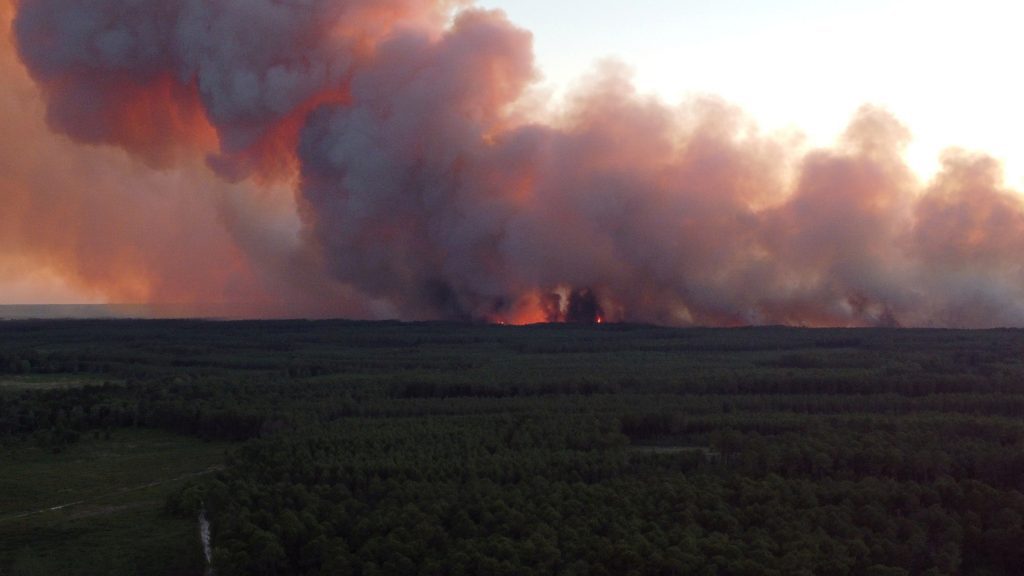
A view shows smoke rising from the Gironde forest fires as seen from Landiras, France. Twitter @Dgamax

Strong winds in the south-west of France are frustrating efforts to contain a fire racing through pine forests.

14,000 people have been ordered to flee from the Gironde region, with this fire and another just south of Bordeaux destroying 10,000 hectares of land.

In southern Spain, 3,200 people have fled from their homes and the blazes are moving closer and closer towards popular tourist area, Málaga.

Portugal’s wildfires have now been extinguished, but 659 people have died from the extreme heat over the past week.

Fire season has hit Europe hard and fast this year, following an unusually dry and hot spring.

Britain’s Met Office issues first ever ‘red’ warning

In the UK, a red extreme heat warning has been issued for the first time in history.

A national emergency has been declared for areas including London, Manchester and York.

Reports suggest millions of workers will stay at home over the next 48 hours to escape the heatwave’s peak.

https://twitter.com/metoffice/status/1547882528832270337?s=20&t=7E6jzOiWckrEQ6tXj6TSYg

The extreme warning means there is a risk to life and authorities are urging residents to make changes to their daily routines in order to stay safe.

Speed restrictions are likely to be imposed for trains, while some schools will close early and hospital appointments cancelled.

The National Health Service (NHS) is also concerned there will be greater demand for ambulances, warning patients could left outside hospitals in emergency vehicles.

Experts believe the extreme temperatures Europe is currently facing can be attributed to climate change.

William is an Executive News Producer at TICKER NEWS, responsible for the production and direction of news bulletins. William is also the presenter of the hourly Weather + Climate segment. With qualifications in Journalism and Law (LLB), William previously worked at the Australian Broadcasting Corporation (ABC) before moving to TICKER NEWS. He was also an intern at the Seven Network's 'Sunrise'. A creative-minded individual, William has a passion for broadcast journalism and reporting on global politics and international affairs.

News

Aden airport closure highlights Saudi-UAE tensions in Yemen

Aden International Airport closes as tensions soar between Saudi Arabia and UAE amid escalating Yemen conflict

Published

on

Aden International Airport closes as tensions soar between Saudi Arabia and the UAE amid escalating Yemen conflict

video
play-sharp-fill
In Short:
– Aden International Airport closed amid rising Saudi-UAE tensions, stranding passengers and highlighting the Yemen crisis.
– Saudi airstrikes targeted STC positions, escalating the conflict as Saudi Arabia and UAE’s interests increasingly clash.

Yemen’s Aden International Airport closed on Thursday due to rising tensions between Saudi Arabia and the United Arab Emirates (UAE), stranding many passengers. This shutdown highlights an escalating crisis between the two Gulf nations over control of Yemen’s resource-rich eastern provinces. Military operations backed by Saudi Arabia resulted in multiple fatalities.Air traffic was suspended following new flight restrictions imposed by Yemen’s internationally recognised government, which is supported by Riyadh. Instead of compliance, Yemen’s transport minister, aligned with the UAE-backed Southern Transitional Council (STC), announced a total shutdown, leaving travellers in difficult situations, especially those needing urgent medical care.

The aviation discord exemplifies a larger divide fracturing the Saudi-led coalition involved in the Yemen conflict. Recent Saudi airstrikes targeted an STC military camp in Al-Khasah, resulting in numerous casualties. Saudi-backed forces initiated a military campaign aimed at reclaiming control over territory occupied by the STC.

Gulf Powers

The situation escalated when the STC seized extensive regions in Hadramout and Al-Mahra provinces. Saudi Arabia publicly condemned the UAE’s activities as a threat to its national security and demanded troop withdrawal. In response, the UAE refuted the claims and prepared to withdraw its forces, although the STC has remained entrenched in its positions.

The current conflict marks a significant public feud between Saudi Arabia and the UAE. They have collaborated since 2015 to combat the Iran-backed Houthi rebels, but their diverging interests have increasingly placed them in opposition.

UAE stock markets experienced mixed results on Friday, reflecting the ongoing regional tensions. Dubai’s index rose 1.1 percent, primarily driven by gains in Emaar Development and Emirates NBD Bank. Conversely, Abu Dhabi’s index remained stable, impacted by a downturn in Abu Dhabi National Energy Company.


Download the Ticker app

Continue Reading

News

Russia claims drone evidence; CIA dismisses allegations

Russia presents alleged drone evidence to US, CIA disputes claims, Ukraine calls accusations a fabrication amid peace talk tensions

Published

on

Russia presents alleged drone evidence to the US, CIA disputes claims, Ukraine calls accusations a fabrication amid peace talk tensions

video
play-sharp-fill
In Short:
– Russia claims Ukraine targeted Putin’s residence with drones, but the CIA dismisses this as disinformation.
– Ukraine denies allegations, arguing they are fabrications hindering peace talks and lacking evidence.

Russia has provided the United States with purported evidence suggesting Ukraine’s involvement in a drone attack aimed at President Vladimir Putin’s residence. This assertion comes as the CIA and other Western officials have dismissed the claims as disinformation.Admiral Igor Kostyukov, head of Russia’s military intelligence, presented a navigation controller from a downed drone to a U.S. military attache. Russian officials claim that the device’s data indicates the drones targeted Putin’s residence in an attack on December 29, involving 91 drones.

The CIA briefed President Donald Trump that Ukraine did not target Putin or his residence during the incident, asserting that the drones were aimed at a military facility instead. This assessment was communicated to Trump on December 31.

Ukraine has refuted the allegations, with President Volodymyr Zelenskyy condemning them as fabrications meant to justify further attacks and hinder peace discussions. The country’s Center for Countering Disinformation pointed out the lack of evidence, such as air defense activity or drone crash footage.

Diplomatic Ramifications

The situation arose shortly after Trump met with Zelenskyy to discuss potential peace agreements. Trump’s initial anger towards Putin’s claims shifted to skepticism as he later shared opinions that criticized Russia’s role in the peace process.

EU Foreign Policy Chief Kaja Kallas labelled Russia’s assertions as distractions aimed at hindering diplomatic negotiations. Meanwhile, Russian Foreign Minister Sergey Lavrov implied that the incident might lead Moscow to reconsider its stance in ongoing discussions aimed at resolving the conflict.


Download the Ticker app

Continue Reading

News

Australian beef industry warns of major export losses under new China tariff

Published

on

China slaps 55% tariff on Australian beef as trade and geopolitical tensions rise

China has imposed a 55% tariff on Australian beef imports that exceed quota limits, a move that threatens more than $1 billion in annual trade and has reignited tensions between Canberra and Beijing. The restrictions, effective from January 1 for three years, cap Australia’s beef quota at 205,000 tonnes—below the volume China imported in 2024—prompting industry claims the decision undermines the spirit of the China-Australia Free Trade Agreement.

Calm fears

Beef producers warn the impact could be severe, with exports to China potentially falling by as much as one-third compared to 2025 levels. Industry groups say the move advantages rival exporters, with Brazil and Argentina receiving far larger quotas, raising concerns Australia could permanently lose market share in a key global market. Prime Minister Anthony Albanese has sought to calm fears, saying Australia is not being singled out and describing the beef sector as the strongest it has ever been.

The tariff decision comes against the backdrop of growing geopolitical strain, days after Australia criticised China’s “Justice Mission 2025” military drills near Taiwan as destabilising. Opposition figures are urging the government to leverage diplomatic ties with President Xi Jinping to ensure Australia is not swept up in broader trade retaliation, as industry calls mount for urgent talks to stabilise relations.


Download the Ticker app

Continue Reading

Trending Now