
Connect with us
https://tickernews.co/wp-content/uploads/2023/10/AmEx-Thought-Leaders.jpg

News

What was discussed in Putin-Xi call?

Published

on

The leaders of Russia and China met through their second video call this year to discuss Western interference in their internal affairs

The one hour summit cemented the relationship between the two powers, who agreed to defend each other’s security interests.

This comes just over a week after Russia’s president Vladimir Putin spoke with US president Joe Biden about the tensions on the border between Russia and Ukraine, highlighting that Western intervention was bringing Russia closer to China.

President Xi says that “certain international forces under the guise of ‘democracy’ and ‘human rights’ are interfering in the internal affairs of China and Russia, and brutally trampling on international law and recognised norms of international relations.
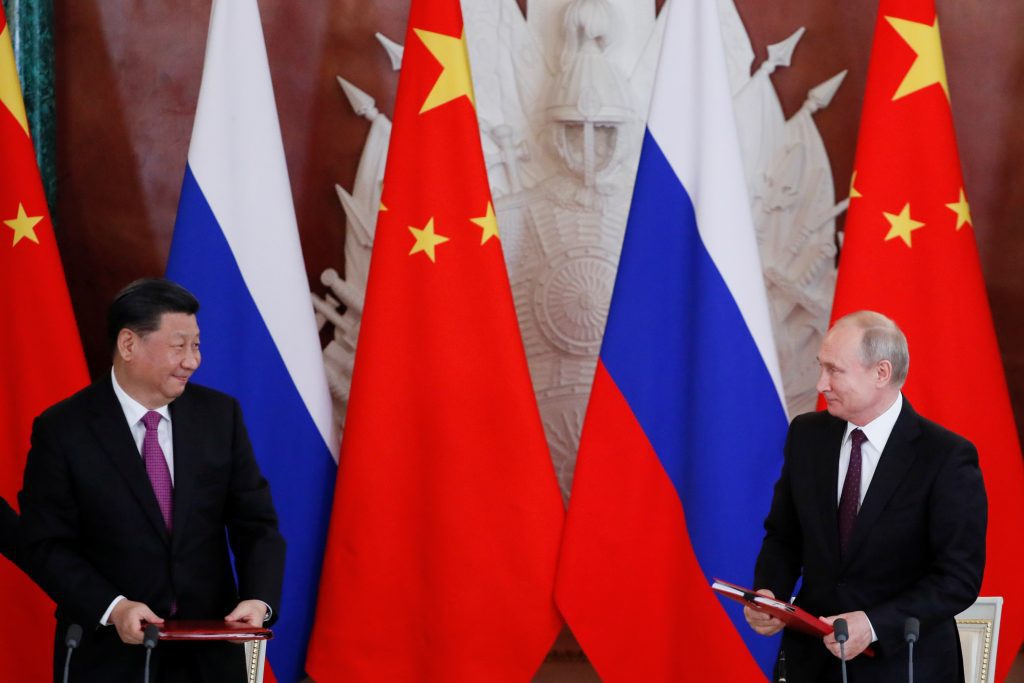
Russian President Vladimir Putin and his Chinese counterpart Xi Jinping look on during a signing ceremony in Moscow, Russia, June 5, 2019. REUTERS/Evgenia Novozhenina

A Kremlin aide says the Chinese leader voiced his support for Russia in pushing to obtain binding security guarantees for the nation from the West.

The AUKUS partnership between Australia, Britain and the U-S and the Indo-Pacific region was also discussed, with the pair expressing their “negative view” of the military alliances.

Natasha is an Associate Producer at ticker NEWS with a Bachelor of arts from Monash University. She has previously worked at Sky News Australia and Monash University as an Online Content Producer.

News

Iran live updates: Trump claims Khamenei dead as Iran insists he remains in command

Published

on

video
play-sharp-fill

What’s happening in the Middle East?

Continue Reading

News

Israel strikes Tehran anew as conflict escalates and global markets react

Israel strikes Tehran after Khamenei’s death; U.S. warns of prolonged conflict as tensions escalate in the Middle East.

Published

on

Israel strikes Tehran after Khamenei’s death; U.S. warns of prolonged conflict as tensions escalate in the Middle East.


Israel has launched a new wave of strikes on Tehran, following the reported killing of Iran’s Supreme Leader, Ali Khamenei. U.S. President Donald Trump has warned the campaign could last up to a month, framing the operation as a move to prevent Iran from acquiring nuclear capabilities.

Iran has retaliated with missile attacks, while its Revolutionary Guards claim responsibility for assaults on oil tankers in the Gulf. The escalating hostilities are already disrupting global shipping lanes and air travel, sending shockwaves through international markets.

With reports of the first U.S. casualties emerging and Washington declaring the Tehran operation a success, tensions across the Middle East are intensifying rapidly. The question now is how far this conflict could spread — and at what cost.

Subscribe to never miss an episode of Ticker – https://www.youtube.com/@weareticker

#Israel #Iran #Tehran #MiddleEastConflict #Geopolitics #OilMarkets #BreakingNews #GlobalSecurity


Download the Ticker app

Continue Reading

News

U.S. and Israel strike Iran as missiles hit Gulf bases and oil surges

U.S. and Israel launch major military operation against Iran; tensions rise as conflict escalates, impacting global markets.

Published

on

U.S. and Israel launch major military operation against Iran; tensions rise as conflict escalates, impacting global markets.

The United States and Israel have launched a sweeping military operation against Iran, striking leadership targets and more than 500 military sites in what President Trump has dubbed Operation Epic Fury.

Explosions have rocked Tehran, with civilians fleeing the capital as U.S. sea and air assets carry out sustained attacks. Washington says the mission is designed to prevent a nuclear armed Iran and has even called on Iranians to rise up against the regime.

Iran has retaliated with a barrage of missiles and drones targeting Israel and U.S. bases across the region, including in Qatar, Kuwait, the United Arab Emirates and Bahrain. While many projectiles were intercepted, a U.S. base in Bahrain sustained damage.

Gulf states long seen as stable hubs for global business are now directly in the firing line, raising fears of a wider regional war.

Oil prices are climbing and tankers are diverting from the Strait of Hormuz as markets react to the escalating conflict. U.S. aircraft carriers, advanced fighter jets and missile destroyers remain in position, signalling more strikes could follow.

With global leaders scrambling diplomatically, the world is watching to see whether this spirals further or shifts back to negotiations.Download the Ticker app

Continue Reading

Trending Now