
Connect with us
https://tickernews.co/wp-content/uploads/2023/10/AmEx-Thought-Leaders.jpg

News

‘Very unbalanced programmes’ – which French candidate is stronger on the world stage?

Published

on

Emmanuel Macron and Marine Le Pen have wrapped their highly-anticipated presidential debate – so who will come out on top to lead France in a few days time?

It’s a little bit like deja vu for voters in France, with this exact same debate occurring five years ago when Le Pen last challenged Macron for the top job.

In just four days, French residents will once again take to the polls and elect their next president.
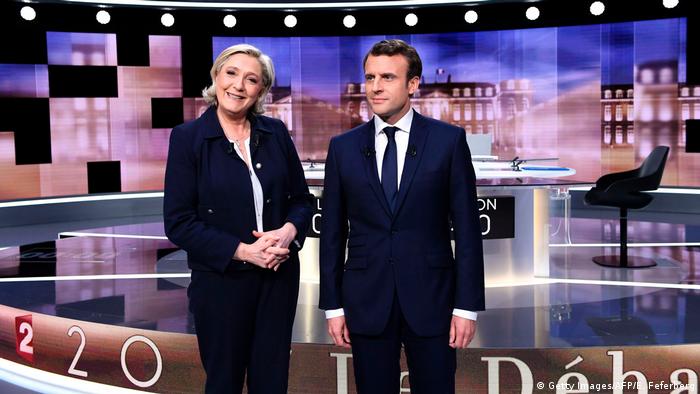
Incumbent leader Macron was victorious in the 2017 showdown and then went on to become president.

It is this debate that was seen as one of the reasons why Le Pen was unsuccessful in her bid for the presidency.

Analysts say Macron was largely on the offensive, appearing like a challenger and interrupting Le Pen on numerous occasions.

Political commentator Natanael Bloch joined ticker NEWS, and says the debate was more civilised than in 2017.

“Le Pen wanted to attack him (Macron) on the five past years. So that’s why Macron was on the offensive because he didn’t want to let her attack him on what he did in the five previous years,” he says.

Le Pen is currently trailing behind Macron in the latest polls, but political analysts stress the race to the Elysee Palace is far from over.

Millions of voters remain undecided and over the two and a half hours of debate, both are hoping to gain the upper hand.

“It’s very difficult to say if (the debate) will have an influence on the vote, there was only one survey poll that happened after the debate showing that at the moment, 60 per cent of the people who have watched the debate were more convinced than Emmanuel Macron and 40 per cent, by Le Pen,” Bloch tells ticker.

As the debate kicked off, Le Pen said 70 per cent of the French people believe their standard of living had declined over the past five years of Macron’s administration.

The two candidates butted heads over this as well as Russia, climate change and immigration.

Le Pen congratulated Macron for his work in Ukraine but criticised him for cutting off Russia.

Bloch says it was impossible for Le Pen to not recognise that Emmanuel Macron, once again, is quite good and successful in some international affairs.

“She’s saying that even if she’s financed by Russia, it doesn’t mean that she’s dependent of Russia, which obviously is something that is really not strong,” bloch tells ticker.

“When you watch the debate. The only thing that she wanted to bring, is that the European Union will have to deal with Russia.”

Macron has been a strong diplomat during the Ukraine war, putting France on the world stage, can the Le Pen handle foreign affairs when she’s so tightly focused on national issues?

Bloch says Le Pen has changed her position in terms of finance.

“In terms of foreign affairs regarding EU for example, a couple of months years ago, she was saying that she wants what we can call the free exit, exiting the European Union. And now when Macron teased her on that yesterday, she said that she doesn’t want to exit the EU anymore, but she wants France to recover more sovereignty and more powers within the EU,” he says.

Bloch says this is difficult, because there are some decisions that can only be taken at the EU level.

“And as an individual state, you can’t really deal even on the international scene, if you don’t have the EU support with you. And this is where we also see the limit of Le Pen programme in terms of Foreign Affairs and International Relations.”

He says Le Pen seems to be in the middle of somewhere. “And naturally assuming the fact that she wants to exit you as she wants also, that France is out of the NATO military command.”

“That’s something that she repeated is that she doesn’t want to quit EU anymore, she really wants France out of NATO military command. And she wants to integrate also Russia and create more tight relationship between NATO and Russia,” he adds.

“But you know, with all of these elements, it seems a very, very unbalanced programmes in terms of international relations.”

Finally, Bloch says Emmanuel Macron knows he has has some success on the international scene such as the Brexit and he has the lead to drive Europe through ongoing crises.

The debate was broadcast on the nation’s two biggest TV networks as well as news channels.

William is an Executive News Producer at TICKER NEWS, responsible for the production and direction of news bulletins. William is also the presenter of the hourly Weather + Climate segment. With qualifications in Journalism and Law (LLB), William previously worked at the Australian Broadcasting Corporation (ABC) before moving to TICKER NEWS. He was also an intern at the Seven Network's 'Sunrise'. A creative-minded individual, William has a passion for broadcast journalism and reporting on global politics and international affairs.

News

Bondi terror attack: Months of planning, extremist videos and a deadly plot exposed

Published

on

Newly released court documents have revealed chilling details about the Bondi terror attack, marking one of Australia’s deadliest attacks in decades. Father-and-son duo Sajid and Naveed Akram allegedly spent months meticulously planning the assault, targeting the “Chanukah by the Sea” festival on Sydney’s Bondi Beach. Police say the pair rehearsed tactics, filmed extremist propaganda, and prepared multiple improvised explosive devices long before the attack that killed 15 people and injured dozens more.

Investigators allege the attack began with the men throwing four improvised bombs into a crowded festival of over 1,000 attendees. The devices, including pipe bombs and a “tennis ball bomb” packed with shrapnel, failed to detonate, but authorities have described them as “viable” IEDs. Moments later, the Akrams opened fire from a footbridge overlooking the festival, creating a scene of chaos and tragedy. Among the victims were a 10-year-old girl, a Holocaust survivor, and worshippers who attempted to confront the gunmen.

Court documents also reveal months of preparation, including firearms training in rural New South Wales. The pair was captured on video handling long-barrelled shotguns, moving tactically, and simulating an assault scenario. Additional footage shows the men seated in front of an Islamic State flag, guns and ammunition visible, as Naveed recites passages from the Quran and then outlines the ideological motivations behind the planned Bondi attack. Authorities say these materials demonstrate a pattern of premeditation and adherence to extremist ideology.

Overseas Islamist networks

Investigators also point to digital evidence recovered from Naveed’s phone, which includes a manifesto and detailed plans for the attack. Police allege the pair’s earlier month-long trip to the southern Philippines may have included contacts with overseas Islamist networks. Intelligence agencies previously reviewed Naveed for potential radicalisation in 2019, but concluded he did not pose a threat. Sajid Akram, meanwhile, legally owned six rifles and shotguns that were later used in the attack.

The human toll of the attack has had lasting impacts on the community. Survivors and witnesses recall the terror of that day as families gathered in celebration. Lawmakers have responded with urgency, including NSW Premier Chris Minns fast-tracked reforms to tighten firearm laws, ban public displays of terrorist symbols, and expand police powers. At a national level, Prime Minister Anthony Albanese has secured agreement from state and territory leaders to review and strengthen post-Port Arthur gun laws and introduce measures targeting extremist propaganda and hate speech.

The Bondi terror attack stands as a stark reminder of the devastating consequences of extremist planning and the importance of vigilant intelligence and community safety measures. While court proceedings continue, the public response underscores the shared grief and determination to prevent such tragedies in the future.

Continue Reading

News

China deploys over 100 ICBMs near Mongolia border

China deploys over 100 ICBMs near Mongolia amidst ongoing tensions and lack of arms control talks with the US

Published

on

China deploys over 100 ICBMs near Mongolia amidst ongoing tensions and lack of arms control talks with the US

video
play-sharp-fill
In Short:
– China has deployed over 100 ICBMs in new silos near Mongolia, marking a significant nuclear expansion.
– Beijing aims to enhance military strategies for Taiwan by 2027, potentially affecting U.S. operations in the region.

China has deployed over 100 solid-fueled intercontinental ballistic missiles (ICBMs) in newly constructed silo fields near its border with Mongolia, according to a draft Pentagon report reviewed by Reuters.This marks the most significant nuclear expansion by Beijing to date. The United States indicates that China shows no intention of engaging in arms control negotiations, despite President Trump’s calls for denuclearization talks with both China and Russia.

The report states that the DF-31 missiles, which have a range of 7,000 to 11,700 kilometers, are positioned across three silo fields. While the Pentagon had previously acknowledged these fields, this is the first confirmation of the number of deployed missiles.

China’s nuclear warhead stockpile was estimated at around 600 in 2024. The report projects an increase to over 1,000 warheads by 2030. It highlights a lack of willingness from Beijing to pursue arms control measures.

Beijing has dismissed such reports as attempts to discredit China and claims that it follows a nuclear strategy of self-defense with a no-first-use policy.

Forceful means

The Pentagon assessment indicates that China plans to be capable of fighting and winning a conflict over Taiwan by 2027. Beijing is reportedly enhancing military strategies to capture the island through forceful means.

These military strikes could potentially disrupt U.S. operations in the Asia-Pacific region.

Neither the Pentagon nor China’s embassy in Washington responded to requests for comment. U.S. officials cautioned that the draft report could change before its formal submission to lawmakers.


Download the Ticker app

Continue Reading

News

Australia’s property market set to soar in 2026

Australia’s property market is set for strong growth in 2026, driven by demand and strategic investments across key regions.

Published

on

Australia’s property market is set for strong growth in 2026, driven by demand and strategic investments across key regions.


Australia’s property market is predicted to perform strongly in 2026, with no major losers expected as demand and prices rise across 14 key regions. Hotspotting’s latest analysis highlights which areas are set to shine and the factors driving this unprecedented growth.

Join Tim Graham from Hotspotting as he explains the methodology behind the price predictions and why infrastructure investments and government policies are playing a key role in shaping the market.

From regional hotspots to major cities, we explore emerging trends, buyer behavior, and the outlook for places like Darwin and Perth. Whether you’re a first home buyer or seasoned investor, this episode is packed with insights to navigate Australia’s booming property landscape.

Subscribe to never miss an episode of Ticker – https://www.youtube.com/@weareticker

#AustraliaProperty #PropertyMarket2026 #Hotspotting #RealEstateTrends #HousingMarket #InvestingAustralia #PropertyGrowth #FirstHomeBuyers


Download the Ticker app

Continue Reading

Trending Now