
Connect with us
https://tickernews.co/wp-content/uploads/2023/10/AmEx-Thought-Leaders.jpg

News

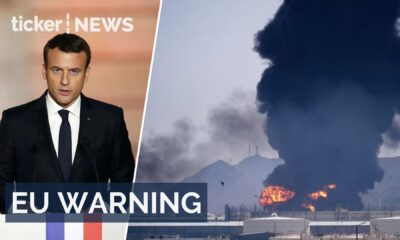
Iranian Shahed drone strike hits central Dubai amid regional war

US-Israel strikes on Iran provoke Tehran’s missile and drone retaliation, sparking a day of horrifying images.


Published

on

US-Israel strikes on Iran provoke Tehran’s missile and drone retaliation, sparking a day of horrifying images.


A day of horrifying images has followed major US-Israel strikes on Iran and Tehran’s retaliation with missiles and drones.


Download the Ticker app

Ahron Young is an award winning journalist who has covered major news events around the world. Ahron is the Managing Editor and Founder of TICKER NEWS.

News

Iran live updates: U.S. and Israel launch strikes on Iran

Published

on

Continue Reading

News

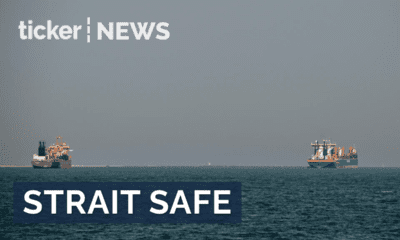
Iran warns ships to avoid Strait of Hormuz

Iran warns ships to avoid Strait of Hormuz amid rising tensions and military buildup in the region

Published

on

Iran warns ships to avoid Strait of Hormuz amid rising tensions and military buildup in the region

video
play-sharp-fill
In Short:
– Iran’s Guard Corps advises ships to avoid the Strait of Hormuz due to rising tensions.
– Tankers have diverted to Qatar and UAE amidst concerns over safety and potential Iranian threats.
Iran’s Islamic Revolutionary Guard Corps has instructed ships to avoid the Strait of Hormuz, a crucial shipping lane linking to the Persian Gulf. About a hundred merchant vessels transit the strait daily, according to the U.S.Tensions have escalated recently as the U.S. increased military presence in the region and Iran issued threats. Western nations are concerned about Iran potentially laying sea mines to disrupt commercial traffic. Currently, no evidence suggests Iran has mined the strait.

Banner

Ships have been repeatedly warned against entering the strait, as stated by crews in the area and the European Union’s naval command, Aspides. On Saturday, dozens of tankers diverted, with some seeking refuge in Qatar and the United Arab Emirates while others opted to steer clear of the region, as reported by oil brokers and shipowners.

Shipping Concerns

Tensions continue to impact shipping operations as carriers remain cautious in the Gulf region.

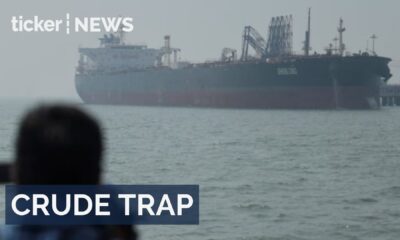
Tanker crews reported hearing explosions near Iran’s Kharg Island, which is vital for the country’s oil exports, as it handles 90% of its crude oil shipments.


Download the Ticker app

Continue Reading

News

U.S. and Israel attack Iran, escalating regional conflict

U.S. and Israel strike Iran, escalating war fears and risking wider regional conflict for the second time in eight months

Published

on

U.S. and Israel strike Iran, escalating war fears and risking wider regional conflict for the second time in eight months

video
play-sharp-fill
In Short:
– U.S. and Israel launched strikes against Iran amid fears of a broader regional conflict.
– Iranian officials warn that attacks could lead to full-scale war as they prepare for retaliation.

The attack marks the second war between the U.S., Israel, and Iran within eight months, raising concerns about a wider regional conflict in a critically important economic area.Israeli Defence Minister Israel Katz confirmed the strikes and declared a state of emergency across all areas of Israel.

The U.S. also carried out strikes as part of the operation, according to a U.S. official.

The military operation followed a month of U.S. military buildup, ignited by President Trump’s commitment to support Iranian protesters who demonstrated against the regime in January.

The President consistently warned Iran could face military action if it continued its nuclear program. Vice President JD Vance stated that Iran’s responses in two negotiation rounds failed to meet U.S. expectations.

Trump address

In a video address announcing the military operation against Iran, President Trump said the U.S. was facing “imminent threats” from Tehran, though he did not detail specific evidence to support that claim.

Instead, he pointed to a history of Iranian aggression and reiterated broader concerns about the country’s nuclear activities, backing of regional proxy groups and its ballistic missile programme.

Iran’s missile development has featured prominently in the administration’s recent justification for military action, with Trump raising it again during Tuesday’s State of the Union address.

However, publicly available U.S. intelligence assessments have indicated that Iran had not decided to build an intercontinental ballistic missile.

Analysts have also noted that, while Tehran possesses missiles capable of reaching parts of Europe, it still faces significant technological barriers before developing a weapon able to strike the U.S. successfully.

Escalating Tensions

Iranian officials cautioned that any attack would provoke retaliation, warning that even minor strikes could escalate into a full-scale regional war.

The nation has prepared for conflict by mobilising its forces, reinforcing its nuclear facilities, decentralising decision-making, and tightening internal security measures.

‘Trump Has Met the Moment,’ Says Sen. Lindsey Graham

In his first interview since the U.S. and Israel attacked Iran, Senator Lindsey Graham said that “President Trump has met the moment” and “put in motion the demise of the Iranian ayatollah.”

“This operation will be massive in scope and has as its goal the elimination of the regime as demanded by the people of Iran,” the staunch Trump ally said, adding that the president concluded Tehran couldn’t be trusted to make a nuclear deal. “It has been a dream of mine for so long that the ayatollah’s murderous regime would be replaced by the people who seek a better life for themselves and their country.”

Graham, echoing Trump, acknowledged the potential risks facing U.S. forces involved in the mission. “If there are death or injuries in this operation, I can say without hesitation that they sacrificed for a noble cause, a safer America and a more just world,” he said.

“The consequence of leaving the regime in place, after all the terrorism, and the slaughter of 30,000 of its own citizens, would have been catastrophic for America’s national security,” Graham continued, referencing estimates of those killed during a January crackdown on anti-regime protestors.

The senator, who recently travelled in the Middle East and has long taken a hawkish position on Tehran, suggested the potential fall of the Iranian regime could revive diplomatic efforts to normalise relations between Israel and Saudi Arabia, describing it as “the biggest regional prize of all.”

“When the regime collapses, the region will spread toward a new dawn, and that normalization will take up where it left off,” Graham said.

Continue Reading

Trending Now