Germany has promised to deliver more weapons to Ukraine, during his first wartime visit
Germany’s leader, Frank-Walter Steinmeier, has vowed to send more weapons to Ukraine amid Russia’s invasion.
The German leader spent the day with Ukrainian leader Volodymyr Zelensky, discussing the war-torn nation’s needs, economically and militarily.
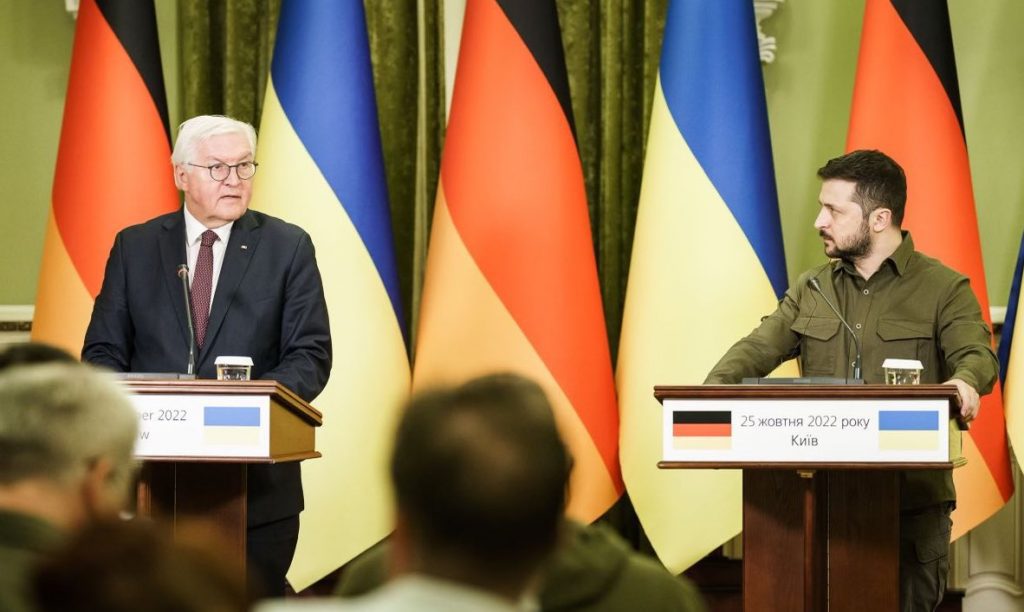
Steinmeier openly condemned Russia’s actions and vowed to support Ukraine militarily.
“Today, Germany is one of the leading suppliers to Ukraine’s air defense.
Thirty Gepard tanks, three Mars2 multiple rocket launchers, several thousand anti-aircraft guns, one of the most modern air defense systems in the world, Iris-T.
I hope it will help to make people a little safer, to protect them from Russia’s brutal aggression.”
Frank-Walter Steinmeier
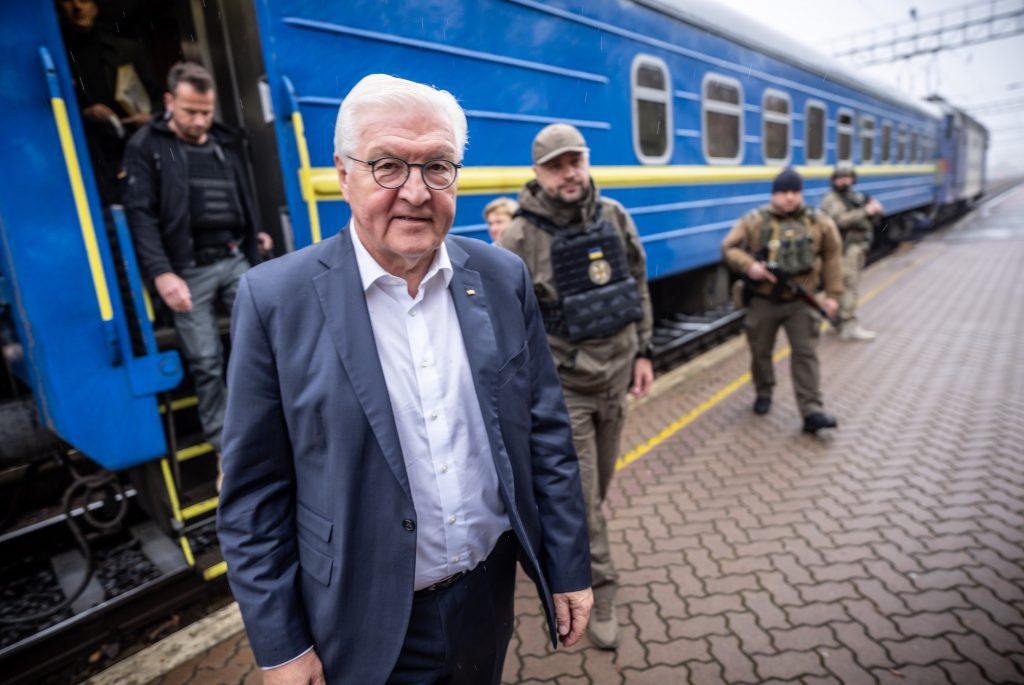
Bundespräsident Frank-Walter Steinmeier steht nach seiner Ankunft am Bahnhof. Steinmeier hält sich zu einem eintägigen Besuch in der Ukraine auf und will sich vor Ort ein Bild von der Zerstörung durch den Angriffskrieg Russlands machen.
Previously, Steinmeier had been criticised for his close political relations with Russia. However, relations between Ukraine and Germany have now turned a new page.
Germany’s alliance with the war-torn nation is clear.
Dirty bomb claims
It comes as Russia continues to make claims about Ukraine planning to use a so-called ‘dirty bomb’.
They made the allegations to the UN Security Council but the west sees the claims as “pure misinformation.”
Russia has since notified the U.S. about its upcoming annual strategic nuclear exercise.
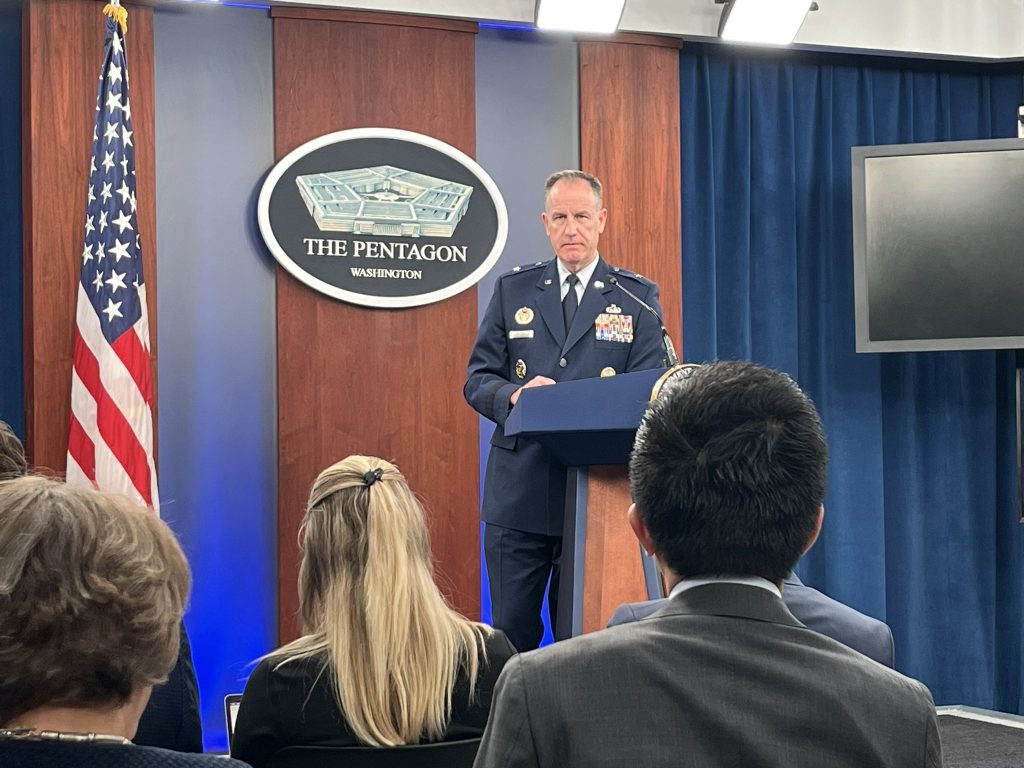
Pentagon officials have confirmed it is strictly a drill and they will be monitoring every move.
“Russia is complying with its arms control obligations and its transparency commitments to make these notifications.”
Ukraine is pleading with its citizens who fled amid the war, not to come home.
The increasing attacks on critical power infrastructure has placed the country under significant strain.
The country has implemented scheduled blackouts to prevent the grid from overloading and to reserve energy.
The warning comes as the winter months approach.
“We need to survive this winter. [If people come back] the electrical grid might fail.
In spring, I would really like for us to work together to rebuild our Kharkiv region, Kherson region and the rest of our cities and settlements here in Ukraine.”
In Short:
– U.S. and Israel launched strikes against Iran amid fears of a broader regional conflict.
– Iranian officials warn that attacks could lead to full-scale war as they prepare for retaliation.
The attack marks the second war between the U.S., Israel, and Iran within eight months, raising concerns about a wider regional conflict in a critically important economic area.Israeli Defence Minister Israel Katz confirmed the strikes and declared a state of emergency across all areas of Israel.
The U.S. also carried out strikes as part of the operation, according to a U.S. official.
The military operation followed a month of U.S. military buildup, ignited by President Trump’s commitment to support Iranian protesters who demonstrated against the regime in January.
The President consistently warned Iran could face military action if it continued its nuclear program. Vice President JD Vance stated that Iran’s responses in two negotiation rounds failed to meet U.S. expectations.
Trump address
In a video address announcing the military operation against Iran, President Trump said the U.S. was facing “imminent threats” from Tehran, though he did not detail specific evidence to support that claim.
Instead, he pointed to a history of Iranian aggression and reiterated broader concerns about the country’s nuclear activities, backing of regional proxy groups and its ballistic missile programme.
Iran’s missile development has featured prominently in the administration’s recent justification for military action, with Trump raising it again during Tuesday’s State of the Union address.
However, publicly available U.S. intelligence assessments have indicated that Iran had not decided to build an intercontinental ballistic missile.
Analysts have also noted that, while Tehran possesses missiles capable of reaching parts of Europe, it still faces significant technological barriers before developing a weapon able to strike the U.S. successfully.
Escalating Tensions
Iranian officials cautioned that any attack would provoke retaliation, warning that even minor strikes could escalate into a full-scale regional war.
The nation has prepared for conflict by mobilising its forces, reinforcing its nuclear facilities, decentralising decision-making, and tightening internal security measures.
‘Trump Has Met the Moment,’ Says Sen. Lindsey Graham
In his first interview since the U.S. and Israel attacked Iran, Senator Lindsey Graham said that “President Trump has met the moment” and “put in motion the demise of the Iranian ayatollah.”
“This operation will be massive in scope and has as its goal the elimination of the regime as demanded by the people of Iran,” the staunch Trump ally said, adding that the president concluded Tehran couldn’t be trusted to make a nuclear deal. “It has been a dream of mine for so long that the ayatollah’s murderous regime would be replaced by the people who seek a better life for themselves and their country.”
Graham, echoing Trump, acknowledged the potential risks facing U.S. forces involved in the mission. “If there are death or injuries in this operation, I can say without hesitation that they sacrificed for a noble cause, a safer America and a more just world,” he said.
“The consequence of leaving the regime in place, after all the terrorism, and the slaughter of 30,000 of its own citizens, would have been catastrophic for America’s national security,” Graham continued, referencing estimates of those killed during a January crackdown on anti-regime protestors.
The senator, who recently travelled in the Middle East and has long taken a hawkish position on Tehran, suggested the potential fall of the Iranian regime could revive diplomatic efforts to normalise relations between Israel and Saudi Arabia, describing it as “the biggest regional prize of all.”
“When the regime collapses, the region will spread toward a new dawn, and that normalization will take up where it left off,” Graham said.
Australian diplomats’ families in Israel and Lebanon urged to evacuate amid rising tensions; all Australians advised to leave soon.
Families of Australian diplomats in Israel and Lebanon have been ordered to evacuate as tensions in the region continue to rise. The government is prioritising the safety of its personnel and their families.
All other Australians have been urged to leave while commercial flights and other travel options are still available. Authorities are emphasising the importance of acting quickly before options become limited.
The Department of Foreign Affairs and Trade has warned that the security situation in the Middle East remains unpredictable and volatile.
Trump warns Iran on nuclear weapons and highlights threats, as the US boosts military presence amid stalled talks.
President Donald Trump laid out a strong warning to Iran during his State of the Union address. He labelled Tehran as the world’s biggest sponsor of terrorism and signalled that the U.S. might take action if Iran continues its nuclear ambitions.
Trump emphasised that Iran’s missile and nuclear programs, along with its backing of militant groups, pose serious threats to regional stability.
This comes amid growing concerns over Iran’s nuclear developments and the stalled diplomatic efforts to curb them.