
Connect with us
https://tickernews.co/wp-content/uploads/2023/10/AmEx-Thought-Leaders.jpg

Ticker Views

China releases video to scare Pelosi from Taiwan

Published

on

The new broke mid-morning Monday in Washington.  The Wall Street Journal reported that House of Representatives Speaker Nancy Pelosi is going to Taiwan. 

SUMMIT COUNTY COLORADO – Neither the Speaker’s office nor the White House would confirm the trip, but spokesman John Kirby, speaking from the briefing room and seeking to frame what is unfolding ahead of the visit, said:
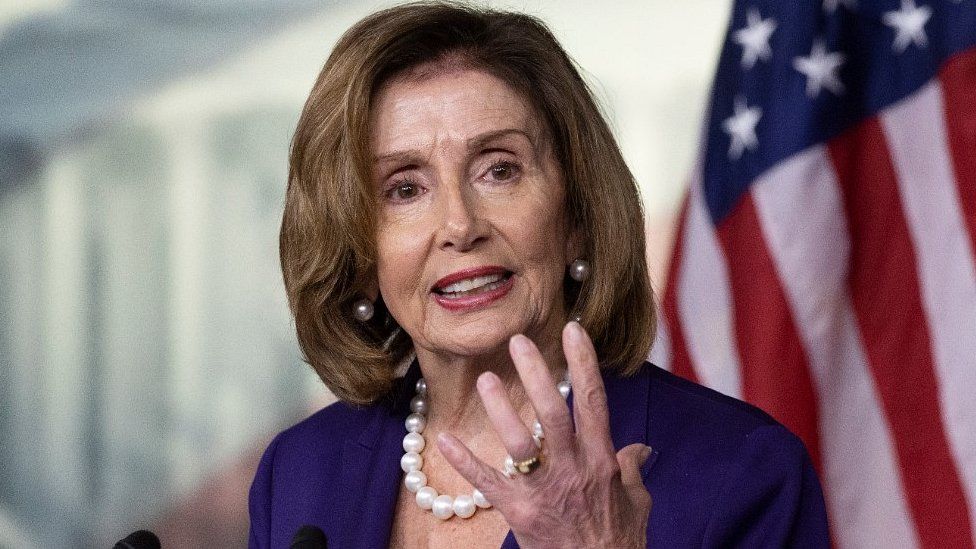
“There is no reason for Beijing to turn a potential visit consistent with longstanding U.S. policy into some sort of crisis or use it as a pretext to increase aggressive military activity in or around the Taiwan Strait. Meanwhile our actions are not threatening and they break no new ground. Nothing about this potential visit — potential visit — which by the way has precedent, would change the status quo.”

So Pelosi in Taiwan is on, after days of speculation and significant angst over what Pelosi’s visit would mean, especially in light of China’s exceptionally hostile words about Pelosi’s trip.  

As Australia knows from the bitter rhetoric and harsh punitive measures China has inflicted on Australia over trade, the messages from Beijing on this trip have risen to high-decibel levels. After the long telephone call last Thursday between President Biden and China’s President Xi Jinping, the official readout from Beijing was emphatic:

“Those who play with fire will perish by it. It is hoped that the U.S. will be clear-eyed about this.” There have been clear intimations of  military displays near Taiwan to coincide with Pelosi’s visit.  There are even concerns that China might target her airplane as it headed towards Taipei.

Many see Pelosi’s visit as exceptionally provocative, and it is clear China expected President Biden to do something about it, particularly after Biden said to the media 10 days ago that “the military thinks it’s not a good idea right now.”  
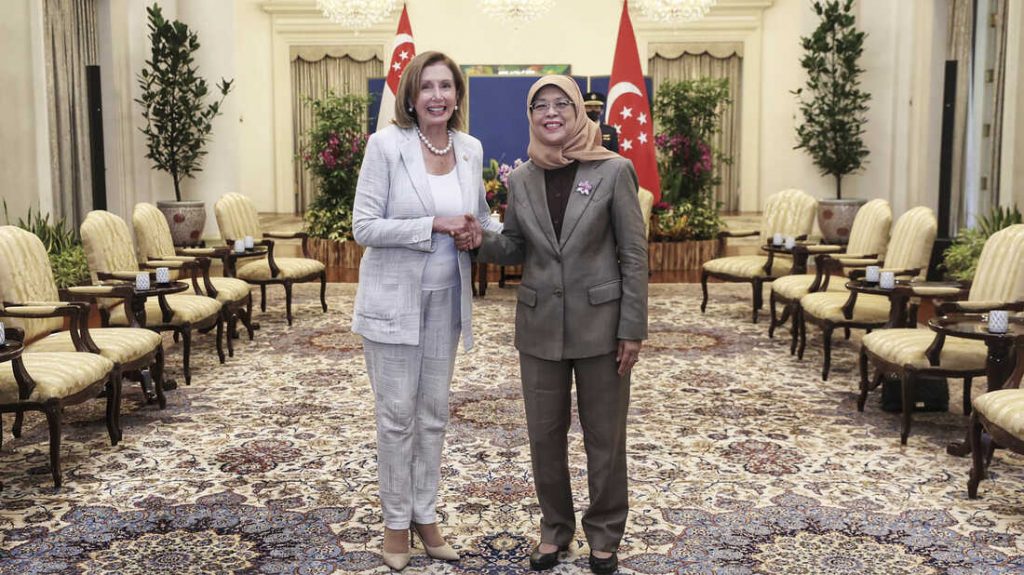
In this photo provided by Ministry of Communications and Information, Singapore, U.S. House Speaker Nancy Pelosi, left, and Singapore President Halimah Yacob shake hands at the Istana Presidential Palace in Singapore, Monday, Aug. 1, 2022. Pelosi arrived in Singapore early Monday, kicking off her Asian tour as questions swirled over a possible stop in Taiwan that has fueled tension with Beijing. (Ministry of Communications and Information, Singapore via AP)

The White House and State Department almost certainly received messages from several foreign countries, including close allies, that the trip was ill-timed and would make a tense situation even more tense at a moment when many are hoping, given all the global shocks flowing from the Russia’s invasion of Ukraine and Putin’s alliance with Xi, that the objective should be to lower – not raise – the temperature on US-China strategic issues.

It was clear over the weekend, however, that the distilled consensus was that as long as the Speaker was intent on visiting Taiwan, buckling to Chinese pressure on the visit would set a most unacceptable precedent. 

Why?

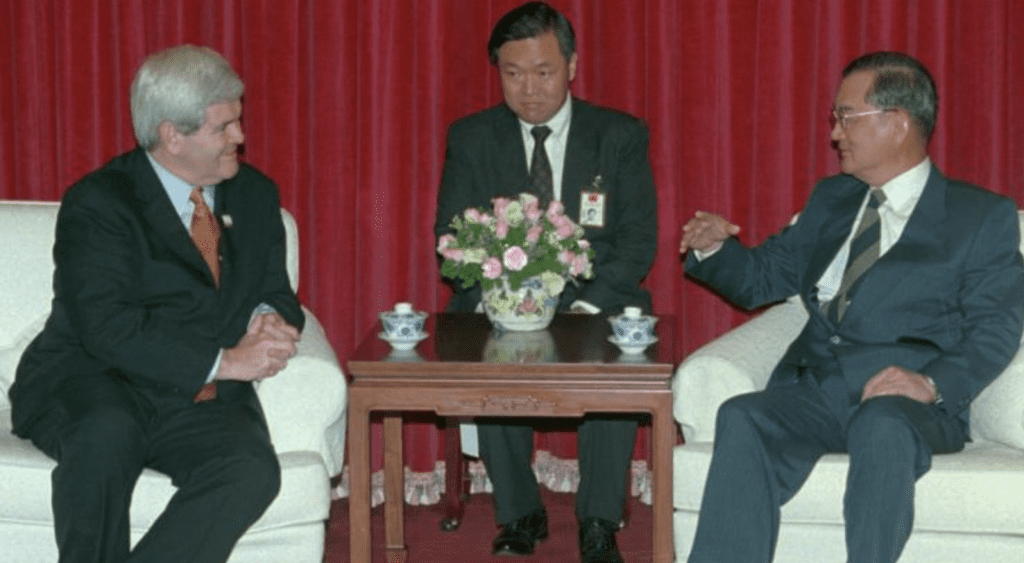
It is not unprecedented for a Speaker of the House to visit Taiwan.  Newt Gingrich did it in 1997.
It would be unprecedented for a President to seek to block a foreign trip by a Speaker of the House. Biden can advise, but consent is not his to give. Under the United States Constitution, there are three co-equal branches of the government.

The Executive, who exercises power over foreign policy.  The Congress, which appropriates money to fund the government, and passes laws affecting all official activities, including foreign policy, and fully exercises oversight authority over what the Executive does.  And the Judiciary. No one branch is subordinate to the other two.

Biden can counsel but cannot tell the Speaker not to go Taipei.  She has every right to go to Taipei and assess the situation to inform what Congress should – or should not – do with respect to American foreign policy interests regarding China and Taiwan and new laws that may warrant enactment.

If China could muscle the Speaker from visiting Taiwan, then China can feel it can muscle the United States from any and all other actions it may undertake with respect to Taiwan.

In Washington, that would be an unacceptable precedent.

The White House has stressed, just before the Pelosi visit gets underway, that nothing has changed with US policy:  that the United States is committed, by law, to the “One China” policy and has said repeatedly that the United States “opposes any unilateral changes to the status quo.”

Translation:  China must not invade Taiwan.  Taiwan must not declare itself independent of China. “One China” must be fully realised peacefully.

The truly big question for today and tomorrow is:  What will Pelosi’s message to Taiwan and China be when she is there?  What signals will she send?  What she says will directly affect strategic calculations of how to further play out the long game over Taiwan.

I met Nancy Pelosi when she was in her first term as a member of the House.  It was days after the Tiananmen massacre in 1989. We were at a small dinner in Washington.  All the talk was of the man before the tank – the lone soul stopping the beast in its path.  But the beat slaughtered those seeking more freedom.

Famous image of man in front of the tank in Tiananmen

 Pelosi talked with conviction and passion that what China did was wrong, and that Tiananmen had to inform the United States’ relationship with China.

That is where Nancy Pelosi was on the issues and who she was then.  That is where she is and who Nancy Pelosi is now.

Bruce Wolpe is a Ticker News US political contributor. He’s a Senior Fellow at the US Studies Centre and has worked with Democrats in Congress during President Barack Obama's first term, and on the staff of Prime Minister Julia Gillard. He has also served as the former PM's chief of staff.

Ticker Views

Rebuilding Gaza: Lessons from the Phoenix Plan

Published

on

What will a rebuilt Gaza look like? The competing visions for the Strip’s future

A girl walks along a street in Gaza to get food during the war between Hamas and Israel.
Jaber Jehad Badwan / Wikimedia Commons, FAL

Timothy J. Dixon, University of Reading; University of Oxford

Following a visit to Gaza in January, the UN undersecretary general, Jorge Moreira da Silva, called the level of destruction there “overwhelming”. He estimated that, on average, every person in the densely populated territory is now “surrounded by 30 tonnes of rubble”.

This staggering level of destruction raises urgent questions about how, and by whom, Gaza should be rebuilt. Since 2023, a variety of reconstruction plans and other initiatives have tried to imagine what Gaza could look like when the conflict ends for good. But which of these visions will shape Gaza’s future?

The Israeli government’s Gaza 2035 plan, which was unveiled in 2024, lays out a three-stage programme to integrate the Gaza Strip into a free-trade zone with Egypt’s El-Arish Port and the Israeli city of Sderot.

AI renderings show futuristic skyscrapers, solar farms and water desalination plants in the Sinai peninsula. The plan also shows offshore oil rigs and a new high-speed rail corridor along Salah al-Din Road, Gaza’s main highway that connects Gaza City and Rafah.

The US government has proposed a similar futuristic vision for Gaza. Its August 2025 Gaza Reconstitution, Economic Acceleration and Transformation Trust plan shows a phased series of modern, AI-powered smart cities developed over a ten-year time frame. The plan, which would place Gaza under a US-run trusteeship, suggested that poor urban design lies at the heart of “Gaza’s ongoing insurgency”.

Jared Kushner presenting the ‘Gaza Riviera’ Project at World Economic Forum in Davos, January 2026.

The latest iteration of this vision was unveiled by Donald Trump’s son-in-law, Jared Kushner, at the recent World Economic Forum in Davos.

He presented slides showing Gaza reconstructed as a “Riviera” of the Middle East, with luxury beachfront resorts, gleaming tower blocks, residential zones and modern transport hubs. Kushner suggested it was “doable” to complete the construction of a “new” Rafah city in “two to three years”.

It has been reported that the US and Israeli visions are heavily influenced by US-based economics professor Joseph Pelzman’s economic plan for Gaza. This plan, Pelzman said on a podcast in 2024, would involve destroying Gaza and restarting from scratch.

In contrast to the US and Israeli visions, the February 2025 Gaza “Phoenix” plan includes input from the people of Gaza. It has a much stronger focus on maintaining and reconstructing the existing buildings, culture and social fabric of the enclave.

The plan was developed by a consortium of international experts together with professionals and academics from Gaza, the West Bank and the Palestinian diaspora, and suggests a reconstruction and development phase of at least five years.

Other plans from the Arab world take a more technocratic view of reconstruction, but still have a short timescale for reconstruction. These include a five-year plan by the United Arab Emirates-based Al Habtoor Group, which promises to grant 70% of ownership in the holding company that will manage Gaza’s reconstruction to the Palestinians.

Feasibility of rebuilding Gaza

So, how feasible are these different visions and how inclusive are they for the people of Gaza? Rebuilding cities after war takes time and money, and also requires local resources. Even in China, a country with plentiful resources and abundant skilled labour, major new cities are rarely completed in less than 20 years.

And in Gaza rebuilding will be complicated by the fact that there are now 61 million tonnes of rubble there, as well as other hazardous debris such as unexploded munitions and human remains. This will need to be removed before any reconstruction can commence, with the UN estimating that clearing the rubble alone could take as long as 20 years.

For comparison, the Polish capital of Warsaw experienced a similar level of destruction during the second world war and it took four decades to rebuild and reconstruct the city’s historic centre. The time frames for reconstruction outlined in all of the plans for Gaza are far shorter than this and, even with modern construction methods, are unlikely to be feasible.

The US and Israeli visions also fail to include Palestinians in the planning of Gaza’s future, overlooking any need to consult with Gazan residents and community groups. This has led critics to argue that the plans amount to “urbicide”, the obliteration of existing cultures through war and reconstruction.

Reports that suggest Gazan residents will be offered cash payments of US$5,000 (£3,650) to leave Gaza “voluntarily” under the US plan, as well as subsidies covering four years of rent outside Gaza, will not have alleviated these concerns.

At the same time, the US plan does not propose a conventional land compensation programme for Gazan residents who lost their homes and businesses during the war. These people will instead be offered digital tokens in exchange for the rights to redevelop their land.

The tokens could eventually be redeemed for an apartment in one of Gaza’s new cities. But the plan also envisages the sale of tokens to investors being used to fund reconstruction. The Council on American-Islamic Relations, the largest Muslim civil rights and advocacy organisation in the US, says the “mass theft” of Palestinian land through the token scheme would amount to a war crime.

With their emphasis on community engagement and the repair and renewal of existing structures, the Phoenix plan and the other Arab-led visions are at least a step forward. But without a fully democratic consensus on how to rebuild Gaza, it is difficult to see how the voices of the Gazan people can be heard.

Whichever vision wins out, history shows that post-war reconstruction succeeds when it involves those whose lives have been destroyed. This is evidenced somewhat ironically by the US Marshall Plan, which funded the reconstruction of many European economies and cities after the second world war, and involved close engagement with civil society and local communities to achieve success.The Conversation

Timothy J. Dixon, Emeritus Professor in the School of the Built Environment, University of Reading; University of Oxford

This article is republished from The Conversation under a Creative Commons license. Read the original article.

Continue Reading

Ticker Views

Winter Olympic security tightens as US-European tensions grow

Published

on

Winter Olympic security tightens as US-European tensions grow

Keith Rathbone, Macquarie University

Since the murder of 11 Israeli hostages at the 1972 Munich Summer Olympics, security has been fundamental for games stakeholders.

The 2024 Paris games set new benchmarks for security at a mega-event, and now the presence of American security officials in Milan Cortina threatens to darken this year’s Winter Olympics before they even start.

Security at the games

The scale of security at the games has magnified considerably since the 1970s.

For the 2024 Olympics, the French government mobilised an unprecedented 45,000 police officers from around the nation.

For the opening ceremony, these forces cordoned off six kilometres of the Seine River.

Advocates point to Paris as an example of security done correctly.

Milipol Paris – one of the world’s largest annual conferences on policing and security – pointed to lower crime across the country during the games and a complete absence of any of the feared large security events. It stated:

The operation demonstrated the effectiveness of advanced planning, inter-agency cooperation and strong logistical coordination. Authorities and observers are now reflecting on which elements of the Paris 2024 model might be applied to future large-scale events.

However, critics complained the security measures infringed on civil liberties.

Controversy as ICE heads to Italy

Ahead of the Milan Cortina games, which run from February 4-23, Italian officials promised they were “ready to meet the challenge of security”.

A newly established cybersecurity headquarters will include officials from around the globe, who will sift through intelligence reports and react to issues in real time.

As well as this, security will feature:

  • 6,000 officers to protect the two major locations – Milan and Cortina d’Ampezzo
  • a no-fly zone around key sites
  • a constant restricted access cordon around some sites (as seen in Paris).

Some of the security officers working in the cybersecurity headquarters will come from the United States.

Traditionally the US diplomatic security service provides protection for US athletes and officials attending mega-events overseas. It has been involved in the games since 1976.

Late last month, however, news broke that some of the officers will be from “a unit of US Immigration and Customs Enforcement (ICE)”.

US and Italian officials were quick to differentiate between Homeland Security Investigations (HSI), which handles cross-border crime, and Enforcement and Removal Operations, the department responsible for the brutal crackdown on immigrant communities across the US.

The HSI has helped protect athletes at previous events and will be stationed at the US Consulate in Milan to provide support to the broader US security team at the games.

But the organisation’s reputation precedes them, and Italians are wary.

In Milan, demonstrators expressed outrage. Left-wing Mayor Giuseppe Sala called ICE a “a militia that kills” while protests broke out in the host cities.

US-European relations are stretched

The presence of ICE has also illuminated fractures within Italian Prime Minister Giorgia Meloni’s governing coalition.

Foreign Minister Antonio Tajani defended the inclusion of the US officers, saying “it’s not like the SS are coming”, referring to the Nazis paramilitary force in Germany.

However, local officials, including those from Meloni’s centre-right coalition, expressed concerns.

The tension inside Meloni’s government reflects broader concerns on the continent about US-European relations.

US Vice President JD Vance and Secretary of State Marco Rubio will attend the opening ceremony in Milan, despite some Europeans viewing Vance as the mouthpiece for US President Donald Trump’s imperial agenda.

Trump’s desire to take over Greenland has undermined American and European support for trans-Atlantic amity and the NATO alliance.

Just ahead of the Olympics, Danish veterans marched outside the US Embassy after Trump disparaged NATO’s contribution to US-led operations in Iraq and Afghanistan. These protests added to Danes’ fears about Trump’s Greenland ambition.

Tensions in Denmark remain high as the Americans and the Danes gear up to play ice hockey in the opening round robin of the men’s competition.

Elsewhere, politicians in the US on both sides have raised concerns that Trump’s bombastic rhetoric will make it harder for American athletes to compete and win.

A double standard?

Critics argue there is an American exception when it comes to global politics interfering in international sport.

Under Trump, the US has attacked Iran and Venezuela, called on Canada to become its 51st state, threatened to occupy Greenland and engaged in cross-border operations in Mexico.

Despite this, US competitors can still wear their nation’s colours at the Olympics.

Compare this to Belarussian and Russian athletes, who are only eligible to compete as Individual Neutral Athletes after the Russian invasion of Ukraine, and only under the condition they have not been publicly supportive of the invasion. An International Olympic Committee (IOC) body assesses each competitor’s eligibility.

Israeli athletes have also been under the spotlight amid geopolitical tensions in the region.

Following the Israeli invasion of Gaza in October 2023, a panel of independent experts at the United Nations urged soccer’s governing body FIFA to ban Israeli athletes, stating:

sporting bodies must not turn a blind eye to grave human rights violations.

But FIFA, and the IOC, have recently defended Israeli athletes’ right to participate in international sport in the face of boycotts and protests.

Competitors from Israel can represent their country at the Winter Olympics.

The political developments which have caused ructions worldwide ironically come after the IOC’s 2021 decision to update the Olympic motto to supposedly recognise the “unifying power of sport and the importance of solidarity”.

The change was a simple one, adding the word “together” after the original three-word motto: “faster, higher, stronger”.

It remains to be seen whether the Milan Cortina games live up to every aspect of the “faster, higher, stronger – together” motto, not just the first three words.The Conversation

Keith Rathbone, Senior Lecturer, Modern European History and Sports History, Macquarie University

This article is republished from The Conversation under a Creative Commons license. Read the original article.

Continue Reading

Ticker Views

Nine Entertainment buys QMS Media for $850 million as radio assets sold

Australia’s Nine Entertainment shifts focus to digital with $850M QMS Media acquisition amid declining broadcast revenues.

Published

on

Australia’s Nine Entertainment shifts focus to digital with $850M QMS Media acquisition amid declining broadcast revenues.


Australia’s Nine Entertainment is making a bold move into digital advertising with its $850 million acquisition of outdoor advertising firm QMS Media. The shift comes as traditional broadcast revenues continue to decline, signalling a new strategic direction for the media giant.

As part of this transition, Nine will sell its metropolitan radio stations, refocusing resources on digital growth and reshaping its media portfolio. Industry experts suggest this could strengthen Nine’s position in the increasingly competitive advertising market.

Darren Woolley from TrinityP3 breaks down the motivations behind the acquisition, the financial strategy, and what it means for Nine’s future revenue streams.

Subscribe to never miss an episode of Ticker – https://www.youtube.com/@weareticker

#NineEntertainment #QMSMedia #DigitalGrowth #MediaAcquisition #AdvertisingNews #AustralianMedia #RadioSale #BusinessStrategy


Download the Ticker app

Continue Reading

Trending Now