Connect with us
https://tickernews.co/wp-content/uploads/2023/10/AmEx-Thought-Leaders.jpg

Ticker Views

‘Trapped in Putin’s panic room’ – journalist receives Russian sanction

Published

on

Some people might complain about receiving a speeding fine, or spilling your morning coffee… but how would you feel if you were sanctioned by Russian President Vladimir Putin?

WATCH – Exclusive interview with war correspondent Misha Zelinsky

Well, that’s the story for war correspondent Misha Zelinsky who received a warning from the Russian leader.

A massive list of 121 well-known Australians have been added to Russia’s blacklist, with the group “indefinitely” banned from the country.

The blacklist has been put together in response to “the growing sanctions of the Australian government, which apply to an increasing number of Russian citizens,” according to Russia’s foreign ministry.

“I woke up this morning, if you asked me earlier this year, what list I would likely end up with that included Gina Reinhart and Twiggy Forest, I knew it wouldn’t have been Australia’s richest 200 people, probably the least likely after that would have been Putin’s sanctions list,”

Misha told ticker NEWS

Misha is a war correspondent for the Financial Times, previously reporting in Ukraine as war atrocities unfolded before his eyes.

Now, Misha is banned from entering Russia.

Russia has accused the sanctioned figures of promoting a “Russophobic agenda”

Misha believes there’s a ‘tit for tat’ going on in regards to sanctions.

“Russians have been sanctioned all over the world, the wealthiest oligarchs are basically trapped in Vladimir Putin’s Panic Room nation. It’s a little bit a tit for tat going on. Russia is rich, Russians are stuck in Russia and unable to holiday, unable to go to London, unable to put their kids in private schools in Europe, versus people like myself are unable to travel to Russia, where you can’t get a Big Mac,”

Misha says.

“I’ll leave it up to viewers to decide who’s got the better deal there,” he jokes with ticker anchor Holly Stearnes.

However, jokes aside, Misha stands by the work he has complete in Ukraine, reporting on the horrific war.

“The biggest fear and concern I have is for people that are dying right now in Ukraine, myself, right now. I’m quite safe, and I’m feeling okay.”

Are journalist’s intimated by Putin’s power play?

Russia announced a similar move against dozens of British journalists on Tuesday, in what Moscow said was a response to Western sanctions and the “spreading of false information about Russia”.

Misha says getting reporting out of Russia, legitimate reporting has been extremely difficult for a very long time.

“You can’t really trust any social media or any reporting coming out of Russia in the sense that the government has enormous control of that information,” he says.

“There are ways to get information out of Russia, you get a lot of Intel out of telegram channels, and other websites. But I don’t think journalists are going to be intimidated on reporting the facts.”

So ultimately, Misha says people aren’t going to be intimidated from telling the truth here, “the truth is on your screens, it’s in your social media feed.”

“The truth is irrefutable that Putin and his cronies are committing war crimes every day in Ukraine, and every day that those stories get told is a critical one.”

The leaders of Europe’s three largest economies – France, Germany, and Italy have visited Ukraine, what does the war-torn country need right now? 
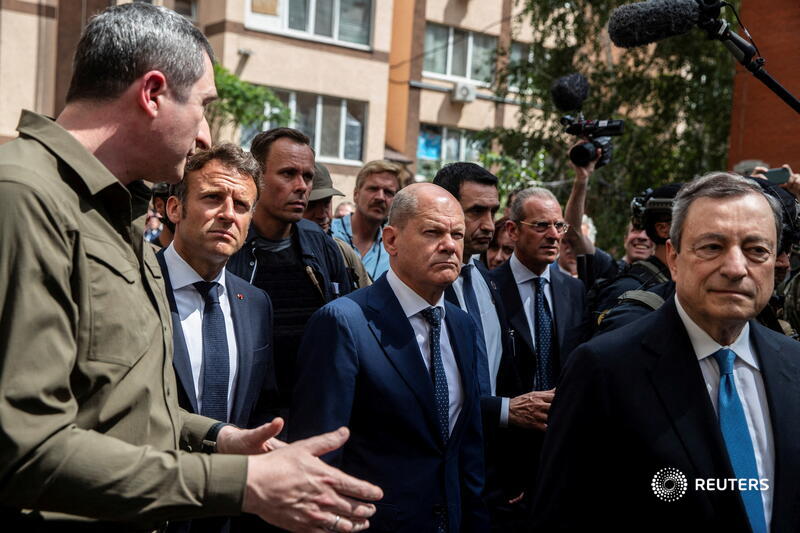
EU leaders gather in Kyiv (REUTERS)

Misha says if you listen to the words of Ukrainian leaders, they say they’ll enjoy support they really need weapons, at the moment of fighting is very localised in the eastern part of the country and Donbas region is almost back to where it started in 2014.

The war reporter says some estimates have the artillery advantage to Russia at a 15 to one “so the Ukrainians are desperate for weaponry, they’re relying at the moment on old Soviet era weapons and the polish and other Warsaw Pact countries have been giving the weapons.”

He continues to say that “they’re running out of the shells that go into that weaponry, and they’re desperate for long and medium range weaponry out of the west out of NATO allied nations. And the promises are on the table.”

However, there has been a delivery gap there and the Germans have been held up as one example of not really meeting what they’ve promised.

So – what do we need to see next?

Misha says it comes down to closing the gap between what’s promised and what’s delivered.

“That needs to happen urgently, joining the EU would be nice, but ultimately not win yet. Candidate status, it’ll probably take 10 years before you actually went from being a candidate to fully integrated because it takes a very long time to synthesise your laws and your legal system and all the bits and pieces that go into joining the EU,” he says.

“So right now that’s going to save lives or win the war, and that’s what’s desperately needed is an evening up of artillery power in the eastern part of Ukraine.”

Ticker Views

Australia jobs, market trends, and tariff ruling: What investors need to know

Australia’s jobs report shapes rate forecasts, with cyclical assets favored amid market volatility and upcoming Supreme Court rulings on tariffs.

Published

on

Australia’s jobs report shapes rate forecasts, with cyclical assets favored amid market volatility and upcoming Supreme Court rulings on tariffs.


Australia’s latest jobs report is shaping market expectations and interest rate forecasts. Strong employment growth could boost confidence in the economy, while weaker data might prompt a rethink of monetary policy.

Investors are favouring cyclical assets over growth stocks, targeting sectors like industrials, materials, and energy. David Scutt from StoneX notes this reflects both caution amid market volatility and a bet on areas tied to economic cycles.

Meanwhile, the upcoming Supreme Court ruling on Trump’s reciprocal tariffs could significantly impact markets, yet many are overlooking its potential effects on trade, commodity prices, and sector valuations. Investors should prepare for possible volatility and adjust strategies accordingly.

#AustraliaJobs #InterestRates #CyclicalAssets #GrowthStocks #MarketInsights #TrumpTariffs #InvestorTrends #TickerNews


Download the Ticker app

Continue Reading

Ticker Views

Can diplomacy survive the Iran-US nuclear standoff?

Published

on

Iran-US nuclear talks may fail due to both nations’ red lines – but that doesn’t make them futile

Nina Srinivasan Rathbun, University of Toronto; USC Dornsife College of Letters, Arts and Sciences

The latest rounds of nuclear talks between the U.S. and Iran are going well enough for now, according to the steady drip of public statements from the main parties involved.

“I think they want to make a deal,” said U.S. President Donald Trump on the eve of the latest round of discussions held in Geneva on Feb. 17, 2026. Iran’s foreign minister, Abbas Araghchi, noted progress over the “guiding principles” of the talks.

Such optimism was similarly on display during initial talks in Oman earlier in the month.

But as someone who has researched nonproliferation and U.S. national security for two decades and was involved in State Department nuclear diplomacy, I know we have been here before.

Optimism also existed in spring 2025, during five rounds of indirect talks that preceded the United States bombing of Iran’s nuclear infrastructure as part of a broader Israeli attack. Pointedly, Iran noted in February that a climate of mistrust created by that attack hangs over the efforts for a negotiated deal now.

And underpinning any pessimism over a deal now is the fact that talks are taking place with a backdrop of U.S. military buildup in the Persian Gulf region and counteraction from Iran, including the closure of the Strait of Hormuz for a live-fire drill.

Red lines

But it is more than mistrust that will need to be overcome. The positions of both the U.S. government and Iran have ossified since May 8, 2018 – the date when the first Trump administration withdrew the United States from the Obama-era Iran nuclear deal.

Iran continues to be unwilling to even discuss its ballistic missile program. This is a red line for them.

Yet the United States continues to demand limits to Iran’s ballistic missiles and the ending of Iran’s support of proxy fighters in the region be included in the nuclear talks, in addition to having Iran fully abandon enriching uranium – including at the low civilian-use level agreed on under the 2015 nuclear deal.

The talks are taking place amid a wider trend toward the end of what can be called the “arms control era.” The expiration of New START – which until Feb. 5, 2026, limited both the size and status of U.S. and Russian nuclear weapons and maintained robust verification mechanisms – together with the increasing willingness to engage in military actions to achieve political goals heightens the challenges for diplomacy.

Military brinkmanship

So why the apparent public optimism from the U.S. government?

Trump believes that Iran is in a weaker position than during his first term, following the largely successful Israeli attacks on Iran’s regional proxies as well as on Iran itself. The strategic capabilities of Tehran’s two main sponsored groups, Hamas and Hezbollah, are clearly diminished as a result of Israeli action.

The U.S. may also still feel it has the upper hand following the June 2025 Operation Rising Lion, in which Iran’s nuclear infrastructure was attacked in response to an International Atomic Energy Agency’s report that Iran’s stockpile of near-weapons grade enriched uranium surged by over 50% in the spring.

Plumes of smoke are seen above buildings
The aftermath of an Israeli strike in Tehran on June 23, 2025.
Elyas/Middle East Images/AFP via Getty Images

The reopening of talks now also comes in the immediate aftermath of Iran’s bloody crackdown on anti-government protests, leaving thousands of protesters dead.

The USS Abraham Lincoln carrier group was deployed near Iranian waters in January as a signal to the protesters of U.S support. U.S. Secretary of State Marco Rubio has said that successful talks must include topics beyond Iran’s nuclear program, including the “treatment of (its) own people.”

Trump continues to consider military options against Iran, warning that “if they don’t make a deal, the consequences are very steep.”

Yet there is a danger that Washington may be overestimating its position.

While the United States maintains that Iranian nuclear sites were “obliterated” in the June attack, satellite imagery indicates that Iran is working to restore its nuclear program. And while Tehran’s proxies in Gaza and Lebanon are severely degraded, Iranian-supported militias in Iraq, including the Kataib Hezbollah, have renewed urgent preparations for war – potentially against the U.S. – and the Houthi rebels have threatened to withdraw from a ceasefire deal with the United States.

Moreover, Iran’s commitment to its ballistic missile program is stronger than ever before, with much of the infrastructure already rebuilt from Operation Rising Lion.

No returning to the 2015 deal

Iran maintains that the talks must be confined only to guarantees about the civilian purpose of its nuclear program, not its missile program, its support of regional proxy groups or its own human rights abuses.

And that is incompatible with the U.S.’s long-held position.

This disagreement ultimately prevented the U.S. and Iran from renewing the now-defunct 2015 political deal during the Biden administration. Signed by China, France, Germany, Russia, the U.K., the United States and Iran, the Joint Comprehensive Plan of Action (JCPOA) halted Iran’s development of nuclear technology and stockpiling of nuclear material in exchange for lifting multiple international economic sanctions placed on Iran. Ballistic missile technology and Iran’s proxy support for regional militias were not included in the original agreement due to Iran’s unwillingness to include those measures.

The parties to the Iran deal ultimately decided that a nuclear deal was better than the alternative of no deal at all.

There was a window for such a deal to be resumed in between the two Trump administrations. And the Biden administration publicly pledged to strengthen and renew the Obama-era nuclear deal in 2021.

But by then, Iran had significantly increased its nuclear technical capability during the four years that has passed since the JCPOA collapsed.

That increased the difficulty: Just to return to the previous deal would have required Iran to give up the new technical capability it had achieved for no new benefits.

The window closed in 2022 after Iran removed all of the International Atomic Energy Agency’s surveillance and monitoring under the deal and started enriching uranium to near weapons levels and stockpiling sufficient amounts for several nuclear weapons.

The IAEA, the U.N’s nuclear watchdog, currently maintains only normal safeguards Iran had agreed to before the JCPOA.

Even with the 2025 U.S. strikes, Iran currently has the ability to produce enough fissile material for a nuclear bomb within weeks to several months. This is up from over a year under the 2015 deal.

LArge ships are seen at sea
The aircraft carrier USS Abraham Lincoln and other vessels sail in formation in the Arabian Sea on Feb. 6, 2026.
Jesse Monford/U.S. Navy via Getty Images

US and Iran talks today

Although most analysts doubt that Iran has developed the weaponization knowledge necessary to build a nuclear bomb – estimates vary from several months to about two years due to the lack of access to and evidence on Iran’s weaponization research – Iran’s technical advances reduce the value for the U.S. government of returning to the 2015 deal. Iran’s knowledge cannot be put back into Pandora’s box.

But talks do not necessarily need an end point – in the shape of a deal – for them to have purpose.

With the increased military brinkmanship, talks could help the U.S. and Iran step back from the edge, build trust and perhaps develop better political relations. Both sides would benefit from this stabilization: Iran economically, from being reintegrated into the international system, and the U.S. from a verifiable lengthening of the time it would take Iran to break out.

None of this is guaranteed.

When I worked in multilateral nuclear diplomacy for the U.S. State Department, we saw talks fail in 2009 regarding North Korea’s nuclear weapons program, after six years of on-and-off progress. The consequence of that failure is a more unstable East Asia and renewed interest by South Korea in developing nuclear weapons.

Unfortunately, the same dynamic appears here. The shape of a potential new deal is unclear. As time passes with no deal, both sides harden their negotiating starting points, making a deal less likely.

Military escalations may lead to a new willingness to compromise on the part of Iran or precipitate its decision to build nuclear weapons.

But even should the talks prove a failure, the effort to dampen the confrontational responses and heightening tensions would still be valuable in reducing the possibility of regional conflict.The Conversation

Nina Srinivasan Rathbun, Professor of International Relations, Munk School of Global Affairs & Public Policy, University of Toronto; USC Dornsife College of Letters, Arts and Sciences

This article is republished from The Conversation under a Creative Commons license. Read the original article.

Continue Reading

Ticker Views

Could your social media live forever? Meta’s AI shows how

Meta’s AI technology raises ethical questions on digital legacy and consent, allowing social media to persist beyond death.

Published

on

Meta’s AI technology raises ethical questions on digital legacy and consent, allowing social media to persist beyond death.


Meta has patented a groundbreaking AI technology that could keep your social media alive even after you’ve passed away, igniting a fierce debate over digital legacy, consent, and the ethics of “eternal online life.”

Imagine your posts, comments, and even phone calls continuing long after you’re gone — a reality that raises profound questions about identity, memory, and mourning in the digital age.

Dr Karen Sutherland from Uni SC joins us to explore how this AI could recreate a person’s voice, tone, and online behavior. Families may face complex psychological risks when interacting with digital clones of their loved ones, while questions of consent and control over a deceased person’s digital presence remain unsettled.

Could these digital personas be monetised? And how do current legal frameworks manage AI-generated content in digital estates?

Subscribe to never miss an episode of Ticker – https://www.youtube.com/@weareticker

#MetaAI #DigitalLegacy #AIClones #DigitalAfterlife #EthicsInTech #SocialMediaAI #GriefTech #FutureOfAI


Download the Ticker app

Continue Reading

Trending Now