
Connect with us
https://tickernews.co/wp-content/uploads/2023/10/AmEx-Thought-Leaders.jpg

Ticker Views

POV: Fully vaxxed Melbourne reporter in the centre of chaos | ticker VIEWS

Published

on

Sunglasses to protect my eyes from pepper spray, trench coat to hide my microphone, and a helmet to protect my head from flares.

A face mask isn’t the only covering I need as a news reporter in Melbourne, Australia

Isn’t it funny how Melbourne was voted top 10 safest city in the world on Sunday.

Two days later, I’ve never felt more scared to be at work.

On scene

I could feel thousands of eyes glare towards me as I pulled my microphone out, to show our global audience what it feels like to be in the city experiencing the longest lockdown in the world.

To my left, hundreds of the Victoria’s top authorities. Riot police were sent to control the protesters, who first gathered outside the CFMEU—Australia’s main trade union headquarters.

To my right, hundreds of protesters shouting anti-vaccination messages.

And I was standing in the centre—fuelled by adrenalin, waiting for movement from either side.

I was scared of the unknown, standing in the middle of passionate Melburnians who were chanting for their freedom from months of stay at home orders

Thousands of construction workers in metropolitan Melbourne and some parts of regional Victoria were stood down after the state government shutdown was announced last night.

Some held a banner reading “freedom”, while others chanted “f*** the jab”.

I feel their anger, I too want to live a life free of government mandated restrictions and emerge from lockdown in Melbourne—a grim reality we’ve lived for too long.

I understand that I’m extremely privileged to be classified as an essential worker. I attend my shifts at the newsroom and can rely on a steady income.

For many, we don’t know what it’s like to be at breaking point. There were protestors in the CBD today who have been out of work for months, struggling to put food on the table and just want their voices heard—because that’s all they have left.

In a shared sense of frustration and anger, some protestors turned violent, with some participants throwing objects, including bottles, at police.

It’s my job to inform people. Rolling coverage on the scene is authenticity

Yet I was shoved and screamed at by angry protestors for standing outside Queen Victoria Market with a microphone.

This is a similar experience for many who work in media.

For giving protestors a voice. For reporting fairly and accurately.

Some argue it’s media who “paint a bad picture” or “write a bad narrative” – but how can you make up the narrative of journalists getting attacked whilst on the job – who are there on scene to hear, report and share their opinions, feelings, and actions.

One identified and unmasked woman approached me so close to the point of touching noses.

“You are FAKE NEWS” she spat into my face. I felt like a targeted villain in a sea of vigilantes

Standing alongside other Australian media outlets, I experienced the first hand hate and disgust towards reporters.

My heart was pounding a million miles a second. I gripped my umbrella tight, in case a protestor launched on me.

I was glad I was wearing a long sleeve jacket, shielding my microphone when off camera to avoid being a target.

A fellow reporter told me to keep sunglasses on my head to use for eye protection from pepper spray and flares.

Many female reporters stayed close to cameramen, as another layer of protection.

We stayed close behind police, who were getting many more profanities sprayed at them. I’m sure they were just as anxious to the unfolding events playing out before our eyes as we were.

https://twitter.com/tickerNEWSco/status/1440135825648357377

Running to keep up with protestors barging through the streets of the City of Melbourne, I witnessed Channel 7 reporter Paul Dowsley get physically attacked.

A protestor approached his camerman and shook him to the ground.

Shortly later, Dowsley had a can of drink thrown at the back of his head while he was presenting live on camera.

“I’ve been grabbed around the neck today, I’ve had urine tipped on me, and now I’ve had a can of energy drink thrown on me,” he said.

Dowsley’s bleeding head was shown on camera. This shakes me. It actually makes me sick to my stomach.

https://twitter.com/tickerNEWSco/status/1440137159890010115

If you can protest against a jab, no matter what industry you’re in, you’re privileged

I’m a fully vaccinated young adult, but it was stressful being amongst unmasked anti-vaxxers parading their hatred towards the Covid-19 vaccination.

Several protesters identified themselves as construction workers and CFMEU members who opposed mandatory vaccinations.

I understand the hesitation towards receiving a Covid-19 vaccine, but it’s an answer to being at work safe and having a ‘normal’ life beyond these life shattering lockdowns.

Just metres down the road from protestors chanting against the effectiveness of COVID vaccines, frontline health workers are treating Covid-19 patients on ventilators in the intensive care unit at the state’s best hospitals.

My dad is frequently in and out of Royal Melbourne Hospital, and visitors are currently banned.
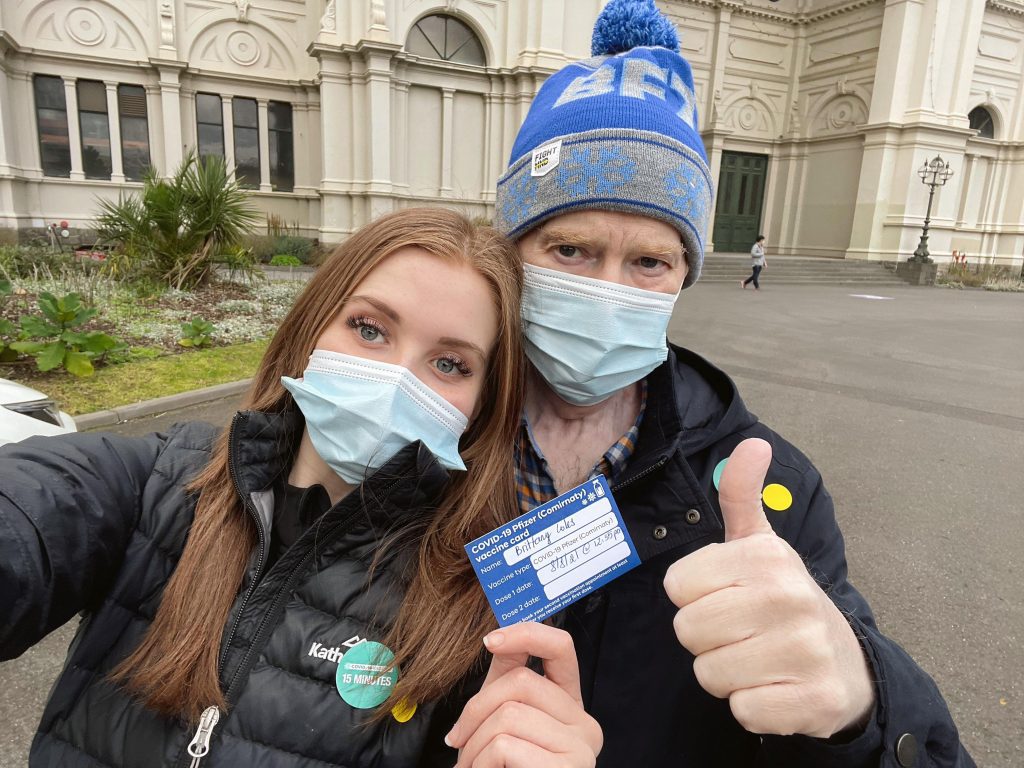
My dad and I receiving a Pfizer Covid-19 vaccine from Royal Exhibition Centre in August.

He has a rare airways disease as a result of cancer, and I’m vaccinated to protect him.

It’s one thing seeing images of people the government calls “[people of] appalling behaviour on site and on our streets” but being in the centre of them, I see the pain in their eyes.

They’ve simply had enough, and it’s not just tradespeople. People of all professions joined the protest to support construction workers today and these scenes will only continue to make headlines.

Their emotions were raw. Their message was clear.

And as I write my own headlines and tell their stories. I just wish to be safe and respected.

Click to comment

Leave a Reply

Your email address will not be published. Required fields are marked *

Ticker Views

U.S. ambassador responds to NATO criticism at Munich Security Conference

At Munich Security Conference, U.S. NATO ambassador discussed defense autonomy, hybrid warfare, and transatlantic cooperation amid rising tensions.

Published

on

At Munich Security Conference, U.S. NATO ambassador discussed defense autonomy, hybrid warfare, and transatlantic cooperation amid rising tensions.


At the Munich Security Conference, the U.S. ambassador to NATO faced tough questions on global order as European allies explored greater defense autonomy amid rising geopolitical tensions. The discussion highlighted the challenges NATO faces in maintaining unity while responding to evolving threats.

The ambassador addressed criticisms directly, emphasizing the importance of transatlantic cooperation and NATO’s role in ensuring international security. European nations voiced concerns about independent defense capabilities and the impact of hybrid warfare from Russia on regional stability.

Oz Sultan from Sultan Interactive Group provides analysis.

Subscribe to never miss an episode of Ticker – https://www.youtube.com/@weareticker

#MunichSecurityConference #NATO #GlobalSecurity #DefenseAutonomy #Geopolitics #TransatlanticAlliance #HybridWarfare #USForeignPolicy


Download the Ticker app

Continue Reading

Ticker Views

Israeli President Herzog visits Australia amid rising antisemitism

Israeli President Herzog’s Australia visit strengthens solidarity and shared values amid recent attacks on the Jewish community.

Published

on

Israeli President Herzog’s Australia visit strengthens solidarity and shared values amid recent attacks on the Jewish community.


Israeli President Isaac Herzog’s visit to Australia marks a significant moment of solidarity between the two nations, especially following recent tragic attacks affecting the Jewish community. The visit underscores shared democratic values and a commitment to combating antisemitism.

Professor Tim Harcourt from UTS discusses the deeper significance of the visit, including the Australian government’s message and the broader implications for Jewish Australians. The timing, following the Bondi attack, highlights the sensitive context in which this diplomatic engagement occurs.

Subscribe to never miss an episode of Ticker – https://www.youtube.com/@weareticker


Download the Ticker app

Continue Reading

Ticker Views

Rebuilding Gaza: Lessons from the Phoenix Plan

Published

on

What will a rebuilt Gaza look like? The competing visions for the Strip’s future

A girl walks along a street in Gaza to get food during the war between Hamas and Israel.
Jaber Jehad Badwan / Wikimedia Commons, FAL

Timothy J. Dixon, University of Reading; University of Oxford

Following a visit to Gaza in January, the UN undersecretary general, Jorge Moreira da Silva, called the level of destruction there “overwhelming”. He estimated that, on average, every person in the densely populated territory is now “surrounded by 30 tonnes of rubble”.

This staggering level of destruction raises urgent questions about how, and by whom, Gaza should be rebuilt. Since 2023, a variety of reconstruction plans and other initiatives have tried to imagine what Gaza could look like when the conflict ends for good. But which of these visions will shape Gaza’s future?

The Israeli government’s Gaza 2035 plan, which was unveiled in 2024, lays out a three-stage programme to integrate the Gaza Strip into a free-trade zone with Egypt’s El-Arish Port and the Israeli city of Sderot.

AI renderings show futuristic skyscrapers, solar farms and water desalination plants in the Sinai peninsula. The plan also shows offshore oil rigs and a new high-speed rail corridor along Salah al-Din Road, Gaza’s main highway that connects Gaza City and Rafah.

The US government has proposed a similar futuristic vision for Gaza. Its August 2025 Gaza Reconstitution, Economic Acceleration and Transformation Trust plan shows a phased series of modern, AI-powered smart cities developed over a ten-year time frame. The plan, which would place Gaza under a US-run trusteeship, suggested that poor urban design lies at the heart of “Gaza’s ongoing insurgency”.

Jared Kushner presenting the ‘Gaza Riviera’ Project at World Economic Forum in Davos, January 2026.

The latest iteration of this vision was unveiled by Donald Trump’s son-in-law, Jared Kushner, at the recent World Economic Forum in Davos.

He presented slides showing Gaza reconstructed as a “Riviera” of the Middle East, with luxury beachfront resorts, gleaming tower blocks, residential zones and modern transport hubs. Kushner suggested it was “doable” to complete the construction of a “new” Rafah city in “two to three years”.

It has been reported that the US and Israeli visions are heavily influenced by US-based economics professor Joseph Pelzman’s economic plan for Gaza. This plan, Pelzman said on a podcast in 2024, would involve destroying Gaza and restarting from scratch.

In contrast to the US and Israeli visions, the February 2025 Gaza “Phoenix” plan includes input from the people of Gaza. It has a much stronger focus on maintaining and reconstructing the existing buildings, culture and social fabric of the enclave.

The plan was developed by a consortium of international experts together with professionals and academics from Gaza, the West Bank and the Palestinian diaspora, and suggests a reconstruction and development phase of at least five years.

Other plans from the Arab world take a more technocratic view of reconstruction, but still have a short timescale for reconstruction. These include a five-year plan by the United Arab Emirates-based Al Habtoor Group, which promises to grant 70% of ownership in the holding company that will manage Gaza’s reconstruction to the Palestinians.

Feasibility of rebuilding Gaza

So, how feasible are these different visions and how inclusive are they for the people of Gaza? Rebuilding cities after war takes time and money, and also requires local resources. Even in China, a country with plentiful resources and abundant skilled labour, major new cities are rarely completed in less than 20 years.

And in Gaza rebuilding will be complicated by the fact that there are now 61 million tonnes of rubble there, as well as other hazardous debris such as unexploded munitions and human remains. This will need to be removed before any reconstruction can commence, with the UN estimating that clearing the rubble alone could take as long as 20 years.

For comparison, the Polish capital of Warsaw experienced a similar level of destruction during the second world war and it took four decades to rebuild and reconstruct the city’s historic centre. The time frames for reconstruction outlined in all of the plans for Gaza are far shorter than this and, even with modern construction methods, are unlikely to be feasible.

The US and Israeli visions also fail to include Palestinians in the planning of Gaza’s future, overlooking any need to consult with Gazan residents and community groups. This has led critics to argue that the plans amount to “urbicide”, the obliteration of existing cultures through war and reconstruction.

Reports that suggest Gazan residents will be offered cash payments of US$5,000 (£3,650) to leave Gaza “voluntarily” under the US plan, as well as subsidies covering four years of rent outside Gaza, will not have alleviated these concerns.

At the same time, the US plan does not propose a conventional land compensation programme for Gazan residents who lost their homes and businesses during the war. These people will instead be offered digital tokens in exchange for the rights to redevelop their land.

The tokens could eventually be redeemed for an apartment in one of Gaza’s new cities. But the plan also envisages the sale of tokens to investors being used to fund reconstruction. The Council on American-Islamic Relations, the largest Muslim civil rights and advocacy organisation in the US, says the “mass theft” of Palestinian land through the token scheme would amount to a war crime.

With their emphasis on community engagement and the repair and renewal of existing structures, the Phoenix plan and the other Arab-led visions are at least a step forward. But without a fully democratic consensus on how to rebuild Gaza, it is difficult to see how the voices of the Gazan people can be heard.

Whichever vision wins out, history shows that post-war reconstruction succeeds when it involves those whose lives have been destroyed. This is evidenced somewhat ironically by the US Marshall Plan, which funded the reconstruction of many European economies and cities after the second world war, and involved close engagement with civil society and local communities to achieve success.The Conversation

Timothy J. Dixon, Emeritus Professor in the School of the Built Environment, University of Reading; University of Oxford

This article is republished from The Conversation under a Creative Commons license. Read the original article.

Continue Reading

Trending Now