Connect with us
https://tickernews.co/wp-content/uploads/2023/10/AmEx-Thought-Leaders.jpg

Ticker Views

POV: Fully vaxxed Melbourne reporter in the centre of chaos | ticker VIEWS

Published

on

Sunglasses to protect my eyes from pepper spray, trench coat to hide my microphone, and a helmet to protect my head from flares.

A face mask isn’t the only covering I need as a news reporter in Melbourne, Australia

Isn’t it funny how Melbourne was voted top 10 safest city in the world on Sunday.

Two days later, I’ve never felt more scared to be at work.

On scene

I could feel thousands of eyes glare towards me as I pulled my microphone out, to show our global audience what it feels like to be in the city experiencing the longest lockdown in the world.

To my left, hundreds of the Victoria’s top authorities. Riot police were sent to control the protesters, who first gathered outside the CFMEU—Australia’s main trade union headquarters.

To my right, hundreds of protesters shouting anti-vaccination messages.

And I was standing in the centre—fuelled by adrenalin, waiting for movement from either side.

I was scared of the unknown, standing in the middle of passionate Melburnians who were chanting for their freedom from months of stay at home orders

Thousands of construction workers in metropolitan Melbourne and some parts of regional Victoria were stood down after the state government shutdown was announced last night.

Some held a banner reading “freedom”, while others chanted “f*** the jab”.

I feel their anger, I too want to live a life free of government mandated restrictions and emerge from lockdown in Melbourne—a grim reality we’ve lived for too long.

I understand that I’m extremely privileged to be classified as an essential worker. I attend my shifts at the newsroom and can rely on a steady income.

For many, we don’t know what it’s like to be at breaking point. There were protestors in the CBD today who have been out of work for months, struggling to put food on the table and just want their voices heard—because that’s all they have left.

In a shared sense of frustration and anger, some protestors turned violent, with some participants throwing objects, including bottles, at police.

It’s my job to inform people. Rolling coverage on the scene is authenticity

Yet I was shoved and screamed at by angry protestors for standing outside Queen Victoria Market with a microphone.

This is a similar experience for many who work in media.

For giving protestors a voice. For reporting fairly and accurately.

Some argue it’s media who “paint a bad picture” or “write a bad narrative” – but how can you make up the narrative of journalists getting attacked whilst on the job – who are there on scene to hear, report and share their opinions, feelings, and actions.

One identified and unmasked woman approached me so close to the point of touching noses.

“You are FAKE NEWS” she spat into my face. I felt like a targeted villain in a sea of vigilantes

Standing alongside other Australian media outlets, I experienced the first hand hate and disgust towards reporters.

My heart was pounding a million miles a second. I gripped my umbrella tight, in case a protestor launched on me.

I was glad I was wearing a long sleeve jacket, shielding my microphone when off camera to avoid being a target.

A fellow reporter told me to keep sunglasses on my head to use for eye protection from pepper spray and flares.

Many female reporters stayed close to cameramen, as another layer of protection.

We stayed close behind police, who were getting many more profanities sprayed at them. I’m sure they were just as anxious to the unfolding events playing out before our eyes as we were.

https://twitter.com/tickerNEWSco/status/1440135825648357377

Running to keep up with protestors barging through the streets of the City of Melbourne, I witnessed Channel 7 reporter Paul Dowsley get physically attacked.

A protestor approached his camerman and shook him to the ground.

Shortly later, Dowsley had a can of drink thrown at the back of his head while he was presenting live on camera.

“I’ve been grabbed around the neck today, I’ve had urine tipped on me, and now I’ve had a can of energy drink thrown on me,” he said.

Dowsley’s bleeding head was shown on camera. This shakes me. It actually makes me sick to my stomach.

https://twitter.com/tickerNEWSco/status/1440137159890010115

If you can protest against a jab, no matter what industry you’re in, you’re privileged

I’m a fully vaccinated young adult, but it was stressful being amongst unmasked anti-vaxxers parading their hatred towards the Covid-19 vaccination.

Several protesters identified themselves as construction workers and CFMEU members who opposed mandatory vaccinations.

I understand the hesitation towards receiving a Covid-19 vaccine, but it’s an answer to being at work safe and having a ‘normal’ life beyond these life shattering lockdowns.

Just metres down the road from protestors chanting against the effectiveness of COVID vaccines, frontline health workers are treating Covid-19 patients on ventilators in the intensive care unit at the state’s best hospitals.

My dad is frequently in and out of Royal Melbourne Hospital, and visitors are currently banned.
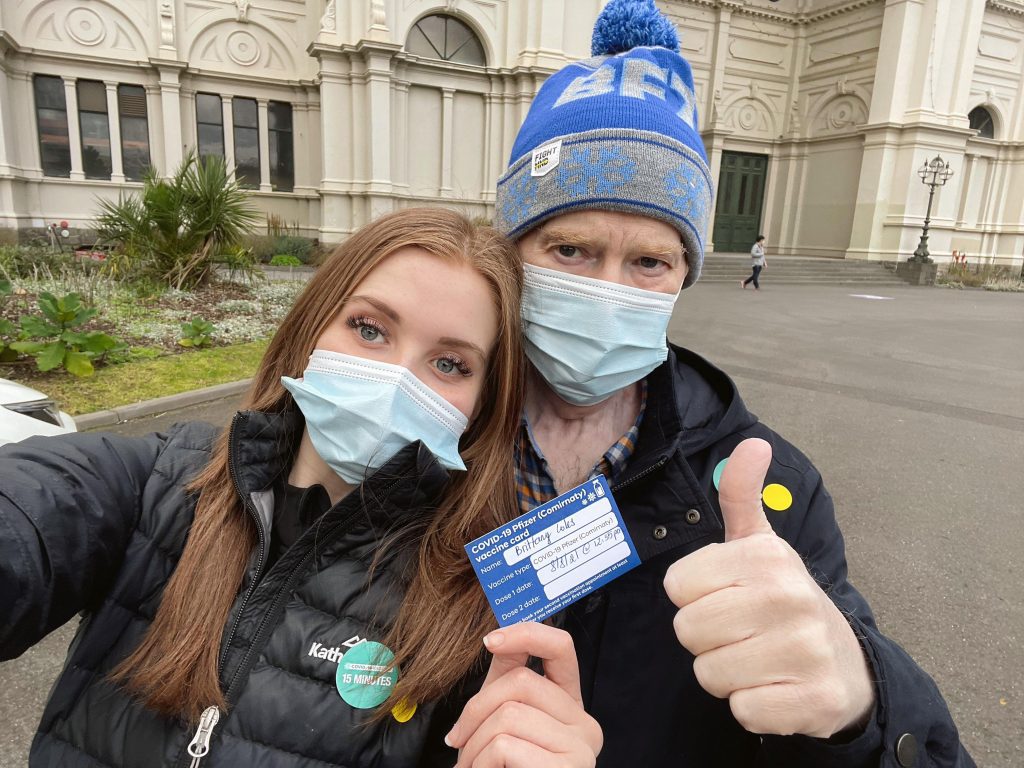
My dad and I receiving a Pfizer Covid-19 vaccine from Royal Exhibition Centre in August.

He has a rare airways disease as a result of cancer, and I’m vaccinated to protect him.

It’s one thing seeing images of people the government calls “[people of] appalling behaviour on site and on our streets” but being in the centre of them, I see the pain in their eyes.

They’ve simply had enough, and it’s not just tradespeople. People of all professions joined the protest to support construction workers today and these scenes will only continue to make headlines.

Their emotions were raw. Their message was clear.

And as I write my own headlines and tell their stories. I just wish to be safe and respected.

Click to comment

Leave a Reply

Your email address will not be published. Required fields are marked *

Ticker Views

US security shift deepens Ukraine’s crisis and Europe’s dilemma

Published

on

New US national security strategy adds to Ukraine’s woes and exacerbates Europe’s dilemmas

Stefan Wolff, University of Birmingham and Tetyana Malyarenko, National University Odesa Law Academy

Ukraine is under unprecedented pressure, not only on the battlefield but also on the domestic and diplomatic fronts.

Each of these challenges on their own would be difficult to handle for any government. But together – and given there is no obvious solution to any of the problems the country is facing – they create a near-perfect storm.

It’s a storm that threatens to bring down Ukrainian president Volodymyr Zelensky’s government and deal a severe blow to Ukraine’s western allies.

On the frontlines in eastern Donbas, Ukraine has continued to lose territory since Russia’s summer offensive began in May 2025. The ground lost has been small in terms of area but significant in terms of the human and material cost.

Between them, Russia and Ukraine have suffered around 2 million casualties over the course of the war.

Perhaps more importantly, the people of Ukraine have endured months and months during which the best news has been that its troops were still holding out despite relentless Russian assaults. This relentless negativity has undermined morale among troops and civilians alike.

As a consequence, recruitment of new soldiers cannot keep pace with losses incurred on the frontlines – both in terms of casualties and desertions.

Moreover, potential conscripts to the Ukrainian army increasingly resort to violence to avoid being drafted into the military. A new recruitment drive, announced by the Ukrainian commander-in-chief, Oleksandr Syrsky, will increase the potential for further unrest.

Russia’s air campaign against Ukraine’s critical infrastructure continues unabated, further damaging what is left of the vital energy grid and leaving millions of families facing lengthy daily blackouts.

The country’s air defence systems are increasingly overwhelmed by nightly Russian attacks, which are penetrating hitherto safe areas such as the capital and key population centres in south and west. It’s a grim outlook for Ukraine’s civilian population who are now heading into the war’s fourth winter. A ceasefire, let alone a viable peace agreement, remains a very distant prospect.

The political turmoil that has engulfed Zelensky and his government adds to the sense of a potentially catastrophic downward spiral. There have been corruption scandals before, but none has come as close to the president himself.

The amounts allegedly involved in the latest bribery scandal – around US$100m (£75 million) – are eye-watering at a time of national emergency. But it is also the callousness of Ukraine’s elites apparently enriching themselves that adds insult to injury.

The latest scandal has also opened a potential Pandora’s box of vicious recriminations. As more and more members of Zelensky’s inner circle are engulfed in corruption allegations, more details of how different parts of his administration benefited from various schemes or simply turned a blind eye are likely to emerge.

This has damaged Zelensky’s own standing with his citizens and allies. What has helped him survive are both his track record as a war leader so far and the lack of alternatives.

Without a clear pathway towards a smooth transition to a new leadership in Ukraine, the mutual dependency between Zelensky and his European allies has grown.

Whose side is the US on anyway?

The US under Donald Trump is no longer, and perhaps never has been, a dependable ally for Ukraine. What is worse, however, is that America has also ceased to be a dependable ally for Europe.

America’s new national security strategy, published last week, has exploded into this already precarious situation and has sent shockwaves across the whole of Europe. It casts the European Union as more of a threat to US interests than Russia.

It also threatens open interference in the domestic affairs of its erstwhile European allies. And crucially for Kyiv, it outlines a trajectory towards American disengagement from European security.

This adds to Ukraine’s problems – not only because Washington cannot be seen as an honest broker in negotiations with Moscow. It also decreases the value of any western security guarantees. In the absence of a US backstop, the primarily European coalition of the willing lacks the capacity, for now, to establish credible deterrence against future Russian adventurism.

ISW map showing the state of the conflict in Ukraine, December 7 2025.
The state of the conflict in Ukraine, December 7 2025.
Institute for the Study of War

Efforts by the coalition of the willing cannot hide the fact that a fractured European Union whose key member states, like France and Germany, have fragile governments that are challenged by openly pro-Trump and pro-Putin populists, is unlikely to step quickly into the assurance gap left by the US. The twin challenge of investing in their own defensive capabilities while keeping Ukraine in the fight against Russia to buy the essential time needed to do so creates a profound dilemma.

Can Europe and Ukraine go it alone?

Without the US, Ukraine’s allies simply do not have the resources to enable Ukraine to even improve its negotiation position, let alone to win this war. In a worst-case scenario, all they may be able to accomplish is delaying a Ukrainian defeat.

But this may still be better than a peace deal that would require enormous resources for Ukraine’s reconstruction, while giving Russia an opportunity to regroup, rebuild and rearm for Putin’s next steps towards an even greater Russian sphere of influence in Europe.

At this moment, neither Zelensky nor his European allies can therefore have any interest in a peace deal negotiated between Trump and Putin.

A resignation by Zelensky or his government is unlikely to improve the situation. On the contrary, it is likely to add to Ukraine’s problems. Any new government would be subject to the most intense pressure to accept an imposed deal that Trump and Putin may be conspiring to strike.

Eventually, this war will end, and it will almost certainly require painful concessions from Ukraine. For Europe, the time until then needs to be used to develop a credible plan for stabilising Ukraine, deterring Russia and learning to live and survive without the transatlantic alliance.

The challenge for Europe is to do all three things simultaneously. The danger for Zelensky is that – for Europe – deterring Russia and appeasing the US become existential priorities in themselves and that he and Ukraine could end up as bargaining chips in a bigger game.The Conversation

Stefan Wolff, Professor of International Security, University of Birmingham and Tetyana Malyarenko, Professor of International Security, Jean Monnet Professor of European Security, National University Odesa Law Academy

This article is republished from The Conversation under a Creative Commons license. Read the original article.

Continue Reading

Ticker Views

Hope and hardship have driven Syrian refugee returns – but many head back to destroyed homes, land disputes

Published

on

Hope and hardship have driven Syrian refugee returns – but many head back to destroyed homes, land disputes

Displaced Syrian families form a return convoy to their destroyed village.
Moawia Atrash/picture alliance via Getty Images

Sandra Joireman, University of Richmond

Close to 1.5 million Syrian refugees have voluntarily returned to their home country over the past year.

That extraordinary figure represents nearly one-quarter of all Syrians who fled fighting during the 13-year civil war to live abroad. It is also a strikingly fast pace for a country where insecurity persists across broad regions.

The scale and speed of these returns since the overthrow of Bashar Assad’s brutal regime on Dec. 8, 2024, raise important questions: Why are so many Syrians going back, and will these returns last? Moreover, what conditions are they returning to?

As an expert in property rights and post-conflict return migration, I have monitored the massive surge in refugee returns to Syria throughout 2024. While a combination of push-and-pull factors have driven the trend, the widespread destruction of property during the brutal civil war poses an ongoing obstacle to resettlement.

Where are Syria’s refugees?

By the time a rebel coalition led by Sunni Islamist organization Hayat Tahrir al-Sham overthrew the Assad government, Syria’s civil war had been going on for more than a decade. What began in 2011 as part of the Arab Spring protests quickly escalated into one of the most destructive conflicts of the 21st century.

Millions of Syrians were displaced internally, and about 6 million sought refuge abroad. The majority went to neighboring countries, including Turkey, Jordan and Lebanon, but a little over a million sought refuge in Europe.

Now, European countries are struggling to determine how they should respond to the changed environment in Syria. Germany and Austria have put a hold on processing asylum applications from Syrians. The international legal principle of non-refoulement prohibits states from returning refugees to unsafe environments where they would face persecution and violence.

But people can choose to return home on their own. And the fall of Assad altered refugees’ perceptions of safety and possibility.

Indeed, the U.N. refugee agency surveys conducted in January 2025 across Jordan, Lebanon, Iraq and Egypt found that 80% of Syrian refugees hoped to return home – up sharply from 57% the previous year. But hope and reality are not always aligned, and the factors motivating return are far more complex than the change in political authority.

Sandra F. Joireman, CC BY-SA

Why are people returning?

In most post-conflict settings, voluntary return begins only after security improves, schools reopen, basic infrastructure is restored and housing reconstruction is underway. Even then, people often return to their country but not their original communities, especially when local political control has shifted or reconstruction remains incomplete.

In present-day Syria, violence continues in several regions, governance is fragmented, and sectarian conflicts persist. Yet refugees are returning anyway.

A major factor is the deteriorating conditions in neighboring host countries. Most of those who came back to Syria in the early months after Assad’s fall came from neighboring states that have hosted large refugee populations for more than a decade and are now struggling with economic crises, political tensions and declining aid.

In Turkey, for example, Syrians have faced increasing deportations and growing structural barriers to integration, such as temporary status without the possibility of naturalization and strict local registration policies.

In Lebanon, meanwhile, recent violence and a steep drop in international assistance have left Syrian refugees unable to secure food, education and health care.

And in Jordan, international reductions in humanitarian support have made daily life more precarious for refugees.

In other words, many Syrians are not returning because their homeland has become safer, but because the places where they sought refuge have become more difficult.

We do not have data on the religious or ethnic makeup of returnees. But patterns from other post-conflict settings suggest that returnees are usually from the majority community aligned with the new dominant political actors. After the war in Kosovo, for instance, ethnic Albanians returned quickly, while Serb and Roma minorities returned in much smaller numbers due to insecurity and threats of reprisals.

If Syria follows this trajectory, Sunni Muslims may return in higher numbers, as the country’s president, Ahmed al-Sharaa, led the Sunni rebel coalition that overthrew Assad.

Syrian minority groups, including Alawites, Christians, Druze and Kurds, may avoid returning altogether. Violent incidents targeting minority communities have underscored ongoing instability. Recent attacks on the Alawite population have triggered new waves of displacement into Lebanon, while conflicts between Druze militias and the government in Sweida, in southern Syria, have led to more displacement within the country. These episodes illustrate that while pockets of the country may feel safe to some, instability persists.

A child walks through rubble.
Thirteen years of civil war left much of Syria in ruin.
Ercin Erturk/Anadolu via Getty Images

Barriers to returns

One of the most significant obstacles facing refugees who wish to return is the condition of their homes and the status of their property rights.

The civil war caused widespread destruction of housing, businesses and public buildings.

Land administration systems, including registry offices and records, were damaged or destroyed. This matters because refugees’ return requires more than physical safety; people need somewhere to live and proof that the home they return to is legally theirs.

Analysis by the conflict-monitoring group ACLED of more than 140,000 qualitative reports of violent incidents between 2014 and 2025 shows that property-related destruction was more concentrated in inland provinces than in the coastal regions, with cities such as Aleppo, Idlib and Homs sustaining some of the heaviest damage.

Sandra F. Joireman, CC BY-SA

This has major implications for where return is feasible and where it will stall. With documentation lost, homes reoccupied and records destroyed, many Syrians risk returning to legal uncertainty or direct – and sometimes violent – conflict over land and housing.

Post-civil war reconstruction will require not only the rebuilding of physical infrastructure but also the restoration of land governance, including mechanisms for property verification, dispute resolution and compensation. Without all this, refugee returns will likely slow as people confront uncertainty about whether they can reclaim their homes.

Shaping Syria

Whether the wave of returns throughout 2025 continues or proves to be a temporary surge will depend on three main criteria: the security situation in Syria, reconstruction of houses and land administration systems, and the policies of the countries hosting Syrian refugees.

But ultimately, a year after the civil war ended, Syrians are returning because of a mixture of hope and hardship: hope that the fall of the Assad government has opened a path home, and hardship driven by declining support and safety in neighboring states.

Whether these returns will be safe, voluntary and sustainable are critical questions that will shape Syria’s recovery for years to come.The Conversation

Sandra Joireman, Weinstein Chair of International Studies, Professor of Political Science, University of Richmond

This article is republished from The Conversation under a Creative Commons license. Read the original article.

Continue Reading

Ticker Views

CDC ends Universal Hepatitis B shots for newborns – what parents need to know

Published

on

Vaccine committee votes to scrap universal hepatitis B shots for newborns despite outcry from children’s health experts

For the past 34 years, the Centers for Disease Control and Prevention has recommended that all babies receive their first hepatitis B vaccine at birth.
FatCamera/E+ via Getty Images

David Higgins, University of Colorado Anschutz Medical Campus

The committee advising the Centers for Disease Control and Prevention on vaccine policy voted on Dec. 5, 2025, to stop recommending that all newborns be routinely vaccinated against the hepatitis B virus – undoing a 34-year prevention strategy that has nearly eliminated early childhood hepatitis B infections in the United States.

Before the U.S. began vaccinating all infants at birth with the hepatitis B vaccine in 1991, around 18,000 children every year contracted the virus before their 10th birthday – about half of them at birth. About 90% of that subset developed a chronic infection.

In the U.S., 1 in 4 children chronically infected with hepatitis B will die prematurely from cirrhosis or liver cancer.

Today, fewer than 1,000 American children or adolescents contract the virus every year – a 95% drop. Fewer than 20 babies each year are reported infected at birth.

I am a pediatrician and preventive medicine specialist who studies vaccine delivery and policy. Vaccinating babies for hepatitis B at birth remains one of the clearest, most evidence-based ways to keep American children free of this lifelong, deadly infection.

What spurred the change?

In September 2025, the Advisory Committee on Immunization Practices, or ACIP, an independent panel of experts that advises the CDC, debated changing the recommendation for a dose of the hepatitis B vaccine at birth, but ultimately delayed the vote.

This committee regularly reviews vaccine guidance. However, since Secretary of Health and Human Services Robert F. Kennedy Jr. disbanded the entire committee and handpicked new members, its activity has drastically departed from business as usual. The committee has long-standing procedures for evaluating evidence on the risks and benefits of vaccines, but these procedures were not followed in the September meeting and were not followed for this most recent decision.

The committee’s new recommendation keeps the hepatitis B vaccine at birth for infants whose mothers test positive for the virus. But the committee now advises that infants whose mothers test negative should consult with their health care provider. Parents and health care providers are instructed to weigh vaccine benefits, vaccine risks and infection risks using “individual-based decision-making” or “shared clinical decision-making.”

The hepatitis B vaccine has an outstanding safety record and has been administered to billions of infants at birth.

On the surface, this sounds reasonable. But while parents have always been free to discuss benefits and risks with their health care providers to make a decision on what’s best for their child, this change is not based on any new evidence, and it introduces uncertainty into a recommendation that has long been clear.

As a doctor, I am already seeing this uncertainty play out in the clinic. I recently had new parents ask to postpone the hepatitis B vaccine until adolescence because they believed federal health leaders had evidence that people only become infected through sexual activity or contaminated needle use.

After a brief conversation, they came to understand that this was inaccurate — children can be infected not only at birth but also through routine household or child care exposures, including shared toothbrushes or even a bite that breaks the skin. In the end, they chose to vaccinate, but this experience highlights how easily well-intentioned parents can be misled when guidance is not clear and consistent.

Why the CDC adopted universal hepatitis B shots

Hepatitis B is a virus that infects liver cells, causing inflammation and damage. It is spread through blood and bodily fluids and is easily transmitted from mother to baby during delivery.

The hepatitis B vaccine has been available since the early 1980s. Before 1991, public health guidance recommended giving newborns the hepatitis B vaccine only if they were at high risk of being infected – for example, if they were born to a mother infected with hepatitis B.

That targeted plan failed. Tens of thousands of infants were still infected each year.

Some newborns were exposed when their mothers weren’t screened; others were exposed after their mothers were infected late in pregnancy, after their initial screening. And like any lab test, the screening can have false negative results, be misinterpreted or not be communicated properly to the baby’s care team.

Recognizing these gaps, in 1991 the CDC recommended hepatitis B vaccination for every child starting at birth, regardless of maternal risk.

The U.S. adopted a policy of vaccinating all babies from birth because the number of people with hepatitis B infections was, and remains, relatively high, and because many mothers do not receive prenatal care, so their infections go undetected.

Meanwhile, in some European countries, like Denmark, only babies with certain risk factors receive the vaccine at birth. That’s because in those countries, hepatitis B infections are much less prevalent and pregnant mothers are more widely tested due to universal health care. Due to these differences, that approach is not effective in the United States. In fact, most World Health Organization member countries do recommend a universal birth dose.

Vaccinating at birth

The greatest danger for infants contracting hepatitis B is at birth, when contact with a mother’s blood can transmit the virus. Without preventive treatment or vaccination, 70% to 90% of infants born to infected mothers will become infected themselves, and 90% of those infections will become chronic. The infection in these children silently damages their liver, potentially leading to liver cancer and death.

Newborn lying on exam table touching doctor's stethoscope
Children are most likely to get infected by hepatitis B at birth, when contact with their mother’s blood can transmit the virus.
Ekkasit Jokthong/iStock via Getty Images Plus

About 80% of parents choose to vaccinate their babies at birth. If parents choose to delay vaccination due to this new recommendation, it will leave babies unprotected during this most vulnerable window, when infection is most likely to lead to chronic infection and silently damage the liver.

A research article published on Dec. 3, 2025, estimates that if only infants born to mothers infected with hepatitis B received the vaccine, an additional 476 perinatal hepatitis B infections would occur each year.

The hepatitis B vaccines used in the U.S. have an outstanding safety record. The only confirmed risk is an allergic reaction called anaphylaxis that occurs in roughly 1 in 600,000 doses, and no child has died from such a reaction. Extensive studies show no link to other serious conditions.

How children get exposed to hepatitis B

Infants and children continue to be vulnerable to hepatitis B long after birth.

Children can become infected through household contacts or in child care settings by exposures as ordinary as shared toothbrushes or a bite that breaks the skin. Because hepatitis B can survive for a week on household surfaces, and many carriers are unaware they are infected, even babies and toddlers of uninfected mothers remained at risk.

Full protection against hepatitis B requires a three-dose vaccine series, given at specific intervals in infancy. Anything short of the full series leaves children vulnerable for life.

In addition to changing the birth dose recommendation, the committee is now advising parents to consult with their health care provider about checking children’s antibody levels after one or two doses of the vaccine to determine whether additional doses are needed. While such testing is sometimes recommended for people in high-risk groups after they get all three doses to confirm their immune system properly responded to the vaccine, it is not a substitute for completing the series.

The recommendation for all babies to receive the vaccine at birth and for infants to complete the full vaccine series is designed to protect every child, including those who slip through gaps in maternal screening or encounter the virus in everyday life. A reversion to the less effective risk-based approach threatens to erode this critical safety net.

Portions of this article originally appeared in a previous article published on Sept. 9, 2025.The Conversation

David Higgins, Assistant Professor of Pediatrics, University of Colorado Anschutz Medical Campus

This article is republished from The Conversation under a Creative Commons license. Read the original article.

Continue Reading

Trending Now