

Money
Post Market Wrap | Macmahon positioned to maintain track record of achieving earnings and revenue guidance


This Post Market Wrap is presented by KOSEC – Kodari Securities
- Revenue and EBITDA up 24 percent pa over past five years
- Recurrent revenue and moderate gearing supports strong capex program
- Higher margins forecast for second-half as start-up projects move to steady state
- Technology and diversification across commodities and mining activities driving earnings growth.
Overview
Macmahon continues to build on its proven track record of growing revenue and earnings, while maintaining its history of meeting or exceeding market guidance. This includes meeting its year-to-date FY22 guidance.
Both Revenue and Underlying EBITDA have increased by 24 percent pa over the past 5 years to June 2021, despite a period in FY21, when growth was paused due to the impact of COVID.

In the current financial year, Macmahon has achieved considerable new contract activity across the business. Mining services activity at Gwalia, Foxleigh, Dawson South and Fimiston has ramped up, while new project activity is planned for Warrawoona and King of Hills Underground, in the months ahead. The majority of Macmahon assets are deployed on contracts of 3 or more years. This recurrent revenue enables Macmahon to meet growth capex while at the same time, maintain a robust balance sheet. At December 2021, Macmahon had cash on hand of $61 million and net debt of $242 million, for a gearing ratio of 31 percent.
Macmahon plans to invest a total of $300 million in capital expenditure during FY21 and FY22, in support of earnings growth beyond FY22. Capital expenditure outlays in the first half of FY22 were $152 million. $80 million of this total is for growth capex for new projects.
First half-year 2022
The first half-year result to December 2021 was impacted by COVID, resulting in higher input costs, which squeezed the Underlying EBIT(A) margin to 5.8 percent, for a $47 million result. Statutory profit was $3.3 million, down from $43.1 million in the prior corresponding period. The statutory profit outcome included the GBF earn-out cost, Software as a Service costs and the amortisation of customer contract assets that were recognised on historical acquisitions. Normalising these costs, Underlying Net Profit After Tax (NPAT) was $31.7 million, compared to $30.4 million, in the previous corresponding period.
Underlying operating cash flow conversion was impacted by higher working capital requirements for new project start-ups and higher inventory levels, in response to COVID-related supply chain disruption. The Underlying EBITDA conversion ratio was 70 percent, resulting in cash flow generation of $96.6 million. This compares to cash flow of $96.7 million for a conversion ratio from Underlying EBITDA of 78.8 percent, in the previous corresponding reporting period.
Macmahon maintains a conservative dividend payout ratio policy of 20 percent of Underlying NPAT.
The interim dividend was 30 cents per share and unfranked. This dividend will be paid to shareholders on April 6.
The FY22 outlook includes several new projects progressing to steady state operations, from the start-up phase, supporting higher margins in the second half year. Full year Underlying EBIT(A) guidance is estimated to be in the range of $95 million to $105 million. Revenue guidance has been increased to be in the range of $1.6 billion – $1.7 billion, up from previous guidance of $1.4 billion – $1.5 billon.
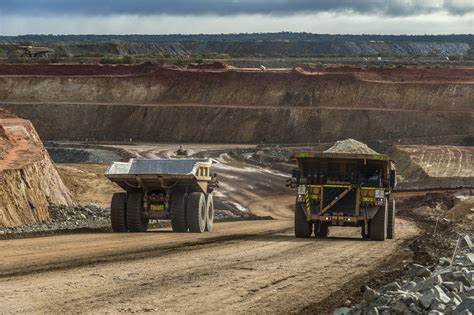
Image: file
Five-Year Strategy
The Macmahon business strategy over the coming five years can be summarised as one involving diversification, technology and people.
Currently Macmahon has a 75 percent concentration in precious metals of gold and copper/gold commodities. Over the coming five-year period, other commodities including lithium, nickel, mineral sands and uranium are to be targeted, together with iron ore and metallurgical coal.
The revenue mix in FY18 was 78 percent surface mining and 21 percent underground mining and just 1 percent of revenue was attributable to mining support services. The current financial year revenue pipeline is targeting 41 percent surface mining, 38 percent underground mining and 21 percent mining support services.
Partnering with technology specialists to drive efficiencies and productivity improvements is key to Macmahon’s five-year growth strategy. This includes in-cab monitoring using AI, automated data for smart and informed decisioning as well as systems for remote operations and control centres in surface and underground mining activities.
Macmahon is also embarking on a training and development program to develop apprentices by rotating them through domestic and offshore opportunities.
Revenue growth is likely to continue, through exposure to a broader range of commodities, and diversified contract mining services, that includes more underground mining activity and increased exposure to mining support services. Productivity-enhancing technology and a highly trained workforce at a time when labour is becoming scarce, supports higher margins on steadily increasing revenue. These factors point to consistent revenue and earnings growth over the medium-term.
This Post Market Wrap is presented by Kodari Securities, written by Michael Kodari, CEO at KOSEC.
-
 Leaders2 days ago
Infosys transforms Australian Open fan experience with AI
-
News1 day ago
Porn sites block Australian users ahead of age verification laws
-
Tech2 days ago
Crypto Bill stalls as banks reject White House compromise
-
News1 day ago
Trump demands unconditional Iran surrender for deal
-
Leaders5 days ago
Nina Hargrave’s journey to Serene Body Health
-
News3 days ago
U.S. submarine sinks Iranian warship near Sri Lanka
-
Ticker Views3 days ago
Kyle and Jackie O break up shakes ARN Media
-
Money3 days ago
How Iran conflict is driving oil prices and global market volatility