

Jill Sheppard, Australian National University and Patrick Leslie, Australian National University
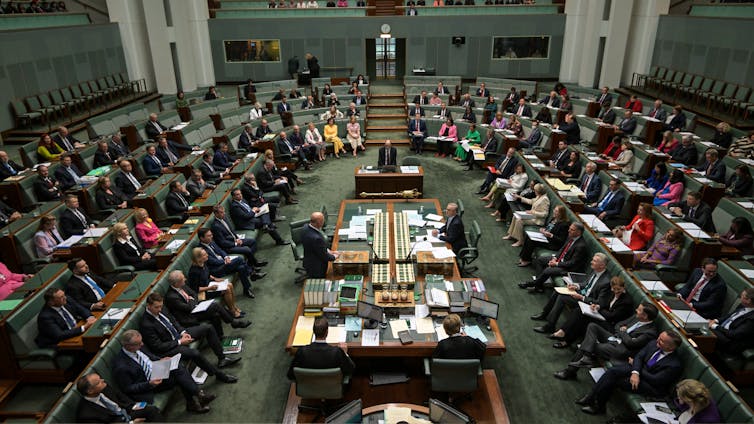
Despite many pre-election predictions, the 48th Australian parliament looks quite similar to the 47th. The Labor Party has greater representation than before: 94 Members of the House of Representatives (up from 77) and 29 Senators (up from 26).
The Coalition’s numbers were famously smashed at the election, and will be represented by 43 Members and 27 Senators.
Despite the landslide electoral victory, Labor’s parliamentary position is not materially improved. It retains a majority in the House of Representatives, but Prime Minister Anthony Albanese faces the problem of finding jobs to keep such a large backbench occupied. Restless politicians reliably create havoc for their leaders (just ask Keir Starmer).
In the Senate, Labor has more possible paths to a majority, but none is particularly pretty. Pre-election, the government required 12 additional senators to support its legislation. Often this support came from the Coalition, with the crossbench bypassed entirely, as in the case of political donation reforms.
Other reforms, including workplace relations, were passed by a combination of Greens and independent senators.
Labor can achieve a majority (38 votes) in the new Senate by negotiating with either the Greens or the Coalition. If neither is forthcoming, Labor can then turn to a disparate group of crossbenchers: four One Nation Senators, plus Fatima Payman, Jacqui Lambie, Ralph Babet and David Pocock.
Clearing the decks
How the new Senate configuration affects Labor’s legislative agenda depends on what exactly that agenda looks like.
Labor went into the 47th parliament emphasising the Voice referendum, COVID and rising inflation.
At the end of that term, ten bills were listed for debate but were “timed out” by the constitutional requirement to hold an election.
The most controversial of these is the proposal to add a new 15% tax on superannuation balances of more than $3 million. The Greens, under previous leader Adam Bandt, promised to support the bill in 2023 pending the government extending superannuation to paid parental leave (which was legislated in 2024 and came into effect on July 1 2025).
The Greens continue to support the tax proposal in principle, but want the threshold lowered to $2 million.
One Nation is strongly opposed. The Coalition has expressed willingness to negotiate on the condition that unrealised gains are exempt from valuations.
The government has also proposed cutting the number of overseas students at Australian universities, ostensibly due to concerns over exploitation of the student visa program. The Greens have called the proposal “disastrous for tertiary education”.
Pocock and the Coalition have both called for key changes to the bill. Their primary concerns are about a ministerial power to decide appropriate student numbers without parliamentary approval.
Despite opposing the bill for different reasons, the Greens and Coalition were willing to team up against the government – perhaps foreshadowing strategy in the new parliament.
What’s on the horizon?
Labor announced just 15 specific policy proposals before the election. Only two costed promises are registered with the Parliamentary Budget Office. This gives Labor a free hand to determine its policy agenda in the 48th parliament.
Right out of the gate, the government promised to cut HECS debt by 20%. Given the Greens would wipe all current HECS debt, they seem likely to wave this through the Senate.
Treasurer Jim Chalmers has since declared that while “the first term was primarily inflation without forgetting productivity, the second term will be primarily productivity without forgetting inflation”.
In search of new thinking, the government has announced an economic reform roundtable comprising government, business and experts, and covering economic resilience, skills, new technologies, healthcare reform and clean energy.
Productivity is notoriously difficult to measure and improve. Whether policies arising from the roundtable will pass the parliament remains to be seen.
However, the government’s invitation to Shadow Treasurer Ted O’Brien was accompanied with commentary that Chalmers does not believe O’Brien or his leader Sussan Ley are “by their nature constructive, collaborative types”.
Other election policies should be legislated with ease. The Coalition has already supported purchasing the Port of Darwin, promised instant asset write-offs for small business, and pledged to match Labor’s Medicare spending dollar for dollar.
The Coalition is also likely to support new fast-track training for 6,000 tradies.
The Greens will likely support pro-worker reforms. These include legislated weekend penalty rates and new mental health spending.
In general, the government’s stated agenda is incremental and should be achievable in this parliament. If the Greens won’t play ball, the Coalition will be waiting in line.
This will probably lead to quixotic policymaking as Labor bounces between two ideologically opposed partners.
Elsewhere, as in the case of the government’s post-election approval of new licences for gas extraction, policy can happen without parliamentary approval at all.
In such cases, meaningful opposition will come from the cross- and backbenches, full of politicians eager to make a name for themselves.
Jill Sheppard, Senior Lecturer, School of Politics and International Relations, Australian National University and Patrick Leslie, Research Fellow in Politics, Australian National University
This article is republished from The Conversation under a Creative Commons license. Read the original article.