

Connect with us
https://tickernews.co/wp-content/uploads/2023/10/AmEx-Thought-Leaders.jpg

Ticker Views

Interrupting coverage of the war | ticker VIEWS
Published

on

… To bring you these under-the-radar political notes from the US

The extraordinarily tragic war in Ukraine has side-lined political news out of Washington and the US. 

Here are a few items worth paying attention to in these very confronting times:

  • Virginia Thomas, wife of US Supreme Court Justice Clarence Thomas, and a forceful conservative political activist in her own right, was in direct touch with Mark Meadows, White house Chief of Staff, throughout President Trump’s campaign to overturn the 2020 presidential election.  
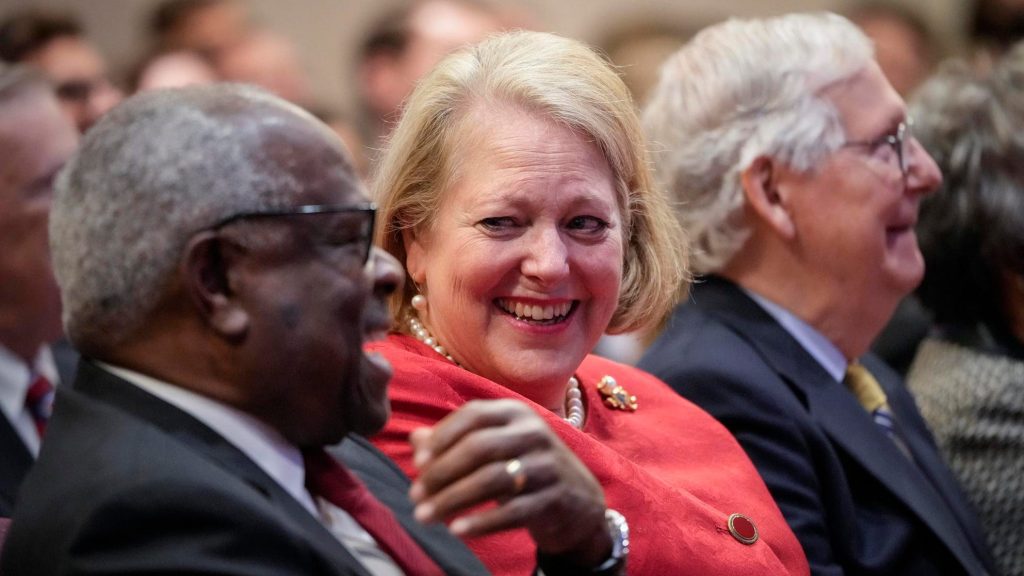
Virginia Thomas

The text messages were included in Meadows’ provision of his phone records to the House Select Committee on the January 6 insurrection. 

Meadows cooperated for a time with the Select Committee, and then ceased providing materials of record.  Bob Woodward and Robert Costa, who co-wrote PERIL on Trump’s last year in office, broke the story for the Washington Post:

“Virginia Thomas, a conservative activist married to Supreme Court Justice Clarence Thomas, repeatedly pressed White House Chief of Staff Mark Meadows to pursue unrelenting efforts to overturn the 2020 presidential election in a series of urgent text exchanges in the critical weeks after the vote, according to copies of the messages obtained by The Washington Post and CBS News.

The messages — 29 in all — reveal an extraordinary pipeline

Between Virginia Thomas, who goes by Ginni, and President Donald Trump’s top aide during a period when Trump and his allies were vowing to go to the Supreme Court in an effort to negate the election results.

On Nov. 10, after news organizations had projected Joe Biden the winner based on state vote totals, Thomas wrote to Meadows: “Help This Great President stand firm, Mark!!!…You are the leader, with him, who is standing for America’s constitutional governance at the precipice. The majority knows Biden and the Left is attempting the greatest Heist of our History.”

Ms Thomas has every right to speak her mind on any issue.  But these texts reveal she was a player in advising Meadows on Trumps strategy to “stop the steal.” 

Those machinations would find their way to the Supreme Court, where her husband would – and did – rule on Trump lawsuits to throw out the election.  Justice Thomas did not recuse himself from those cases.

What to watch for:

Will the House Committee subpoena Ms Thomas to testify on what she did and whether she worked with her husband?  Will Justice Thomas take unilateral steps to recuse himself from any further participation in Trump-related cases before the Supreme Court? Public hearings on all the Select Committee’s work will occur in the next few weeks.  They will be explosive.

  • Trump dumps Brooks.  President Trump has endorsed dozens of Republican candidates for House and Senate races in the upcoming midterm elections.  

Trump dumps Brooks.

If Trump-backed candidates win, and if Republicans take control of the House or Senate or both, Trump will claim credit for the Republican wave and further boost his prospects for the 2024 Republican presidential nomination.

Rep. Mel Brooks of Alabama was a huge Trump backer.  He appeared onstage at the rally January 6 that helped incite the Trump mob to attack the Capitol. Trump endorsed Brooks for his run at the open Senate seat in Alabama.  But Brooks has been polling badly, and Trump pulled his endorsement last week.  Brooks is angry, and went public on what Trump expected him to do in return for the endorsement:

“President Trump asked me to rescind the 2020 elections, immediately remove Joe Biden from the White House, immediately put President Trump back in the White House, and hold a new special election for the presidency. As a lawyer, I’ve repeatedly advised President Trump that January 6 was the final election contest verdict and neither the U.S. Constitution nor the U.S. Code permit what President Trump asks. Period.”

What to watch for:

This is shocking stuff.  First, the only way Biden can be removed as president is by impeachment, and that will not happen. 

Second, there is no way that Brooks or anyone else can put Trump back into the White House – only the American people can do that.  Third, there are no “special elections” in the United States for the presidency.  What this episode shows is how Trump is increasingly fixated on 2020, more than he is in looking beyond the 2024 election – and this obsession of Trump’s is becoming a bigger issue for many rank-and-file Republicans.

  • Republicans look very strong heading into the midterms.  New polling shows growing Republican support in 77 key swing districts across the country.  They need a net gain of only five seats to take control of the House.

Politico is reporting:

Republicans lead the generic ballot by 4 points. Biden won these battleground seats by an average of 5.5 points.  In these districts, 75% of swing voters say Democrats are “out of touch” or “condescending.” About two-thirds say Democrats are spending too much money in Washington.  Biden’s net approval rating in these districts is -15. About 40% of voters in these seats approve of the job Biden is doing as president, while 55% disapprove. Among independent voters, his net approval is -32 — a 34-point swing since February 2021 from a group that often dictates which party holds the House majority. And among Hispanic voters, his net approval is -10, a drop of 31 points in the same time frame. Economic concerns substantially advantage the GOP. Voters who identified jobs/the economy as their No. 1 concern favor Republicans by 20 points on the generic ballot. Among those who put “cost of living” at the top, Republicans are at a 24-point advantage. 

What to watch for

Continuing Republican pressure on what they believe are the killer issues for them in November:  inflation, gasoline prices, crime in the cities, immigration at the southern border, what woke progressives are teaching children in schools, especially on racial issues, transgender sports, new laws to restrict abortion.  Republicans firmly believe these hot button issues will drive their voters to the polls – and President Biden’s approval remains well under 50%.

  • She’s baaack?!  Don Young, Alaska’s solo member of the House of Representatives and the longest-serving member of the current House (elected 1973), died last week at 88.  His seat will be filled in the November election.

Don Young

It looks like Sarah Palin, the former Alaska governor who was John McCain’s incendiary vice-presidential running mate in 2008, and who famously said she could see Russia from her backyard, is positioning to run.  Here’s what she told Sean Hannity on Fox last week:

“I’m going to throw my hat in the ring because we need people that have cajones. We need people like Donald Trump who has nothing to lose like me. We got nothing to lose and no more of this vanilla milquetoast namby-pamby wussy pussy stuff”

Sarah Palin, the former Alaska governor

What to watch for

Whether her pre-formal-entry stunting is enough to scare off other challengers and whether she still has strong appeal in the state.  The special election is likely to be held well before November.

Which is a good note on which to bring this special edition to a close.

Bruce Wolpe is a Ticker News US political contributor. He’s a Senior Fellow at the US Studies Centre and has worked with Democrats in Congress during President Barack Obama's first term, and on the staff of Prime Minister Julia Gillard. He has also served as the former PM's chief of staff.

Ticker Views

Hope and hardship have driven Syrian refugee returns – but many head back to destroyed homes, land disputes

Published

on

Hope and hardship have driven Syrian refugee returns – but many head back to destroyed homes, land disputes

Displaced Syrian families form a return convoy to their destroyed village.
Moawia Atrash/picture alliance via Getty Images

Sandra Joireman, University of Richmond

Close to 1.5 million Syrian refugees have voluntarily returned to their home country over the past year.

That extraordinary figure represents nearly one-quarter of all Syrians who fled fighting during the 13-year civil war to live abroad. It is also a strikingly fast pace for a country where insecurity persists across broad regions.

The scale and speed of these returns since the overthrow of Bashar Assad’s brutal regime on Dec. 8, 2024, raise important questions: Why are so many Syrians going back, and will these returns last? Moreover, what conditions are they returning to?

As an expert in property rights and post-conflict return migration, I have monitored the massive surge in refugee returns to Syria throughout 2024. While a combination of push-and-pull factors have driven the trend, the widespread destruction of property during the brutal civil war poses an ongoing obstacle to resettlement.

Where are Syria’s refugees?

By the time a rebel coalition led by Sunni Islamist organization Hayat Tahrir al-Sham overthrew the Assad government, Syria’s civil war had been going on for more than a decade. What began in 2011 as part of the Arab Spring protests quickly escalated into one of the most destructive conflicts of the 21st century.

Millions of Syrians were displaced internally, and about 6 million sought refuge abroad. The majority went to neighboring countries, including Turkey, Jordan and Lebanon, but a little over a million sought refuge in Europe.

Now, European countries are struggling to determine how they should respond to the changed environment in Syria. Germany and Austria have put a hold on processing asylum applications from Syrians. The international legal principle of non-refoulement prohibits states from returning refugees to unsafe environments where they would face persecution and violence.

But people can choose to return home on their own. And the fall of Assad altered refugees’ perceptions of safety and possibility.

Indeed, the U.N. refugee agency surveys conducted in January 2025 across Jordan, Lebanon, Iraq and Egypt found that 80% of Syrian refugees hoped to return home – up sharply from 57% the previous year. But hope and reality are not always aligned, and the factors motivating return are far more complex than the change in political authority.

Sandra F. Joireman, CC BY-SA

Why are people returning?

In most post-conflict settings, voluntary return begins only after security improves, schools reopen, basic infrastructure is restored and housing reconstruction is underway. Even then, people often return to their country but not their original communities, especially when local political control has shifted or reconstruction remains incomplete.

In present-day Syria, violence continues in several regions, governance is fragmented, and sectarian conflicts persist. Yet refugees are returning anyway.

A major factor is the deteriorating conditions in neighboring host countries. Most of those who came back to Syria in the early months after Assad’s fall came from neighboring states that have hosted large refugee populations for more than a decade and are now struggling with economic crises, political tensions and declining aid.

In Turkey, for example, Syrians have faced increasing deportations and growing structural barriers to integration, such as temporary status without the possibility of naturalization and strict local registration policies.

In Lebanon, meanwhile, recent violence and a steep drop in international assistance have left Syrian refugees unable to secure food, education and health care.

And in Jordan, international reductions in humanitarian support have made daily life more precarious for refugees.

In other words, many Syrians are not returning because their homeland has become safer, but because the places where they sought refuge have become more difficult.

We do not have data on the religious or ethnic makeup of returnees. But patterns from other post-conflict settings suggest that returnees are usually from the majority community aligned with the new dominant political actors. After the war in Kosovo, for instance, ethnic Albanians returned quickly, while Serb and Roma minorities returned in much smaller numbers due to insecurity and threats of reprisals.

If Syria follows this trajectory, Sunni Muslims may return in higher numbers, as the country’s president, Ahmed al-Sharaa, led the Sunni rebel coalition that overthrew Assad.

Syrian minority groups, including Alawites, Christians, Druze and Kurds, may avoid returning altogether. Violent incidents targeting minority communities have underscored ongoing instability. Recent attacks on the Alawite population have triggered new waves of displacement into Lebanon, while conflicts between Druze militias and the government in Sweida, in southern Syria, have led to more displacement within the country. These episodes illustrate that while pockets of the country may feel safe to some, instability persists.

A child walks through rubble.
Thirteen years of civil war left much of Syria in ruin.
Ercin Erturk/Anadolu via Getty Images

Barriers to returns

One of the most significant obstacles facing refugees who wish to return is the condition of their homes and the status of their property rights.

The civil war caused widespread destruction of housing, businesses and public buildings.

Land administration systems, including registry offices and records, were damaged or destroyed. This matters because refugees’ return requires more than physical safety; people need somewhere to live and proof that the home they return to is legally theirs.

Analysis by the conflict-monitoring group ACLED of more than 140,000 qualitative reports of violent incidents between 2014 and 2025 shows that property-related destruction was more concentrated in inland provinces than in the coastal regions, with cities such as Aleppo, Idlib and Homs sustaining some of the heaviest damage.

Sandra F. Joireman, CC BY-SA

This has major implications for where return is feasible and where it will stall. With documentation lost, homes reoccupied and records destroyed, many Syrians risk returning to legal uncertainty or direct – and sometimes violent – conflict over land and housing.

Post-civil war reconstruction will require not only the rebuilding of physical infrastructure but also the restoration of land governance, including mechanisms for property verification, dispute resolution and compensation. Without all this, refugee returns will likely slow as people confront uncertainty about whether they can reclaim their homes.

Shaping Syria

Whether the wave of returns throughout 2025 continues or proves to be a temporary surge will depend on three main criteria: the security situation in Syria, reconstruction of houses and land administration systems, and the policies of the countries hosting Syrian refugees.

But ultimately, a year after the civil war ended, Syrians are returning because of a mixture of hope and hardship: hope that the fall of the Assad government has opened a path home, and hardship driven by declining support and safety in neighboring states.

Whether these returns will be safe, voluntary and sustainable are critical questions that will shape Syria’s recovery for years to come.The Conversation

Sandra Joireman, Weinstein Chair of International Studies, Professor of Political Science, University of Richmond

This article is republished from The Conversation under a Creative Commons license. Read the original article.

Continue Reading

Ticker Views

CDC ends Universal Hepatitis B shots for newborns – what parents need to know

Published

on

Vaccine committee votes to scrap universal hepatitis B shots for newborns despite outcry from children’s health experts

For the past 34 years, the Centers for Disease Control and Prevention has recommended that all babies receive their first hepatitis B vaccine at birth.
FatCamera/E+ via Getty Images

David Higgins, University of Colorado Anschutz Medical Campus

The committee advising the Centers for Disease Control and Prevention on vaccine policy voted on Dec. 5, 2025, to stop recommending that all newborns be routinely vaccinated against the hepatitis B virus – undoing a 34-year prevention strategy that has nearly eliminated early childhood hepatitis B infections in the United States.

Before the U.S. began vaccinating all infants at birth with the hepatitis B vaccine in 1991, around 18,000 children every year contracted the virus before their 10th birthday – about half of them at birth. About 90% of that subset developed a chronic infection.

In the U.S., 1 in 4 children chronically infected with hepatitis B will die prematurely from cirrhosis or liver cancer.

Today, fewer than 1,000 American children or adolescents contract the virus every year – a 95% drop. Fewer than 20 babies each year are reported infected at birth.

I am a pediatrician and preventive medicine specialist who studies vaccine delivery and policy. Vaccinating babies for hepatitis B at birth remains one of the clearest, most evidence-based ways to keep American children free of this lifelong, deadly infection.

What spurred the change?

In September 2025, the Advisory Committee on Immunization Practices, or ACIP, an independent panel of experts that advises the CDC, debated changing the recommendation for a dose of the hepatitis B vaccine at birth, but ultimately delayed the vote.

This committee regularly reviews vaccine guidance. However, since Secretary of Health and Human Services Robert F. Kennedy Jr. disbanded the entire committee and handpicked new members, its activity has drastically departed from business as usual. The committee has long-standing procedures for evaluating evidence on the risks and benefits of vaccines, but these procedures were not followed in the September meeting and were not followed for this most recent decision.

The committee’s new recommendation keeps the hepatitis B vaccine at birth for infants whose mothers test positive for the virus. But the committee now advises that infants whose mothers test negative should consult with their health care provider. Parents and health care providers are instructed to weigh vaccine benefits, vaccine risks and infection risks using “individual-based decision-making” or “shared clinical decision-making.”

The hepatitis B vaccine has an outstanding safety record and has been administered to billions of infants at birth.

On the surface, this sounds reasonable. But while parents have always been free to discuss benefits and risks with their health care providers to make a decision on what’s best for their child, this change is not based on any new evidence, and it introduces uncertainty into a recommendation that has long been clear.

As a doctor, I am already seeing this uncertainty play out in the clinic. I recently had new parents ask to postpone the hepatitis B vaccine until adolescence because they believed federal health leaders had evidence that people only become infected through sexual activity or contaminated needle use.

After a brief conversation, they came to understand that this was inaccurate — children can be infected not only at birth but also through routine household or child care exposures, including shared toothbrushes or even a bite that breaks the skin. In the end, they chose to vaccinate, but this experience highlights how easily well-intentioned parents can be misled when guidance is not clear and consistent.

Why the CDC adopted universal hepatitis B shots

Hepatitis B is a virus that infects liver cells, causing inflammation and damage. It is spread through blood and bodily fluids and is easily transmitted from mother to baby during delivery.

The hepatitis B vaccine has been available since the early 1980s. Before 1991, public health guidance recommended giving newborns the hepatitis B vaccine only if they were at high risk of being infected – for example, if they were born to a mother infected with hepatitis B.

That targeted plan failed. Tens of thousands of infants were still infected each year.

Some newborns were exposed when their mothers weren’t screened; others were exposed after their mothers were infected late in pregnancy, after their initial screening. And like any lab test, the screening can have false negative results, be misinterpreted or not be communicated properly to the baby’s care team.

Recognizing these gaps, in 1991 the CDC recommended hepatitis B vaccination for every child starting at birth, regardless of maternal risk.

The U.S. adopted a policy of vaccinating all babies from birth because the number of people with hepatitis B infections was, and remains, relatively high, and because many mothers do not receive prenatal care, so their infections go undetected.

Meanwhile, in some European countries, like Denmark, only babies with certain risk factors receive the vaccine at birth. That’s because in those countries, hepatitis B infections are much less prevalent and pregnant mothers are more widely tested due to universal health care. Due to these differences, that approach is not effective in the United States. In fact, most World Health Organization member countries do recommend a universal birth dose.

Vaccinating at birth

The greatest danger for infants contracting hepatitis B is at birth, when contact with a mother’s blood can transmit the virus. Without preventive treatment or vaccination, 70% to 90% of infants born to infected mothers will become infected themselves, and 90% of those infections will become chronic. The infection in these children silently damages their liver, potentially leading to liver cancer and death.

Newborn lying on exam table touching doctor's stethoscope
Children are most likely to get infected by hepatitis B at birth, when contact with their mother’s blood can transmit the virus.
Ekkasit Jokthong/iStock via Getty Images Plus

About 80% of parents choose to vaccinate their babies at birth. If parents choose to delay vaccination due to this new recommendation, it will leave babies unprotected during this most vulnerable window, when infection is most likely to lead to chronic infection and silently damage the liver.

A research article published on Dec. 3, 2025, estimates that if only infants born to mothers infected with hepatitis B received the vaccine, an additional 476 perinatal hepatitis B infections would occur each year.

The hepatitis B vaccines used in the U.S. have an outstanding safety record. The only confirmed risk is an allergic reaction called anaphylaxis that occurs in roughly 1 in 600,000 doses, and no child has died from such a reaction. Extensive studies show no link to other serious conditions.

How children get exposed to hepatitis B

Infants and children continue to be vulnerable to hepatitis B long after birth.

Children can become infected through household contacts or in child care settings by exposures as ordinary as shared toothbrushes or a bite that breaks the skin. Because hepatitis B can survive for a week on household surfaces, and many carriers are unaware they are infected, even babies and toddlers of uninfected mothers remained at risk.

Full protection against hepatitis B requires a three-dose vaccine series, given at specific intervals in infancy. Anything short of the full series leaves children vulnerable for life.

In addition to changing the birth dose recommendation, the committee is now advising parents to consult with their health care provider about checking children’s antibody levels after one or two doses of the vaccine to determine whether additional doses are needed. While such testing is sometimes recommended for people in high-risk groups after they get all three doses to confirm their immune system properly responded to the vaccine, it is not a substitute for completing the series.

The recommendation for all babies to receive the vaccine at birth and for infants to complete the full vaccine series is designed to protect every child, including those who slip through gaps in maternal screening or encounter the virus in everyday life. A reversion to the less effective risk-based approach threatens to erode this critical safety net.

Portions of this article originally appeared in a previous article published on Sept. 9, 2025.The Conversation

David Higgins, Assistant Professor of Pediatrics, University of Colorado Anschutz Medical Campus

This article is republished from The Conversation under a Creative Commons license. Read the original article.

Continue Reading

Ticker Views

The housing crisis is forcing Americans to choose between affordability and safety

Published

on

The housing crisis is forcing Americans to choose between affordability and safety

Ivis García, Texas A&M University

Picture this: You’re looking to buy a place to live, and you have two options.

Option A is a beautiful home in California near good schools and job opportunities. But it goes for nearly a million dollars – the median California home sells for US$906,500 – and you’d be paying a mortgage that’s risen 82% since January 2020.

Option B is a similar home in Texas, where the median home costs less than half as much: just $353,700. The catch? Option B sits in an area with significant hurricane and flood risk.

As a professor of urban planning, I know this isn’t just a hypothetical scenario. It’s the impossible choice millions of Americans face every day as the U.S. housing crisis collides with climate change. And we’re not handling it well.

The numbers tell the story

The migration patterns are stark. Take California, which lost 239,575 residents in 2024 – the largest out-migration of any state. High housing costs are a primary driver: The median home price in California is more than double the national median.

Where are these displaced residents going? Many are heading to southern and western states like Florida and Texas. Texas, which is the top destination for former California residents, saw a net gain of 85,267 people in 2024, much of it from domestic migration. These newcomers are drawn primarily by more affordable housing markets.

Housing costs are the main driver of the California exodus, the Los Angeles Times notes.

This isn’t simply people chasing lower taxes. It’s a housing affordability crisis in motion. The annual household income needed to qualify for a mortgage on a mid-tier California home was about $237,000 in June 2025, a recent analysis found – over twice the state’s median household income.

Over 21 million renter households nationwide spent more than 30% of their income on housing costs in 2023, according to the U.S. Census Bureau. For them and others struggling to get by, the financial math is simple, even if the risk calculation isn’t.

I find this troubling. In essence, the U.S. is creating a system where your income determines your exposure to climate disasters. When housing becomes unaffordable in safer areas, the only available and affordable property is often in riskier locations – low-lying areas at flood risk in Houston and coastal Texas, or higher-wildfire-risk areas as California cities expand into fire-prone foothills and canyons.

Climate risk becomes part of the equation

The destinations drawing newcomers aren’t exactly safe havens. Research shows that America’s high-fire-risk counties saw 63,365 more people move in than out in 2023, much of that flowing to Texas. Meanwhile, my own research and other studies of post-disaster recovery have shown how the most vulnerable communities – low-income residents, people of color, renters – face the greatest barriers to rebuilding after disasters strike.

Consider the insurance crisis brewing in these destination states. Dozens of insurers in Florida, Louisiana, Texas and beyond have collapsed in recent years, unable to sustain the mounting claims from increasingly frequent and severe disasters like wildfires and hurricanes. Economists Benjamin Keys and Philip Mulder, who study climate change impacts on real estate, describe the insurance markets in some high-risk areas as “broken”. Between 2018 and 2023, insurers canceled nearly 2 million homeowner policies nationwide – four times the historically typical rate.

Yet people keep moving into risky areas. For example, recent research shows that people have been moving toward areas most at risk of wildfires, even holding wealth and other factors constant. The wild beauty of fire-prone areas may be part of the attraction, but so is housing availability and cost.

The policy failures behind the false choice

In my view, this isn’t really about individual choice – it’s about policy failure. The state of California aims to build 2.5 million new homes by 2030, which would require adding more than 350,000 units annually. Yet in 2024, the state only added about 100,000 – falling dramatically short of what’s needed. When local governments restrict housing development through exclusionary zoning, they’re effectively pricing out working families and pushing them toward risk.

My research on disaster recovery has consistently shown how housing policies intersect with climate vulnerability. Communities with limited housing options before disasters become even more constrained afterward. People can’t “choose” resilience if resilient places won’t let them build affordable housing.

The federal government started recognizing this connection – to an extent. For example, in 2023, the Federal Emergency Management Agency encouraged communities to consider “social vulnerability” in disaster planning, in addition to things like geographic risk. Social vulnerability refers to socioeconomic factors like poverty, lack of transportation or language barriers that make it harder for communities to deal with disasters.

However, the agency more recently stepped back from that move – just as the 2025 hurricane season began.

In my view, when a society forces people to choose between paying for housing and staying safe, that society has failed. Housing should be a right, not a risk calculation.

But until decision-makers address the underlying policies that create housing scarcity in safe areas and fail to protect people in vulnerable ones, climate change will continue to reshape who gets to live where – and who gets left behind when the next disaster strikes.The Conversation

Ivis García, Associate Professor of Landscape Architecture and Urban Planning, Texas A&M University

This article is republished from The Conversation under a Creative Commons license. Read the original article.

Continue Reading

Trending Now