
Connect with us
https://tickernews.co/wp-content/uploads/2023/10/AmEx-Thought-Leaders.jpg

Ticker Views

How Iran is powering Russia’s next generation drone war

Published

on

Russia’s drone pipeline: How Iran helps Moscow produce an ever-evolving unmanned fleet

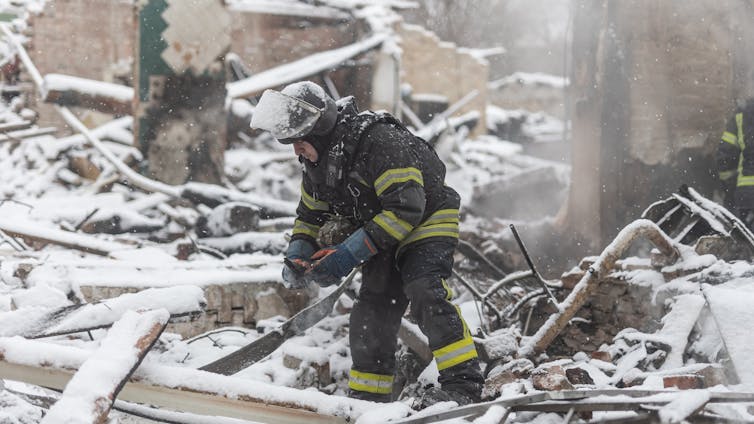
Ukrainian firefighters extinguish a fire in a house after it was hit by a Russian drone on Jan. 15, 2026.
Diego Herrera Carcedo/Anadolu via Getty Images

Amy McAuliffe, University of Notre Dame

With Russian ground troops bogged down in a grinding war of attrition, Moscow is striving to press home its advantage in the skies – through an ever-evolving army of drones, courtesy of Iran.

In early January, wreckage of a drone found in Ukraine hinted at a new high-speed model of drone being deployed by Russia in the conflict. It prompted Ukraine President Volodymyr Zelenskyy to air fears over failing to keep pace. “We produce (drones) at about 1,000 a day. We really produce them, but it’s not enough. It’s still not enough,” he told an audience of political business leaders at the World Economic Forum on Jan. 22, 2026.

Ukrainian intelligence suggests that Moscow, too, will also soon be pumping out 1,000 drone units a day, in large part thanks to the support and technical assistance of Iran. A central concern for Ukraine is Russia’s increasing production of long-range attack drones that it has used in mass attacks to strike targets in Ukraine.

Tehran’s role in supplying Russia with hundreds of long-range, kamikaze-style drones is long known. But what has gone largely unnoticed outside Ukraine is Iran’s central role in teaching Russia to produce these drones itself.

As an expert on weapons technology and former assistant director of the CIA for weapons and counterproliferation, I believe use of Iranian technology has helped Russia develop a fleet of sophisticated drones able to erode Ukrainian air defenses and strain the country’s resolve. By doing so, Moscow is able to preserve more expensive missiles for long-range precision strikes.

Designed in Iran, produced in Russia

Both Ukraine and Russia have ramped up drone production since the beginning of the current conflict in February 2022.

Russia was initially unable to produce large numbers of kamikaze drones, and the country’s military seemingly did not at first understand the decisive role long-range strike drones could play. Instead, Moscow invested in traditional battlefield weapons, such as missiles. It mainly thought of drones as carrying out the roles of intelligence, reconnaissance and surveillance.

Tehran had the expertise Russia needed. It also had an existing defense relationship with Russia. Moreover, faced with a cash-strapped economy due to yearslong sanctions, Iran needed money.

Since probably about early 2022, Tehran has been providing drones and drone technology to Russia for use in Ukraine. Later that year, Russia and Iran signed the agreement to set up a production plant in Russia for Iranian-designed attack drones.

With Iranian blueprints and technology, a production plant in Tatarstan in western Russia now produces large numbers of drones originally designed by Iran. At this factory, Russia manufactures the Geran-2, Moscow’s name for the Iranian Shahed-136 strike drone.

Easily identifiable by its delta-wing shape, the drone has optimized certain design features, such as range, endurance and weight capacity. It can carry an estimated 90 to 110 pounds of explosives hundreds of miles.

Meanwhile, the delta-wing design optimizes precision diving, helps prevent stalling at low speeds, and increases the drone’s stability during the attack phase.

These features enable targeting of strategic infrastructure at much less cost than long-range missiles.

Two men look over a winged aerial vehicle
Remains of a Russian drone in Vinnytsia Oblast on March 18, 2024.
National Police of Ukraine/Wikimedia Commons, CC BY-SA

Russia can now produce hundreds of one-way Geran-2 attack drones a day. It may soon be able to launch thousands in salvos.

Russia is also modifying and enhancing the drones with features such as precise navigation, heavier warheads and new engines.

Some reports claim Russia is testing telemetry and video links to fly drones remotely, a significant improvement over its current preprogrammed design that would improve accuracy and range. Iran also supplied Russia with technology to build a jet-powered drone variant based on the Shahed-238 that can fly faster.

Called the Geran-3, Russia has produced and used fewer of these drones, whose jet power makes them more challenging for Ukrainian air defense to detect and intercept. New generations of the drone – Geran-4s and Geran-5s – have since been rolled out and apparently deployed in the war with Ukraine.

Sanctions-busting procurement

Even with the blueprints and Iranian assistance, Russia is still reliant on Western and Chinese suppliers for some drone components, many of them commercial, off-the-shelf technology. These include the engine, fuel pump, GPS and navigation systems, semiconductors and components for antennas.

To assist Russia, Iran exploits its networks of brokers and companies in acquiring Western components to evade international sanctions.

A procurement network headed by the Iranian company Sahara Thunder used shipping firms in the UAE and India to sell Russia the original Iranian drones and components and to negotiate the deal for the production plant.

The U.S. Treasury Department has sanctioned this firm and others involved in the drone sales, but Iran set up new companies to help Moscow acquire components. Multiple studies and reports documenting the inclusion of foreign components in downed Geran-2s show Moscow’s continued acquisition of these parts, almost certainly with Iranian assistance.

A weapon of terror

Russia uses the Geran and other longer-range Iranian and Russian models to purposefully target civilians and civilian infrastructure in Ukraine, including residential housing in Ukrainian cities. Russia has even targeted first responders and humanitarian distribution points, according to a United Nations account.

In fact, the U.N. concluded in October 2025 that Russia’s use of short-range, unmanned aerial vehicles against civilians in southern Ukraine constituted a crime against humanity and a war crime.
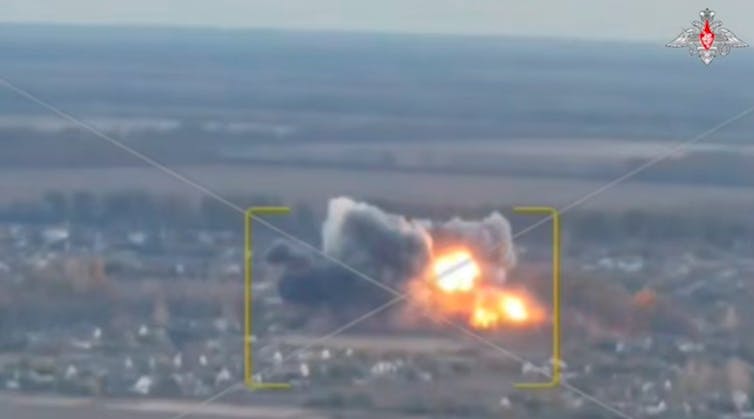
An explosion is seen with smoke around it.
A screen grab from a video shows Russian strikes in the Kharkiv region of Ukraine on Dec. 23, 2025.
The Russian Ministry of Defense/Anadolu via Getty Images

A two-day attack in May 2025 on the Ukrainian cities of Kharkiv in the northeast and Odessa in the south highlights the destructive power and human cost of the drone attacks. According to accounts in the Kyiv Post, Russia launched over 100 drones. In Kharkiv, three blocks were burned down, including 90 shops, and two people were injured. In Odessa, the drones killed one person and damaged residential buildings.

Beyond psychologically tormenting the Ukrainian population, these drones have a profound effect on the battlefield.

Ukraine has responded to Russia’s battlefield success with the Iranian-designed drones by diversifying the types of drones it manufactures, attacking Russian infrastructure for manufacturing drones and developing counter-drone technologies.

A mutually beneficial arrangement

Iran also benefits from this terror campaign. Reeling from the economic impact of sanctions, Iran will make an estimated US$1 billion to $1.75 billion from the deal for drones and the production facility. Russia is reportedly paying Iran a portion of the bill in gold.

A screen shows flying vehicles.
Iranian families watch a video clip of Iranian-made unmanned aerial vehicles during a ceremony commemorating the 45th anniversary of the Iran-Iraq war in Tehran on Sept. 25, 2025.
Morteza Nikoubazl/NurPhoto via Getty Images

Iran is unlikely to stop its assistance anytime soon, given its own economic problems. Helping Moscow obtain drone components and even modify new versions of the Geran-2 will also benefit Iran militarily as it, too, learns to make the new drones and use them itself.

But the main beneficiary of this relationship is Moscow. Without Iranian support, Russia would face more difficult trade-offs on the battlefield. The lower-cost drones allow Russia to preserve its expensive advanced missiles for the most significant targets in Ukraine and to employ large swarms of drones to target Ukrainian infrastructure.

And with the ground offensive yielding little progress of late for Moscow, that could be crucial as the war enters its fifth year.The Conversation

Amy McAuliffe, Visiting Distinguished Professor of the Practice, University of Notre Dame

This article is republished from The Conversation under a Creative Commons license. Read the original article.

Ticker Views

Australia inflation, USD volatility and Fed dissent explained

Australia’s inflation report raises questions for the RBA, influencing interest rates, markets, and a volatile US dollar.

Published

on

Australia’s inflation report raises questions for the RBA, influencing interest rates, markets, and a volatile US dollar.


Australia’s latest inflation report is raising questions about the Reserve Bank of Australia (RBA) and its next moves.

David Scutt from StoneX breaks down what the numbers mean for interest rates, investors, and global markets, highlighting the ripple effects that could reach far beyond Australia.

Meanwhile, the US dollar has seen a surge in volatility, sparking concerns about the impact on Australia’s economy and global trade. David explains the challenges and potential risks of pursuing a weaker dollar policy, and what it could mean for markets in the months ahead.

Subscribe to never miss an episode of Ticker – https://www.youtube.com/@weareticke

#AustraliaInflation #RBA #USDVolatility #WeakerDollar #FedMeeting #GlobalMarkets #FinanceNews #TickerInterview


Download the Ticker app

Continue Reading

Ticker Views

The Cold War maps that can help us rethink today’s Arctic conflict

Published

on

The Cold War maps that can help us rethink today’s Arctic conflict

A US view of the cold war world, 1950, showing the fearsome power of the USSR.
Cornell University – PJ Mode Collection of Persuasive Cartography.

James Cheshire, UCL

The late 1940s and early 1950s were a golden age for polar mapmaking in the US. Major magazines such as Time, Life and Fortune commissioned a generation of famous cartographers – who had come of age in the second world war – to explain the new geopolitics to a mass audience that was highly engaged after the catastrophic global conflict they had just lived through.

Their maps were large, dramatic and designed to be spread across kitchen tables and classroom desks. And they also offered a very different perspective to the mainstream maps we have become accustomed to today.

I’ve spent the past four years unearthing maps from the late 1940s and early 1950s to research a book about a largely forgotten map library at my university, and I am always struck by how consequential they feel to the global arguments of their era. Not least because they invited debate from their readers who were asked to become global strategists by discussing the next moves in the game of geopolitics.

These maps didn’t just illustrate the world – they implored people to think about it differently. As the world enters a new period of international relations and global tensions, it’s worth considering the different perspectives maps can offer us.

With each new US foreign policy intervention – such as the US president’s current preoccupation with taking over Greenland – I have often wondered if these maps of global adversaries could have percolated into a young Trump’s mind. The world must have seemed a menacing place and it is shown on these maps as a series of threats and opportunities to be gamed, with the “Arctic arena” as a major venue.

A map showing the political alignments as they were in 1941
The World Divided is an iconic map showing the geoopolitical situation at the height of the second world war. It was created by Richard Edes Harrison and published by Fortune Magazine in August 1941.
Cornell University – PJ Mode Collection of Persuasive Cartography.

The consensus encouraged by the maps was that of alliances, most notably Nato, and US opinion tended to endorse what Henry Luce, the influential owner of Time and Life magazines, called the “American century” in which the US would abandon isolationism and take on a global role.

a map using the North Polar Azimuthal Equidisant Projection
Published in 1950, this map introduces the Azimuthal Equidistant Projection to Time Magazine’s readers.
Time Magazine

Whatever one thinks of that worldview, it was frequently framed in terms of collective responsibility rather than individual dominance. Luce argued that the “work” of shaping the future “cannot come out of the vision of any one man”.

As we can now see with Greenland, Trump has taken the geography of threats and opportunity shown on these influential maps but reached a very different conclusion: an “America first”, resulting from the vision of the US president himself.

Dawning of the ‘air age’

The skilful of the cartographers of the era played with a range of map projections that offered different perspectives of geopolitical arenas. The master of this was Richard Edes Harrison who is described by the historian Susan Schultern as “the person most responsible for sensitizing the public to geography in the 1940s. [The public] tore his maps out of magazines and snatched them off shelves and, in the process, endowed Harrison himself with the status of a minor celebrity.”

Edes Harrison adopted many projections in his work – but for maps of the Arctic, he alighted on the azimuthal equidistant projection. While this creates maps that distort the shapes of countries, it enables the correct distances to be shown from the centre point of the map.

The projection became widely used in the 1940s and 1950s (and was indeed adopted for the UN flag in 1946) because it proved effective at demonstrating the wonder of the burgeoning “air age” as commercial flights followed great circle routes over the Arctic.

World map centered on London 1945
The Air Age Map of The World, 1945 (centered on London).
The Library of Lost Maps

This contrasted with the roundabout routes that needed to be followed by ships and it also mapped the countries that bordered and occupied the Arctic with a much greater sense of proximity and threat.

Missiles and bombers were just as able to travel over the top of Earth as were holidaymakers – and this created a juxtaposition exploited by cartographers. Rand McNally, a renowned map publisher, for example, published a collection of maps entitled Air Age Map of the Global Crisis in 1949.

These set out “the growing line-up of countries and peoples behind the two rival ways of life competing for power in the 20th Century” – that is capitalism as embodied by the US and Soviet and Chinese communism.

Those who bought it were told: “Keep this map folder! It may have great historic significance a generation from now.”

Magazine insert from 1950s with a series of geopolitical maps.
This 1950s map published by Rand McNally was produced as part of a marketing campaign for Airwick air freshener, but also sought to inform the US public about the spread of communism.
Rand McNally

New world order

Donald Trump’s return to office has revived talk of a world moving beyond the assumptions of the postwar order — weakening alliances, acting unilaterally, treating territory as leverage. At the same time, maps remain one of the most trusted forms of evidence in public life.

A Mercator-shaped worldview, widely used by digital maps can distort reality – for example, making Greenland much larger than it is.

Cartographers have long known the strengths and limitations of Mercator, but Trump’s approach to foreign policy is a further reminder of the perspective we lose when we depend on the standardised views of Earth that digital maps encourage (some have also speculated that Mercator’s exaggeration of Greenland’s area heightens its real estate appeal to Trump).

Maps are powerful things and in times of crisis, or rapid change, we turn to them to help explain events and locate ourselves within them. But they can be just as much about arguments as they are facts – and Trump knows this.

The maps of the 1940s and 1950s were about a fresh (American) perspective to create a new world order. They instilled Trump’s generation with a sense of the geopolitical rivalries that tend to get washed out of generic digital maps that are most widely consumed today.

Nearly 80 years on, this order may be creaking – but the maps are still there to remind us of what’s at stake.The Conversation

James Cheshire, Professor of Geographic Information and Cartography, UCL

This article is republished from The Conversation under a Creative Commons license. Read the original article.

Continue Reading

Ticker Views

Landmark trial targets Meta, TikTok and YouTube over youth mental health

Meta, TikTok, and YouTube face trial over claims of social media addiction and mental health impact on youth.

Published

on

Meta, TikTok, and YouTube face trial over claims of social media addiction and mental health impact on youth.


Meta, TikTok, and YouTube are facing a landmark trial in Los Angeles as a 19-year-old woman alleges the platforms contributed to her social media addiction and mental health struggles.

The case is being closely watched as it could set a precedent for how tech companies are held accountable for the impact of their platforms on young users.

Dr Karen Sutherland from Uni SC joins us to break down the specific allegations, the plaintiff’s claims, and how social media use is being linked to mental health challenges. We also explore the tech companies’ legal defenses and what makes this trial such a pivotal moment in digital regulation.

The outcome of this trial could have far-reaching consequences, potentially influencing future lawsuits, federal regulations, and the national conversation around youth screen time.

Subscribe to never miss an episode of Ticker – https://www.youtube.com/@weareticker

#SocialMediaTrial #YouthMentalHealth #TikTok #Meta #YouTube #DigitalAddiction #ScreenTime #LegalBattle


Download the Ticker app

Continue Reading

Trending Now