

Ticker Views
Global markets brace for higher oil, bond yields and a possible rate hike

| Investment markets and key developments |
|
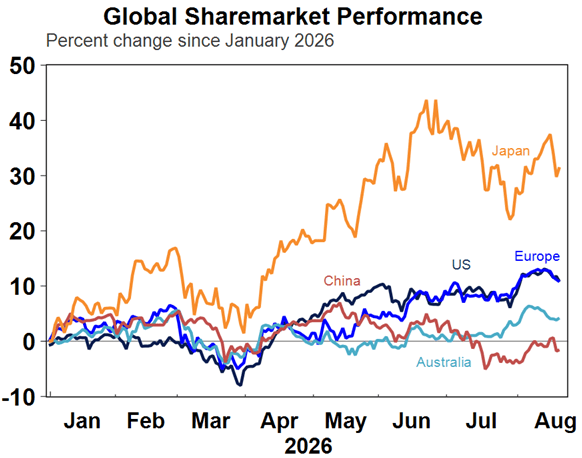
After record highs in US and European shares a week ago, global shares pulled back in the last week reflecting concerns about rising bond yields, not helped by a further rise in oil prices and some continuing concerns about chip makers. The weak global lead along with mixed earnings reports also weighed on the Australian share market which is down around 0.6% for the week with falls led by retailers, banks, property and IT shares more than offsetting gains in health and resources shares.
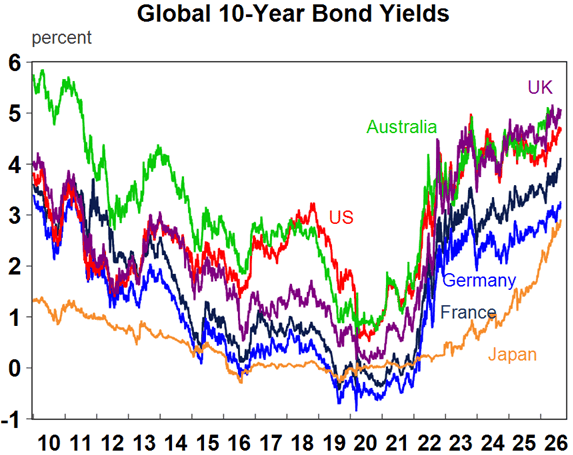
Source: Macrobond, AMP Bond yields mostly rose, not helped by higher oil prices and despite US Treasury efforts to lower them.
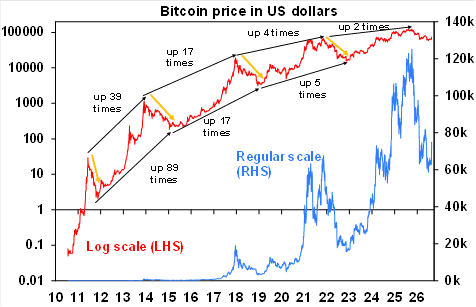
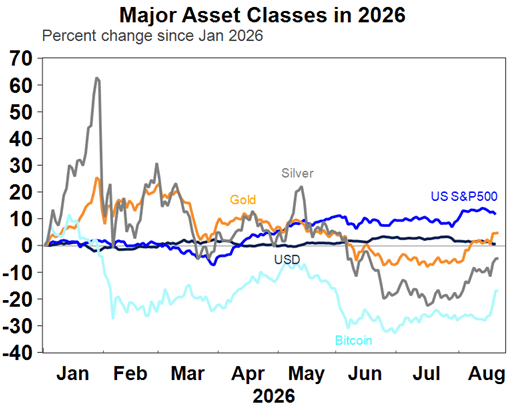
Source: Macrobond, AMP Bitcoin broke decisively above its 200-day moving average, a move which confirmed the end of the last four crypto winters (which saw circa 80% falls) this time only after a fall of 53%. Technically Bitcoin looks like it’s on the way up again. If we have seen the bottom after a much milder winter than in the past it’s a positive sign that Bitcoin is maturing.
Source: Bloomberg, AMP Similarly, gold also looks to be breaking higher after a 27% fall, although its currently right on its 200-day moving average. Both are benefitting from having had long positions and excessive optimism washed out and signs of renewed $US weakness. The latter is also seeing the $A hold above $US0.71. Meanwhile, iron ore prices also rose but metal prices fell.
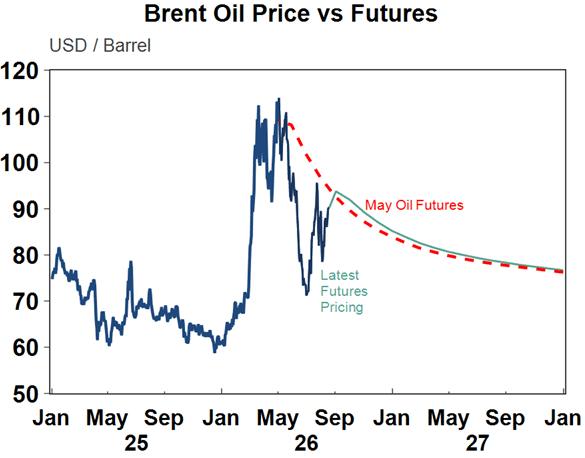
Source: Macrobond, AMP Oil prices rose again with no resolution to the Strait of Hormuz. The past week saw mixed reports on how much shipping was moving through the Strait, the June interim peace deal expired, Trump indicated there are no talks with Iran, the UK reported a ship in the Strait had been hit and then Trump announced that the US will now use “Economic Warfare and Isolation on an unprecedented scale” against Iran with “TREMENDOUS Economic Consequences” for “ANY country” that supports it. The latter looks like a return to sanctions but its hard to see why these will work now when they haven’t for years or that the US will seriously ramp up pressure on China given the risk of blow back to the US economy. So the conflict looks as messy as ever with only bad options – return to war (which Trump knows will go down very badly back in the US) or agree a bad deal (giving Iran what it wants). Our base case remains that oil prices will stay in a $US70-100 range with Iran preventing it going lower and the US moving to try and calm things down whenever it gets above $US100….but the risk is high that with no resolution the world will have to face much higher oil prices (like $US150) as reserves run down.
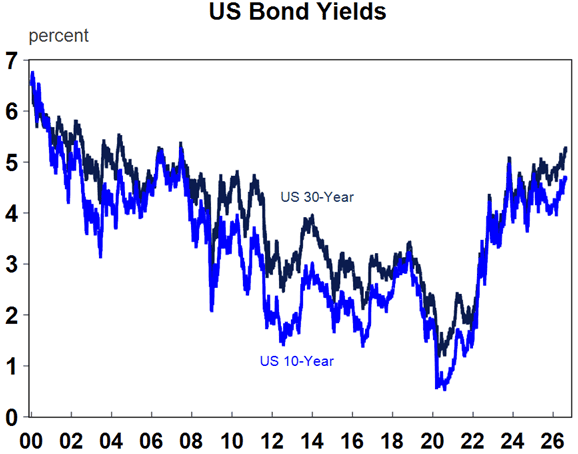
Source: Macrobond, AMP Can the latest version of Operation Twist stop US (and hence global) bond yields rising? It’s doubtful. Quite clearly the US Government has become concerned about the rise in long term Treasury yields. They have been rising because of ongoing huge US budget deficits, surging corporate debt issuance to finance the AI boom, worries about higher inflation and rising Japanese bond yields. This has pushed the 30-year bond yield up to levels not seen for two decades – the main problem being that the level of Federal public debt to GDP is roughly double what it was 20 years ago and so the rise in bond yields in the last five years has seen net interest costs surge from 6% of tax revenue to 14% which is a record high in the context of the last 70 years. So, the US Treasury announced it is buying back more long term bonds presumably financed by issuing more short term Treasury bills. Since Treasury bills are anchored by the Fed Funds rate this helps bring down long term bond yields. It’s a bit like the Fed’s Operation Twists in 1961 and 2011. So far, the results are mixed with long term bond yields first down a bit but then reversing their fall. Since the operation does not change any fundamentals with the US still having to issue debt to finance its huge budget deficit of around 6-7% of US GDP and corporate borrowing still on the rise its likely only a temporary fix. Just like the recent interventions to push up the Yen. So, absent a recession the rise in bond yields is likely to continue. It could even backfire for the US Treasury if the Fed does have to raise rates and so Treasury has to pay even more to borrow long term down the track. If anything by easing US financial conditions this latest operation twist adds to the risk that the Fed with have to hike. Since US Treasuries are seen as the global risk-free rate upwards pressure on them is likely to result in upwards pressure on Australian long term bond yields which risks higher borrowing costs for Australian governments, companies and for mortgage holders borrowing with fixed mortgage rates.
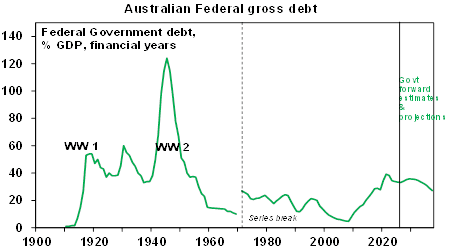
Source: Macrobond, AMP Fortunately, public debt in Australia is a fraction of US levels (circa 55% of GDP here versus around 125% of GDP in the US, but its still well up from where it was before the GFC and Federally just went through $A1 trillion. While that’s just a big round number, as a share of GDP, which is more important, it’s projected to remain around the highest levels seen since the aftermath of World War Two. While the Budget projected a fall in public debt as a share of GDP next decade this depends on rather optimistic assumptions that the budget deficit will fall and turn into a surplus. More importantly, public debt interest is the fastest growing major spending item in the Federal Budget currently accounting for around 4.7% of tax revenue but set to rise further. The more bond yields rise the faster public debt interest will rise and the more tax revenue it will take up.
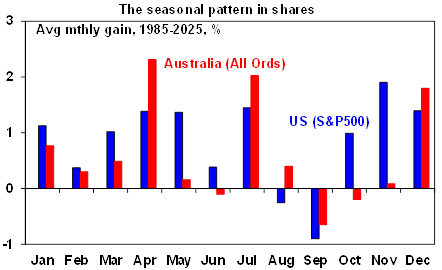
Source: Australian Treasury, AMP In terms of the Fed, the minutes from its last meeting were hawkish with “several” members favouring a hike and “many” members saying a hike would be needed if inflation did not decline. Inflation data released so far for July suggests that core private final consumption deflator inflation will come in at 0.2%mom or 3.3%yoy, which would probably leave the Fed on hold, but it’s a close call with unrounded forecasts coming in at 0.24%mom and if ticks up to 0.3% many at the Fed would likely support a hike. In Australia, despite mixed economic data we continue to expect another rate hike from the RBA around November. RBA Deputy Governor Hauser reiterated the RBA’s concerns about inflation, that consumer spending and employment growth would need to slow further to get it down and that if upside risks materialise then the RBA will hike. Economic data in the last week provided a mixed bag regarding this with a bounce in consumer confidence, wages growth in the June quarter which was benign but likely to pick up this quarter and jobs data was softish in July but still consistent with a labour market that is a “bit tight”. All, up we continue to expect another RBA hike, probably in November as inflation is unlikely to slow to back to target quickly enough. Seasonal weakness. After strong gains year to date left US shares overbought a pullback through the seasonally weak months of August and September is a high risk which would likely drag Australian shares down. Rising bond yields, a possible Fed rate hike, rising oil prices, worries about an AI bubble and political uncertainty ahead of the mid terms are potential triggers. But with earnings growth remaining strong we would see any pullback as a correction rather than the start of a new bear market.
Source: Bloomberg, AMP Most would remember Johnny Young as the saccharine like host of Young Talent Time. But he was actually much more and gave Australia one of it’s best rock songs. In the late 1960s much Australian pop music was covers of overseas bands, but Johnny Young came up with The Real Thing which was sung by Russel Morris and produced by Ian (Molly) Meldrum into a psychedelic extravaganza lasting more than six minutes. Here’s a brilliant covid era version. Of course, Molly then went on to Countdown – so do yourself a favour and check out The Real Thing!
|
| Major global economic events and implications |
|
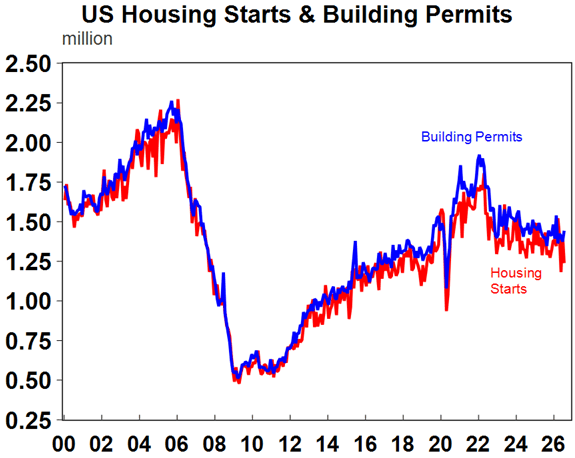
US housing indicators remained soft with housing starts down 12% and home builder conditions remaining weak. Industrial production rose less than expected in July but manufacturing conditions were strong, although price pressures remain elevated. Jobless claims remain low.
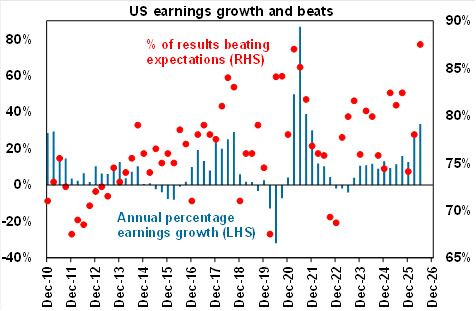
Source: Macrobond, AMP The US earnings reporting season has now seen 94% of S&P 500 companies report with 87.5% exceeding expectations. The consensus expectation for earnings growth has now risen to 33%yoy. Earnings growth is being led by energy and tech companies and 2027 earnings estimates have been upgraded by around 4% over the last two months.
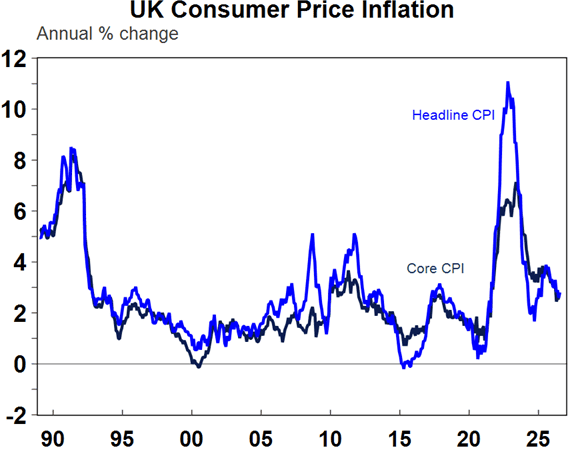
Source: Bloomberg, AMP Canadian CPI inflation rose to 3%yoy in July due to higher energy prices and some World Cup price hikes, and core inflation measures rose slightly to 1.9-2%yoy but since they are around target the Bank of Canada is likely to remain on hold in the near term. UK CPI inflation also rose to 2.9%yoy in July due to higher energy prices, but core inflation was unchanged at 2.6%yoy, which along with unemployment still at 4.9% and wages growth cooling slightly to 4.1% probably leaves the Bank of England on hold for now. The money market still sees a rate hike by year end though.
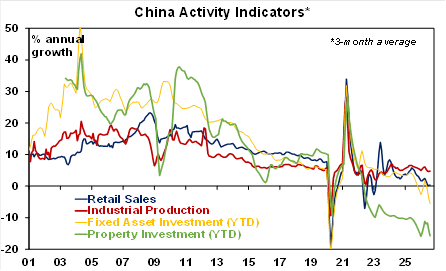
Source: Macrobond, AMP Japanese June quarter GDP growth was weaker than expected at 0.3%qoq with falls in consumer spending, housing investment and business investment. Inflation rose to 1.9%yoy in July with core (ex food and energy) inflation rising to 1.4%yoy from 1.2%, partly due to soaring memory chip prices. Expect further gradual Bank of Japan rate hikes. Chinese economic activity indicators for July were soft. Retail sales growth slowed to just 0.6%yoy, industrial production slowed to 4.5%yoy and investment fell further with property investment, sales and home prices continuing to slide. China requires more stimulus measures to boost consumer spending.
Source: Bloomberg, AMP |
| Australia economic events and implications |
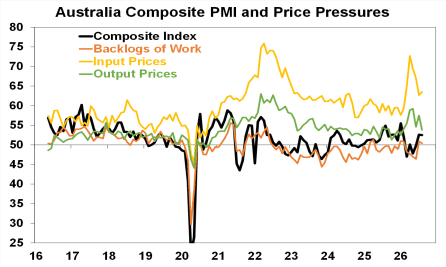
| Australian business conditions PMIs for August fell slightly but to a still okay 52.5 with a fall in services, employment and orders. Output price pressures fell particularly in services suggesting some easing in inflationary pressures, but input prices rose and remain relatively high.
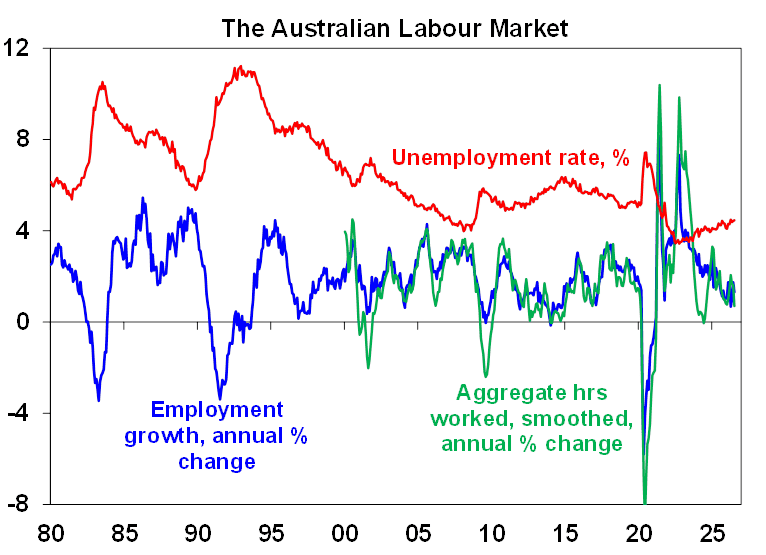
Source: Bloomberg, AMP Jobs data for August was softer than expected but is not as weak as it looks. Employment fell by 15,800, hours worked fell and unemployment rose to 4.5% again. However, it’s not as soft as the headline numbers suggest as the fall in employment followed several strong months and so a soft month was inevitable sooner or later, full-time employment rose, the unemployment rate only rose from 4.43% to 4.46%, labour underutilisation fell slightly and the weakness was concentrated in NSW.
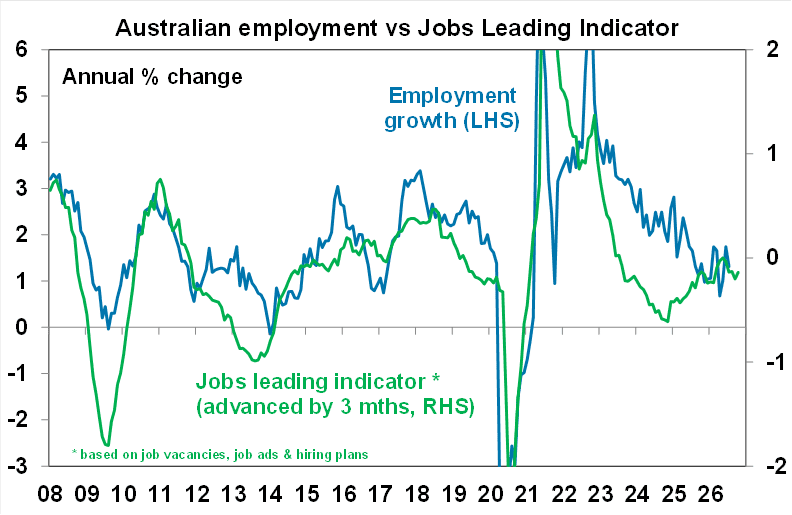
Source: ABS, AMP Forward looking labour market indicators like job ads and hiring intentions point to jobs growth remaining around current levels. This is highlighted in our Jobs Leading Indicator in the next chart and should keep unemployment hovering around current levels for the time being. All of which will likely see the RBA continue to characterise the jobs market as a “bit tight” whereas it needs to see jobs growth slow further for inflation pressures to recede.
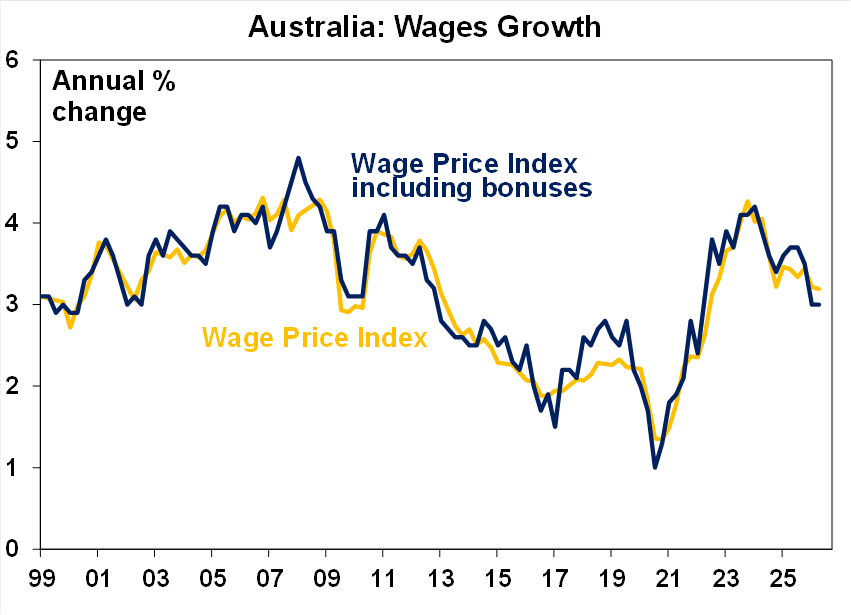
Source: ABS, AMP Wages growth was unchanged at 0.8%qoq or 3.2%yoy in the June quarter.
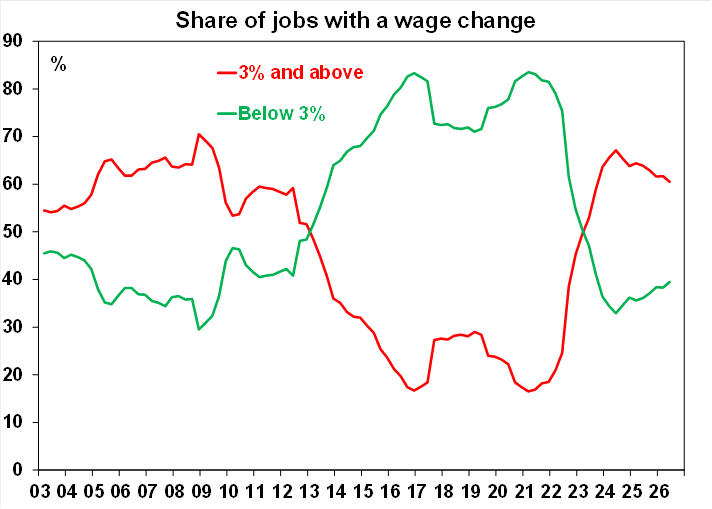
Source: ABS, AMP There was a further slowing in the proportion of jobs with 3% or more wages growth, but wages growth will pick up this financial year as the 6% and 4.75% increases in minimum and award wages impact, & some seek compensation for higher inflation. This will remain a concern for the RBA given low productivity growth.
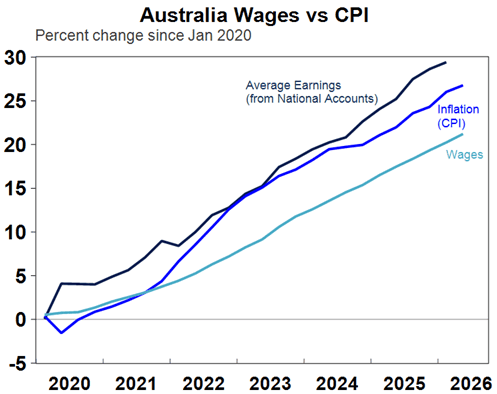
Source: ABS, AMP Cost of living pressures remain, although they are maybe not quite as severe as some comparisons suggest. Over the year to the June quarter real wages fell 0.8% as inflation was 4%yoy. And since 2020 prices in the CPI rose 27% compared to the wage price index that rose 21%, resulting in a real wage fall of 6%. However, a broader measure of average earnings in the national accounts – which allows for people moving jobs, promotions, hours worked, etc – shows that total labour earnings have kept up with inflation. The truth is probably in between.
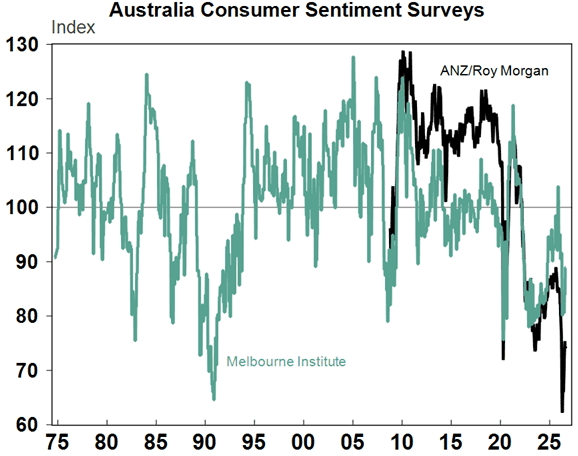
Source: Macrobond, AMP Consumer confidence rose another 6% in August, which is surprising, but the rise was concentrated in mortgage holders relieved at the RBA decision to hold rates this month. This is of course leaves it very dependent on what the RBA does going forward. And its worth noting that it remains weak with the alternative ANZ/Roy Morgan consumer sentiment survey even weaker.
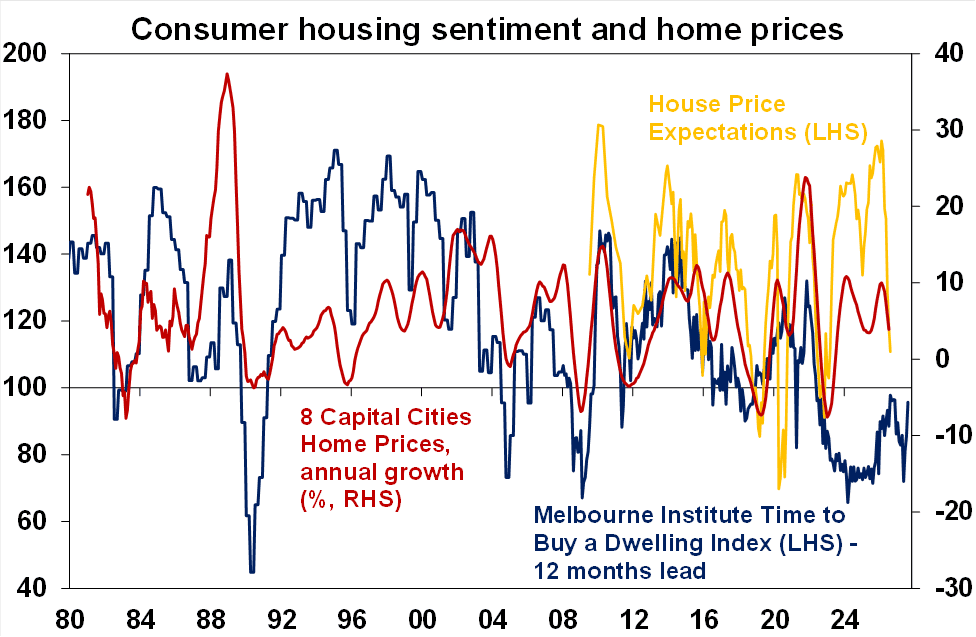
Source: Westpac/Melbourne Institute, ANZ/Roy Morgan, AMP The Westpac/MI consumer survey also showed a further sharp fall in home price expectations, but falling prices have led to a sharp rise in perceptions of whether now is a good time to buy a dwelling.
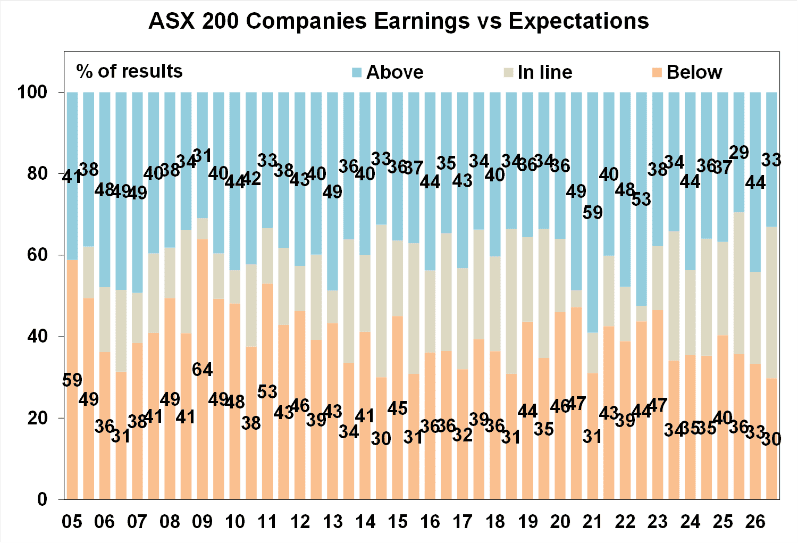
Source: Westpac/Melbourne Institute, Cotality, AMP The HIA reported that new home sales fell for the third month in a row in July as rate hikes impact and falling home prices make building new homes less viable. Tax policy uncertainty around the impact of the investor tax changes may also be impacting. Expect another year with home completions running well below the Housing Accord target for 240,000 homes a year. The Australian June half earnings reporting season is now around 60% complete, and while profits are up nicely its narrowly based with results on the soft side. Profits are seeing a rebound after three financial years of falls, but it remains subdued compared to the AI enhanced profit boom being seen in the US, where profits are up more than 30%, and elsewhere. The consensus expectation for 2025-26 earnings growth of 12% has already been revised down to 11.7% with 2026-27 earnings growth expectations also revised down slightly to 10.5%. Strength is narrowly based on a rebound in mining sector profits which was confirmed by good results at BHP and solid growth for financials with profits in the rest of the market only likely to see growth of 2.5%. So far banks have been under pressure on concerns about slowing housing finance, and stocks exposed to the consumer (eg JB HiFi) and housing (eg Temple and Webster) have had difficult results. Ø The proportion of results beating expectations are running ahead of misses but only marginally at 33% versus 30%. And the number of beats was less than the norm of 40%, but so too was the number of misses where the norm is 41%.
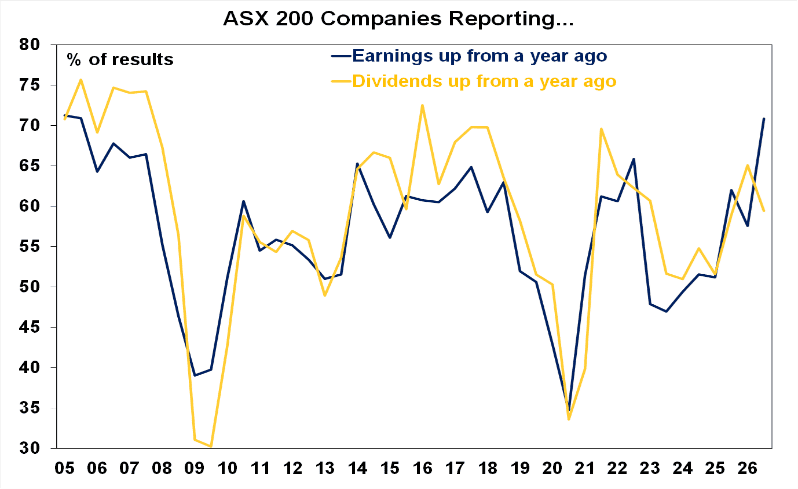
The horizontal axis data relate to reporting season. Source: Bloomberg, AMP Ø 71% of companies have seen earnings rise on a year ago, and this is better than the norm of 56% and confirms the rebound in profits but as noted above its coming in a bit weaker than expected in aggregate. Ø 59% of companies have increased their dividends on a year ago which is in line with the norm, but down slightly from the last reporting season. The failure of dividends to match the rise in earnings suggests a degree of corporate caution about the outlook.
The horizontal axis data relate to reporting season. Source: Bloomberg, AMP
|
| What to watch over the next week? |
|
In the US, expect to see a fall in consumer confidence and soft growth in home prices (Tuesday) but continued solid gains in underlying capital goods orders (Wednesday). July consumer data is likely to show modest growth in spending. Meanwhile, the core PCE deflator inflation rate for July is likely to be 0.2%mom leaving it at 3.3%yoy. A 0.2% monthly rise would be consistent with the Fed holding but if it tips over to 0.3%mom it will increase pressure on the Fed to hike next month. Comments by Fed Chair Warsh at the annual Jackson Hole Symposium (Friday) will be watched for any clues regarding whether the Fed might raise interest rates but its doubtful he will give much away. In Australia, the July CPI (Wednesday) is expected to rise 0.8%mom reflecting higher prices for fuel, travel, water, clothing and computers offsetting some fall in electricity prices but because of the base effect of a very strong rise a year ago dropping out it’s likely to see annual inflation fall back to 3.2%yoy (from 3.8%). Trimmed mean inflation is also likely to fall slightly but only to 3.5%yoy (from 3.6%) due to base effects with the monthly increase remaining too high at 0.3%mom. In other data, expect just a 2.5% rise in June quarter construction (Wednesday), a 1% rise in June quarter business investment and a 0.7%mom rise in July household spending (both due Thursday). The minutes from the last RBA meeting (Tuesday) are likely to reiterate the RBA remains hawkish and biased towards another rate hike. The Australian June half profit reporting season will wrap up with about 85 major companies reporting including Bendigo Bank, Woodside, Woolworths, Qantas, South32 and Harvey Norman.
|
| Outlook for investment markets |
|
Global and Australian share markets are likely to remain volatile with the lack of any resolution to the Iran War and hit to global oil supplies, stretched valuations, sticky inflation, political uncertainty associated with Trump & the midterm elections and worries about the impact of AI and whether there is an AI bubble. However, returns should still be okay for the next 12 months as a whole thanks to continuing economic growth with recession avoided and strong global profit growth and likely rate cuts next year. Bonds are likely to see returns around running yield or a bit less. Unlisted commercial property returns are likely to be solid helped by strong demand for industrial property associated with data centres. Australian home prices are expected to fall around 7% top to bottom, of which they have already done around 2%, out to the June quarter next year as a result of poor affordability, RBA rate hikes, reduced investor demand flowing from the winding back of negative gearing and the capital gains tax discount and poor confidence. Cash and bank deposits are expected to provide returns around 4-5%. The $A is likely to rise reflecting the wider interest rate differential to the US, although a move to Fed hikes may limit this. Fair value for the $A is around $US0.72.
Shane Oliver AMP | Superannuation & Investments |

-
 News4 days ago
Farage’s Clacton win puts Britain’s major parties under pressure
-
News3 days ago
Rents expected to rise 30% soon
-
News3 days ago
Hanson proposes 75% cut in cigarette prices
-
News3 days ago
Hayden Panettiere dies at 36 from overdose
-
News4 days ago
Coles and Woolworths trial facial recognition technology
-
News3 days ago
Airlines face high costs despite improving jet availability
-
News3 days ago
Qantas launches biggest domestic sale starting $99
-
News4 days ago
U.S. commander addresses mental health issues aboard Lincoln