

Connect with us
https://tickernews.co/wp-content/uploads/2023/10/AmEx-Thought-Leaders.jpg

Ticker Views

G7 nations: Is this the end of coal? | ticker VIEWS

Published

on

The recent G7 summit in the UK, makes a historic move towards phasing out coal.

This week on Ticker Climate, Energy Expert Scott Hamilton and Ticker News Presenter Holly Stearnes, speak with German Energy Agency’s (DENA) Managing Director Kristina Haverkamp. Unpacking the G7 Summit from a climate perspective and what it means for climate change and the race to zero emissions.  

Certain left leaning groups are suggesting the G7 Summit is another lost opportunity, to halt climate change. Although, Haverkamp, a leader in the renewable energy space says, “the results are satisfactory”. 

For the first time, the role of coal in global warming has been specifically mentioned in the G7 official statements saying its “the single biggest source of greenhouse gas emissions”.

The seven nations are agreeing on tough new measures to phase out the biggest contributor to global warming. The G7 statement also stating that “international investments in unabated coal must stop now and we commit now to an end to new direct government support for unabated international thermal coal power generation by the end of 2021.”

Scott Hamilton says phasing out the number one contributor is a critical action.

“A range of urgent policies were agreed, chief among them being the phasing out coal burning, unless it includes carbon capture and storage.”

Scott Hamilton

All seven major industrialised nations including the UK, US, Canada, Japan, France, Italy and Germany have previously agreed to meet the goal of net zero emissions by 2050, and to stop funding for coal power by the end of this year.

Germany has recently increased its level of ambition to achieve climate neutrality by 2045. Also, agreeing to a 68% reduction in emissions by 2030. Having already commenced the phase out of coal fired electricity generation, it now appears it’s happening much quicker in Germany, than anticipated. The previous coal closure target was set at 2038. 

Haverkamp reiterates that Germany is well on track to end coal fired electricity generation, ahead of schedule.

“We will probably be already out of coal fired electricity generation…by 2030”

Kristina Haverkamp

https://twitter.com/SDHamiltonVIC/status/1404614219538976768?s=20

Farewell to a prominent leader

It’s the end of an era for German Chancellor, Angela Merkel, as she prepares to step down, after serving 16 years for her country. Working with global leaders, in the face on many challenges, Merkel is an iconic leader, that will be sorely missed. Haverkamp says Merkel’s climate leadership is admirable. 

“Chancellor Merkel has done a great job. In particular, for the climate and her moderate approach at finding concentral, moderated solutions for societal challenges, have been a prerequisite our moving forward in the energy transition.”

Kristina Haverkamp

Is Australia lagging behind the rest of the world? 

When its comes to climate change action, Australian Prime Minister Scott Morrison, is consistently criticised for his lack of commitment. He tries to talk up the level of action being taken by his Government fighting climate change. Although, despite the relatively weak 2030 targets and failure to give a clear commitment to net zero emissions by 2050.

Morrison told the G7 that Australia has already cut emissions by 20%. Although, he seems leaving out that he relies on changes to land use clearing, for the overwhelming majority of the reductions.

Emissions in almost every sector of the Australian economy are rising. This is all except in electricity generation, which is mostly due to cheap solar power and action from state and territory Governments.

In a major miss-step, Morrison fails to secure a highly anticipated one-on-one meeting with US President, Joe Biden. The Australian Prime Minister needs to get on the same page when it comes to climate change, if he wants to be included in vital meetings with other world leaders.  
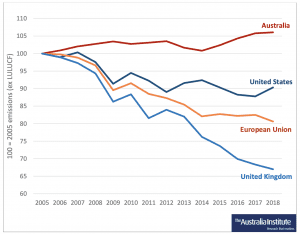
 

[Graphic credit: The Australian Institute]

Germany and Australia sign deal on hydrogen production

Germany and Australia officially sign a bilateral alliance on hydrogen production and trade to try to facilitate a renewable energy-based hydrogen supply chain, between the two countries. 

Scott Hamilton says Germany is head and shoulders above others, when it comes to promoting renewable hydrogen and global powerfuels.

“Germany has a 9 billion euro plan and a thirst for renewable hydrogen.”

Scott Hamilton

Australia has the potential to be a global renewable energy exporting superpower. Let’s hope he realises the countries opportunity before the Glasgow Conference later this year. Australia should want special one on one meetings and to be in the room when real climate change negotiations happen. 

Watch the full episode of Ticker Climate here:


Continue Reading
Click to comment

Leave a Reply

Your email address will not be published. Required fields are marked *

Ticker Views

What charges does Benjamin Netanyahu face, and what’s at stake if he is granted a pardon?

Published

on

Michelle Burgis-Kasthala, La Trobe University

Israeli Prime Minister Benjamin Netanyahu has requested a pardon in his long-running corruption trial – a move that has set off alarm bells among his critics that he’s trying to circumvent the rule of law.

In a video message, Netanyahu says Israel’s current “security and political” situation makes it impossible for him to appear in court several times a week.

His request for a pardon from Israel’s president is just the latest twist in a case that has dragged on for years. It could have significant implications for Israel’s legal system – and Netanyahu’s political future, with elections due next year.

What charges does he face?

Netanyahu is indisputably the most important political figure of modern Israeli politics. He was first elected prime minister in 1996 and is now in his sixth term.

He has been indicted on charges of bribery, fraud and breach of trust, related to investigations that date back to 2016. There are three cases now known by numbers – Case 1,000, Case 2,000 and Case 4,000. The trial began in 2020.

In Case 1,000, Netanyahu is alleged to have received some US$200,000 (A$305,000) worth of gifts, including cigars and champagne, from Hollywood producer Arnon Milchan and Australian billionaire James Packer.

Case 2,000 is related to alleged meetings Netanyahu had with Arnon Mozes, the publisher of the prominent Yediot Ahronot newspaper. Prosecutors say Mozes offered Netanyahu favourable coverage in exchange for restrictions being imposed on one of his rival newspapers.

And the final case, Case 4,000 is related to a communications conglomerate, Bezeq. The attorney-general alleges another reciprocal agreement: Netanyahu would be portrayed positively on the online platform, it’s alleged, in exchange for him supporting regulatory changes that would benefit Bezeq’s controlling shareholder.

Netanyahu has consistently denied any wrongdoing in the cases, saying he’s a victim of a “witch hunt”. In 2021, he characterised the charges as “fabricated and ludicorous”. When he took the stand in 2024, he said:

These investigations were born of sin. There was no offence, so they found an offence.

Experts have pointed out that a pardon can only be given once someone’s been convicted of a crime. But Netanyahu is not offering to admit any responsibility or guilt in the case, and he likely never will. He’s simply asking for a pardon, so that he can get on with his job.

Independence of Israel’s judicial system

Since the trial began in 2020, many witnesses have testified in the case, including some former Netanyahu aides who entered into plea bargains and became state witnesses. So, there’s been some pretty damning material brought against Netanyahu.

But he’s been extremely savvy and politically intelligent to use other issues – particularly the Gaza war – at every opportunity to try to postpone or interrupt the proceedings.

And after the Hamas attacks of October 2023, the number of trial days was limited because of security. According to media reports, Netanyahu has frequently requested his hearings be cancelled due to his handling of the war.

Netanyahu’s supporters don’t seem to have a problem with his request for a pardon, but it is shining a light on broader questions around the independence of the Israeli legal system.

In early 2023, the Netanyahu government put forth plans to overhaul the judicial system, which critics said would weaken the Supreme Court and Israel’s system of checks and balances. Netanyahu wasn’t involved in the effort because the attorney-general said it would be a conflict of interest due to his corruption trial, but other ministers in his cabinet were pushing it.

Massive protests happened on a regular basis throughout Israel in response to this move. Critics saw this as a frontal attack on the basic foundations of the Israeli legal system.

The request for a pardon is now part of this wider story, even though the two issues are not formally linked. Netanyahu’s opponents say it’s yet another indication of him and his coalition having a fundamentally different conception of the rule of law.

Netanyahu’s political survival

This is all about Netanyahu’s personal and political survival. He was re-elected leader of the Likud Party this month and he has declared his intention to run again for prime minister in next year’s elections – and that he expects to win.

The Israeli Basic Law suggests Netanyahu couldn’t run if he’s been convicted of a serious offence, though it’s not clear if he would actually be blocked at this point.

Media reports have suggested Netanyahu wants to move up the elections from November to June in the hopes he’ll be able to secure deals to normalise relations with both Saudi Arabia and Indonesia by then. This fits a pattern of him trying to use foreign policy gains to offset his domestic problems.

With elections coming, he’s now trying every possible manoeuvre to improve his position – and the pardon is just one of them. It’s likely the only option he has now to make the case go away because the trial has gone on for so long and at some point the court will have to make a decision.The Conversation

Michelle Burgis-Kasthala, Professor of International Law, La Trobe University

This article is republished from The Conversation under a Creative Commons license. Read the original article.

Continue Reading

Ticker Views

Australia’s national AI plan has just been released. Who exactly will benefit?

Published

on

Jake Goldenfein, The University of Melbourne; Christine Parker, The University of Melbourne, and Kimberlee Weatherall, University of Sydney

Today, the Albanese Labor government released the long-awaited National AI Plan, “a whole-of-government framework that ensures technology works for people, not the other way around”.

With this plan, the government promises an inclusive artificial intelligence (AI) economy that protects workers, fills service gaps, and supports local AI development.

In a major reversal, it also confirms Australia won’t implement mandatory guardrails for high-risk AI. Instead, it argues our existing legal regime is sufficient, and any minor changes for specific AI harms or risk can be managed with help from a new A$30 million AI Safety Institute within the Department of Industry.

Avoiding big changes to Australia’s legal system makes sense in light of the plan’s primary goal – making Australia an attractive location for international data centre investment.

The initial caution is gone

After the public release of ChatGPT in November 2022 ushered in a generative AI boom, initial responses focused on existential risks posed by AI.

Leading AI figures even called for a pause on all AI research. Governments outlined plans to regulate.

But as investment in AI has grown, governments around the world have now shifted from caution to an AI race: embracing the opportunities while managing risks.

In 2023, the European Union created the world’s leading AI plan promoting the uptake of human-centric and trustworthy artificial intelligence. The United States launched its own, more bullish action plan in July 2025.

The new Australian plan prioritises creating a local AI software industry, spreading the benefit of AI “productivity gains” to workers and public service users, capturing some of the relentless global investment in AI data centres, and promoting Australia’s regional leadership by becoming an infrastructure and computing hub in the Indo-Pacific.

Those goals are outlined in the plan’s three pillars: capturing the opportunities, spreading the benefits, and keeping us safe.

What opportunities are we capturing?

The jury is still out on whether AI will actually boost productivity for all organisations and businesses that adopt it.

Regardless, global investment in AI infrastructure has been immense, with some predictions on global data centre investments reaching A$8 trillion by 2030 (so long as the bubble doesn’t burst before then).

Through the new AI plan, Australia wants to get in on the boom and become a location for US and global tech industry capital investment.

In the AI plan, the selling point for increased Australian data centre investment is the boost this would provide for our renewable energy transition. States are already competing for that investment. New South Wales has streamlined data centre approval processes, and Victoria is creating incentives to “ruthlessly” chase data centre investment in greenfield sites.

Under the new federal environmental law reforms passed last week, new data centre approvals may be fast-tracked if they are co-located with new renewable power, meaning less time to consider biodiversity and other environmental impacts.

But data centres are also controversial. Concerns about the energy and water demands of large data centres in Australia are already growing.

The water use impacts of data centres are significant – and the plan is remarkably silent on this apart from promising “efficient liquid cooling”. So far, experience from Germany and the US shows data centres stretching energy grids beyond their limit.

It’s true data centre companies are likely to invest in renewable energy, but at the same time growth in data centre demands is currently justifying the continuation of fossil fuel use.

There’s some requirement for Australian agencies to consider the environmental sustainability of data centres hosting government services. But a robust plan for environmental assessment and reporting across public and private sectors is lacking.

Who will really benefit from AI?

The plan promises the economic and efficiency benefits of AI will be for everyone – workers, small and medium businesses, and those receiving government services.

Recent scandals suggest Australian businesses are keen to use AI to reduce labour costs without necessarily maintaining service quality. This has created anxiety around the impact of AI on labour markets and work conditions.

Australia’s AI plan tackles this through promoting worker development, training and re-skilling, rather than protecting existing conditions.

The Australian union movement will need to be active to make the “AI-ready workers” narrative a reality, and to protect workers from AI being used to reduce labour costs, increase surveillance, and speed up work.

The plan also mentions improving public service efficiency. Whether or not those efficiency gains are possible is hard to say. However, the plan does recognise we’ll need comprehensive investment to unlock the value of private data holdings and public public data holdings useful for AI.

Will we be safe enough?

With the release of the plan, the government has officially abandoned last year’s proposals for mandatory guardrails for high-risk AI systems. It claims Australia’s existing legal frameworks are already strong, and can be updated “case by case”.

As we’ve pointed out previously, this is out of step with public opinion. More than 75% of Australians want AI regulation.

It’s also out of step with other countries. The European Union already prohibits the most risky AI systems, and has updated product safety and platform regulations. It’s also currently refining a framework for regulating high-risk AI systems. Canadian federal government systems are regulated by a tiered risk management system. South Korea, Japan, Brazil and China all have rules that govern AI-specific risks.

Australia’s claim to have a strong, adequate and stable legal framework would be much more credible if the document included a plan for, or clarity about our significant law reform backlog. This backlog includes privacy rights, consumer protection, automated decision-making in government post-Robodebt, as well as copyright and digital duty of care.

Ultimately the National AI Plan says some good things about sustainability, sharing the benefits, and keeping Australians safe even as the government makes a pitch for data centre investment and becoming an AI hub for the region.

Compared with those of some other nations, the plan is short on specificity. The test will lie in whether the government gives substance to its goals and promises, instead of just chasing the short-term AI investment dollar.The Conversation

Jake Goldenfein, Senior Lecturer, Law and Technology, The University of Melbourne; Christine Parker, Professor of Law, The University of Melbourne, and Kimberlee Weatherall, Professor of Law, University of Sydney

This article is republished from The Conversation under a Creative Commons license. Read the original article.

Continue Reading

Ticker Views

Immigration panic comes in waves. Data shows who worries most, and when

Published

on

Peter Mayer, University of Adelaide and Sukhmani Khorana, UNSW Sydney

There are several predictable cycles in Australian public opinion, and one of them is the moral panic surrounding immigration.

Some readers will remember the immigration panic of the 1990s, which gave rise to Pauline Hanson and her One Nation party.

Then the issue fades from the mainstream, only to return sometime later. Why?

It turns out it’s possible to chart the voters who will become concerned about immigration, and when.

We studied the cycles of concern

There are predictable cycles in public concerns about the level of migrants accepted into Australia.

The most recent wave of migration panic in Australia was made obvious during the anti-immigration protests across capital cities that began in late August this year.

While the numbers who turned up to these protests were small compared to similar rallies in the United Kingdom, they were not insignificant for a settler-colonial nation built on successive waves of migration.

Australia’s history with anti-immigration fears goes back as far as the Lambing Flat riots in New South Wales in 1860, when white miners attacked and drove off about 2,000 Chinese miners.

What characterises almost all these moments is a period of economic recession and rising unemployment.

Generally, when unemployment rises, so does the number of Australians who feel migrant numbers are “too high”. One such cycle occurred in the early 1980s when unemployment, especially youth unemployment, rose sharply.

A second period of near-panic occurred during the recession in the early 1990s, when more than 70% of the population felt migration levels were too high.

There was a secondary burst of concern during the Asian Financial Crisis in the late 1990s; at that time there was rising concern about the number of asylum-seekers arriving by boat.

In that period Pauline Hanson was disendorsed by the Liberal Party and then founded the One Nation Party in 1997.

John Howard responded to the Tampa Affair in 2001 by passing the Border Protection Bill which undercut rising support for One Nation and opened a path to re-election later that year.

Still, the number of undocumented migrants arriving by boat increased sharply up until 2013.

The COVID pandemic appears to have disrupted the close link between rates of unemployment and concern about migration numbers.

In 2018-19, unemployment rates were relatively low but concerns over immigration numbers began to rise. During 2020, with migration barred, concerns over migration plunged.

After the peak of COVID, unemployment levels have remained very low but concerns over migration levels shot up sharply. Here again, the cause is probably economic – this time reflecting concerns over inflation, the cost of living and housing.

Even at this year’s election, the housing crisis was falsely linked to migration.

Trends in age groups

Who is most likely to feel the number of migrants is too high?

Data from recent Australian electoral surveys, taken after each general election, allow us to form a clearer picture.

It’s clear older voters are more likely to feel numbers are too high. Younger generations tend to be less worried about migration numbers than the generations that preceded them.

At the time of the 2022 election, those feeling migration levels were “much too high” fell to single digits, except for Gen X-ers. In this year’s election, a sharp increase in concern is clear, especially for Boomers and Gen X.

How you vote says a lot

When we look at the relationship between political party voters and immigration attitudes, we can see One Nation voters are much more likely to feel concern about the number of migrants.

In 2022, fewer than 10% of supporters of other major parties expressed great concern. In 2025, there was a noticeable divergence between parties of the right and left.

Virtually all One Nation supporters and more than 40% of Liberal and National supporters felt the number of migrants should be “reduced a lot”. There was only a modest increase in concern expressed by Labor voters and virtually no change by Greens supporters.

There is currently sharply rising concern over migrant numbers in Australia, so it is not surprising that support for One Nation has risen.

This is continuing despite a decisive 2025 election win for the Labor Party which originally seemed to suggest the scapegoating of migrants for the nation’s complex problems is unacceptable to the majority of Australians.

Recent data on social cohesion shows “concerning levels of prejudice, particularly towards people of Islamic faith and Australians from Asian and African backgrounds”.

Governments at all levels need to act promptly to contain this latest moral panic.The Conversation

Peter Mayer, Associate Professor, School of History and Politics, University of Adelaide and Sukhmani Khorana, Associate Professor, Faculty of Arts, Design and Architecture, UNSW Sydney

This article is republished from The Conversation under a Creative Commons license. Read the original article.

Continue Reading

Trending Now